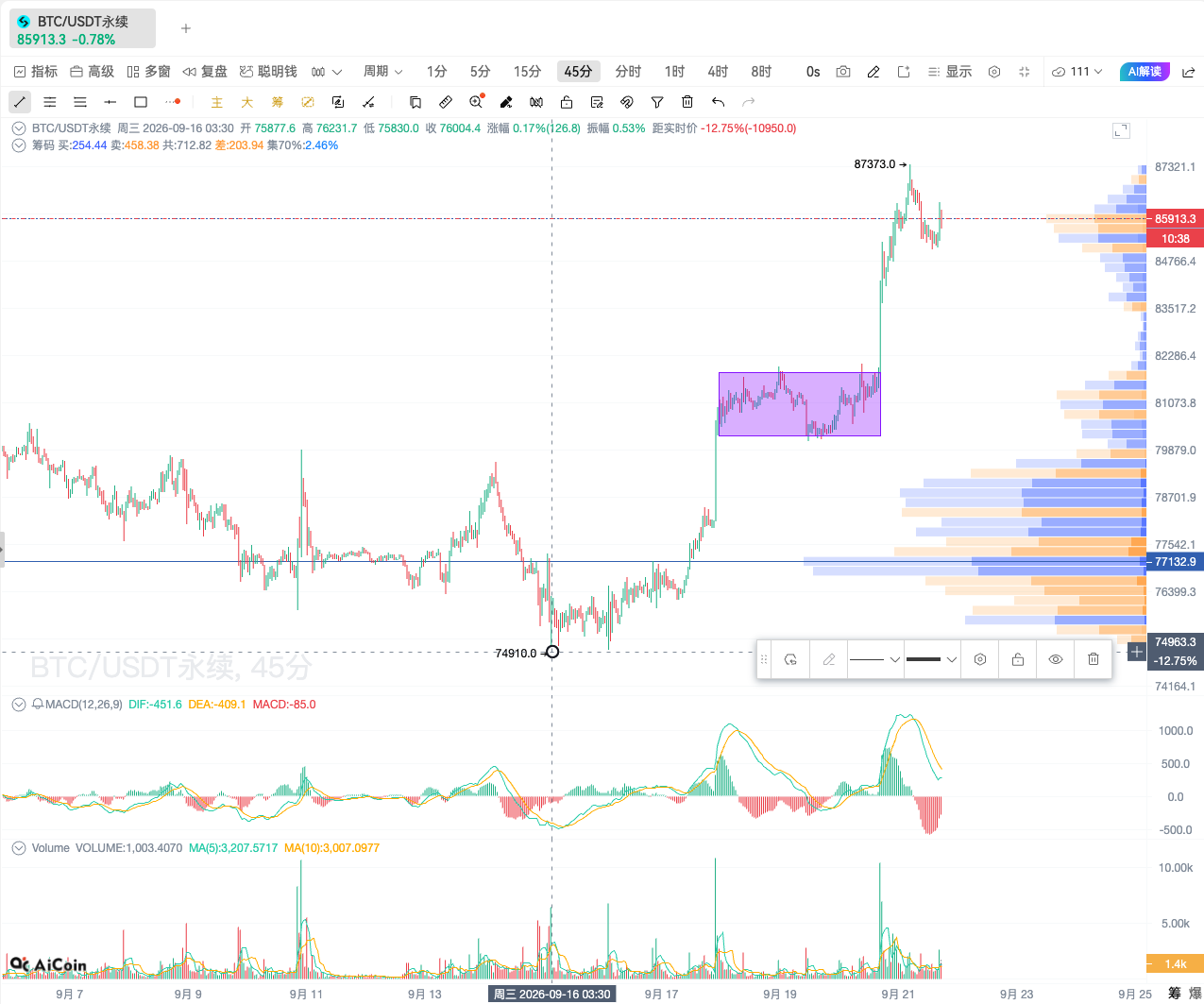
On February 1, 2026, mainstream assets such as BTC and ETH experienced a sharp crash during the trading hours of the East Eight Zone, plummeting from high positions: Bitcoin touched the $70,000 range for the first time in 296 days but quickly fell back, while Ethereum recorded a dramatic drop of about 11.8% within 24 hours. As prices plummeted, the derivatives market triggered a chain of liquidations, with Coinglass data showing that the total liquidation amount across the network reached $1.6 billion, involving approximately 356,000 traders, with long positions being the absolute focus. The core judgment of this article is: against the backdrop of geopolitical and macro liquidity uncertainties, the structural imbalance of high-leverage long positions was amplified by concentrated selling pressure and weak depth, leading to a systemic liquidation cascade.
Bitcoin's $70,000 Flip: From Surge to Sudden Drop
● Background of the High Revisit: According to a single source, Bitcoin returned to the $70,000 range around February 1, 2026, after a gap of 296 days. This breakthrough was related to previous halving expectations, institutional product expansion, and a rebound in risk appetite. However, it is important to emphasize that the data regarding the revisit to $70,000 mainly comes from a single channel, lacking unified verification across multiple platforms. Investors should maintain a certain tolerance for uncertainty when referencing this level as an absolute benchmark, viewing it more as a symbolic high reflecting market sentiment and expectations.
● Mainstream Coins Surge Then Drop: In sync with BTC's high revisit, ETH recorded a drop of about 11.8% within the same 24 hours (according to a single source), displaying a typical structure of "upward surge to entice longs, followed by unilateral retraction." The surge-then-drop pattern indicates that a large amount of long funds, chasing high prices and adding leverage, concentrated their entry during the upward phase, only to be forced out as selling pressure intensified and liquidity withdrew, causing mainstream coins to quickly switch from a trend-driven ascent to a liquidation-driven accelerated decline.
● The Critical Four-Hour Turning Point: From a daily structure perspective, in the trading interval before the flash crash, BTC and ETH had limited time in a high-level consolidation, and shortly after upward momentum weakened, a significant drop occurred. In the critical 4-hour node, prices quickly fell below previous support from local highs, triggering a strong liquidation chain reaction in derivatives. The breakdown of the subsequent liquidation data shows that this four-hour directional reversal became a watershed moment for leveraged funds—longs were instantly pushed from "profit withdrawal" to "massive liquidation."
$1.6 Billion Liquidation Bloodbath: Concentrated Defeat of Long Leverage
● Quantifying the Liquidation Scale: According to Coinglass statistics, within 24 hours on February 1, the total liquidation amount in the contract market reached approximately $1.6 billion, involving about 356,000 traders being forcibly liquidated. This magnitude corresponds to a typical systemic clearing phase of high-leverage crowding: not only did small and medium accounts suffer concentrated losses, but some large positions were also pushed to the brink of liquidation in a short time, reflecting the high fragility and correlation of position structures under price shocks.
● Extreme Long-Short Imbalance: In this round of systemic liquidation, the liquidation structure was extremely one-sided. Reports indicate that during the critical 4 hours, the scale of long liquidations reached $1.051 billion (according to a single source), while "the scale of short liquidations was only about 1/50 of that of longs," becoming a market consensus. This means that the vast majority of leveraged risks were concentrated on the bullish side, and when prices retraced from highs, the market did not form an effective short hedge buffer, leading to forced selling that further amplified the magnitude and speed of the decline.
● Largest Single Liquidation Sample: In a specific case, a position liquidation amounting to $13.3899 million in ETH on Hyperliquid was one of the largest publicly tracked liquidations in this round, highlighting that some large leveraged accounts faced "total liquidation" amid volatility. Regarding whether the related address had added approximately $2 million in USDC margin, details currently come from unverified information sources and remain to be verified. Without further cross-confirmation from on-chain and platform dimensions, it is inappropriate to extend more detailed behavioral inferences based on this.
● Amplified Chain Reaction of Liquidity Gaps: High-leverage longs were highly concentrated in perpetual contracts, futures, and other derivatives, making them extremely sensitive to market depth and active buying. When key support was breached and longs were continuously liquidated, the actual selling pressure was mainly generated by system matching. In an environment where both spot and contract order book depths were not sufficient, even a small market sell order could penetrate multiple price levels, triggering a price gap drop. The lack of sufficient counterparties meant that what could have been a "controllable pullback" quickly evolved into a systemic liquidation cascade.
Geopolitical Risks Combined with Liquidity: Who is Toppling the Long Dominoes
● Trigger Factors for Market Consensus: After cross-verifying the views of multiple research institutions and trading teams, the market narrative is relatively consistent: "The situation in the Middle East and the risk of a U.S. government shutdown triggered a contest for key support levels." This statement is not from a single media outlet but rather a resonance of multiple viewpoints at the macro and trading levels—geopolitical tensions raised global risk premiums, and the uncertainty of U.S. fiscal and government operations reinforced preferences for hedging and reducing positions. Technically, this manifested as a lack of incremental supporting funds near key support levels, exposing the originally fragile leverage structure.
● Amplified Uncertainty in Technical Level Games: Macro and geopolitical variables are inherently difficult to quantify to a single price level, but they can transmit through sentiment and risk preferences to the contest for technical support levels. When investors lack clear expectations for future policy paths and event directions, they tend to "lightly observe" rather than actively bottom-fish around key price levels. Thus, when prices first broke below previous support, areas that could have formed reflexive buying instead turned into an accelerated zone for "trend-following position reduction," amplifying short-term declines and volatility elasticity.
● Systemic Liquidation Under Deep Contraction: From the feedback at the transaction and order book levels, trading volume expanded rapidly during the flash crash, but the order book depth did not expand in sync, indicating that short-term "positions were passively cleared at thin depths." In this environment, localized selling pressure would not be evenly absorbed but would create a series of downward price vacuums, triggering more stop-losses and liquidations in succession. Therefore, this round of decline was not a simple trend correction but a typical "systemic liquidation" amid liquidity contraction and a retreat in risk appetite, rather than an ordinary pullback.
Whales and Large Positions: The Invisible Leverage of a Buy Order and a Loan
● The $5 Million Signal from 0xd90…2D975: The market noted that the address 0xd90…2D975 had a buy order behavior of about $5 million before and after this round of volatility (according to report citation channels), interpreted by some investors as "whale bottom-fishing" or "sentiment anchoring." Regardless of its true trading intent, such publicly visible large purchases are often amplified in sentiment: during the upward phase, they are seen as trend confirmation, while before and after a decline, they are viewed as endorsements of "smart money entering," thus creating a demonstrative effect on retail sentiment and leveraged positions in the short term.
● Attention to Yi Li Hua's 175,800 WETH Collateral Position: Reports indicate that Yi Li Hua established a large loan position by collateralizing 175,800 WETH (valued at approximately $445 million at the time), with a health ratio of about 1.34 (according to a single source). This position itself was not directly triggered in this round of flash crash, but its scale and leverage sensitivity made it a "systemic variable" that the market constantly monitored: during significant price fluctuations, investors would subconsciously assess the liquidation risk of such large positions, thereby amplifying overall risk perception and fear premium regarding downward trends.
● Potential Selling Pressure from 538.09 BTC: Research reports also mentioned that an anonymous address transferred 538.09 BTC to an exchange before and after the event, estimated at about $43.6 million (according to a single source). Such large BTC transfers to exchanges are typically interpreted by the market as "potential selling pressure entering the waiting area," especially in a context of tense sentiment and high leverage, easily amplified into a signal of "whales about to dump," triggering more passive position reductions and sell-offs, exacerbating the asymmetry of price volatility.
● Individual Behavior and Structural Fragility: From these cases of whales and large positions, a deeper conclusion can be abstracted: when market liquidity is highly concentrated in a few large funds and mainstream varieties, the position adjustments, collateral actions, or entry actions of a single large address can trigger larger-scale chain reactions at the sentiment and order book levels. In an environment where depth is already limited and leverage is already high, the higher the market concentration, the greater the overall structure's sensitivity to individual behaviors, making liquidity fragility increasingly difficult to ignore.
Long-Short Structure and Future Choices: Repair Paths After Liquidation
● Phase Assessment of Leverage Clearing: From the ratio of long to short liquidations, this round of clearing was highly biased towards longs, with long liquidations far exceeding short liquidations. The structure of "shorts being only about 1/50 of longs" indicates that the crowded area of long leverage has been concentratedly squeezed. In the short term, this extreme unilateral clearing helps alleviate the selling pressure from floating profits and high-leverage positions above, leaving structural repair space for subsequent trends. However, whether a "complete clearing" has been achieved still depends on whether prices can stabilize and change hands in a lower-leverage environment.
● Where to Attract Incremental Funds: For spot and mid-low leverage funds, attractiveness depends not only on absolute prices but also on risk-return ratios. If mainstream coins can build up trading volume near previous dense trading areas over a period and show signs of active capital absorption and converging volatility, they may attract "long-term funds + low-leverage funds" back into the market. Conversely, if prices rebound too quickly and leverage rises rapidly, it is more likely to be seen as a "technical repair" rather than the start of a "new trend."
● Guiding Significance of Derivatives Indicators: In the coming trading days, the funding rates and open interest (OI) recovery rhythm in the derivatives market will provide important signals for short-term volatility and rebound quality. If funding rates remain moderate or even negative during price rebounds, and OI gradually recovers without extreme expansion, it usually indicates that the rebound is more driven by spot and low leverage, with a relatively healthy structure. Conversely, if funding rates quickly turn to significantly positive values and OI expands sharply, it indicates that leverage impulses are reigniting, and the probability of a "second liquidation" in the short term cannot be ignored.
What the Market Should Learn from This Flash Crash
● Exposure of Three Major Structural Risks: The flash crash on February 1 exposed three major structural risks in the current crypto market: first, high-leverage longs are highly concentrated in a few mainstream varieties and derivatives, making it possible for any slight market disturbance to evolve into systemic liquidation; second, overall liquidity and order book depth are significantly weak during periods of macro uncertainty, leading to localized selling pressure piercing through multiple price levels and creating price vacuums; third, the behavior of whales and large positions is amplified by emotions in a high-concentration environment, becoming important triggers for amplifying volatility and accelerating liquidations.
● Operational Recommendations in High Uncertainty Periods: For traders, during phases of high geopolitical, macro, and policy uncertainty, it is crucial to maintain restraint in leverage and position structures. Specifically, first, reduce overall leverage multiples to avoid compressing margins into the critical zone of "forced liquidation"; second, diversify entry rhythms and targets to reduce concentrated exposure at single price levels and single assets; third, set gradual position reduction and stop-loss plans in advance near key technical levels, rather than leaving the game entirely to system liquidations, to avoid passively becoming the "last stick" of liquidity in extreme market conditions.
● Rhythm Changes and Risk Reminders: Looking ahead, if the geopolitical risks such as the situation in the Middle East and the U.S. government shutdown marginally ease, while funding costs and risk aversion sentiments decline, mainstream assets may experience a shift from "passive deleveraging" to "orderly turnover and repricing." However, regardless of how the macro environment evolves, this event reminds the market that price predictions are far less important than risk management. What truly needs attention is not whether BTC or ETH can once again reach a certain integer level, but whether one's position structure and leverage levels are resilient enough to withstand the next systemic volatility.
Join our community to discuss and become stronger together!
Official Telegram community: https://t.me/aicoincn
AiCoin Chinese Twitter: https://x.com/AiCoinzh
OKX Benefits Group: https://aicoin.com/link/chat?cid=l61eM4owQ
Binance Benefits Group: https://aicoin.com/link/chat?cid=ynr7d1P6Z
免责声明:本文章仅代表作者个人观点,不代表本平台的立场和观点。本文章仅供信息分享,不构成对任何人的任何投资建议。用户与作者之间的任何争议,与本平台无关。如网页中刊载的文章或图片涉及侵权,请提供相关的权利证明和身份证明发送邮件到support@aicoin.com,本平台相关工作人员将会进行核查。