Original Title: "Average Profit of $90 Million per Person, the Largest Private Buyer of Gold on Earth"
Original Author: Lin Wanwan, Dongcha Beating
A private company has become the largest holder of gold in the world outside of central banks.
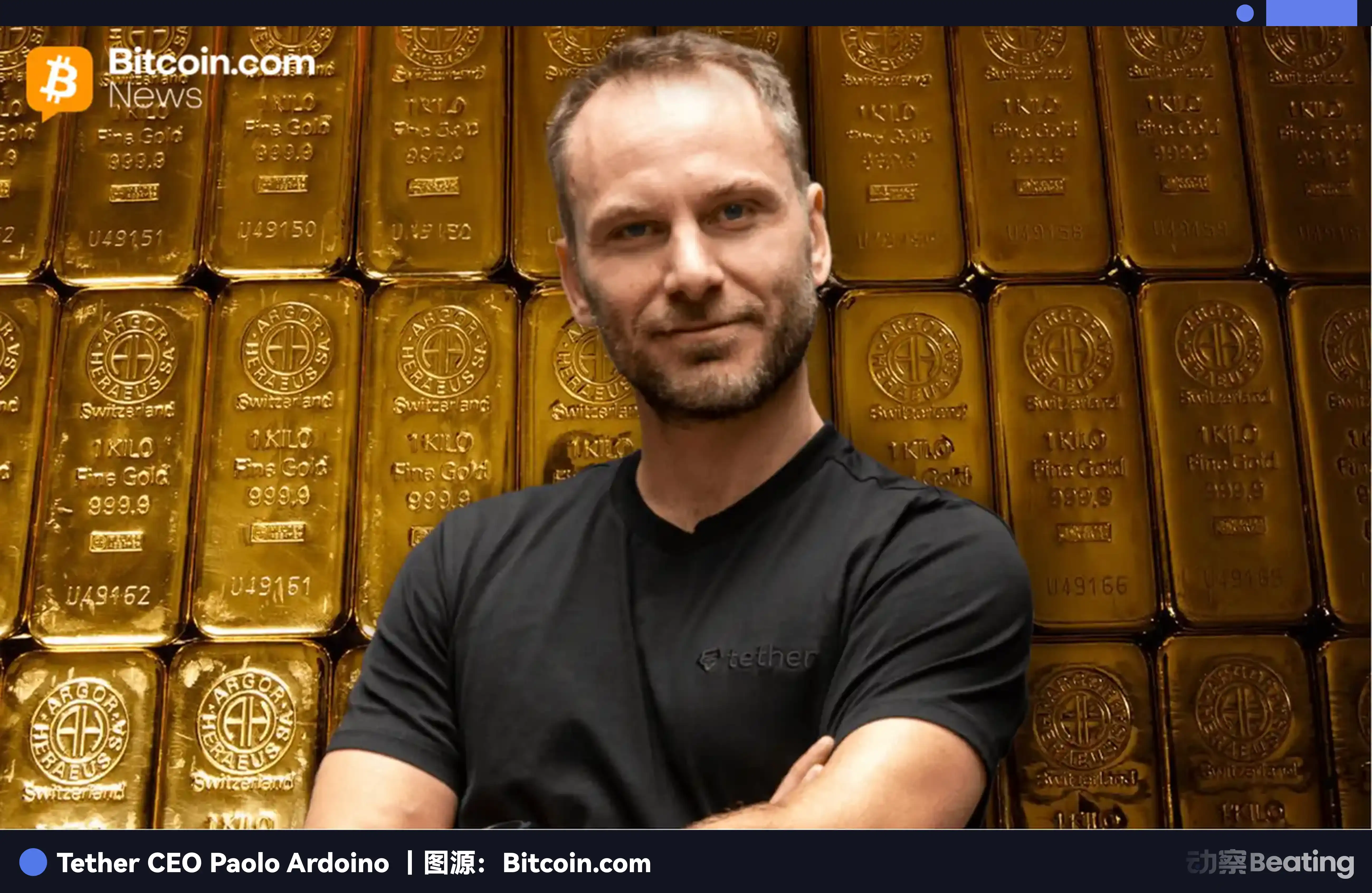
Paolo Ardoino has been very busy lately. He spends $1 billion a month, buying 1 to 2 tons of gold each week, and says "it won't stop in the coming months."
Paolo is not the head of a central bank; he is the CEO of Tether, the largest stablecoin company in the world.
The USDT issued by Tether is the largest stablecoin globally, with a circulation of about $187 billion. The business model is extremely simple: you give it $1, and it gives you 1 USDT token. You use the token for trading, and it uses the dollars to buy government bonds to earn interest.
In 2024, the net profit exceeded $13 billion, with a team of about 150 people, resulting in an average profit of about $86 million per person. According to the net profit for the first three quarters of 2025, which has already exceeded $10 billion, the annual total is expected to reach $15 billion, surpassing Goldman Sachs. This year, Tether may achieve an average profit of $100 million per person.
However, this company that relies on the dollar has been doing something outside its main business in recent years: hoarding gold.
Tether has hoarded about 140 tons of gold, worth approximately $24 billion. This figure exceeds the reserves of central banks in countries like South Korea, Hungary, Greece, Qatar, and Australia.
Tether has become the largest holder of gold in the world outside of central banks.
At Tether's current pace, the monthly gold purchase exceeds $1 billion. The gold price has risen from about $2,650 at the end of September 2024 to over $5,100 now, resulting in a paper profit far exceeding $5 billion.
Ardoino once said, "Gold is logically safer than any national currency."
A large number of Tether's users come from countries like Turkey, Argentina, and Nigeria, where currencies have long depreciated. They use USDT, essentially escaping from their own central banks. Ardoino takes this logic a step further: what if one day the dollar also fails?
Selling dollars with one hand and hoarding gold with the other, he is more aware of the risks than anyone else.
The Vault in the Nuclear Bunker and Traders Dug Out from HSBC
The gold purchased by Tether is stored in a former nuclear bunker in Switzerland.
During the Cold War, Switzerland built about 370,000 nuclear bunkers to protect against atomic bombs, most of which are now abandoned. Tether converted one of them into a vault. Ardoino describes the place as "guarded by thick steel doors, with over 1 ton of gold being transported in every week," calling it a "James Bond-style place."
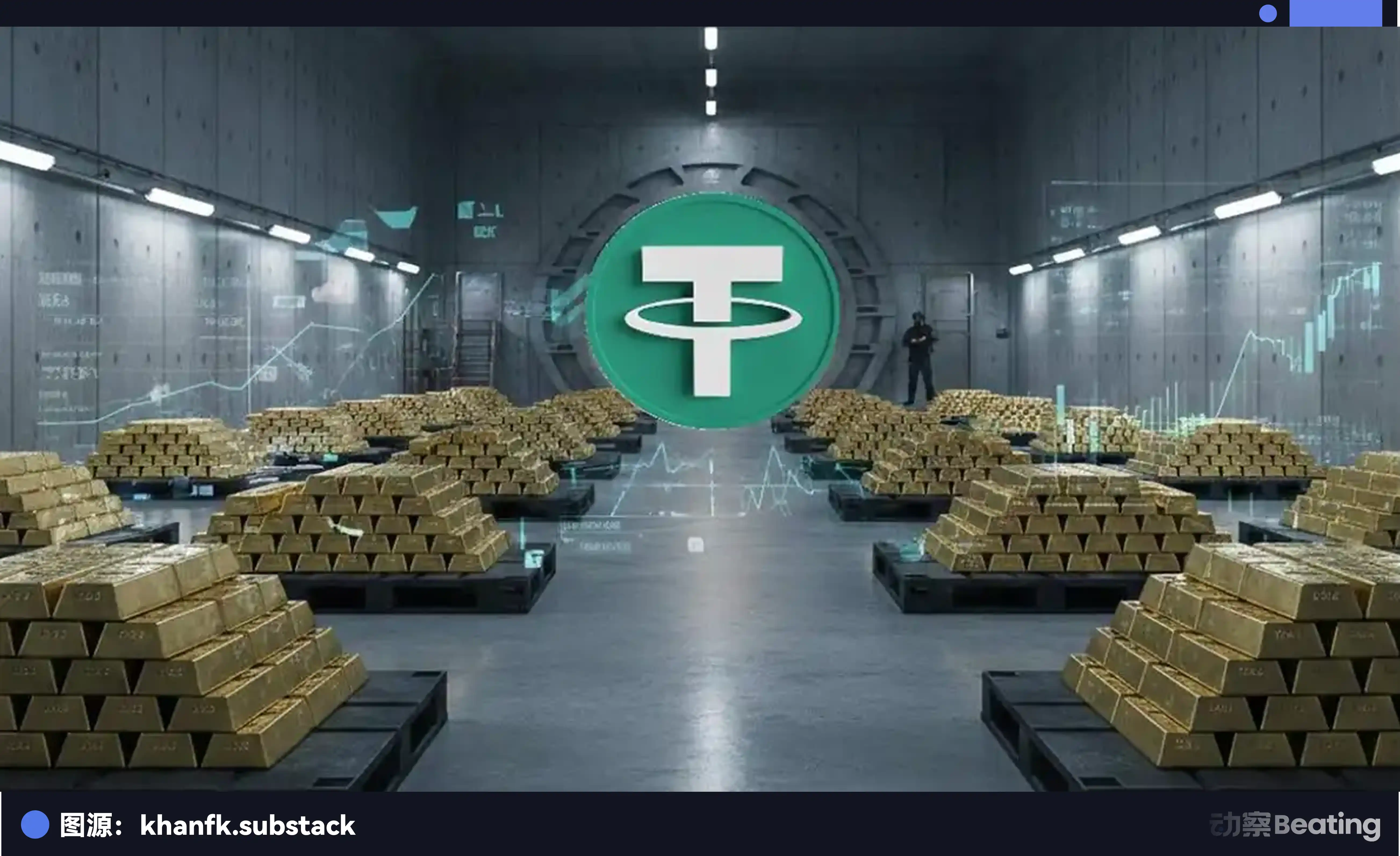
Physical gold is not a liability for anyone, does not rely on any government credit, and cannot be frozen, sanctioned, or printed out of thin air. It provides a sense of security that is the oldest form.
But Ardoino's ambition goes beyond hoarding; he also wants to engage in trading.
The global gold trading market is dominated by large banks like JPMorgan, HSBC, and Citigroup, which control pricing power and liquidity.
In November 2025, Vincent Domien, HSBC's global head of metals trading, and Mathew O'Neill, head of precious metals for Europe, the Middle East, and Africa, both left the company. Both are top figures in the industry; Domien has been the global head of metals trading at HSBC since 2022 and is also a board member of the London Bullion Market Association (LBMA); O'Neill has worked at HSBC since 2008.
Their new employer is Tether.
A crypto company has poached the top gold traders from traditional finance, causing a stir in the City of London.
Ardoino stated that he needs "the best gold trading platform in the world" to facilitate long-term gold purchases and "take advantage of potential market inefficiencies."
Buying about $1 billion of physical gold each month is actually quite troublesome, as it has to solve a series of logistical challenges.
Currently, Tether "procures directly from Swiss refineries and also from large financial institutions, with a large order potentially taking months to arrive." They have no bargaining power in the supply chain; how much they can buy and when it arrives depends on others.
Building their own trading capabilities is aimed at breaking free from this passivity. If they can save 0.5% in trading costs, that amounts to $60 million a year. More importantly, it gives them control.
From Central Banks to Gold Consortium
Tether's attitude towards gold is increasingly resembling that of central banks.
Central banks like gold for two reasons: it has good liquidity recognized worldwide, and it is not a liability for anyone, thus not relying on the credit of other countries.
After Trump took office, tariff threats were constant, and the dollar fell to a three-year low. Meanwhile, global central banks have been increasing their gold holdings. The National Bank of Poland was the largest gold buyer among central banks in 2024 and 2025, increasing its holdings by about 90 tons in 2024 and continuing to lead in 2025. China, Russia, Turkey, India, and Brazil are also continuously increasing their positions.
Tether has pushed this trend to the extreme. It is doing what central banks do in a private manner. Jefferies analysts point out that Tether, as "an important new buyer, may drive continued growth in gold demand," with its purchases in the third quarter of 2025 accounting for about 2% of global gold demand. A stablecoin company has become one of the drivers of rising gold prices.
But the layout does not stop there. Tether is also quietly acquiring shares in gold royalty companies.
Royalty companies purchase revenue streams from miners. Miners extract gold, and royalty companies take a portion of the profits, similar to collecting rent. The advantage is that they do not have to mine themselves and do not bear the risks of extraction, just sitting back and sharing the profits.
According to Bloomberg, Tether has invested over $200 million to acquire about 37.8% of Elemental Altus Royalties, followed by an additional $100 million investment to support its merger with EMX, and also holds shares in several mid-sized Canadian-listed royalty companies such as Metalla Royalty, Versamet Royalties, and Gold Royalty.
This matter is being handled by Juan Sartori, Tether's Vice President of Strategic Projects.
He was a senator in Uruguay, a co-owner of the English Premier League team Sunderland, and is also the vice president of AS Monaco Football Club and the founder of Union Group. His identities as a politician, businessman, football owner, and crypto executive are quite international.
From downstream stablecoins to midstream physical gold and trading capabilities, and upstream mining rights, Tether is building a complete gold industry chain, increasingly resembling a gold consortium.
In addition to physical gold, Tether also has a gold token called XAUT. Buying 1 XAUT corresponds to physical gold stored in a Swiss vault, and if you want to redeem it, they can actually send you gold bars. Currently, XAUT accounts for about 60% of the global gold token market, with a circulating market value of about $2.7 billion. By the end of 2025, XAUT is expected to be backed by about 16.2 tons of physical gold.
Ardoino predicts that it could reach a circulation of $5 billion to $10 billion by the end of 2026. If it really reaches $10 billion, it would require an increase of about 60 tons of gold reserves. Just to support XAUT, they would need to buy over 1 ton of gold each week.
He also made a prediction, "Some countries are buying large amounts of gold, and we believe they will soon launch tokenized versions of gold as a competing currency to the dollar."
He did not specify which countries. But everyone knows who has been buying gold like crazy in recent years.
Someone is always ready with their own vault
James Rickards, a former financial warfare advisor at the Pentagon, wrote in "Currency Wars": the underlying competition of currencies is a competition for reserves.
In the 1960s, French Finance Minister Valéry Giscard d'Estaing complained that the U.S. enjoyed "arrogant privileges," printing a few cents of paper while the whole world had to exchange it for real gold and silver.
This game has been played for sixty years, relying on the world's trust in the dollar.
Trust can collapse quickly. This is also the core logic of the reserve war.
The apparent trade war, tariff war, and currency war are merely external manifestations of the competition for currency credit. The foundation of currency credit lies in the quality of reserves.
When the dollar is repeatedly weaponized, freezing foreign exchange reserves, cutting off SWIFT channels, and imposing financial sanctions, the world has to rethink: what kind of reserves are truly safe?
Central banks understand this, which is why they are quietly increasing their gold holdings. Tether understands this too, which is why it is hoarding gold like crazy.
John Reade, chief strategist at the World Gold Council, said that Tether's purchases do impact gold prices, but they are just a small part of the reasons for the increase. He added, "What is really interesting is that one of the main players in the cryptocurrency space views gold as the original trade against dollar depreciation."
In August 2025, Tether hired Bo Hines, the former executive director of the White House Cryptocurrency Task Force under the Trump administration, as a strategic advisor in the U.S. Hines helped push the first stablecoin regulatory bill, the Genius Act, through Congress during his tenure. In January 2026, Tether launched the U.S.-specific token USAT in compliance with that act.
On one hand, hoarding gold in a Swiss nuclear bunker, and on the other, lobbying in Washington, both hands are quite strong.
Gold prices continue to hit new highs, while the dollar has fallen to a three-year low. In an inconspicuous cave at the foot of the Swiss Alps, over 1 ton of gold has been transported in, and the heavy steel door slowly closes.
The world is indeed becoming more turbulent, but some people have already prepared their own vaults in advance.
免责声明:本文章仅代表作者个人观点,不代表本平台的立场和观点。本文章仅供信息分享,不构成对任何人的任何投资建议。用户与作者之间的任何争议,与本平台无关。如网页中刊载的文章或图片涉及侵权,请提供相关的权利证明和身份证明发送邮件到support@aicoin.com,本平台相关工作人员将会进行核查。