The fleet deployed by the United States to Iran is much larger than the one sent to Venezuela a while ago, which also means that the asset crash this time will be more severe.
A few hours ago, Trump and the Iranian side began exchanging harsh words. Meanwhile, there are rumors circulating in the community that the U.S. aircraft carrier "Abraham Lincoln" and its strike group deployed in the Middle East have entered a "full ship blackout" communication interruption state, indicating that actions against Iran may soon be underway.
All financial market investors are on edge.
First, let's look at the U.S. stock market. The Nasdaq 100's decline quickly expanded to 2%, the S&P 500 fell over 1%, and the Dow Jones also suffered, dropping 0.5%. The hardest hit were all assets highly correlated with risk appetite, with cryptocurrency stocks being almost ground into the dirt. MSTR fell nearly 7%, COIN dropped over 4%, and HOOD, SBET, BMNR, and CRCL all saw significant pullbacks.
The so-called safe-haven assets, gold and silver, are also declining. Spot gold fell below three hundred dollar marks in just half an hour, dropping over $400 from its high, with the latest price around $5155. Silver was even more dramatic, plunging 8% in a day, dropping from $121 to just over $108.
The crypto market also couldn't escape. As soon as the U.S. stock market opened, Bitcoin began to slide, dropping from $88,000 to around $84,500; Ethereum briefly fell below $2800, SOL lost $118, and BNB also dropped below $865.
This indicates that global funds have already assumed the worst-case scenario: war is about to begin.
What the U.S. Prepared Before the Last "Rough Action"
First, lay the cards on the table, then decide whether to flip the table. This seems to be the consistent approach of the U.S. government.
Looking back at the recent actions against Venezuela, we can see a series of signals before the formal attack: weeks before launching a series of attacks on Venezuelan vessels, the U.S. had already amassed a large amount of military assets in the Caribbean. The official explanation at the time was that these vessels were suspected of smuggling drugs into the U.S., but no clear evidence was ever presented.
The real outcome is well known: on January 3, U.S. forces directly intervened and took Venezuelan President Maduro from Caracas.
It is said that the U.S. aircraft carrier was already in place at that time, typically 5 to 7 days before taking action, the core strike forces of the U.S. military had already entered the designated sea area, just waiting for a "suitable moment."
Before the attack on Iran in June 2025, the rhythm was exactly the same. A few days before the action began, the media captured unusual movements of U.S. military equipment. On June 21, the U.S. suddenly deployed six B-2 stealth bombers to Guam, later downplaying it as a feint to maintain surprise advantage. But those familiar with U.S. military operational logic understand that such strategic assets are never casually "exercised." Meanwhile, two carrier strike groups led by the USS Carl Vinson and USS Lincoln had already been pre-deployed in the Arabian Sea. The Aegis destroyer USS Thomas Hudner was also redirected to the eastern Mediterranean.
Thus, the deployment of aircraft carriers at sea, the mobilization of strategic bombers and heavy strike capabilities, and the deployment of air defense systems are the three major characteristics of U.S. military deployments before conflicts.
Now, similar signals are gradually reappearing.
Is a Second Aircraft Carrier on the Way?
"We have a large fleet heading in that direction, and maybe we won't need to use it," Trump said. Following this, the U.S. Central Command confirmed on social media platform X that a nuclear-powered aircraft carrier, the "Lincoln," has been dispatched to the Middle East.
This carrier left San Diego last November and had been on a mission in the South China Sea. Now, it has a new combat objective—Iran.
The Lincoln is one of the core assets of the U.S. Navy and is one of ten nuclear-powered aircraft carriers. It does not rely on diesel but is powered by a nuclear reactor, theoretically capable of operating for decades without refueling. It is equipped with highly advanced missile systems, radar, and sensors, essentially serving as a floating command center.
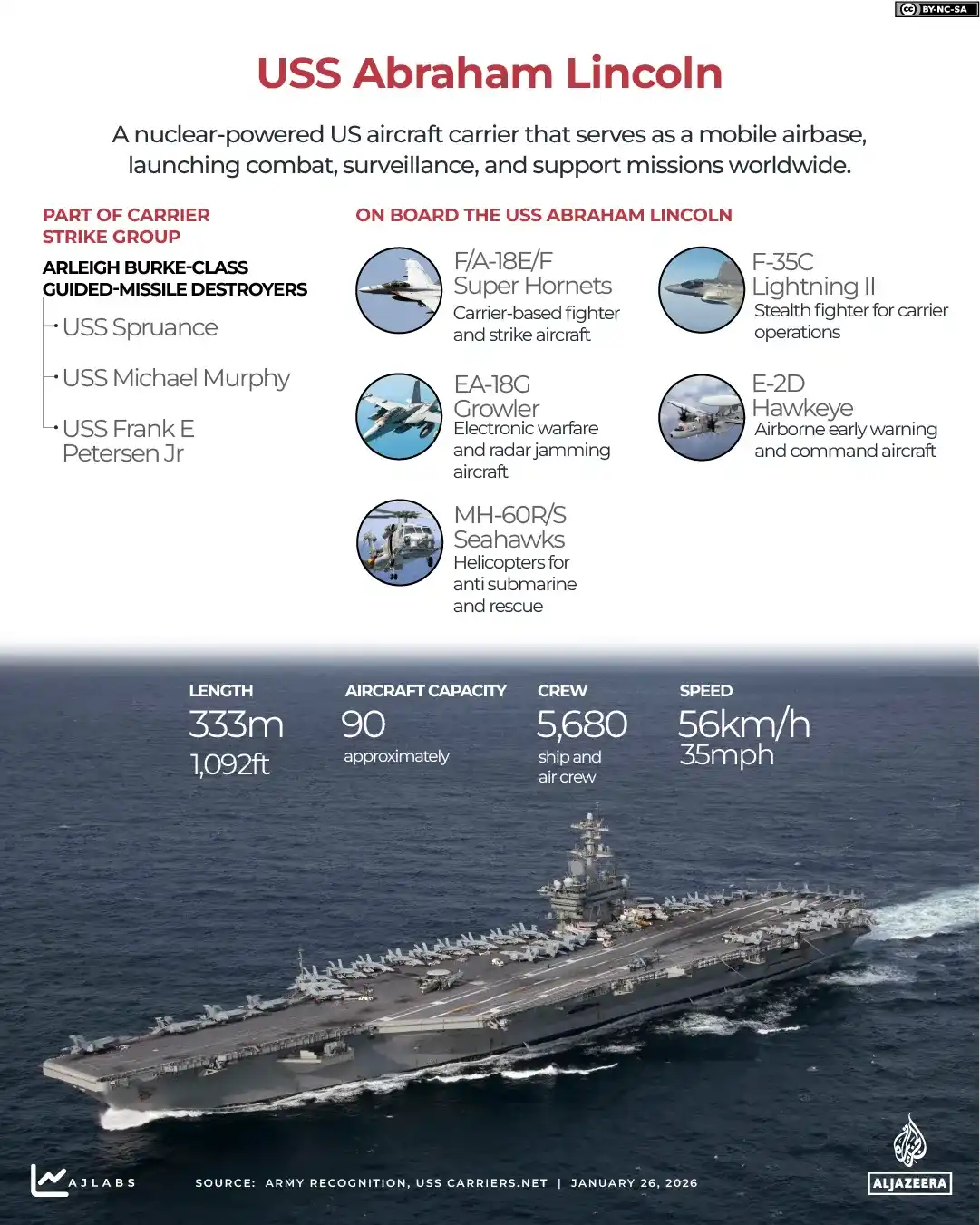
Information on the Lincoln aircraft carrier
The movements of the Lincoln were originally highly classified, but because it had to pass through the Strait of Malacca, one of the busiest waterways in the world, it had to turn on its transponder to avoid collisions. This brief "lighting up" confirmed that it crossed the Indian Ocean on January 23. Subsequently, the transponder was turned off, and its location disappeared again. However, based on its speed, it has now essentially arrived near the combat zone and is in a standby state.
After passing through the Strait of Malacca, the transponder was turned off again, and the carrier disappeared from radar. The remaining information can only be estimated based on speed. But according to speed calculations, the Lincoln has now basically arrived near the combat zone and is in position.
At the same time, a second aircraft carrier seems to be on the way.
The "George Bush" left the U.S. East Coast on January 13, and it is widely speculated that it will likely cross the Atlantic Ocean and enter the Mediterranean through the Strait of Gibraltar. While the possibility of it being just a training exercise cannot be ruled out, at this point in time, few truly believe this is a coincidence. Most military analysts speculate that the purpose of the George Bush's deployment is to "escalate" the situation in the Middle East.
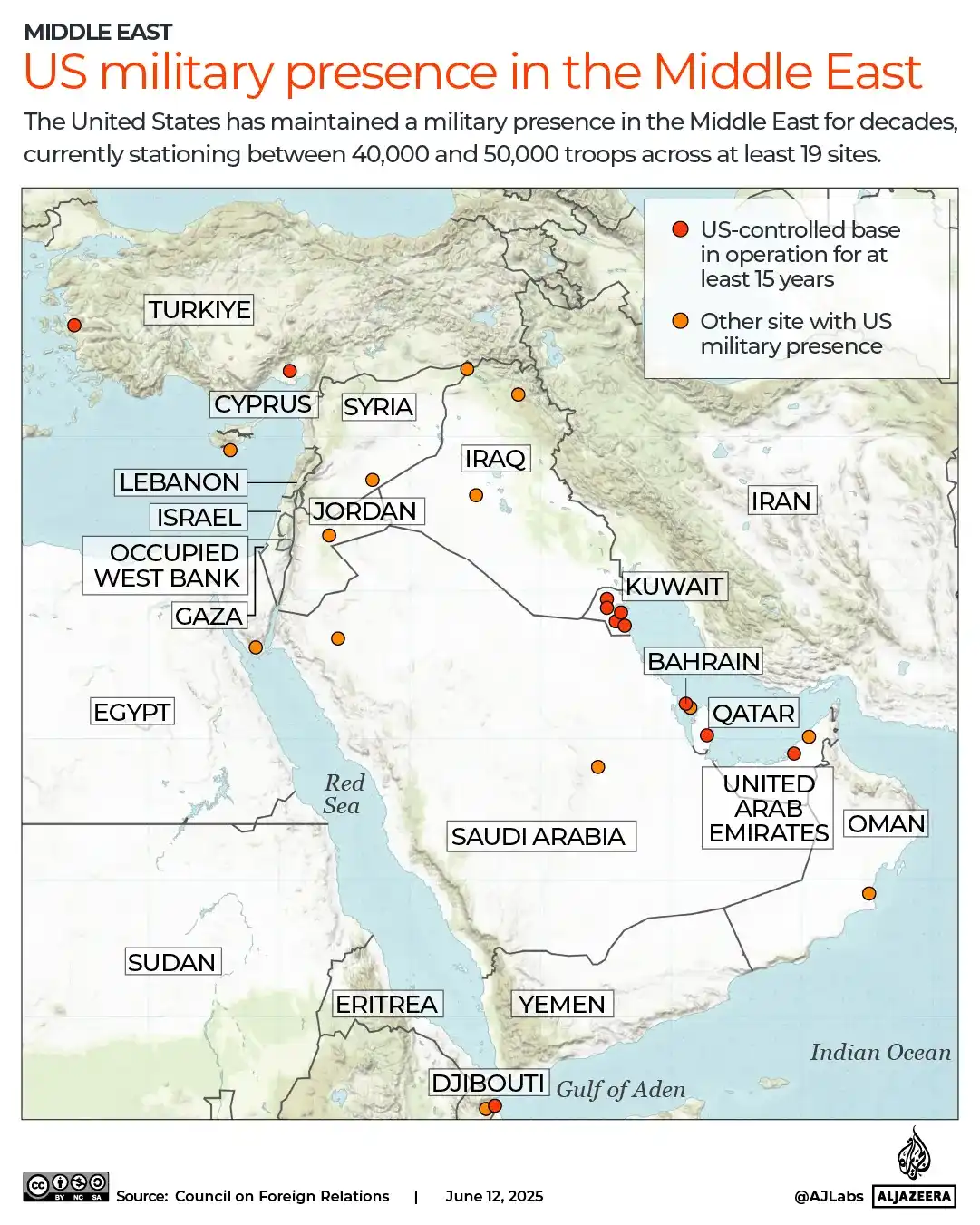
Middle East Terrain
Many military analysts agree: the truly "suitable" time to strike is likely after the second carrier strike group is in place. One aircraft carrier can certainly strike, but two means air superiority, strike frequency, and margin for error will all be maximized. Since the best window for attacking Iran during the protests in early January has already passed, the difference between waiting a day or a week is not significant. Rather than rushing to act, it is better to wait for the second carrier strike group to arrive, maximizing military strength in the Middle East before making a decisive move.
However, as of now, the Bush has not been spotted crossing the critical strait, and based on speed calculations, it has not yet fully entered a combat-ready position.
Speaking of aircraft carrier deployments, the air force is also busy. The U.S. Air Force Central Command has announced that it will conduct several days of readiness exercises in its area of responsibility, covering over 20 countries in the Middle East, Asia, and Africa. The term "exercise" itself is quite flexible.
Of course, where there is offense, there must be defense.
Especially regarding the U.S. protection of Israel. According to the Wall Street Journal, the U.S. is also sending additional "Patriot" and "THAAD" missile defense systems to the Middle East. The deployment of air defense systems is often when the real timeline for war begins. But the specific timing is almost impossible for outsiders to know.
Some analysts even look further: Trump's obsession with Greenland is not just for resources. It houses critical U.S. radar warning facilities, which are important nodes for preventing long-range ballistic missile attacks. Controlling these areas essentially opens up defensive depth for larger-scale conflicts.
Israel has clearly also entered the same timeline. On January 25, local time, the commander of the Israel Defense Forces Northern Command, Rafi Milo, publicly stated that the Israeli military is preparing for the chain reaction that may follow U.S. military actions against Iran. Earlier, the Homeland reported that the Israeli military had raised its alert level in response to "possible U.S. attacks in the coming days."
In this context, the real goals of the U.S. appear increasingly clear. If action is taken, the target is likely not just a limited strike but aimed directly at the Iranian regime itself. This is precisely why the U.S. emphasizes that "everything is ready." A missed strike would come at the cost of long-term attrition, which is a political risk that no U.S. government is willing to bear.
The Internal and External Pressures of the U.S. Government's "Partial Shutdown"
Meanwhile, beyond military risks, pressure is also building domestically in the U.S.
The editor believes that the "partial shutdown" of the U.S. government before the end of the month is also one of the important reasons for today's decline.
Each fiscal year, the U.S. Congress must pass 12 appropriations bills. If negotiations fail, the government must shut down. The current temporary appropriations bill is set to expire on January 31, leaving Congress with only two working days. Informal voting in the Senate has already shown that the procedural vote to advance the appropriations bill has failed, making a partial or full government shutdown almost a likely event.
Now, with only 2 working days left, the fact of a partial government shutdown is basically confirmed. The informal voting results in the Senate indicate that the procedural vote held that day failed to advance the appropriations bill that had already been passed by the House of Representatives.
The budget disagreements between the two parties mainly revolve around the Department of Homeland Security. The main event is that Minnesota, a long-time Democratic stronghold, was recently exposed to be involved in one of the largest welfare fraud cases in U.S. history, with an amount as high as $9 billion. For more details, see the related article: "Will the U.S. Government Shut Down Again, and Will the Crypto Market Be Hit?," but here I will just briefly mention the points of contention:
Many of the organizations involved are closely linked to the local Democratic political ecosystem. There is evidence that a significant portion of the funds obtained through these welfare fraud organizations has flowed into Democratic campaign contributions.
Minnesota itself is also a highly immigrant state, with a large Somali immigrant population. The Minnesota Attorney General's office stated that among the 92 defendants charged in this case, 82 are Somali Americans. This intertwines immigration enforcement, welfare distribution, and public safety issues, hitting right at the core issues of long-standing opposition between the Democratic and Republican parties, and is also a key policy commitment repeatedly emphasized by Trump and the Republican Party during the campaign.
As a result, Trump has intensified immigration enforcement in Minnesota. The sudden increase in enforcement intensity quickly led to serious consequences, with two incidents of federal immigration enforcement officers accidentally shooting and killing local residents, leading to large-scale protests and riots, even involving the National Guard to maintain order. The Democratic Party quickly seized this opportunity, using the fatal shootings by ICE in Minnesota as ironclad evidence of the agency's out-of-control enforcement methods.
The logic of the Democratic Party is clear: ICE caused two deaths in Minnesota, which proves that the agency's enforcement methods have serious problems. Without substantial reforms to ICE and the addition of strict limitations, why should we continue to fund it? The Democratic Party demands a reduction in ICE's size or at least the addition of strict restrictions.
The Republican Party's stance is sharply opposed: the Minnesota welfare fraud case involves $9 billion, and most of the defendants are Somali, which precisely indicates the need to strengthen rather than weaken immigration enforcement. ICE is a key force in combating illegal immigration and welfare fraud and must be adequately funded.
The internal conflict has yielded no results, while external risks are simultaneously escalating. Whether war will truly occur, no one can provide a definitive answer. But the editor hopes for world peace.
免责声明:本文章仅代表作者个人观点,不代表本平台的立场和观点。本文章仅供信息分享,不构成对任何人的任何投资建议。用户与作者之间的任何争议,与本平台无关。如网页中刊载的文章或图片涉及侵权,请提供相关的权利证明和身份证明发送邮件到support@aicoin.com,本平台相关工作人员将会进行核查。


