Written by: Deep Tide TechFlow
In a bear market, there’s always someone to blame.
In the past few days, that person has been CZ.
Opening Twitter to search for his name, the English timeline is filled with comments like "fraud," "send him back to prison," and "a hundred times worse than SBF"… In the comments section, someone created a "crypto crime ranking," placing his avatar at the top tier.
Scrolling down, someone posted the price charts of over 200 tokens launched by Binance last year, with almost every line heading in the same direction, accompanied by the phrase: "structural harvesting."
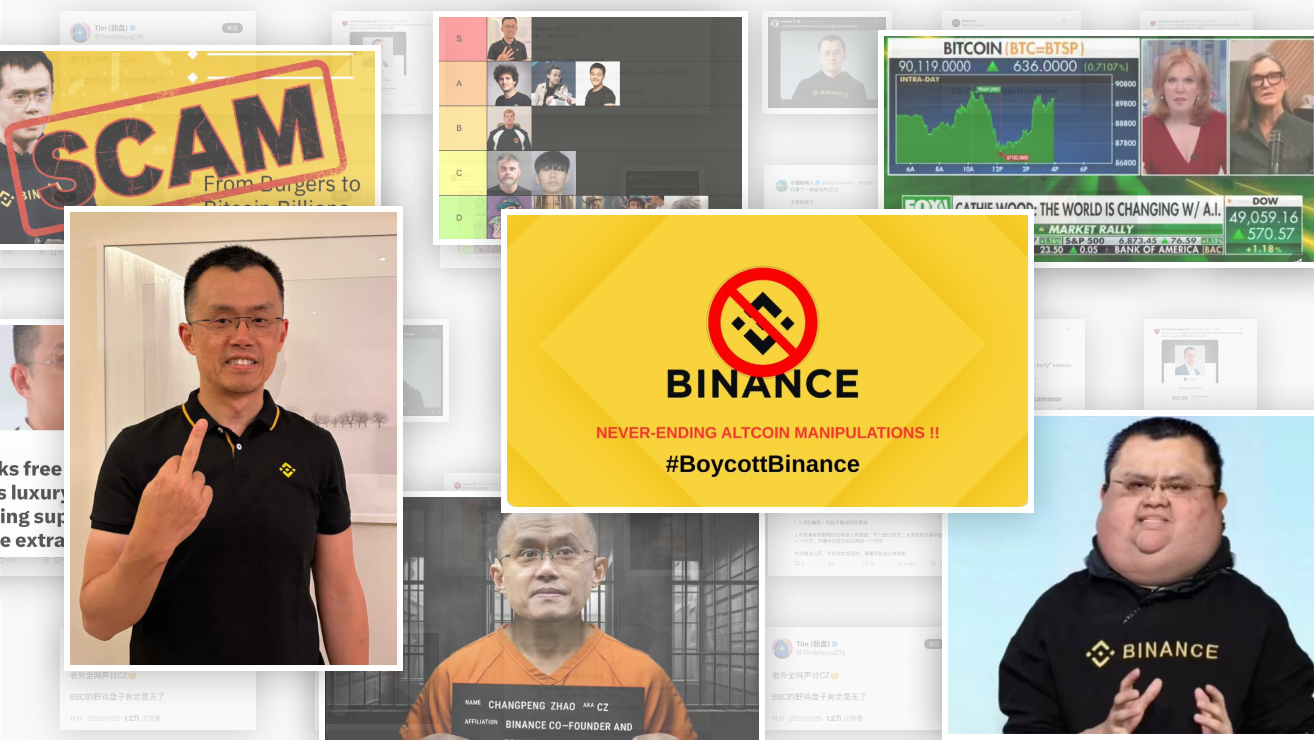
Whether it’s organized and premeditated defamation or a concentrated release of loss sentiment during the crypto winter, CZ has become the most criticized person on social media in recent days.
Returning to the Chinese community, the criticism and complaints are slightly more subtle, but the meaning is mostly the same.
It’s not just retail investors who are criticizing him. On January 28, OKX founder Xu Mingxing tweeted that the incident on October 10 last year "caused real and lasting damage to the industry."
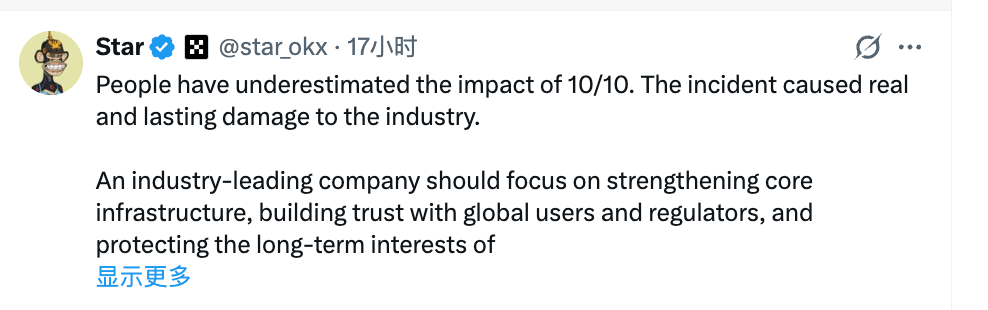
Although this statement didn’t name anyone, everyone knows who it’s referring to. Comments from competitors at such times are more likely to incite emotional support.
On the other hand, Hyperliquid's HIP-3 contract trading volume has hit a new high, with founder Jeff stating that the liquidity depth of certain trading pairs has surpassed that of Binance.
Challengers are quietly catching the users, funds, and attention that are flowing away.
With internal troubles unresolved, external threats have emerged. This may be the toughest start to a year for Binance in the past few years.
Lighting the Fire
The concentrated outburst of sentiment in the English community can be traced back to a single statement.
On January 26, ARK Invest founder Cathie Wood (known as "Wood Sister") was asked in an interview with Fox Business why Bitcoin has been so weak recently. Her response was:
On October 10 last year, Binance experienced a software malfunction that triggered massive automatic deleveraging, forcing the entire system to liquidate about $28 billion.
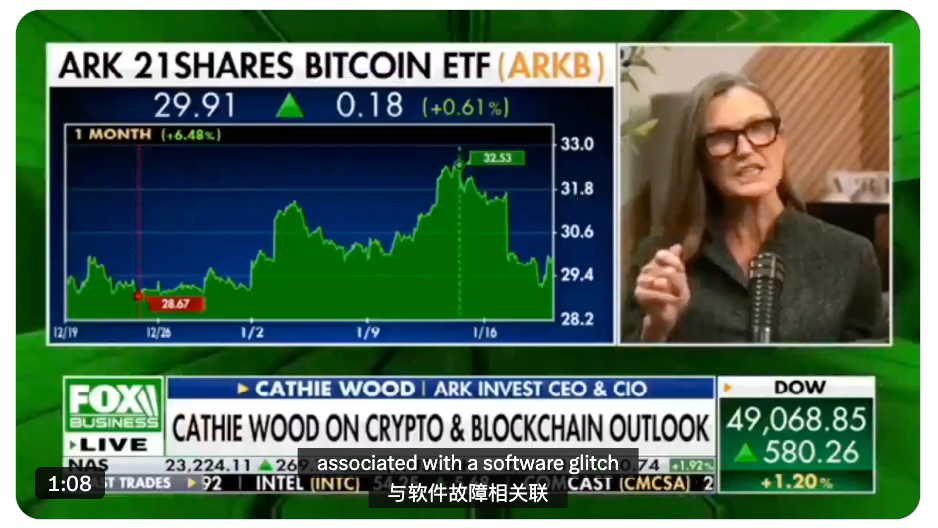
"Software malfunction." These four words, coming from Wood Sister, carry a different weight in the English community.
Her ARK Invest is one of the most aggressive tech investment firms globally; she started betting on Bitcoin when it was still at $200. Although she has lost a lot in the past two years following the market trends, her institutional influence remains.
As one of Wall Street's most vocal Bitcoin bulls, her public criticism of Binance may itself be a signal.
You might overlook the fact that in the same week she gave the interview, ARK had just purchased over $20 million in Coinbase stock. Coinbase is the largest compliant exchange in the U.S. and Binance's most direct competitor in the Western market.
It brings to mind a saying: "Public statements are meant to uphold positions and interests, not to express thoughts and cognition."
At the same time, He Yi quickly replied on Twitter: "Wood Sister is not a Binance user; Binance does not serve Americans."

So, is Wood Sister really being biased?
She didn’t answer this question, and perhaps it doesn’t need an answer. But her statement indeed acted like a match, igniting the emotions that have been building since October 11.
Perhaps, this is truly something many people have been holding back.
After October, not knowing whom to blame or to whom to seek an explanation, after holding it in for more than three months, Wood Sister’s statement just happened to open a gap.
But from another perspective, the $28 billion liquidation is also a ready-made target.
Simple, intuitive, no need for explanation, it naturally carries emotion. If someone wants to attack Binance, there’s no need to fabricate a story; the material is right there.
So, whether what happened next was a long-overdue heartfelt expression or an organized premeditated exploitation of the situation, it’s still unclear. But it can be confirmed that once the gap is opened, both forces will rush in.
Silence and Resentment
Once the gap was opened, too much poured in.
If you look closely at those posts, you’ll find that the criticisms revolve around two main issues: one is the flash crash in October, and the other is the listing of Binance Alpha.
Let’s talk about October 11.
What exactly happened that day? To this day, there hasn’t been a complete investigation report. Binance’s official statement is "market factors," claiming the system was operating normally and that they have compensated affected users $283 million.
But retail investors remember another set of numbers: $28 billion in forced liquidations.
$283 million was compensated, but that’s only 1% of $28 billion. What about the remaining 99%? Whose money was it, where did it go, and why did it evaporate within a few hours?
Some say it was a problem with market makers, others say a system vulnerability was exploited, and some say it was a premeditated attack. These claims have circulated on Twitter for three months, but until now, there hasn’t been much official or persuasive explanation.
A habitual reaction on social media is that silence itself is a response. Retail investors might feel that if you don’t speak, it’s because you can’t explain.
Now, let’s talk about the Alpha listing.
Binance Alpha is a new project launch channel introduced by Binance last year, focusing on early discovery.
Critics have posted various statistics, claiming that most Alpha projects experience a rise followed by a crash after listing. The specific ratios vary, and the statistics differ, but the impression of "high opening and low closing" has already formed.
The entire market is bearish, and the declines of Binance Alpha listings are quite severe, which is actually a natural phenomenon. But previously, CZ had stated that good projects don’t need to beg exchanges for listings.
Logically, this statement is sound, but in light of current emotions, it seems to add fuel to the fire.
If Alpha were just a gathering place for ordinary junk projects, people might accept it. Nine out of ten projects go to zero; you gamble and accept the loss.
But if they are all selected projects, experiencing astonishing declines, and even becoming a gathering place for certain conspiracy theories and insider information, when the trust anchor of Binance starts to be questioned, the sentiment changes.
Isolated, each issue can be explained with "market risks are borne by oneself." But when they stack up, pointing to the same platform and the same person, it’s no longer just a matter of risk.
It’s a loss of trust.
The bear market amplifies this sentiment, but the sentiment itself doesn’t come from nowhere.
After CZ's Return
On September 27, 2024, CZ was released from prison.
As part of a plea agreement, he resigned as CEO of Binance and promised not to participate in the company’s daily operations.
At the end of October, he appeared at Binance Blockchain Week in Dubai, receiving a standing ovation. Some in the audience shouted, "The king has returned," while others called him a "martyr." He spoke about his prison life, saying it wasn’t fun, but it gave him a lot of time to reflect.
Then came the educational project from Giggle Academy and the investment in Aster by YZI Labs, interpreted by the outside world as constructive measures in response to competition from Hyperliquid.
By January of this year, he appeared in Davos. In an interview with CNBC, he stated that 2026 would be Bitcoin's "super cycle," and that over 5-10 years, Bitcoin would definitely rise.
These statements are quite positive.
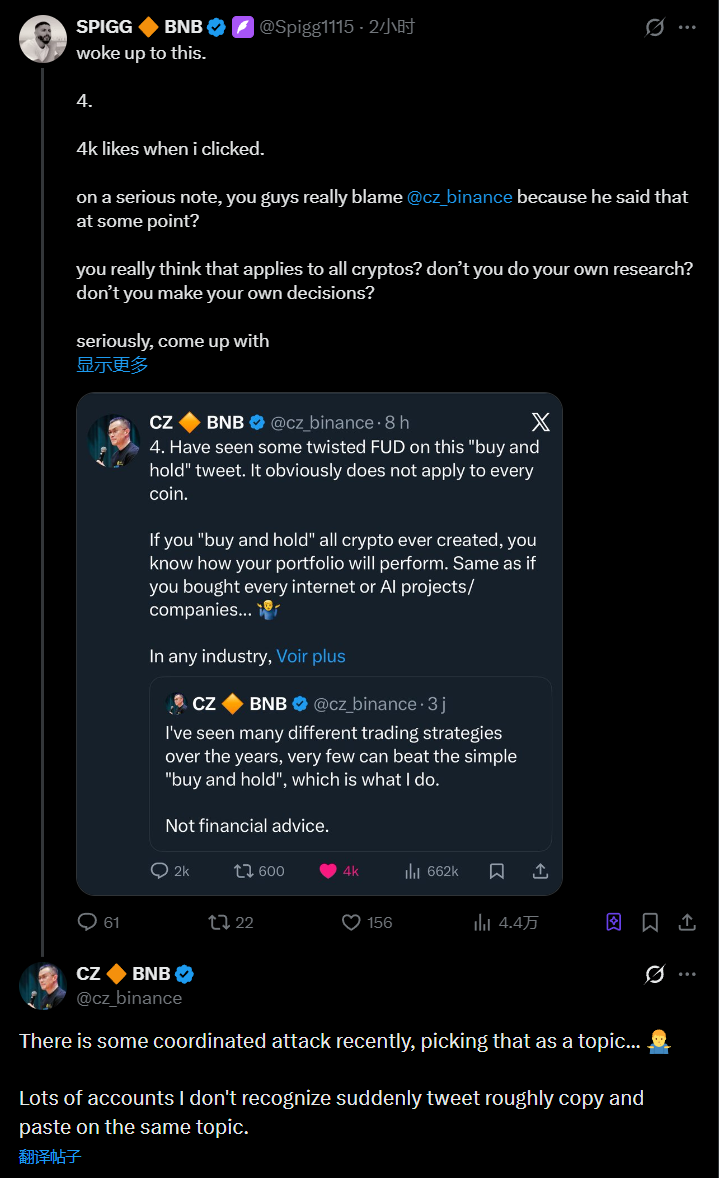
On January 28, CZ responded in a tweet: "Recently, I’ve noticed many unfamiliar accounts suddenly appearing, spreading FUD against my views, and the content is almost copy-pasted… This is an organized attack."
However, CZ is still Binance's largest shareholder, and one question may be unavoidable:
Has Binance improved over the past year?
All external thoughts on this question will inevitably reflect on CZ; reflections on the industry's slowdown will also inevitably project onto CZ.
Why Now
However, it’s worth noting that CZ has been out of prison for nearly a year and a half, Alpha has been online for over half a year, and the October 11 flash crash happened over three months ago. Why is it that suddenly now, everyone has started to criticize?
A glance at the market makes it clear.
Bitcoin has dropped nearly 20% from its high in August last year, hovering around $90,000. During the same period, gold broke through $5,000, silver hit new highs, and even copper is rising. Traditional safe-haven assets are booming, while the crypto market is bleak.
A bunch of meme coins have emerged on BNB Chain and Binance Alpha, some with Chinese pinyin, some with emojis, and some you don’t even know how to pronounce.
Most tokens peak upon listing, halving in value within three days, and essentially disappearing within a week, with no change in the script.
In such a market, people can break down.
You watch others make money buying gold, while you’re in the community asking what the next Alpha listing will be, but you just can’t find the wealth effect.
Anger needs an outlet.
Whether it’s Wood Sister’s statement or the criticisms from the English crypto Twitter, CZ just happens to be there, easily taking the brunt of the blame. He’s the most famous, the wealthiest, and just declared a Bitcoin super cycle.
Blaming him is more useful than blaming the market and feels better than blaming oneself.
This isn’t to say the criticism is unfounded. The doubts surrounding the October 11 incident are real, the controversies over Alpha are real, and the loss of trust is also real.
In a bull market, no one cares about these things. When prices rise, exchanges are friends, comrades, partners in wealth. When prices fall, the same exchanges become manipulators, scythes, the source of all evil.
Human nature is like this, and it’s even more pronounced in the crypto circle.
People need a villain, and right now, CZ is that villain.
Thus, this controversy is less a judgment against Binance and more a collective release of bear market emotions.
CZ is not the only target; he’s just the biggest one. After the blame, life must go on.
This industry needs a significant rally to restore confidence. I hope the market improves soon, and I hope Binance can become better.
免责声明:本文章仅代表作者个人观点,不代表本平台的立场和观点。本文章仅供信息分享,不构成对任何人的任何投资建议。用户与作者之间的任何争议,与本平台无关。如网页中刊载的文章或图片涉及侵权,请提供相关的权利证明和身份证明发送邮件到support@aicoin.com,本平台相关工作人员将会进行核查。


