Written by: Glendon, Techub News
As the global wave of asset tokenization sweeps through financial markets, U.S. crypto regulation has once again escalated. Today, the U.S. Securities and Exchange Commission (SEC) released guidelines in the field of "tokenized securities," developed jointly by the Division of Corporation Finance, the Division of Investment Management, and the Division of Trading and Markets.
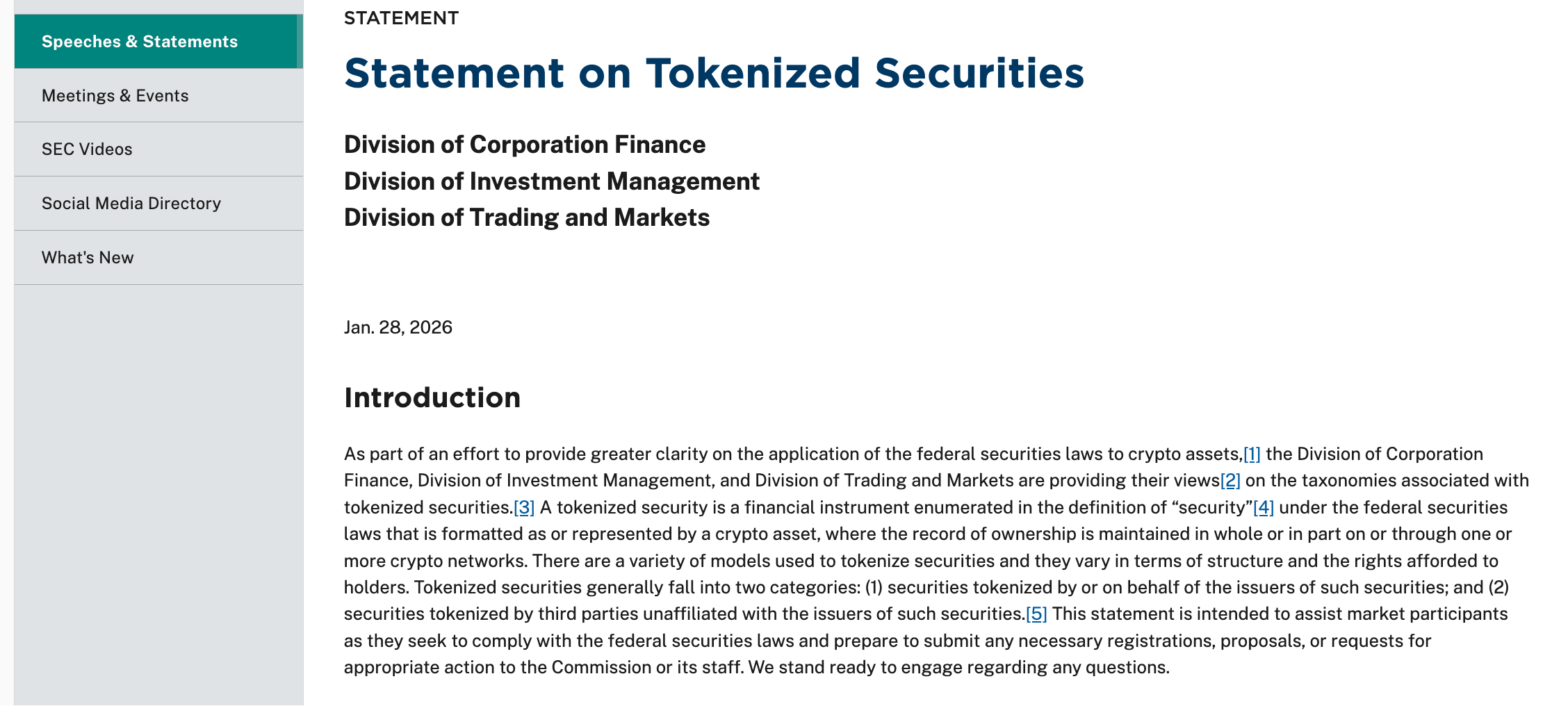
The core of these guidelines is to clarify a fundamental principle: the innovation of technology (tokenization) does not change the legal nature of the underlying asset. Tokenized securities (such as stocks and bonds) remain securities, and therefore their issuance, sale, and trading must fully comply with the existing framework of federal securities laws, bearing the corresponding registration, disclosure, and other obligations.
The issuance of these guidelines is clearly a strong response to the strong recommendations from Wall Street giants. On Tuesday, executives from five Wall Street giants, including the Securities Industry and Financial Markets Association (SIFMA), Cahill Gordon & Reindel LLP, Citadel LLC, and JPMorgan Chase, met with the SEC's crypto task force. These institutions insisted that tokenized securities should be regulated under existing federal securities laws, rather than establishing a set of regulatory rules independent of the current system. They warned during the meeting that allowing tokenized assets to trade under looser standards could undermine investor protection and market structure rules, arguing that "tokenization changes the market's infrastructure, not the underlying economic substance of the securities," and therefore should not be granted special exemptions simply because the assets are traded on a blockchain.
The release of these guidelines not only reflects a growing consensus between the SEC and traditional financial giants on the position that "the essence of tokenized securities remains securities," but also marks an important evolution of the U.S. securities regulatory system in the digital age.
In the guidelines, the SEC first categorizes tokenized securities into two main types based on the key dimension of "issuer": "issuer-initiated" and "third-party initiated," and formulates differentiated regulatory strategies for each.
Issuer-Initiated Tokenized Securities
This type is directly tokenized by the securities issuer or their agents. They need to integrate distributed ledger technology (DLT) into the securities ownership record system to achieve synchronization between on-chain crypto asset transfers and off-chain "master securities holder files." Essentially, the form of issuance or the method of recording holders, whether on-chain or off-chain, does not affect the applicability of federal securities laws. On this basis, the SEC allows the same class of securities to be issued in various forms, including tokenized forms, and supports free conversion between forms. For example, regardless of the form of stock, it is all considered "equity securities." This regulatory flexibility reflects the SEC's response to market demands, recognizing technological innovation while ensuring regulatory consistency.
Another scenario is that tokenized securities act as "observers" and "messengers." The issuer issues a crypto asset to the securities holders, but this asset does not represent any rights, obligations, or interests in the securities (such as dividend rights, voting rights, etc.). Moreover, the issuer does not directly transfer the ownership records of the securities to the blockchain; the main record (master securities holder file) remains in the traditional off-chain database. The primary function of this type of tokenized security is that when it is transferred on-chain, it triggers a notification to inform the issuer (or their agent) that "someone wants to transfer the securities." Subsequently, the issuer can use the on-chain database records to update the off-chain database records, ensuring the speed and consistency of information.
Third-Party Initiated Tokenized Securities
This type is implemented by independent third parties for securities tokenization, with various models. Due to the potential introduction of additional risks (such as counterparty risk, bankruptcy risk, etc.), the SEC assigns a higher regulatory weight to this type and further divides it into "custodial tokenized securities" and "synthetic tokenized securities."
Custodial Tokenized Securities: A third party holds the "underlying securities" and possesses the rights to the tokenized securities, similar to the "issuer-initiated" model, and federal securities laws still apply. The third party (such as a custodian) can use blockchain technology to manage the records of "securities interests," and the tokenized securities held by users can directly prove their indirect ownership of the "underlying securities."
Synthetic Tokenized Securities: A third party issues crypto assets that represent its own securities, providing synthetic exposure to the "underlying securities," such as tokenized related securities or token-based securities swaps.
The guidelines emphasize that "synthetic tokenized securities" have complex product structures and entail higher risks. In this model, related securities and securities swaps serve as two core synthetic exposure tools, which, while presenting similarities in economic function, differ in legal nature and regulatory requirements.
In terms of similarities, both provide synthetic exposure to the "underlying securities," with their value and returns directly linked to the price performance of the "underlying securities" or related events (such as earnings releases, credit rating changes). Holders receive the benefits derived from this "linkage" but do not enjoy any rights from the issuer of the "underlying securities," including dividends, voting, or information rights. Furthermore, regardless of how the structure is designed, as long as they possess the essential characteristics of securities, both must strictly comply with the registration and disclosure requirements of the Securities Act to ensure market transparency and investors' right to information.
The differences lie in that related securities are securities issued by the third party itself, which can be either debt securities (such as structured notes) or equity securities (such as exchangeable stocks), applicable to general securities issuance and trading rules, and can be issued to both qualified professional investors and eligible retail investors. In contrast, securities swaps are more unique, being both securities and a regulated financial contract, with federal securities laws providing a series of additional or different regulations for their oversight. For example, if tokenized assets are deemed to be securities swaps, selling such products to non-qualified contract participants must be registered under securities laws and traded on national securities exchanges.
It can be seen that the SEC has clearly raised the compliance threshold for such products. Tokenization is no longer merely a simple technical deployment but a comprehensive set of rules, financial, and information disclosure engineering comparable to traditional IPOs or securities issuance. This move also reflects the SEC's gradual regulatory strategy towards financial innovation, marking a shift in securities regulation from "formal compliance" to "substantive risk control."
Conclusion
The SEC's guidelines on tokenized securities are an important part of SEC Chairman Paul Atkins' establishment of a "token classification" framework, aimed at aligning with the market structure legislation being advanced by U.S. lawmakers to build a clear regulatory framework for the category of crypto assets. At the same time, it fully incorporates tokenized securities into the existing, mature securities regulatory system.
For industry participants, these guidelines convey a dual message: first, the compliance path is clear but the threshold is extremely high, especially regarding information disclosure and product characterization; second, innovation must occur within a stringent financial regulatory framework, particularly for innovations involving derivative structures, which require extra caution. Additionally, clear rules will attract more traditional financial institutions to engage in the tokenized securities space, helping to promote the development of integrated, licensed large trading platforms, thereby accelerating the institutionalization of this market.
Undoubtedly, these guidelines also signify that the SEC has taken another important step in the regulation of crypto assets. In the future, the market will enter a new phase of "rule-driven innovation," where compliance capability may become the core competitive advantage for the survival and development of projects.
免责声明:本文章仅代表作者个人观点,不代表本平台的立场和观点。本文章仅供信息分享,不构成对任何人的任何投资建议。用户与作者之间的任何争议,与本平台无关。如网页中刊载的文章或图片涉及侵权,请提供相关的权利证明和身份证明发送邮件到support@aicoin.com,本平台相关工作人员将会进行核查。


