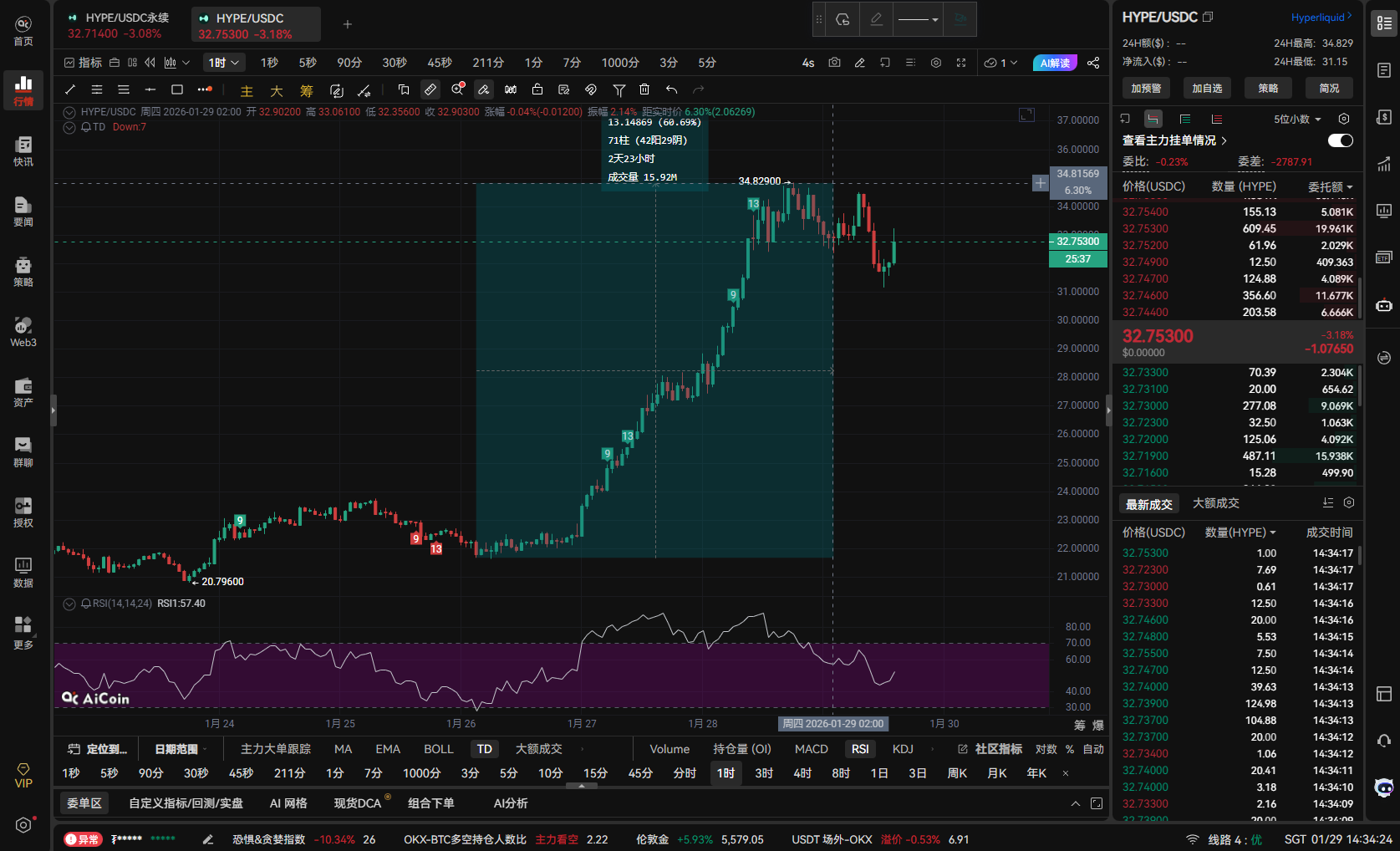
From January 28 to 29, in East 8 Time, Bitcoin fluctuated narrowly above the key support zone, with prices consolidating horizontally around previous highs, as market sentiment oscillated between hesitation and wait-and-see. Behind the current consolidation range, there are two widely watched defensive lines: one is the on-chain data indicating a short-term holder cost basis of approximately $96,500, which many institutions view as the bull-bear dividing line for this cycle; the other is the $83,400 key support level focused on by technical analysts, which, if lost, could open up space for further retracement to $80,700. At the same time, the 30-day moving average of spot ETF fund flows has clearly returned to neutral, with incremental funds no longer pouring in continuously as before, while the bearish preference in the options market and significant liquidation events have amplified pessimistic expectations on the derivatives side, leading to a structural tug-of-war between long and short funds around this range.
Emotional Reversal at the $96,500 Cost Line
● The short-term holder cost basis of approximately $96,500 is seen as an important bull-bear dividing line for the current cycle, with funds concentrated around this price that have taken on high positions. If the price runs below this cost line for an extended period, short-term positions are more likely to fall into a loss zone, which the market will interpret as a signal of diminishing upward trend or even a potential peak; conversely, if it can quickly return and stabilize above this line, it indicates that short-term funds still hold the initiative, allowing the trend narrative to continue.
● Combined with on-chain data showing an increase in the proportion of loss supply, market debates are focused on two directions: one viewpoint suggests that this resembles a natural pullback after a bull peak, primarily due to profit-taking from high-positioned funds, and does not constitute a complete bear market structure; the other references historical experience, pointing out that an increase in the proportion of loss supply often appears in the early stages of a bear market, warning investors to be cautious of the possibility of a shift from "normal pullback" to "trend reversal." Due to the lack of more detailed data breakdowns, this debate is unlikely to reach a conclusion in the short term and can only serve as a thermometer for sentiment tracking.
● If a large number of positions accumulated by short-term holders above $96,500 remain in a loss state, the potential chain reaction is a simultaneous amplification of selling pressure and volatility. On one hand, leveraged funds are more likely to trigger passive liquidation under margin pressure, combined with emotional stop-loss selling, which will accelerate the price's downward test of lower support; on the other hand, high-frequency trading and quantitative models often respond to increased volatility by tightening positions, leading to thinner liquidity, making the same amount of selling pressure have a greater impact on prices, forming a short-term structural risk of "falling faster and rebounding harder."
The Fragile Technical Game at $83,400 Support
● From a technical structure perspective, $83,400 is viewed as the key support level for this round of pullback by both bulls and bears, with a corresponding price concentration area for potential retracement target at $80,700 below. However, as of January 29, the market has not yet shown a clear and effective breakdown of $83,400; any judgment about "triggering a deeper pullback" belongs to a preemptive assumption rather than an established fact. Tracking this price range should focus on intraday trading density and closing positions, rather than prematurely viewing it as an inevitable breach.
● Once $83,400 is broken with volume and confirmed, short-term sentiment, leveraged funds, and passive selling mechanisms may resonate. First, the market will quickly re-evaluate risk expectations, and some previously steadfast bulls may actively reduce their positions; second, in the contract market, once the price breaks below the key level, it is easier to trigger a series of forced liquidations and margin calls, amplifying short-term selling pressure; finally, quantitative strategies and passive products that track price and volatility often reduce positions to control risk during spikes in volatility, further weakening buying support, thus forming a trajectory of accelerated downward price movement.
● It is important to emphasize that the current discussion around $83,400 is essentially a risk assessment of the "tactical-level pullback range," rather than an emotional rendering of a "systemic collapse." In the absence of hard trigger factors such as on-chain breaks, a sharp tightening of macro liquidity, or large-scale ETF redemptions, magnifying short-term technical pullbacks into extreme crisis scenarios does not align with current data and can easily mislead risk pricing. A more reasonable framework is to view $83,400-$80,700 as the defensive zone for this round of market activity, focusing on structural adjustments within this range rather than amplifying it into a single anchor point for trend termination.
The Tug-of-War Between ETF Funds and Derivative Signals
● At the spot ETF level, according to data sources like Glassnode, the 30-day moving average of fund flows for Bitcoin-related products has returned to a neutral range, indicating a phase of cooling from the previously sustained net inflow. The current state is closer to a "balanced turnover" pattern of "buying and selling," with no signals of large-scale systemic redemption pressure. This shows that the allocation rhythm of long-term funds is slowing down, but there has been no collective withdrawal or fundamental denial of the track logic.
● In stark contrast to the neutral stance of ETFs, the options and contract markets have seen an increased preference for bearish positions, reflecting a more pessimistic outlook on short-term prices from the leveraged side. Research briefs mention that the derivatives market recently experienced a $31.64 million whale liquidation event, highlighting the fragility of high-leverage structures during periods of amplified volatility. The rising protective put positions and event-driven liquidations have formed a misalignment pattern of "downward bets on the options side, while the spot side remains cautious," providing an amplifier for short-term volatility.
● The key to this round of competition lies in the mismatch of time dimensions: the funds behind ETFs are mostly long-term or passively allocated, with slower rebalancing rhythms, focusing more on medium to long-term allocation ratios and asset correlations; while options and futures traders are highly sensitive to intraday and weekly fluctuations, competing on short-term direction and volatility. At this stage, short-term price dominance is more in the hands of derivatives, while ETF funds act more like "underlying liquidity supporters." In the absence of new passive buying pressure, even if the underlying positions are not reduced, short-term prices can experience violent fluctuations driven by leveraged funds.
The Discrepancy Between Gold's Surge and Bitcoin's Market Value
● At the macro asset level, the comparison is particularly striking: research briefs show that the total market value of gold increased by approximately $1.64 trillion in a single day, while Bitcoin's current overall market value is about $1.74 trillion. This means that the incremental value absorbed by traditional safe-haven assets in one day is almost equivalent to a "replication" of Bitcoin's entire market value, highlighting that in this round of major asset rotation, Bitcoin is not the primary beneficiary of risk hedging.
● Veteran trader Peter Brandt described this round of precious metal market activity as "one of the largest precious metal fluctuations of my career," reflecting that macro risk aversion is concentrating on traditional assets like gold. In an environment of combined geopolitical and policy uncertainty, institutional asset allocation tends to prioritize increasing positions in tools with longer histories and more mature pricing systems, while adopting a more restrained attitude towards crypto assets still in regulatory and valuation battles.
● For the "digital gold" narrative, this round of market activity resembles a reality stress test: in the short term, there are clear signs of funds shifting towards gold and rebalancing allocations away from Bitcoin, causing the linear story of "rising with gold to hedge risks" to encounter setbacks. However, from a medium to long-term perspective, the daily market value increase of gold compared to Bitcoin's total market value also suggests that crypto assets still have room for expansion in global asset allocation. If regulatory paths and product forms gradually become clearer in the future, Bitcoin has the opportunity to play a complementary rather than substitutive role, capturing some demand for "digital safe-haven assets," provided it maintains key support and stabilizes market confidence amid short-term volatility.
The Invisible Pressure of Regulatory Clouds and Emotional Premiums
● At the regulatory level, the pressure from the U.S. political sphere on the crypto industry still exists, including inquiries and statements from some senators to Department of Justice officials, adding reasons for off-market funds to remain cautious. Although these movements lack specific actionable clauses, they are sufficient to raise the "policy discount factor" within institutional risk control frameworks, causing some potential allocators to choose to delay their entry, waiting for a clearer regulatory context.
● Regulatory uncertainty is particularly evident in the transmission through the options market: in the absence of concrete negative developments, many institutions and professional traders still tend to increase bearish hedges to cope with potential sudden policy news. This defensive layout has driven up volatility and demand for put options, but has not resulted in a corresponding scale of realization in ETF net flows—current data shows that spot ETFs are more "slowing down" rather than "withdrawing," indicating that policy concerns are more priced into volatility premiums rather than immediately triggering large-scale sell-offs of underlying assets.
● Observing the combination of on-chain and off-chain behaviors, current policy noise is more reflected in discounted risk preferences and heightened emotional premiums, rather than triggering systemic runs. There has been no evidence of concentrated large-scale outflows corresponding to panic footprints on-chain, nor is there sustained net redemption data off-chain to support the "escape" narrative. A more reasonable understanding is that regulatory clouds have suppressed the speed of marginal new funds entering the market and raised the premium requirements for short-term volatility, making each pullback at key price levels more likely to be accompanied by emotional amplification effects.
The Decisive Moves After the Support Defense Battle
● Overall, in the short term, the defense and offense surrounding the $83,400 technical support and $96,500 short-term cost line will largely determine whether this round of price movement is classified as a "healthy pullback with oscillation rebalancing" or gradually tilting towards "bear market expectations." If the price can repeatedly solidify a bottom above this range without triggering large-scale chain liquidations, it will be beneficial to digest the current volatility into structural reshuffling; conversely, if both defensive lines are breached in succession, the short-term narrative is more likely to shift towards pricing in deeper retracement ranges.
● From a data perspective, two scenario splits can be made: first, in the case of support holding, ETF fund flows remain neutral or even shift back towards net inflows, protective put positions in the options market gradually reduce, volatility declines, and sentiment slowly repairs between "fear-neutral," allowing Bitcoin to challenge the short-term cost line again and validate bullish momentum; second, in the case of support being lost, prices may seek new balance points towards $80,700 or even lower historical trading concentration areas, potentially requiring longer sideways trading and turnover to digest short-term losses and passive selling pressure, with the market rebuilding risk preference ranges at a more conservative pace.
● For investors, the current stage requires a focus on validated data and public indicators, including clear cost zones, ETF fund flow moving averages, on-chain supply structures, and actual liquidation scales. At the same time, caution should be exercised against unverified amplifications of loss ratios, on-chain behaviors, and systemic risks, especially regarding information lacking precise values or still in a verification state, to avoid treating them as "established facts" in trading decisions. Defining risk ranges with data and managing positions to cope with volatility is more critical than chasing emotional extreme narratives.
Join our community to discuss and grow stronger together!
Official Telegram community: https://t.me/aicoincn
AiCoin Chinese Twitter: https://x.com/AiCoinzh
OKX Benefits Group: https://aicoin.com/link/chat?cid=l61eM4owQ
Binance Benefits Group: https://aicoin.com/link/chat?cid=ynr7d1P6Z
免责声明:本文章仅代表作者个人观点,不代表本平台的立场和观点。本文章仅供信息分享,不构成对任何人的任何投资建议。用户与作者之间的任何争议,与本平台无关。如网页中刊载的文章或图片涉及侵权,请提供相关的权利证明和身份证明发送邮件到support@aicoin.com,本平台相关工作人员将会进行核查。