Original | Odaily Planet Daily (@OdailyChina)
Author | Ethan (@ethanzhangweb3)_

The large sell-off marked as "1inch team" has sparked negative reviews again.
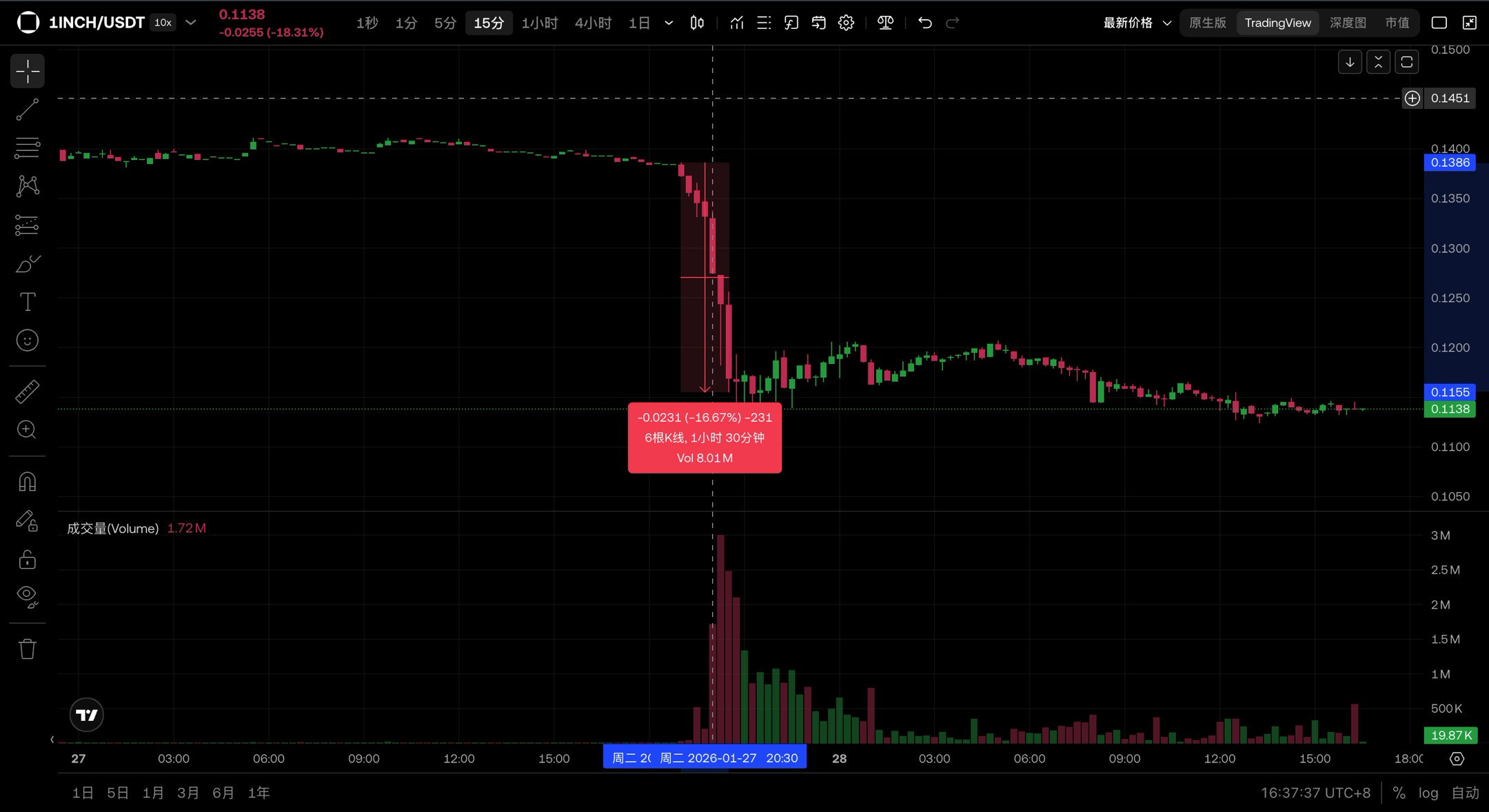
Recently, the on-chain data platform ARKHAM showed that three wallets marked as "1inch team" sold a total of 36.36 million 1INCH tokens, worth 5.04 million dollars. According to OKX market data, as a result, the price of the 1INCH token temporarily dropped by 16.7% to 0.1155 dollars, currently reported at 0.1164 dollars. A question quickly arose in the market regarding this sell-off: Is this really the project team dumping their own tokens?
Looking solely at this sell-off, the outcome is not ideal. On-chain data shows that the aforementioned 1INCH was mainly transferred to related addresses in late November 2024, with an estimated cost around 0.42 dollars, corresponding to a value of about 15.27 million dollars. Before this sell-off, the price of 1INCH had already fallen to around 0.14 dollars. Coupled with the slippage effect caused by the large amount of funds during the sell-off, the actual loss from this batch of positions could exceed 10 million dollars.
Reference: 1inch team's past trading style
Previously, the 1inch team investment fund's on-chain operations during multiple rounds of market fluctuations were regarded by the market as the actions of a "professional trading team."
As early as between February and April, the 1inch team investment fund began to accumulate 1INCH at low prices. At that time, market sentiment had not yet warmed up, and 1INCH lingered around 0.2 dollars for a long time. During this period, the team invested a total of about 6.648 million dollars, buying 33.19 million 1INCH at an average cost of about 0.2 dollars.
However, this round of buying did not trigger significant price fluctuations; what truly caught the market's attention was the concentrated accumulation in early July. From July 6 to 9, the 1inch team investment fund made another move, adding about 4.4 million dollars in just a few days, buying 22.99 million 1INCH. As buying pressure continued, the price of 1INCH rose from around 0.18 dollars to 0.206 dollars, a phase increase of about 14%. During this time, the team transferred 3 million USDC to Binance and gradually withdrew 1INCH to their own addresses, indicating that the related funds were not exhausted at once, possibly waiting for the right opportunity to continue buying.
After July 10, the pace of operations clearly accelerated. On the afternoon of July 10, the team again bought 4.12 million 1INCH for about 880,000 dollars, while supplementing 2 million USDT to Binance to prepare for subsequent trades. On the evening of July 11, on-chain monitoring showed that the team seemingly bought 11.81 million 1INCH at a higher price range, with transaction prices rising to around 0.28 dollars. By then, the holdings of that address had increased to 83.97 million 1INCH, with a book value exceeding 23 million dollars. On July 13, the team continued to withdraw 6.334 million 1INCH from Binance.
If we trace back to early February, the 1inch team investment fund had cumulatively invested about 13.64 million dollars since the beginning of the year, buying 55.85 million 1INCH at an average cost of about 0.244 dollars. With the price of 1INCH peaking above 0.39 dollars in mid-July, this portion of positions had already realized several million dollars in profits.
It is worth noting that the team is not "buying without selling." On the evening of July 13, they began to realize profits on a small scale, selling about 904,000 1INCH at a price of 0.33 dollars, exchanging for 298,000 dollars; earlier, they had already sold part of their 1INCH in batches at around 0.28 dollars.
At the same time, the team also took profits on another important position: ETH, which was previously bought at an average price of 2,577 dollars in February, has begun to be sold in batches above 4,200 dollars, achieving profits of over a million dollars solely from the ETH position.
On August 11, according to on-chain analyst Yujin Monitoring, the 1inch team investment fund began to realize part of its previous positions on-chain. Data shows that they sold 5,000 ETH at an average price of 4,215 dollars, exchanging for 21.07 million USDC; at the same time, they sold 6.45 million 1INCH at an average price of 0.28 dollars, exchanging for about 1.8 million USDC.
From the perspective of acquisition costs, the aforementioned ETH was bought by the 1inch team in February at an average price of about 2,577 dollars; the corresponding 1INCH was mainly acquired in July, with a comprehensive cost of about 0.253 dollars. Just considering the already sold ETH and 1INCH positions, the 1inch team investment fund has realized about 8.36 million dollars in book profits.
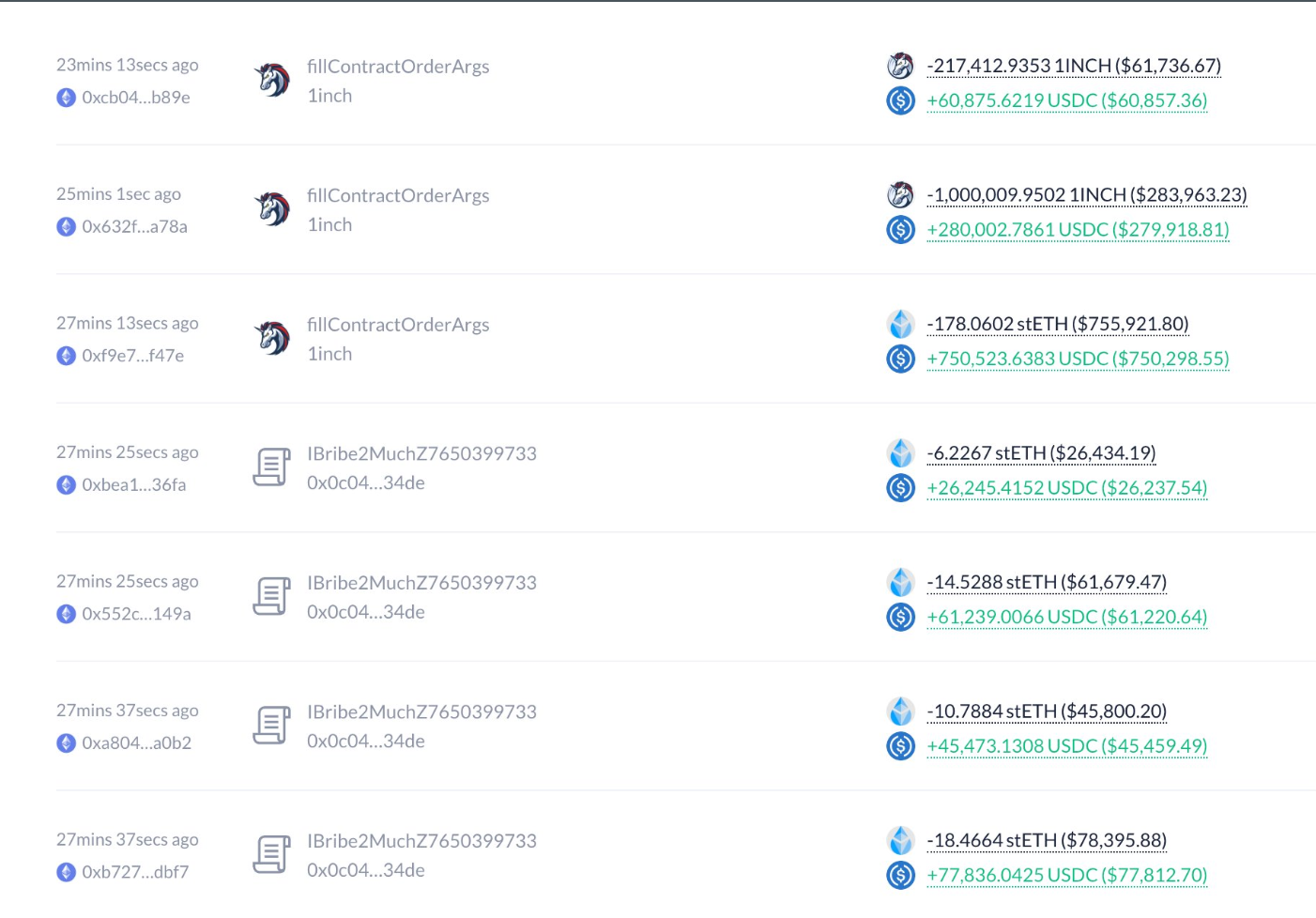
If we look further back, the 1inch team's "counter-cyclical buying and trend-following selling" operation path on BTC is also clear. Between February and March this year, they bought 160.8 WBTC at an average price of about 88,000 dollars during the BTC pullback phase and completed liquidation when BTC approached the 100,000 dollar mark again in May, realizing nearly 1 million dollars in overall profit.
Considering the three asset lines of BTC, ETH, and 1INCH, the on-chain operations of the 1inch team investment fund resemble a set of funding strategies that have been repeatedly practiced: building positions during market adjustments, continuously adding during price increases, and gradually realizing profits when prices enter high ranges.
But this time, is it really them operating?
It should be noted that if we compare this large sell-off occurring around 0.14 dollars with the past on-chain operations of the 1inch team investment fund, we find that: if this sell-off was indeed directly led by the team, then the execution method itself deviates significantly from their past trading logic. In historical operations involving BTC, ETH, or 1INCH, the team more commonly executed profit-taking in batches after confirming price trends, rather than concentrating on selling in clearly low liquidity ranges.
For this reason, some market participants began to question: Is this sell-off marked as "1inch team" really from the team or wallets directly controlled by them?
Subsequently, 1inch's official response to the related controversy was made. In their statement, they clearly stated that this sell-off did not occur in any wallets controlled by the 1inch team, entities, or treasury multi-signatures, and the team cannot intervene in the asset allocation and trading decisions of third-party holders.
In other words, the associated relationship indicated by the on-chain label does not equate to actual control. From the execution rhythm and price range, this sell-off is more likely to come from third-party holders who have already detached from project control, rather than a shift in the trading logic of the 1inch team itself.
In a phase where liquidity is already limited, a single large sell-off is quickly equated with "team dumping," which itself is an overly compressed interpretation of information. It overlooks the natural gap between address labels and real control rights after the long-term circulation of tokens.
Returning to 1inch itself. The official statement emphasized that this market fluctuation has not changed its core business and long-term direction. Since 2019, 1inch has cumulatively facilitated nearly 800 billion dollars in trading volume, and even during market downturns, it can still maintain daily trading volumes in the hundreds of millions of dollars. The team also stated that they plan to reassess the token economic model this year to enhance overall resilience during low liquidity and downward cycles. In this context, the discussion around "whether the 1inch team is dumping" seems more like a misinterpretation amplified by on-chain labels, liquidity environment, and emotional interpretations.
However, even if it ultimately proves to be a misinterpretation, this sell-off still constitutes a real secondary impact on the already weakening price of 1INCH. Since the last cycle's peak of 6 dollars, 1INCH has experienced a long-term unilateral decline, now hovering around 0.11 dollars.
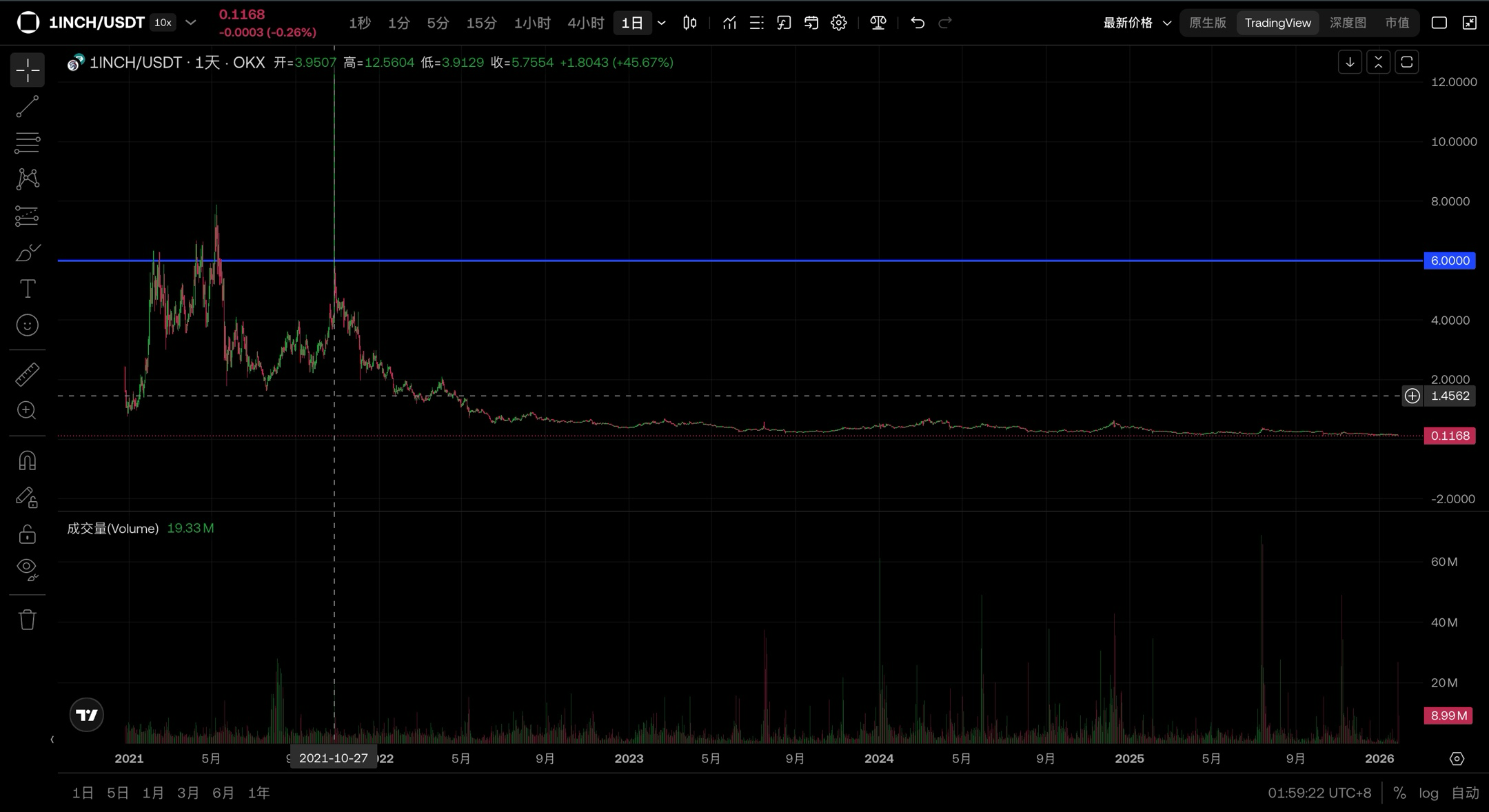
In such a trend, the market clearly lacks sufficient buffer space to absorb any sudden sell-off signals. These amplified sell-off events ultimately bear the emotional shock, often affecting the most risk-averse side—the retail investors.
免责声明:本文章仅代表作者个人观点,不代表本平台的立场和观点。本文章仅供信息分享,不构成对任何人的任何投资建议。用户与作者之间的任何争议,与本平台无关。如网页中刊载的文章或图片涉及侵权,请提供相关的权利证明和身份证明发送邮件到support@aicoin.com,本平台相关工作人员将会进行核查。


