Written by: Cathy
On January 11, 2026, Nikita Bier, the product lead for X, sent out a tweet that instantly ignited the crypto community.
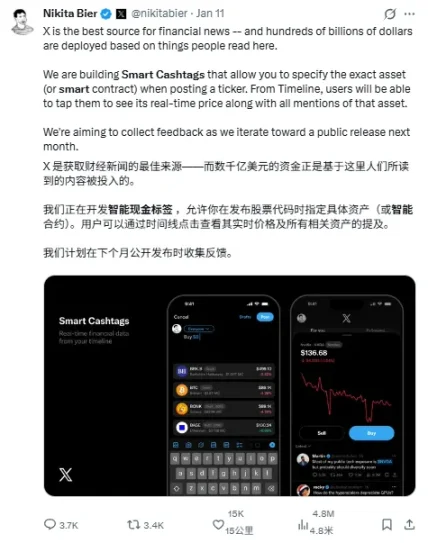
He announced that Smart Cashtags would launch in February.
This was supposed to be a routine product update, but the prominent appearance of "Buy" and "Sell" buttons in the preview screenshot made everyone realize that Musk's ambition for a "super app" was finally becoming a reality.
However, few noticed that Nikita Bier also held another identity: Strategic Advisor at Solana Labs.
Almost simultaneously, Solana officially announced its deep integration into the X app. As soon as the news broke, the price of SOL surged.
From social plaza to exchange, X is conducting an unprecedented experiment.
01 From Blue Bird to "Wallet"
To understand X's ambition for financialization, one must first review its entanglement with cryptocurrency.
During Jack Dorsey's leadership, Twitter's embrace of crypto was heavily idealistic. In September 2021, Twitter was the first to launch a Bitcoin tipping feature on iOS, enabling near-zero-cost global micropayments through the Lightning Network. In January 2022, it introduced NFT profile picture verification for Twitter Blue users.
But these features were more like "additives" rather than "catalysts"—users still discussed on Twitter and traded on Coinbase. The flow of information and the flow of funds remained separate.
In October 2022, Musk completed the acquisition for $44 billion, and everything began to change.
He quickly removed decorative Web3 features, disbanded the existing crypto engineering team, and reassembled a team focused on payment licenses and core financial infrastructure. Dogecoin became the platform's unofficial mascot, from Tesla accepting DOGE payments to briefly changing the blue bird logo to a Shiba Inu avatar, Musk embedded DOGE into the DNA of X through a series of performance art actions.
More importantly, X Payments LLC has quietly applied for money transmission licenses in various states over the past two years. As of January 2026, it has been approved in about 41 states and Washington D.C., covering populous and economically significant states like California, Pennsylvania, and Utah. In January 2025, X also announced a strategic partnership with Visa to enable real-time deposits and withdrawals through the Visa Direct network.
However, behind this impressive report card lies a significant setback: X Payments had withdrawn its license application in New York as early as April 2024 and has since failed to make any breakthroughs.
In May 2025, New York State Senator Brad Hoylman-Sigal and Assemblyman Micah Lasher jointly wrote to the New York State Department of Financial Services (NYDFS), explicitly opposing the issuance of a license to X. The reasons pointed directly to the "character and fitness" clause in New York banking law—Musk's management style during his tenure at Tesla and SpaceX, the significant share of Saudi investors in X's capital structure, and Musk's previous public calls to dissolve federal agencies regulating his businesses all became targets of opposition.
This means that in the foreseeable future, X will be unable to provide legal payment services to New York residents. As a global financial center, New York's absence will severely restrict the institutional business expansion of X Payments.
The foundation has been laid, but the most critical brick is still stuck outside the door.
02 Smart Cashtags: Turning Tweets into Buy Buttons
If X Payments is the foundation of financialization, then Smart Cashtags is the interactive interface directly facing users.
In the current social networks, when users input "$PEPE," the system does not understand which specific asset this represents. In the cryptocurrency field, this is a huge pain point—tokens with the same name may exist on multiple chains like Ethereum, Solana, and BSC, and there are even countless scam tokens with the same name.
According to Nikita Bier, the core innovation of Smart Cashtags lies in allowing users to specify a particular asset or even a smart contract address. When users mention a new meme token, they can bind it to a unique address on the chain.
Once bound, the tag will no longer be a simple hyperlink but an interactive data object. When users click the tag, it will directly display real-time candlestick charts, price changes, market capitalization, as well as related news and social discussions above the timeline.
Nikita revealed that the new API will be able to "process any asset minted on-chain in near real-time." This means that X may rely on decentralized data aggregation tools like DexScreener and Birdeye to obtain data.
The most eye-catching feature is the "Buy" and "Sell" buttons in the preview screenshot.
In the initial phase, these buttons may serve as "intention routers"—clicking "Buy" will invoke the wallet app on the user's phone (such as Phantom or MetaMask) through deep linking, automatically pre-filling the trading pair and amount.
As X Payments' licensing improves, the ultimate form in the future may be to complete transactions directly within the X app. X may aggregate third-party liquidity (like Jupiter or Uniswap) and only charge transaction fees as a front-end entry point.
This will fundamentally change the content ecosystem of the crypto market. KOLs will not just be outputting opinions; they will become "lead traders."
03 Why Solana?
Among various blockchain protocols, Solana is gradually becoming X's preferred partner.
The reason is simple: speed is justice.
The user experience of social networks is measured in milliseconds. Users are accustomed to liking and retweeting happening instantly. If a transfer takes 15 seconds (Ethereum) or even longer, the experience will be disastrous. Solana's 400-millisecond block time is one of the public chains closest to the Web2 experience.
More critically is the micro-payment economics. X's vision includes scenarios like tipping and paying per article. If a $0.1 tip incurs a $0.05 gas fee, the model becomes unviable. Solana's transaction fee rate of less than $0.001 makes high-frequency micropayments economically feasible.
Of course, there is another factor that cannot be ignored: people.
The aforementioned Nikita Bier not only oversees X's product roadmap but also serves as a strategic advisor at Solana Labs. This dual identity, while sparking controversy in the crypto community regarding "conflicts of interest" and "suppressing other public chains," also ensures that Solana's technology has priority on the X platform. Bier has publicly defended this strategy, stating that X's API aims to support all high-performance on-chain activities, but objectively, Solana's high throughput characteristics make it the best match.
The "Blinks" protocol launched by the Solana ecosystem is tailor-made for X.
Imagine an NFT project tweeting on X: "Click here to mint our latest NFT." In the traditional model, users would need to click a link, switch to a browser, connect their wallet, sign, and return to the tweet. In the Blinks model, a "Mint" button is displayed directly below the tweet; users click it, their wallet pops up for signing, and the transaction is completed. The entire process does not require leaving the X app.
If X natively integrates the Blinks standard into its client, it will instantly gain the interactive capabilities of all DApps in the Solana ecosystem without having to develop any front-end itself.
04 Challenges and Questions
The vision is beautiful, but reality is harsh.
First is the regulatory challenge. As mentioned earlier, X Payments has officially withdrawn its license application in New York. In the face of this regulatory barrier, X has adjusted its 2026 release strategy from "full-scale explosion" to "layered advancement": the first phase will launch P2P tipping and balance features in states where licenses have been obtained; the second phase will introduce the "X Card" virtual debit card in conjunction with the Visa network. To address the absence of states like New York, X will deploy strict geo-fencing technology to block payment access for users in unlicensed areas—this may lead to a fragmented user experience across the U.S.
Secondly, there are security risks. The traditional risk of account theft still exists—if an account is linked not only to reputation but also to bank cards and crypto wallets, the motivation for hackers to attack will increase exponentially. But more concerning is the new threat posed by Blinks: recently, a large number of phishing links disguised as legitimate Blinks have appeared in the market. Attackers create seemingly legitimate NFT minting buttons, and once users click to sign, their wallet assets are drained.
When the convenience of "one-click trading" meets the risk of "one-click zeroing," X's content review mechanism will face extremely high challenges.
05 Conclusion
The financialization experiment that X is conducting is one of the boldest bets in internet history.
It attempts to transform the noisiest plaza of humanity into the most efficient exchange, constructing a complete closed loop referred to as "FiSo (Financial Social)."
But the risks cannot be ignored either. X's deep involvement in token issuance and trading execution makes it easy for the SEC to define it as an "unregistered securities exchange" or "broker." The withdrawal of the New York license application may just be the prelude to a regulatory storm.
For the cryptocurrency industry, this is both an opportunity and a challenge.
The opportunity lies in the fact that hundreds of millions of users will be exposed to crypto assets through a familiar interface.
The challenge is that traffic and liquidity may once again concentrate in a centralized giant, which runs counter to the original decentralized vision of cryptocurrency.
Regardless of success or failure, X's leap will redefine the boundaries between social media and fintech.
免责声明:本文章仅代表作者个人观点,不代表本平台的立场和观点。本文章仅供信息分享,不构成对任何人的任何投资建议。用户与作者之间的任何争议,与本平台无关。如网页中刊载的文章或图片涉及侵权,请提供相关的权利证明和身份证明发送邮件到support@aicoin.com,本平台相关工作人员将会进行核查。


