Written by: Yokiiiya
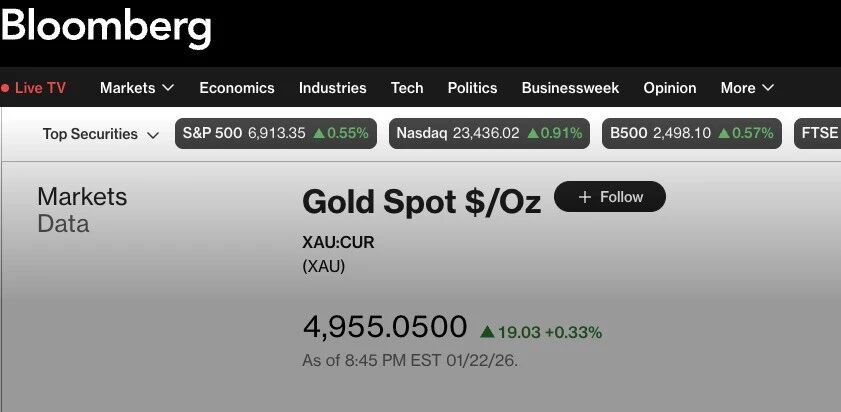
In recent days, I have come across articles about gold almost every day. When I started writing this article, I saw that the gold price was already approaching $5000 per ounce. I wonder if by the time I finish this article, the gold price will actually surpass $5000. But one thing is already clear: gold has transformed from an "asset occasionally mentioned" into an undeniable presence.
This change did not happen suddenly. Last December, during a public debate about Bitcoin and gold, the discussion was brought back to the forefront. Peter Schiff, during an interview, looked directly into the camera and made a statement that quickly went viral: "Bitcoin is a dream." The value of Bitcoin comes more from belief, narrative, and imagination about the future, rather than from cash flow or asset backing in the real world. However, while all attention was focused on Schiff's mockery of BTC, a more significant and epoch-making change was overlooked.
What may have truly changed is not Bitcoin, but gold. Behind the discussion sparked by CZ and Schiff, gold is re-entering the core of the financial system in a way that is different from the past.
In the past, gold could only be stored; today, gold is starting to be used. It can be collateralized, lent, enter DeFi, and even be called upon by AI agents, becoming the underlying collateral in on-chain financial systems. In other words: while Schiff mocks BTC for still being in a "dreaming" state, gold has transformed from a dormant store of value into an executable asset—it has begun to "work." This is what Tokenized Gold represents.
1. A Look Back: What Happened to BTC, Gold, and the S&P 500 Over the Past Decade?
Before continuing the discussion on whether gold has "awakened," it is necessary to extend the timeline a bit. Over the past decade, discussions about assets can easily be summarized in one sentence: this is the era of Bitcoin, the era of risk assets, while gold is merely a gradually marginalized conservative option. However, if we truly return to the timeline, this conclusion is not entirely valid. In a recent retrospective article by "Wu Says Real," they compared several core assets from 2015 to 2025: Bitcoin, gold, and the U.S. stock market represented by the S&P 500.
This comparison is not meant to conclude which is better, but rather to answer a more fundamental question: what different assets have relied on to create returns over the past decade.
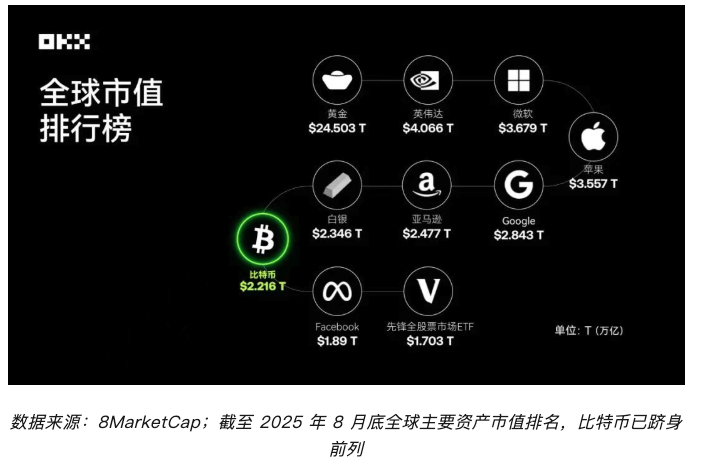
Bitcoin: The Most Extreme Returns, Highly Dependent on Narrative
If we look solely at returns, Bitcoin is clearly the most extreme and dazzling presence. It has generated returns far exceeding traditional assets across multiple cycles, continuously reinforcing the narrative of a "new financial form." However, its path is equally clear: extreme volatility, deep drawdowns, and a high dependence on emotions and consensus.
The returns of Bitcoin essentially come from bets on the future. It resembles a long-term belief asset rather than a tool that has already stabilized within the real financial system.
S&P 500: Stable Compounding, Built on Institutional Continuity
The stock market represented by the S&P 500 presents a completely different state. Over the past decade, U.S. stocks have continuously provided compounded returns through corporate profit growth, technological expansion, and a relatively stable institutional environment. Its advantage lies in its participation in the system itself, continuously accumulating value within a normally functioning financial system.
However, this stability is also built on a premise: institutional continuity, capital freedom, and an uninterrupted system. Once these conditions change, stocks do not possess the ability to exist independently outside the system.
Gold: No Narrative Climax, but Always Present
In contrast, gold appears particularly quiet. It has not created wealth myths and rarely becomes the center of market narratives. However, if we extend the timeline, we find a recurring fact: during every phase of rising systemic uncertainty, gold is brought back out and reaffirmed. Its returns do not depend on a single event or a technological breakthrough, but rather stem from a long-validated attribute: independence from systemic risk. This is why, over the past decade, gold has not truly "exited the stage," but has repeatedly returned to the core position of asset allocation at critical moments.
What this comparison truly illustrates is not who won; placing Bitcoin, stocks, and gold together for review is not meant to yield a simple victory or defeat conclusion. More importantly, they each expose completely different structural characteristics:
Bitcoin relies on imagination about the future.
Stocks rely on participation in the existing system.
Gold relies on its independence from the normal operation of any party.
If we say that gold has had a problem over the past decade, that problem does not lie in the returns themselves. Rather, it is that it has always been held but rarely truly used. It is here that we truly approach the next question: why do we say that gold has actually been "asleep"?
2. Why Do We Say Gold Has Always Been "Asleep"?
Saying that gold is asleep does not deny its value. On the contrary, the reason gold has been repeatedly chosen over thousands of years is precisely because it is stable enough and realistic enough. It transcends civilizations, institutions, and cycles, playing a role close to "ultimate hedge" in almost all asset systems. Because of this stability, gold has never needed to prove itself through narrative; it only needs to exist when cracks appear in the system.
However, it is precisely this stability that has kept gold's position in the modern financial system very fixed for a long time. Its default state is not to participate in the system's operation but to be stored. Whether lying in a vault, being custodied, sealed, or packaged into ETFs for asset allocation, fundamentally, nothing has changed: gold is allowed to exist but rarely permitted to enter the system itself. The form changes, but the role does not.
If we look only from the perspective of price or long-term returns, gold has not failed. During phases of rising inflation, geopolitical tension, financial crises, and credit risk exposure, it has been repeatedly reaffirmed. It does not rely on growth stories or technological breakthroughs; as long as instability arises in the system, it fulfills its role as a safe-haven asset. In this sense, the problem with gold has never been that it is "worthless."
The real problem is that gold, as an asset, has long been in a state of high stability and high stagnation. It can store value but cannot be called upon; it can hedge risks but cannot enter the risk management system itself; it can be held long-term but is difficult to combine, collateralize, or execute. In the modern financial system, assets are no longer just about "whether they are safe," but about "whether they can be used," and gold has long been excluded from this aspect.
In a financial environment centered on efficiency, liquidity, and capital turnover, this stagnation itself is a limitation. Stocks can be pledged, split, and combined into indices; bonds can form yield curves, entering leverage and term structures; cash can be called upon at any time, becoming the starting point for all transactions. Gold, more often than not, is merely placed on the periphery of the system, existing as a form of "ultimate guarantee," but not participating in the system's daily operations.
From this perspective, "asleep" is not an emotional evaluation but a description of a state. Gold has not lost its value; it has lost the ability to enter the operational layer of the modern financial system. It has exchanged inactivity for safety. But in an increasingly automated and systematized financial system, this exchange is beginning to seem too costly.
It is here that a new question truly emerges. If gold has been repeatedly proven to be worth holding long-term, then the next question to be answered is no longer whether gold is valuable, but whether it can be truly used. The change begins with this question.
3. Where the Change Begins: Gold is Truly "Used" for the First Time
Gold truly begins to change not because people suddenly realize it is "important." This has been repeatedly validated over a longer history. The real change comes from a more specific and realistic turning point: gold is being treated for the first time as an asset that can participate in the operation of the system, rather than merely being a stored value. For a long time, gold's position in the financial system has been highly stable and singular.
Its function has been fixed on "store of value" and "hedge"—when the system operates smoothly, it is set aside; when uncertainty arises, it is brought back out for confirmation. This is not a problem with gold itself, but rather the traditional financial system's usage of it has determined that it can only remain at the storage level, rather than the operational level.
The change begins when gold is integrated into the on-chain system.
When gold exists in a tokenized form, it has for the first time escaped the state of "only being stored" and entered an environment where it can be directly called upon and executed by the system. It no longer relies on manual matching, manual clearing, or centralized approval, but instead enters a programmable and composable financial system as an on-chain asset. If we break down this change, it is not complex. The so-called "gold begins to be used" is not an abstract judgment but is reflected in its first structural changes in asset status, liquidity methods, transparency, and system role.
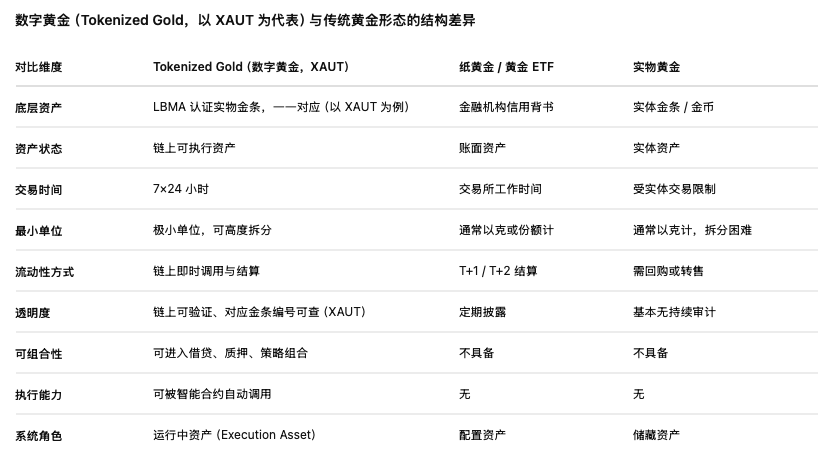
These differences do not mean that digital gold is more radical; they simply indicate one thing: Tokenized Gold, represented by XAUT, has for the first time endowed gold with the ability to be continuously called upon and executed by the system.
In traditional forms, whether paper gold or physical gold, their operational logic is essentially the same: gold is custodied, recorded, and declared to exist, but rarely continuously verified or called upon. It exists more outside the system, as a result asset, rather than a part of the operational process. You can hold it, but it is difficult to let it participate in any ongoing financial mechanism.
However, Tokenized Gold, represented by XAUT, has broken this state for the first time. Gold is no longer just "put away," but has been integrated into an automatically operating system. It can be highly fragmented, thereby improving capital utilization efficiency; it can be used as collateral to release liquidity; it can be written into smart contracts to operate continuously without human intervention; and it can enter automated strategies, being monitored, adjusted, and cleared by the system in real-time.
From this perspective, Tokenized Gold has not changed the risk attributes of gold, nor has it introduced new price narratives. It does not make gold more radical; it makes gold more usable.
What has truly changed is not whether gold "is worth money," but that gold has for the first time been allowed to enter a continuously operating financial system. In this system, whether an asset is important no longer solely depends on whether it is safe, but also on whether it is callable, combinable, and executable. When gold possesses these capabilities, its position in the financial system also changes accordingly.
It is no longer just a line in the asset allocation table; it has begun to participate in the flow of funds, risk management, and strategy execution itself. It has transformed from a dormant store of value into an asset that is starting to "work." It is here that the metaphor of "awakening" truly holds. Gold has not suddenly become important; it has been allowed for the first time to enter the system and participate in the daily operations of the financial system. It is no longer just an "ultimate guarantee" standing outside the system, waiting for a crisis to occur, but has begun to take on a callable and executable role within the system.
When gold starts to "work," it is no longer just a historical asset but begins to possess future attributes.
4. BTC, Gold, and Tokenized Gold Are Not on the Same Level
The debate surrounding Bitcoin and gold has lasted for over a decade. Which one resembles "digital gold" more, which has higher returns, and which better represents the future—these questions have been repeatedly raised and discussed.
However, if we extend the timeline and elevate our perspective, we will discover a long-ignored fact: BTC, gold, and Tokenized Gold have never been the same type of asset. The real differences between them do not lie in price or narrative, but in the different asset tiers they occupy.
Bitcoin is closer to an asset of the "dream layer." It embodies people's imagination of a decentralized currency system, challenges to the existing financial order, and bets on future technological paths. Its value is highly dependent on consensus and belief, which also gives it strong volatility and narrative tension. The success of BTC is essentially a collective experiment about "another possibility."
Gold, on the other hand, is completely different. It does not need to convince anyone to believe in the future; it exists in reality itself. Gold transcends institutions, civilizations, and cycles, making it the closest existence to "ultimate hedge" in almost all asset systems. It does not rely on the operation of the system, nor does it participate in it; rather, it proves its validity when the system fails. From this perspective, BTC represents a belief in the future, while gold represents a confirmation of reality.
The emergence of Tokenized Gold is not about choosing sides between the two; it fills a long-missing tier. It does not attempt to replace Bitcoin's narrative role, nor does it weaken gold's attributes as a real asset. On the contrary, it does something more concrete and pragmatic: it connects real-world gold to a financial system that can operate and execute. This means that real assets no longer remain at the level of "being held," but begin to enter the level of "being used."
Gold is no longer just a store of value or an ultimate guarantee; it can be called upon, combined, and written into rules, becoming part of the system's operation.
If we must use a clearer structure to describe the relationship among these three, it can be understood as follows:
BTC is in the dream layer, representing imagination and bets on future financial forms.
Gold is in the reality layer, representing value anchoring across cycles.
Tokenized Gold is in the execution layer, representing the interface for real assets to enter the future financial system.
They are not in a substitutive relationship but rather a layered relationship. Because of this, many debates have been misaligned from the start. When people compare them using "returns," "market capitalization," or "who will replace whom," they are actually using the same yardstick to measure completely different tiers. What is truly worth discussing is not whether BTC will replace gold, nor whether gold will lose to new technologies. Rather, it is: What changes will occur in the entire financial system's structure when real assets begin to possess execution capabilities? From this perspective, Tokenized Gold is not an opposing option but an interface layer.
It connects assets that have already been validated in the real world with a financial system that is taking shape for the future. This is why the focus of today's discussion should not be "who won this debate," but rather: who can become an asset that is continuously called upon by the system in the future financial system.
Conclusion: When Asset Competition Shifts from Narrative to Capability
Over the past decade, we have become accustomed to using the same set of questions to discuss different assets: who has risen more, who is more decentralized, who better represents the future. However, this set of questions is becoming ineffective. As the financial system shifts from "holding" to "operating," asset competition is no longer just a competition of narratives and beliefs, but is beginning to transform into a competition of capabilities—who can be called upon, who can be combined, who can enter the system and continue to work.
From this perspective, Bitcoin still represents an important imagination. Gold remains the most reliable anchor of reality. The emergence of Tokenized Gold does not seek to deny any of these but rather fills a long-missing tier. It allows real-world assets that have already been validated to possess execution capabilities for the first time in the future financial system. This does not mean that gold will replace Bitcoin, nor does it mean that on-chain assets will negate real assets. What is truly happening is a quieter and deeper change: assets are beginning to move from "being preserved" to "being used." If the past financial system was more concerned with "what you own,"
then the emerging new system is beginning to care about—what you can make participate in operation. In this sense,
BTC may still be dreaming,
Gold is still sedimenting value,
And Tokenized Gold is waking up and starting to work.
This is not a debate with a predetermined winner or loser, but a structural transformation that is currently taking place.
免责声明:本文章仅代表作者个人观点,不代表本平台的立场和观点。本文章仅供信息分享,不构成对任何人的任何投资建议。用户与作者之间的任何争议,与本平台无关。如网页中刊载的文章或图片涉及侵权,请提供相关的权利证明和身份证明发送邮件到support@aicoin.com,本平台相关工作人员将会进行核查。


