Recently, the price performance of coins in the Perp DEX track has not been ideal. HYPE has dropped from its peak to $21, LIT has maintained at $1.7, and there was an incident with ParaDEX, making the entire sector look a bit sluggish.
Interestingly, the enthusiasm for this track does not seem to have cooled down as a result. On the contrary, many players are more actively farming projects that have not yet issued tokens. After all, a small bear market is the best time to accumulate points, and when the market improves and tokens are issued, it will be more competitive.
Two weeks ago, I wrote an article introducing projects titled “After Lighter, the Next Batch of Perp DEX Worth Focusing On,” which received a lot of feedback from friends. Many new users learned about platforms worth paying attention to, but they were still confused about how to operate, how to open and close positions, and how to maximize point weight. Therefore, today’s detailed practical tutorial is very suitable for beginners to get started. For demonstration purposes, I mainly chose Variational and Extended, two Perp DEXs that seem to have good trading volume and background.
I. Essential Preparations: Initial Setup
Before starting, you need to prepare 2 EVM wallets (it is recommended to use two different wallet addresses to reduce the risk of being identified as a witch attack by the project team). I would recommend using Metamask or Zerion wallet.
Currently, most Perp DEXs support deposits on the Arbitrum network, so preparing USDC on the Arbitrum network will generally allow you to navigate Perp DEXs smoothly.
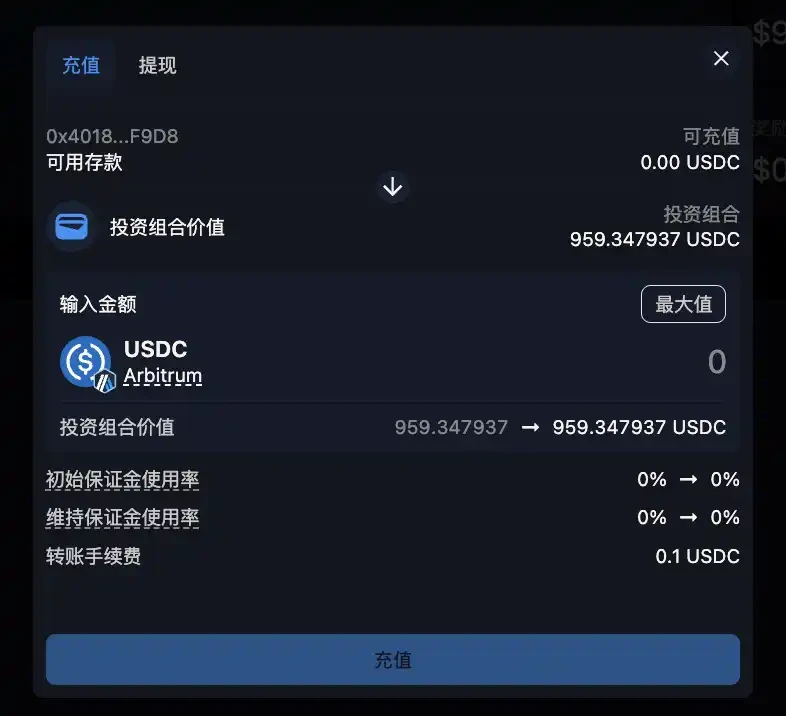
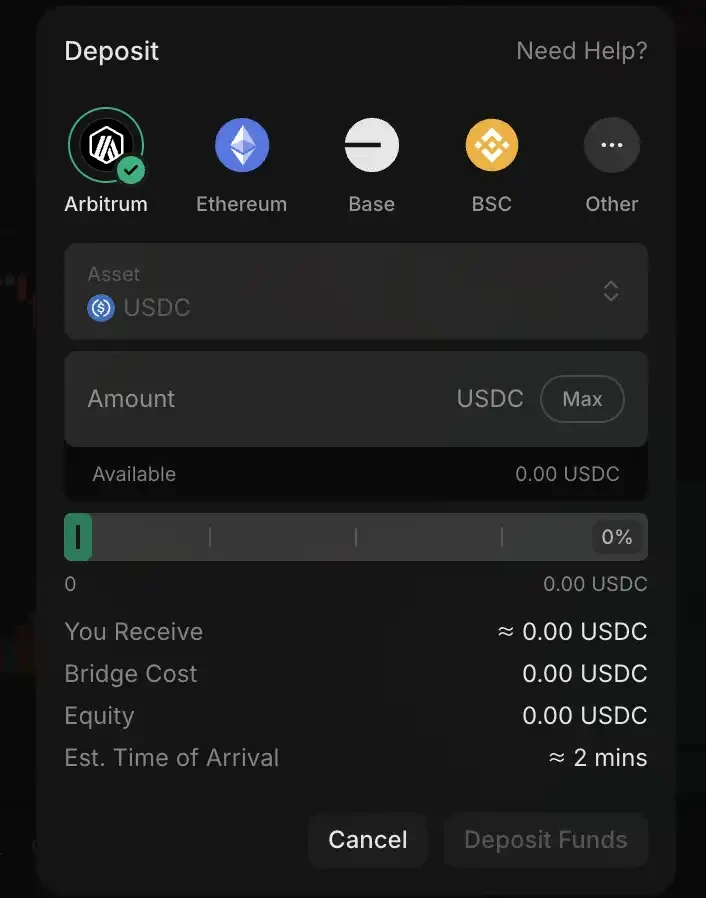
Currently, Variational only supports USDC deposits on Arbitrum, while Extended supports a wider range of chains, including Ethereum, Arbitrum, Base, BSC, Avalanche, and Polygon, but the currency is still USDC.
Additionally, the competition in the perp DEX track is quite fierce, and each platform has special rewards in their invitation mechanisms. Variational currently requires an invitation code to use; my invitation code is OMNI796TLUPK, or you can also find it on Twitter. Some higher-level invitation codes or ambassador codes will offer varying degrees of rebates or fee discounts. For example, on the Extended platform, invited users can enjoy a 10% discount on commissions until their total trading volume reaches $50 million.
II. Beginner-Friendly: Dual Platform Hedging for Points
After completing the previous steps of depositing USDC and preparing, we will now enter the practical operation phase: selecting the market, setting leverage, and placing orders. Here, we will first use the simplest and most stable hedging strategy to earn points.
The core principle is to hedge against price volatility risks by opening opposite positions on different DEXs. For example, while going long on Variational, you can go short on Extended with an equal scale and multiple. This way, regardless of how the price fluctuates, the profits and losses on both sides can offset each other, and you mainly incur transaction fees, but can steadily earn point rewards.
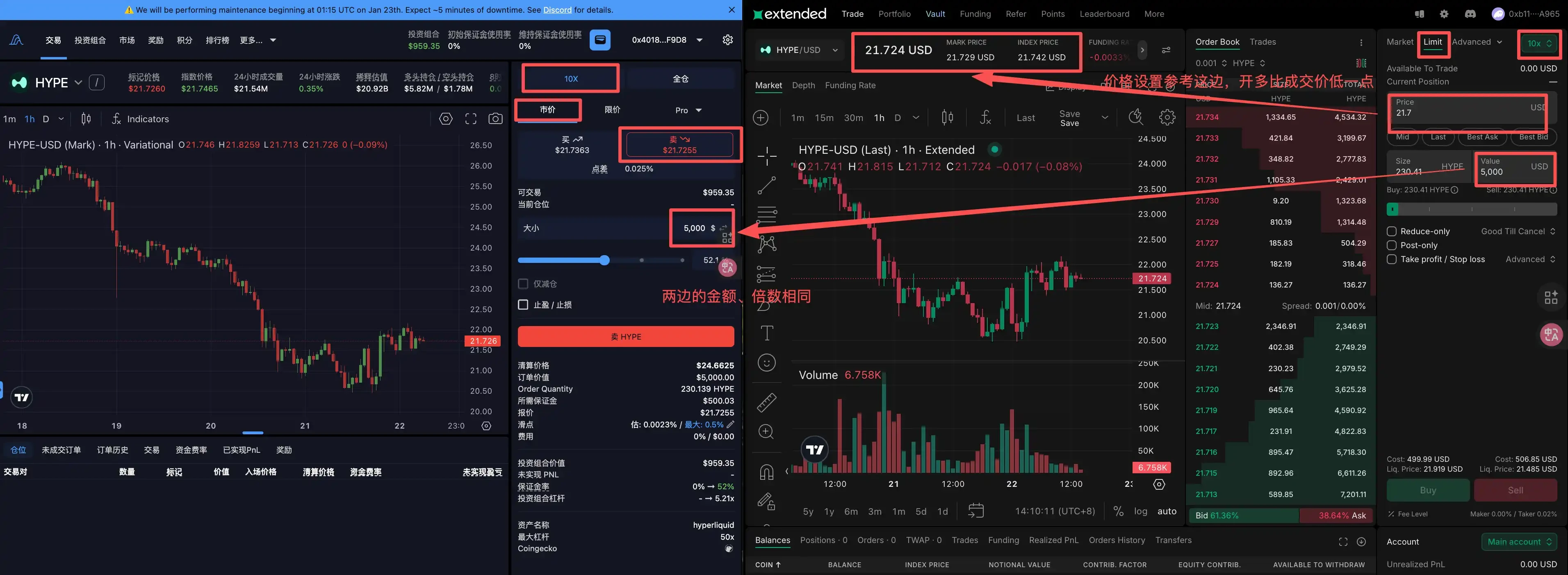
In terms of specific operations, since Extended's fee structure is more favorable for Maker orders, the optimal way is to first place a Maker order close to the market price on Extended to enjoy the platform's rebate. Then, when the order is filled on Extended, quickly open a Taker order at market price on Variational to fill the opposite position. This back-and-forth will hedge the positions, and we essentially incur some platform fees, spreads, and slippage to earn point rewards.
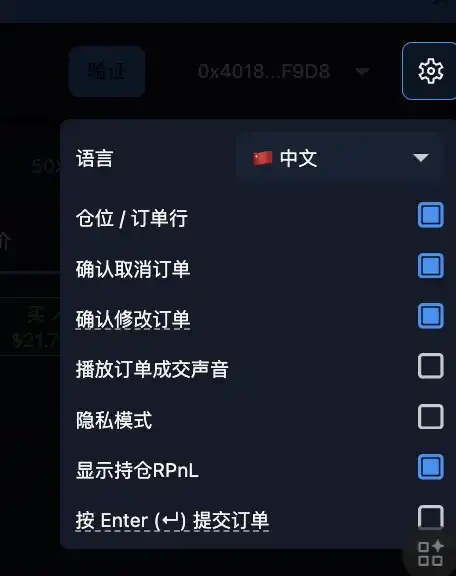
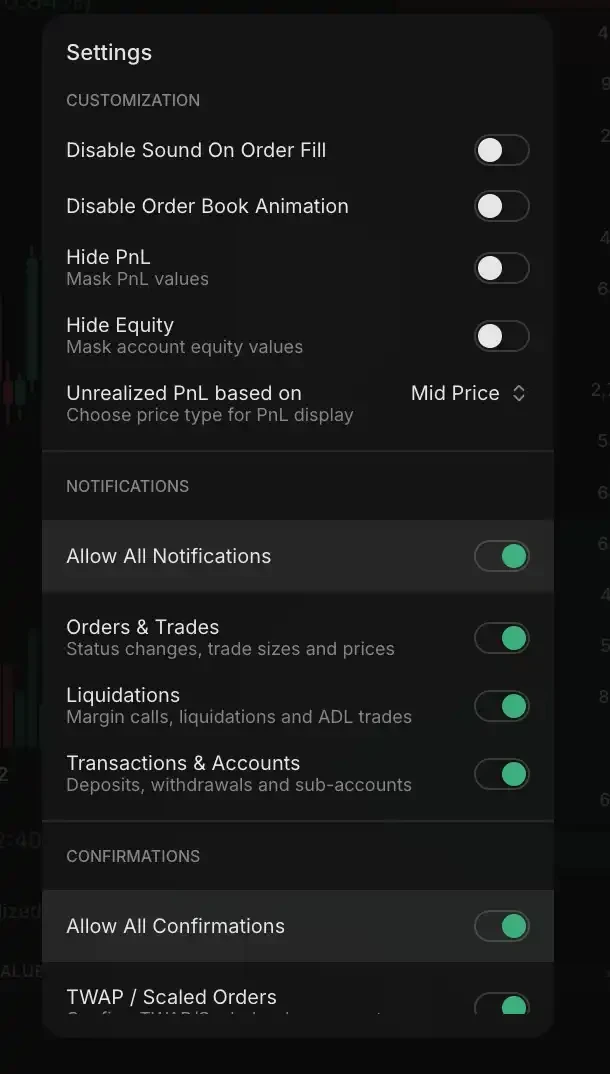
Additionally, here’s a practical tip. There is a switch for "Play order fill sound" in the settings at the top right corner of Variational; remember to turn it on. Extended also has a "Disable sound" option at the top right corner; make sure not to check it. The benefit of this setup is that when a Maker order on Extended is filled, you will receive an audio prompt, allowing you to immediately react and open a Taker order on Variational. If you control this time difference well, it can effectively reduce slippage losses caused by price fluctuations.
When closing positions, set your take-profit and stop-loss prices in advance, which can also be at the same profit-loss ratio or price points. I would suggest keeping the Extended account profitable while allowing the Variational account to show losses. Why do this? Because Variational has an interesting mechanism: when you reach Bronze level (trading volume of $1 million in 30 days), there will be a loss refund lottery mechanism. Although the probability is not high, between 0%-3%, the higher the level, the higher the chance of winning. If you win, the compensation amount will be the lower of your actual loss or 20% of the total funds in the loss compensation pool. So keeping losses in the Variational account gives you a chance to recover some of the losses.
Once you become proficient in this operation, we can increase the difficulty by widening the spread on Variational. (The spread is the difference between the buying and selling price, which is also the transaction cost for users; the smaller the spread, the lower the transaction cost).
Even though the point weight on Variational may have slight weekly changes, fundamentally, since Variational profits through the Omni Liquidity Provider's spread arbitrage mechanism, there is only one market maker on Variational, which is Variational itself. Therefore, when you open a position on Variational, the platform will charge a spread of 4-6 basis points, and then simultaneously open an opposite position on external trading platforms to hedge the risk, profiting from the internal and external price differences. Many experienced players have discovered a pattern through repeated testing: the larger the spread, the more Variational earns, and correspondingly, the higher the point weight given to users. This gives us an idea: to maximize point weight, we need to find ways to increase the spread.
Based on the principles discussed earlier, we know that ways to reduce the spread include trading mainstream coins like BTC or ETH and choosing liquidity-rich time periods. Conversely, to increase the spread, we can trade small coins, as the spreads on illiquid altcoins are larger than those on mainstream coins. Additionally, we can choose liquidity-poor time periods, such as weekends or Asian nighttime. This way, the weight will be relatively high. On this basis, we can also change the coins (don’t always trade the same coins), increase the number of trades, holding duration, and single trade amounts to expand trading volume data.
Moreover, besides the common cryptocurrencies in the crypto circle, both Extended and edgeX platforms also support trading of traditional financial assets. Extended currently offers a relatively rich selection, covering indices like the S&P 500 and NASDAQ, forex like EUR/USD, precious metals like gold and silver, and commodities like oil, totaling six varieties. EdgeX currently only has the S&P 500 and Nvidia as its targets.
Since both platforms have the S&P 500 index, there is another hedging opportunity. We can also perform a cross-hedge between Extended and edgeX for the S&P 500 to enrich the entire trading system. The operation method is exactly the same as the previous hedging with the same coins between Variational and Extended: one goes long while the other goes short, locking in risks to earn points. However, due to the closing mechanism involved with TradFi assets, it is best to trade during US stock market hours for simpler operations.
III. Advanced Play: Long Position Strategy for Mainstream Coins
The small coin and TradFi asset hedging mentioned earlier, while having a high point weight due to larger spreads, has a clear shortcoming—poor liquidity. This means that such strategies are only suitable for short-term operations, quickly entering and exiting to boost trading volume, and are not suitable for long-term holding. After all, during times of poor liquidity, price fluctuations can be quite severe, and holding for too long increases risk.
Therefore, to make the entire trading system more complete and also improve the holding duration IO metric, which is also a very important point weight, we can intersperse long positions in mainstream coins during times when we are not monitoring the market. For example, during the day when you are at work or before going to bed at night, you can open some long positions in liquid mainstream coins like BTC and ETH to naturally extend the holding time.
In terms of specific operations, you can implement a hedging strategy between BTC and ETH on Variational. You can observe the relative strength relationship between these two coins; when one rises 2-3% compared to the other, go long on the slower-rising one while shorting the faster-rising one. The logic behind this strategy is that BTC and ETH have a high correlation in the long term, and after short-term deviations, they often revert. The holding time can be slightly longer, anywhere from 8 to 12 hours or even longer, and you can consider closing the position once one side starts to profit. Even if there is a temporary floating loss, don’t rush to stop-loss; just hold according to plan.
The advantage of this strategy is that it compensates for the previous strategy's limitation of only placing market orders on Variational; this strategy allows for more use of limit orders, making it look more like real trading rather than just volume brushing.
However, I still want to remind you that even with mainstream coins, it is not advisable to hold positions overnight. The crypto market operates 24/7, and if there is a sudden market crash or a black swan event, the hedged positions may not be adjusted in time, leading to liquidation, which would be counterproductive. Also, do not use too high leverage; keeping mainstream coins within 20x is sufficient, safety first.
Additionally, Extended can implement some strategies based on the characteristics of its vault. Extended Vault Shares, abbreviated as XVS, has a clever design where 90% of the value of XVS is counted towards your account's net worth and available trading balance, which is more refined than what Hyperliquid offers.
Assuming you have 1000 USDC in your account, at this point, your net worth and available balance are both $1000. When you deposit this 1000 USDC into the vault and receive an equivalent amount of XVS, your net worth and available balance change to $900. Then, if you open a $1000 long position in BTC with 4x leverage, your net worth remains at $900, but your available balance changes to $650 ($900 minus the margin requirement of $1000 divided by 4). If this BTC long position has an unrealized profit of $100, your net worth rises to $1000, and your available balance also increases to $750. Throughout this process, your principal remains in the vault earning APR while also supporting your trading position.
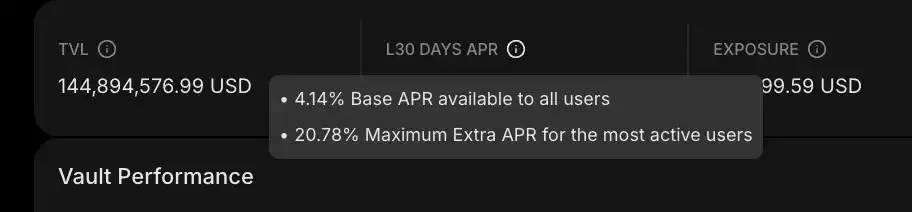
The earnings from the Extended vault are divided into two parts: basic earnings and additional earnings. The APR for the past 30 days is 24.92%. Basic earnings are available to all depositors and currently stand at 4.14% APR, reflected through the continuous rise in the price of XVS. The revenue sources for the vault are similar to other Perp DEXs, primarily from market-making and liquidation fees. Additional earnings are linked to the trading activity of the account, starting from the Knight level, where users can enjoy additional earnings, currently capped at 20.78% APR.
### IV. Advanced Skills: Funding Rate Arbitrage
The previous discussion focused on earning points through hedging; now let's talk about a more advanced strategy that utilizes the differences in funding rates between different platforms to make money. This strategy is appealing because it not only allows you to earn points but also generates real profits, although it is slightly more complex and not suitable for beginners.
Before discussing the strategy, let’s explain what the funding rate is. Unlike traditional futures, perpetual contracts do not have an expiration date. To anchor the contract price to the spot price, exchanges have designed a mechanism where both long and short positions periodically pay each other a funding fee. When market sentiment is bullish and the contract price is above the spot price, the funding rate is positive, meaning long positions pay short positions; conversely, when market sentiment is fearful and the contract price is below the spot price, the funding rate is negative, meaning short positions pay long positions.
Since the funding rates for the same cryptocurrency can vary significantly across different platforms, this creates arbitrage opportunities. Ideally, you would go long on the platform with a lower rate and short on the platform with a higher rate, allowing you to earn fees on both sides. Generally speaking, if you can find a funding rate difference, you already meet the trading conditions, and then the operation is the same as before, with the same leverage and position size.
What are the benefits of this operation? First, after hedging, you are completely neutral to BTC price fluctuations; the ups and downs do not affect your total assets. Second, while you pay a funding fee for going long on Variational, you can collect a funding fee for going short on Extended. If the funding rate on Extended is higher, you can profit from this difference.
For example, on January 15, there was an arbitrage opportunity for the cryptocurrency IP between different platforms with an annualized funding rate of 953%. What does this mean? If you invest $10,000, theoretically, you could earn $9,530 in a year, although this is an ideal scenario; in reality, funding rates fluctuate and cannot maintain such high levels consistently. The arbitrage opportunity for the cryptocurrency BERA on that day was also annualized at 435%. For more details, you can refer to @0xfarmed's post.
In practice, these high-yield opportunities often arise with new cryptocurrencies that have low FDV (Fully Diluted Valuation). These coins have low circulation, making market sentiment prone to extremes, which leads to significant fluctuations in funding rates.
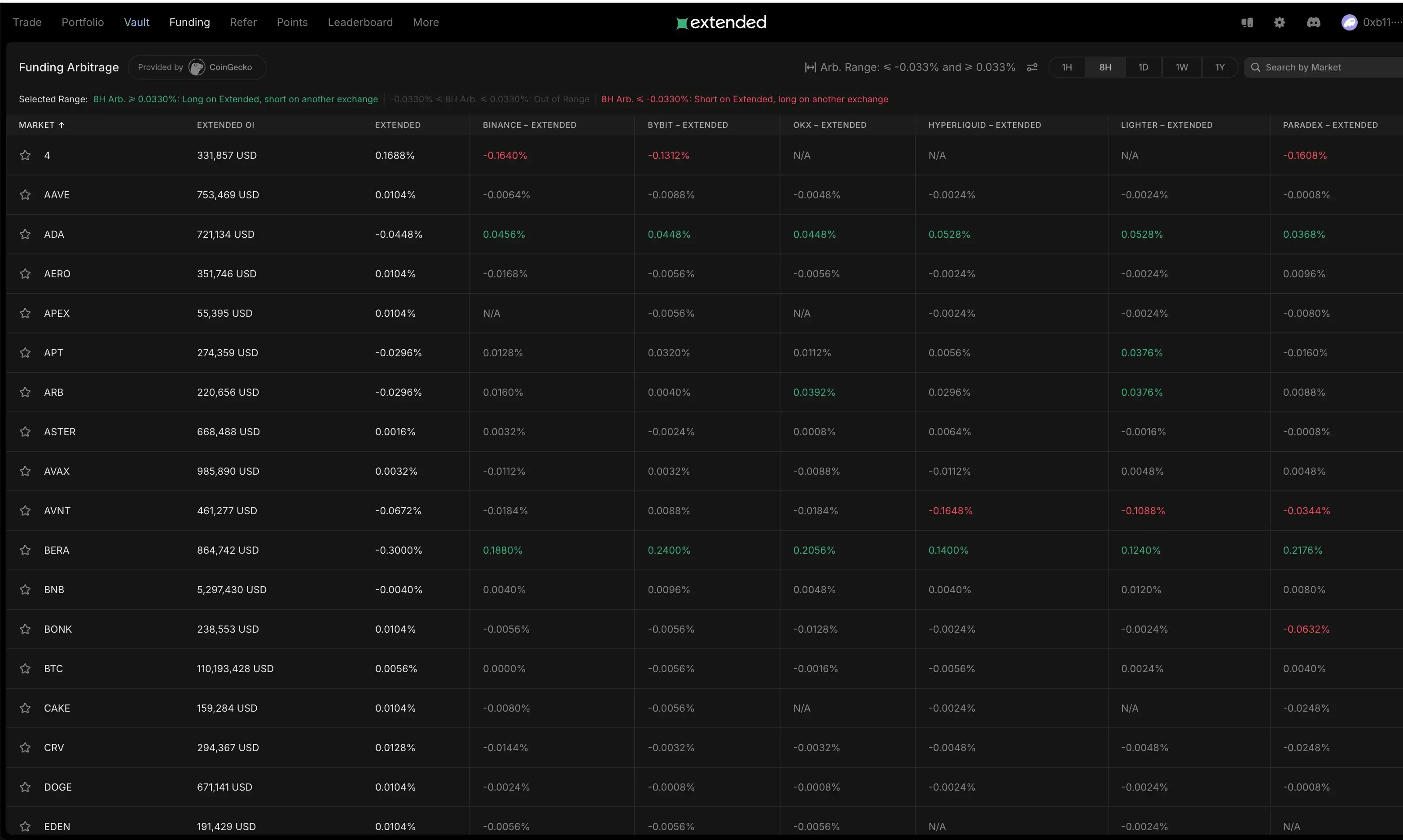
Here, we need to monitor the funding rates across different platforms to identify the funding rates for perpetual contracts in the markets. We can use tools like SmartArbitrage, which can display real-time arbitrage opportunities across platforms, and Variational's API, as well as Extended's visual rate comparison interface. Additionally, there is a Telegram bot, @lighterarbitragebot, which automatically pushes notifications for arbitrage opportunities. Once you notice that the funding rate difference begins to narrow or that one side's rate turns negative, you can consider closing your positions.
免责声明:本文章仅代表作者个人观点,不代表本平台的立场和观点。本文章仅供信息分享,不构成对任何人的任何投资建议。用户与作者之间的任何争议,与本平台无关。如网页中刊载的文章或图片涉及侵权,请提供相关的权利证明和身份证明发送邮件到support@aicoin.com,本平台相关工作人员将会进行核查。


