Written by: Glendon, Techub News
Yesterday, at the World Economic Forum in Davos, Switzerland, U.S. President Trump reiterated that the United States has further solidified its position as the "world capital of cryptocurrency" by supporting legislation that promotes the development of the digital asset industry. He emphasized that Congress is currently drafting a broader crypto market structure bill and hopes to sign it "soon."
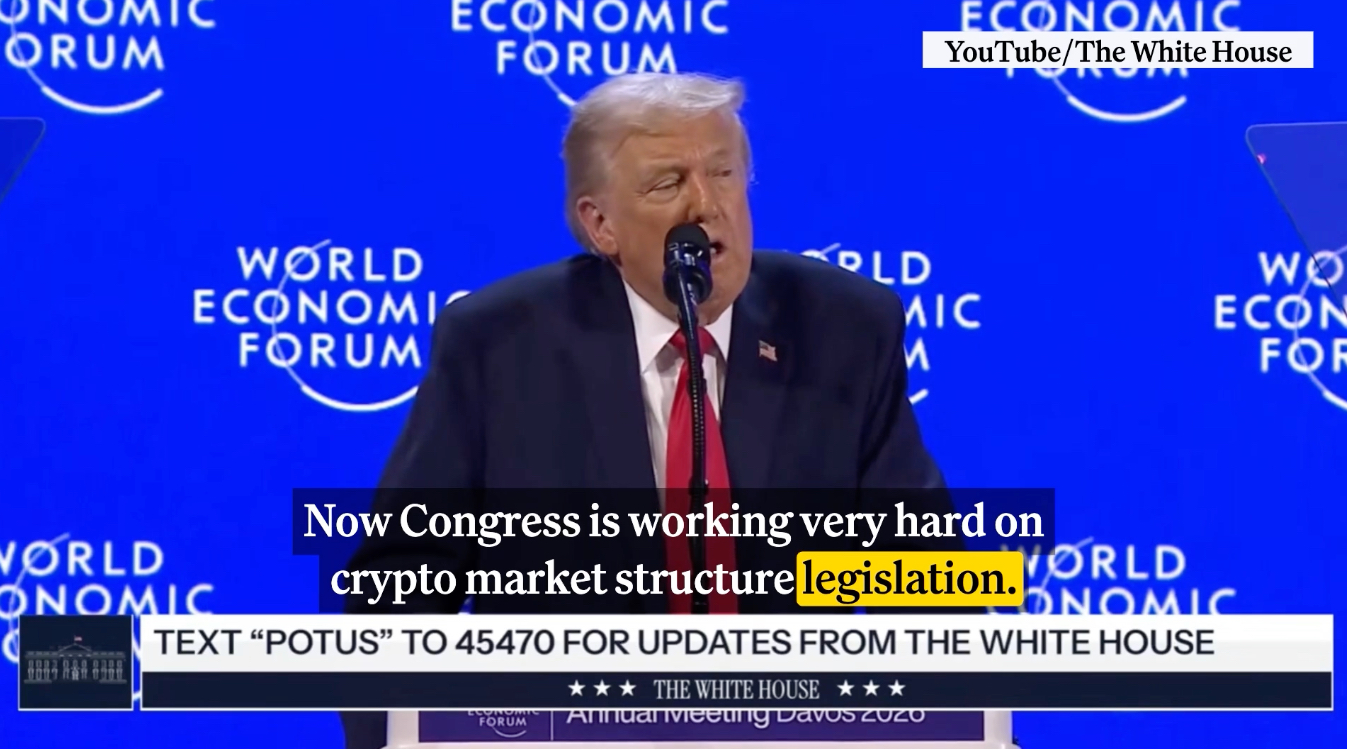
Despite Trump's relentless urging, the progress of the bill has not been smooth. Last week, Coinbase CEO Brian Armstrong suddenly withdrew his support for the latest text of the "CLARITY Act," a crypto market structure bill before the U.S. Senate Banking Committee. He cited "too many issues" with the draft, including restrictions on stablecoin yield rewards, effectively banning tokenized stocks, stifling DeFi innovation, regulatory uncertainty, and granting excessive power to the U.S. Securities and Exchange Commission (SEC). This move has led to a deadlock in the bill's progress and triggered severe turbulence in the crypto market.
In response, Senate Democrats decided to renegotiate with representatives from the crypto industry to discuss the next steps for the "CLARITY Act." The first vote originally scheduled for January 15 by the Senate Banking Committee has also been postponed. Compounding the issue, according to Bloomberg, the review of the "CLARITY Act" may be further delayed until late February or March, as key senators on the Banking Committee shift their focus to potential housing legislation.
Fortunately, the Agriculture Committee's voting meeting has not been postponed and is still scheduled for January 27. Moreover, the Agriculture Committee today released the latest text of the cryptocurrency market structure bill, the "Digital Commodity Intermediaries Act" (DCIA).
Previously, Armstrong had clearly pointed out that the Banking Committee's version of the "CLARITY Act" grants the SEC excessive regulatory authority, which could undermine the Commodity Futures Trading Commission's (CFTC) role in regulating digital commodities, leading to confusion and uncertainty in the regulatory framework. Based on this, the "Digital Commodity Intermediaries Act" (DCIA) focuses on key issues such as the definition of "digital commodities," token classification standards, and CFTC regulatory funding. So, what new core points and key content does this bill introduce?
Overall Framework and Core Content of the DCIA
Compared to the "CLARITY Act," the DCIA focuses on digital commodities, aiming to establish a federal regulatory framework for the issuance and sale of digital commodities. The legislative goal is to bring key intermediary institutions (exchanges, brokers, and dealers) in the digital commodity spot market under the regulatory system of the U.S. CFTC. The bill mainly covers key aspects such as core definitions and regulatory scope, a comprehensive regulatory framework, jurisdictional division, and new specific exemptions and protection clauses.
Core Definitions and Regulatory Scope
In this section, the DCIA primarily revolves around clarifying the definition of "digital commodities" and defining three core intermediary types.
First, the bill adds a detailed explanation of digital commodities in Section 1a of the Commodity Exchange Act, referring to replaceable digital assets that can be exclusively owned, transferred peer-to-peer without relying on intermediaries, and recorded on a blockchain. On one hand, the bill clearly states that digital commodities include network tokens and "meme coins" (with specific meme coins excluded), while excluding securities, security derivatives, approved payment stablecoins, bank deposits, physical commodity derivatives, collective investment tools (such as pools and investment funds), and non-commodity digital assets with intrinsic value or utility (such as NFTs, artworks, game assets, loyalty points, etc.). This means that these excluded assets will fall outside the CFTC's regulatory scope, but they may be subject to other laws (such as securities laws).
Secondly, the bill introduces a series of key new concepts, adding definitions for foundational technologies and services such as blockchain, blockchain applications, blockchain protocols, blockchain systems, decentralized finance messaging systems, decentralized finance trading protocols, decentralized governance systems, digital asset custodians, qualified digital asset custodians, and hybrid digital asset trading. This move provides a clear and unified terminology basis for subsequent regulatory work to avoid regulatory confusion caused by ambiguous concepts.
On the other hand, the bill clearly defines three core intermediary types: digital commodity exchanges, digital commodity brokers, and digital commodity dealers.
Digital Commodity Exchange: Provides trading facilities for at least one digital commodity spot or cash market.
Digital Commodity Broker: Solicits or accepts orders for non-qualified contract participants (i.e., retail customers) in the digital commodity spot market and simultaneously receives or controls customer funds or assets, or solicits orders for digital commodity dealers, or solicits orders on registered digital commodity exchanges.
Digital Commodity Dealer: Engages in the buying and selling of digital commodities with non-qualified contract participants in the spot or cash digital commodity market outside of exchanges or decentralized finance trading protocols.
Based on this, the bill imposes strict qualification requirements on entities that custody customer digital assets, including the necessity to be supervised and inspected by federal or state regulatory agencies while meeting a series of standards related to capital, risk control, record-keeping, and cybersecurity.
Specifically, the bill requires the addition of Section 5i (Digital Commodity Exchange Registration) and Section 4u (Digital Broker and Dealer Registration) to the Commodity Exchange Act, establishing a new federal registration system for these three types of intermediaries. Unless exempted, engaging in related business must register with the U.S. Commodity Futures Trading Commission to strengthen access management for the digital commodity market.
For example, exchanges must comply with a series of core principles, including:
Establishing and enforcing trading rules to prevent market abuse;
Only trading digital commodities that are not easily manipulable and requiring issuers to provide sufficient information disclosure (such as source code, trading history, token economics, governance mechanisms, trading volume and volatility, risk warnings, etc.);
Establishing real-time monitoring and trade reconstruction capabilities to prevent manipulation and market disruption;
Establishing governance arrangements to minimize and disclose conflicts of interest, especially regarding vertically integrated market structures;
Holding sufficient funds to cover operating costs and meet all obligations to customers;
Establishing risk management, cybersecurity, and disaster recovery plans;
Customer digital assets must be stored with "qualified digital asset custodians," strictly implementing asset segregation and prohibiting the misappropriation of customer assets.
For digital commodity brokers and dealers, the bill requires them to adhere to business conduct standards, specifically including compliance with anti-fraud and anti-manipulation regulations, providing sufficient risk disclosures to retail customers to ensure fair and transparent pricing, and regulating marketing practices; at the same time, they need to maintain complete trading records, audit trails, and daily trading records, and report as required by the CFTC. Additionally, similar to exchanges, these institutions must also store customer digital assets with qualified custodians to implement strict asset segregation.
Furthermore, the bill establishes a "temporary status" mechanism and a fast registration channel. Section 104 of the bill states that intermediary institutions that have submitted registration applications may continue to operate existing businesses under specific conditions before the final rules take effect. This mechanism aims to provide a transition period for intermediary institutions to ensure stable market operations. Meanwhile, the CFTC is required to establish a fast registration process within 180 days after the bill takes effect to improve registration efficiency, reduce waiting times for intermediary institutions, and require them to disclose their unregulated status to customers before registration.
This series of requirements in the DCIA is significant as it precisely fills the long-standing gap in the U.S. digital commodity spot market's lack of a comprehensive, tailored regulatory framework. In the long run, this bill will strongly promote the gradual inclusion of digital commodity trading platforms and intermediaries, which are still in a regulatory gray area, into the federal regulatory vision.
Regulatory Jurisdiction Division and Coordination Mechanism
Similar to the "CLARITY Act," the DCIA also focuses on clarifying the division of responsibilities between the CFTC and SEC. The bill amends Section 2 of the Commodity Exchange Act to clarify that the CFTC has exclusive jurisdiction over accounts, agreements, contracts, and transactions involving digital commodities (including the spot market), provided that these activities occur on registered entities or are conducted by entities registered with the CFTC.
At the same time, the bill provides detailed regulations on the handling of hybrid assets and stablecoins. It requires the CFTC and SEC to jointly formulate rules on several matters, including "hybrid digital asset trading" (trading between digital commodities and securities), regulatory exemptions for dual-registered entities, product delisting procedures, and portfolio margining, to avoid regulatory overlap, conflicts, or undue burdens.
For "approved payment stablecoins" defined by the "GENIUS Act," the bill also provides special arrangements. The CFTC only has the authority to regulate its quoting, execution, solicitation, or acceptance activities on registered entities and does not have the authority to regulate the operations of stablecoin issuers or the stablecoins themselves. This provision undoubtedly delineates clear regulatory boundaries for the development of the stablecoin market.
It is noteworthy that the DCIA places a high emphasis on the protection of software developers. The bill adds Section 4v to the Commodity Exchange Act, explicitly stating that software developers engaged in activities such as compiling network transactions, running nodes, providing user interfaces, developing or releasing blockchain systems, decentralized finance protocols, wallets, etc., are generally not subject to regulation under this act unless they involve violations such as anti-fraud, anti-manipulation, or false reporting. This rule again highlights that the CFTC's regulatory focus is on intermediary institutions rather than protocols, self-custody wallets (where users control the keys), or non-custodial DeFi interfaces (not involving fund control).
In addition to the core content mentioned above, the DCIA also establishes a series of supporting implementation resources and consumer protection measures.
In terms of funding support, it sets up special fees and appropriations. The bill authorizes the CFTC to charge registration fees and annual fees to registered intermediary institutions and qualified custodians to cover regulatory costs. Before the fee mechanism is formally established, the bill also specifically authorizes an appropriation of $150 million for the implementation of the bill and provides the CFTC with accelerated hiring authority to attract professional talent in the digital commodity market field to strengthen the regulatory team.
Regarding consumer protection, the bill requires the CFTC to establish an internal "Digital Commodity Retail Advocacy Office" and "Ombudsman" positions. These entities and personnel are specifically responsible for handling retail participant complaints, analyzing the impact of regulatory policies on retail participants, conducting market research, and proposing recommendations to protect the interests of retail participants, as well as submitting annual reports directly to Congress.
Summary
Overall, the "Digital Commodity Intermediaries Act" (DCIA) and the "CLARITY Act" have significant differences in their focus. The "CLARITY Act" operates under the SEC framework, clarifying the regulatory boundaries for securities-like digital assets. It provides a "horizontal" flexible development space for digital asset innovation through new disclosure rules and the non-securitization certification of "network tokens," focusing on regulating the disclosure of issuance behavior and clarifying the nature of assets. In contrast, the core of the "Digital Commodity Intermediaries Act" is to construct a "vertical" system under the CFTC framework for the spot market of digital assets defined as "digital commodities," encompassing definitions, jurisdiction, and comprehensive regulation of intermediary institutions, with a focus on compliance of trading venues and intermediary behavior, as well as consumer protection.
Opinions on this new bill text vary among stakeholders. Supporters generally believe that the bill provides strong protections for DeFi protocols and consumers, effectively avoiding liquidation chaos similar to that of FTX during bankruptcies. It is seen as a significant boon for self-custody, clearly protecting retail hardware wallets, software wallets (such as MetaMask's non-custodial mode), and truly self-held assets, with some praising it as an "excellent draft."
Some opponents argue that the CFTC's exclusive jurisdiction over all spot trading means that investors' cryptocurrencies can only be held by government-approved custodians. They believe that the combination of these two bill texts will allow the government to have "complete knowledge" of every digital asset transaction in the U.S. They argue that this does not clarify regulation but rather marks the end of financial privacy.
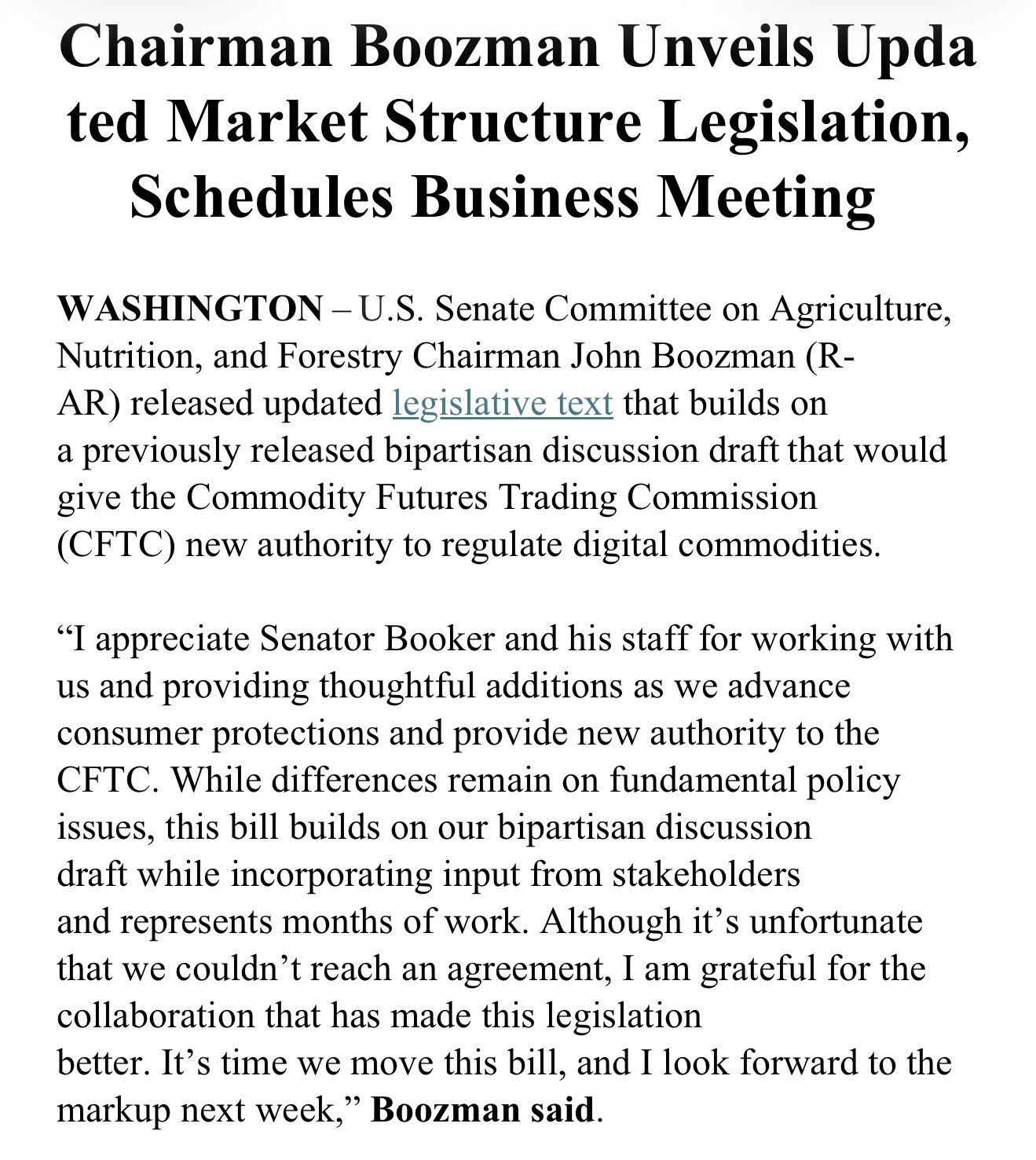
It is worth mentioning that John Boozman, chairman of the U.S. Senate Agriculture Committee, revealed today that this latest bill text was developed based on previous bipartisan discussions. Although an agreement could not be reached with Democrats, he still looks forward to next week's review. This statement casts a shadow of uncertainty over the bill, as the text may change as a result.
However, even with potential variables, the value of this bill text cannot be overlooked, as it provides a relatively clear direction for regulatory thinking in the U.S. crypto market. For the Banking Committee version of the "CLARITY Act" and the DCIA bill text, if both can complement each other, they theoretically hold the potential to construct a relatively complete U.S. federal regulatory framework covering the main activity areas of digital assets (both securities-like and commodity-like).
免责声明:本文章仅代表作者个人观点,不代表本平台的立场和观点。本文章仅供信息分享,不构成对任何人的任何投资建议。用户与作者之间的任何争议,与本平台无关。如网页中刊载的文章或图片涉及侵权,请提供相关的权利证明和身份证明发送邮件到support@aicoin.com,本平台相关工作人员将会进行核查。


