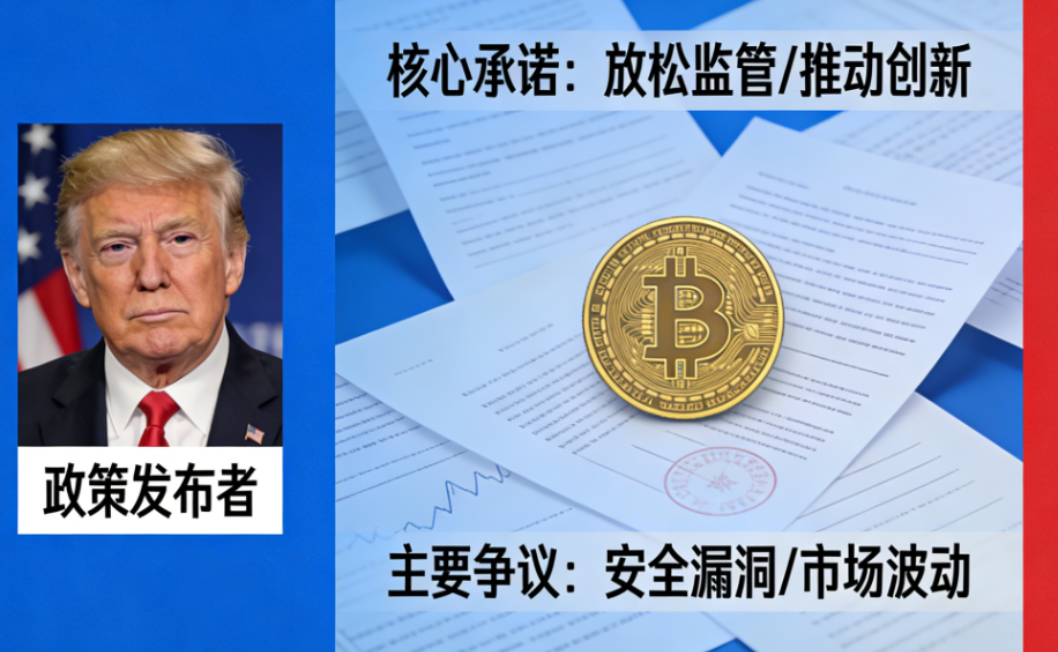
Since taking office in January 2025, President Trump has taken swift and distinct policy actions in the cryptocurrency sector, attempting to turn his campaign promise of "building a crypto-friendly America" into reality through a series of executive orders, personnel appointments, and legislative pushes.
However, alongside the release of policy dividends, controversies surrounding his personal involvement in the market, interference with financial regulatory agencies, and policy uncertainties have made this "crypto revolution" fraught with complex games and risks.
I. Campaign Promises: A High-Profile Embrace of the Crypto Industry
Trump's attitude towards cryptocurrency has undergone a complete public transformation. During his first term, he harshly criticized cryptocurrencies as "a disaster waiting to happen" and believed they lacked intrinsic value. However, this stance turned 180 degrees during the 2024 campaign cycle.
This shift is closely tied to the massive political donations from the crypto industry. The Trump team became the first major party campaign team to accept cryptocurrency donations, receiving various digital assets like Bitcoin and Ethereum through channels such as Coinbase. A political action committee named "Trump 47" raised a significant amount of crypto asset donations in a short time. At the 2024 Nashville Bitcoin Conference, Trump made a series of core commitments that established his campaign image as the "crypto president":
● Deregulation: He promised to halt the regulatory actions known in the industry as "Operation Chokepoint 2.0" (which allegedly restricts crypto business through the banking system) and ordered federal agencies to stop their "attacks" on cryptocurrencies.
● Support for Bitcoin Mining: He declared a desire for "all Bitcoin to be mined in the United States" and promised to enhance the country's mining competitiveness by increasing electricity production.
● Establishment of a Consulting Body: He planned to create a "Presidential Advisory Committee on Bitcoin and Cryptocurrency" to provide direct policy communication channels for the industry.
● Opposition to Central Bank Digital Currencies (CBDCs): He clearly stated his opposition to the government issuing digital currencies, aligning with the libertarian ideals of the crypto community.
These commitments successfully garnered substantial support from crypto practitioners and investors, making the crypto industry an important source of campaign funding and political alliance.
II. Policy Implementation: From Executive Orders to Legislative Progress
After taking office, the Trump administration took a series of concrete actions, the speed and scope of which exceeded many observers' expectations.
1. Signing Key Executive Orders to Establish Policy Tone
Just three days after taking office, on January 23, 2025, Trump signed an executive order titled "Strengthening America's Leadership in Digital Financial Technology." This order is seen as the programmatic document of his crypto policy, with core points including:
● Ensuring the rights of individuals and entities to use public blockchain networks for legitimate purposes without undue interference.
● Encouraging the development of legitimate dollar stablecoins and consolidating the dollar's position in the global digital economy.
● Establishing a "Presidential Digital Asset Market Working Group" led by the Secretary of the Treasury, Attorney General, Secretary of Commerce, and others to coordinate policy.
2. Reshaping Regulatory Personnel and Direction
Trump quickly appointed crypto-friendly officials to key regulatory departments, completely reversing the regulatory atmosphere of the Biden era:
● At the Securities and Exchange Commission (SEC), he first appointed Republican Commissioner Mark Uyeda as acting chairman, then nominated Paul S. Atkins, a long-time advocate for relaxed regulation, to officially serve as chairman. The SEC swiftly rescinded the "Employee Accounting Bulletin No. 121," seen as an anti-crypto measure (which required crypto assets to be listed as liabilities), and established a "Crypto Assets Special Working Group" led by pro-crypto Commissioner Hester Peirce, aimed at creating an environment that encourages innovation rather than enforcement.
● The government also established the "Office of Digital Assets and AI Affairs," led by prominent venture capitalist David Sacks, responsible for coordinating crypto policy and legislation.
3. Promoting Congressional Legislation for Long-Term Framework
While executive orders can quickly pivot, a lasting and clear legal framework requires congressional legislation. The Trump administration prioritized pushing for comprehensive crypto legislation.
● Market Structure Bill: Aimed at thoroughly resolving the long-standing regulatory jurisdiction dispute between the SEC and the Commodity Futures Trading Commission (CFTC), clarifying the classification and regulatory authority of various digital assets. The House version of this bill, the "Clarity Act," was passed in July 2025, with the Senate hearing seen as a critical juncture in January 2026.
● Stablecoin Bill: Legislation for stablecoins, represented by the "GENIUS Act," made significant progress in 2025. This bill aims to establish a federal regulatory framework for stablecoin issuance. The deadline for drafting accompanying regulatory details is July 18, 2026, and it is still in negotiation due to disputes over "stablecoin reward arrangements."
● Trump stated at the January 2026 World Economic Forum in Davos that a comprehensive cryptocurrency bill is expected to be sent to his desk soon and that passing this bill would be a government priority.
4. Symbolic Measures: Bitcoin Strategic Reserve
In March 2025, Trump signed an executive order announcing the establishment of a U.S. Bitcoin Strategic Reserve, referring to Bitcoin as "digital gold." According to the latest information, the plan is still in progress, but funding sources are strictly limited to assets seized and confiscated by the judiciary, without involving public funds for open market purchases. This is more seen as a political symbol, aiming to link Bitcoin with U.S. national strategy.
III. Controversies and Risks: Personal Interests, Interference with the Central Bank, and Uncertainty
Despite the rapid advancement of policies, Trump's crypto strategy is accompanied by significant controversies and potential risks.
1. Personal Interests and Deep Ties to the Market
Trump and his family members are deeply involved in the crypto market, raising serious conflicts of interest concerns:
● Before taking office, he launched a personal-themed "Meme Coin"—the $TRUMP coin. This coin once surged in price due to his influence, but reports indicate that his team sold off after the price increase, potentially profiting hundreds of millions of dollars, leading many speculative investors to incur losses. This issuance of highly speculative, non-substantive personal tokens has been criticized as exploiting presidential influence for market harvesting.
● Trump's adult children are also actively involved in NFT and blockchain investment activities. The family-affiliated "World Freedom Finance" platform directly engages in crypto asset trading. This situation of "being both the referee and the player" undermines the credibility of the policy.
2. Statements and Policies Causing Severe Market Disturbances
Trump's statements can have immediate and significant impacts on the crypto market. For example, his comments about "delaying tariffs on China" or "using cryptocurrency to solve national debt" can instantly trigger market surges; subsequent policy reversals or tariff threats may lead to crashes and massive liquidations of traders. This "statement-driven market" model exacerbates market speculation and instability, being accused of utilizing information advantages for dual harvesting.
3. Long-Term Risks from Interfering with the Federal Reserve's Independence
To stimulate the economy (and potentially provide short-term benefits to risk assets like cryptocurrencies), Trump has frequently publicly pressured Federal Reserve Chairman Powell to quickly and significantly lower interest rates, even considering appointing a more "compliant" successor after Powell's term ends on May 15, 2026. This political interference with central bank independence could undermine the credibility of the dollar and financial stability in the long run, potentially bringing unpredictable fundamental risks to the crypto market.
IV. Outlook for 2026: Key Nodes Determine Future Direction
2026 will be a critical year for the formation of the U.S. crypto regulatory framework, with several key dates being crucial:
January 2026: Senate hearing on the Market Structure Bill; SEC may introduce an "innovation exemption" mechanism.
May 15, 2026: End of Federal Reserve Chairman Powell's term; the choice of successor will impact global monetary policy and risk asset trends.
July 1, 2026: California's "Digital Financial Assets Act" takes effect, with its local regulatory practices serving as a national trendsetter.
July 18, 2026: Deadline for the release of regulatory details for the "GENIUS Act" stablecoin legislation.
November 3, 2026: U.S. midterm elections. The current slight Republican advantage in Congress is a crucial condition for advancing crypto legislation. If the election results change the balance of power in Congress, the current legislative momentum may come to a halt.
Actions taken by Trump over more than a year in office indicate that he is rapidly fulfilling his core campaign promise of deregulation and embracing crypto on a technical level. From reshuffling regulatory personnel to vigorously pushing legislation, the U.S. crypto policy environment has undergone a fundamental transformation.
However, this politically driven "crypto revolution" is intertwined with significant personal interests, distortions of market rules, and impacts on traditional financial governance frameworks.
What ultimately remains is either a healthier market with greater innovative vitality or a fragile bubble deeply ensnared by political speculation and short-term interests. The many key decisions in 2026 will provide initial answers. For the industry and investors, while embracing policy dividends, it is essential to maintain a clear awareness of the accompanying significant uncertainties and non-market risks.
Join our community to discuss and grow stronger together!
Official Telegram community: https://t.me/aicoincn
AiCoin Chinese Twitter: https://x.com/AiCoinzh
OKX benefits group: https://aicoin.com/link/chat?cid=l61eM4owQ
Binance benefits group: https://aicoin.com/link/chat?cid=ynr7d1P6Z
免责声明:本文章仅代表作者个人观点,不代表本平台的立场和观点。本文章仅供信息分享,不构成对任何人的任何投资建议。用户与作者之间的任何争议,与本平台无关。如网页中刊载的文章或图片涉及侵权,请提供相关的权利证明和身份证明发送邮件到support@aicoin.com,本平台相关工作人员将会进行核查。