Which is the best risk market barometer, gold or U.S. Treasuries?
Besides Miss Rabbit, many friends believe that gold is the benchmark. Here are my purely personal views:
- Gold is a safe-haven asset that reflects market sentiment. If gold rises, it indicates that market sentiment is unstable and funds are seeking safety. This statement is not entirely correct.
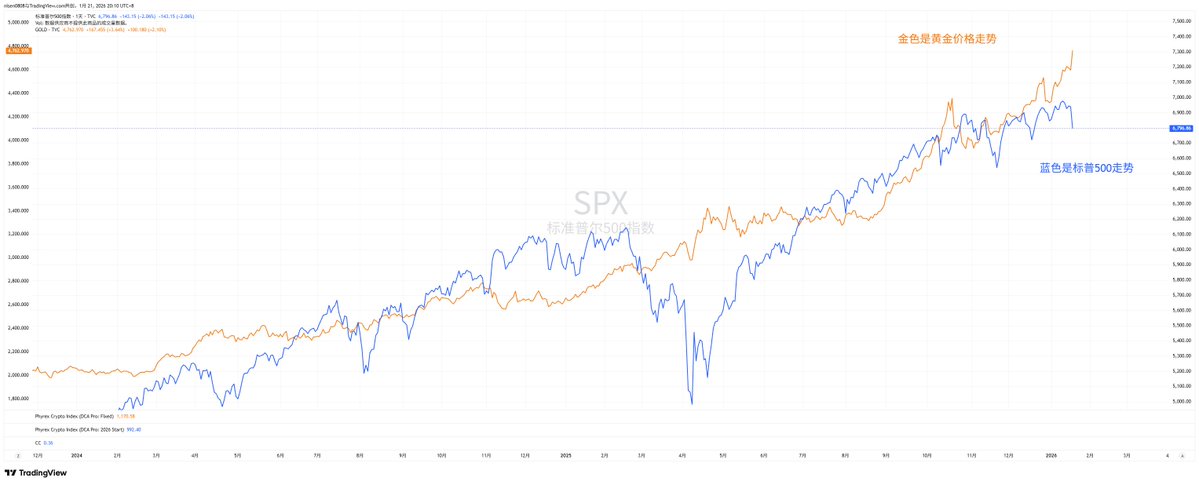
From the comparison chart, it is clear that although gold and the S&P 500 occasionally diverge, for most of the time, gold and the S&P 500 are both on a long-term upward trend. Although the logic behind the rise may differ, it does not mean that an increase in gold necessarily corresponds to a decrease in U.S. stocks.
Especially at this stage, I remember that last March, both EVA @Eva_Matrixdock and I believed that gold's target for the next three years was $4,800. As of today, that price has already been achieved, and the S&P 500 and Nasdaq have also been hitting new highs. Currently, gold has shown FOMO sentiment, which is not entirely for hedging purposes.
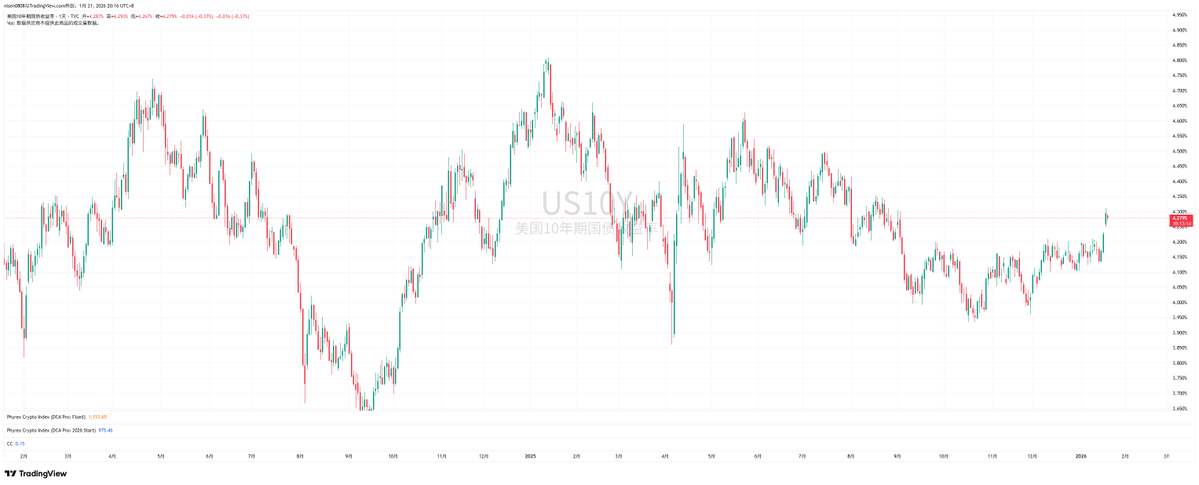
- If you really want to find a benchmark, the best choice should be U.S. Treasuries. The 2-year U.S. Treasury resembles the essence of the Federal Reserve's path, while the 10-year U.S. Treasury is more like the discount rate anchor for risk assets. U.S. Treasuries correspond to the market's pricing of the Federal Reserve's future path, whether future interest rates will be higher for longer or enter a rate-cutting phase. At the same time, bonds also combine inflation expectations, real interest rates, and term premiums.
The reason this is more suitable as a benchmark than gold is that gold often acts as a result variable. When the dollar weakens, gold can rise; when real interest rates decline, gold can rise; when liquidity is abundant, gold can rise; and during geopolitical conflicts, gold can also rise. It is difficult to use gold to infer what the market is trading next.
However, U.S. Treasuries are different, especially the 10-year U.S. Treasury, which is more influenced by expectations of rate cuts, persistent inflation, or fiscal and debt supply pushing up the term premium.
- Current tariffs are no longer just simple trade frictions; they are being used as geopolitical tools, inflation tools, and fiscal tools all at once. In this context, a rise in gold cannot automatically be interpreted as a decrease in risk appetite because tariffs essentially add a layer of tax to the global supply chain. The market will trade along two lines simultaneously: one for inflation and the other for growth.
Ultimately, both lines will return to the 10-year U.S. Treasury. If the upward movement in the 10-year U.S. Treasury is more due to real interest rates or term premiums, it is less friendly to risk markets. Conversely, if the downward movement in the 10-year U.S. Treasury is more due to weakening growth and expectations of rate cuts, it may actually be beneficial for risk assets in the short term.
@bitget VIP, lower fees, better benefits
免责声明:本文章仅代表作者个人观点,不代表本平台的立场和观点。本文章仅供信息分享,不构成对任何人的任何投资建议。用户与作者之间的任何争议,与本平台无关。如网页中刊载的文章或图片涉及侵权,请提供相关的权利证明和身份证明发送邮件到support@aicoin.com,本平台相关工作人员将会进行核查。


