Written by: Yangz, Techub News
On January 19, an announcement from the New York Stock Exchange (NYSE), part of the Intercontinental Exchange (ICE), dropped a heavy bombshell at the intersection of the global financial and crypto worlds. This symbol of Wall Street, which has long set trading rules for global capital, is now humbly learning the language of the "new world"—developing a tokenized securities platform, supporting 24/7 continuous trading, allowing orders in dollar amounts, and introducing instant settlement and stablecoin fund circulation. As the guardians of traditional finance begin to self-evolve, a silent revolution has quietly started in the engine room of the old world.
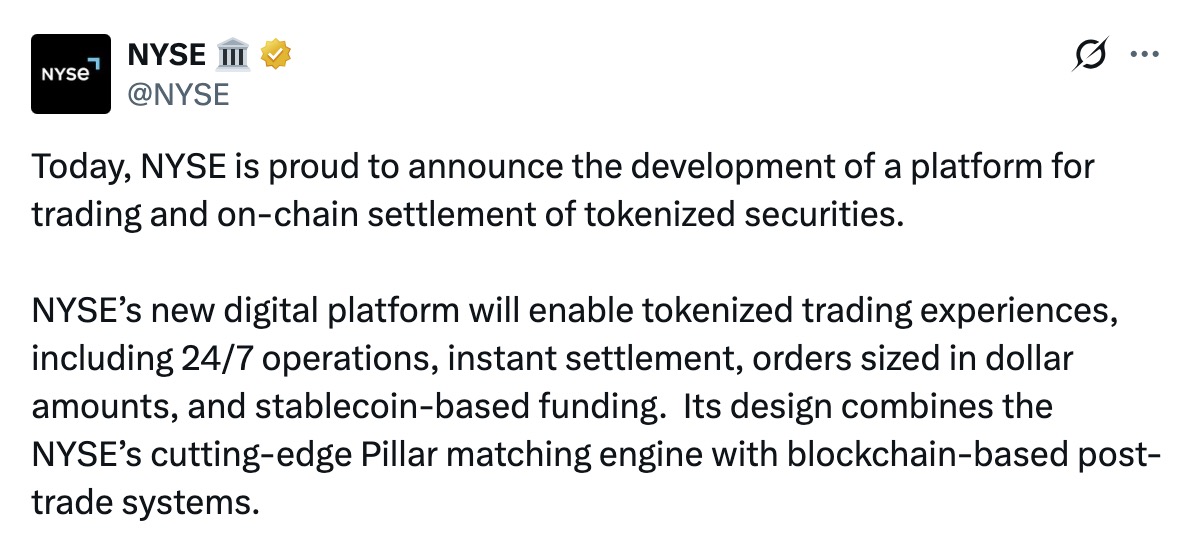
The Four "Revolutions" of the NYSE Tokenized Securities Platform
The NYSE's announcement may seem straightforward, but beneath the calm surface of the financial market, it has unleashed a silent giant wave. Every detail in the official statement points to an ambitious future scenario.
Time Revolution: Traditional financial markets are constrained by physical time zones and business hours, creating a repetitive trading day cycle. The NYSE plans to launch 24/7 trading, essentially transforming the market from a service with time windows into a perpetual value discovery system. This means that whether it's an earnings report released at three in the morning or a geopolitical event that occurs over the weekend, the real supply and demand can be instantly priced and digested by global capital, allowing price curves to continuously reflect the pulse of world changes.
Settlement Revolution: The traditional "T+1" settlement cycle in securities trading is a massive and fragile backend pipeline in the global financial system, involving multiple parties such as custodians and clearinghouses, consuming huge amounts of capital and operational costs. The platform proposed by the NYSE will integrate trading settlement and delivery on-chain, achieving near-instant (T+0 or real-time) completion. This is not just an enhancement in "speed," but a fundamental shift in the risk paradigm. Counterparty risk and custody risk will be significantly reduced due to the simplification and transparency of the process. Additionally, it is noteworthy that the platform intends to use dollar stablecoins for fund circulation and has established deep cooperation with Citibank and BNY Mellon to introduce "tokenized deposits." This design marks the mainstream financial system's formal acceptance of stablecoins as compliant and efficient settlement infrastructure, which is far more significant than just an innovation in payment tools.
Granularity Revolution: The fractional share feature allowing trading in dollar amounts superficially lowers the investment threshold, but in reality, it deeply deconstructs the form of asset ownership. On a micro level, it enables any scale of capital to achieve precise asset allocation, making "small investments" possible and potentially activating a vast incremental retail market; from a macro perspective, this may also lay the foundational track for the NYSE's future where everything can be tokenized. Once the splitting of equity becomes incredibly simple, logically, any asset that can generate cash flow can be transformed into standardized token assets for trading.
Architecture Revolution: The announcement mentions the combination of the existing Pillar matching engine and blockchain settlement system, supporting multi-chain settlement and custody, which can be considered the technical foundation of the platform. The Pillar engine represents the pinnacle of traditional finance in terms of speed, reliability, and risk control, while blockchain embodies the possibilities of transparency, automation, and an open future. The combination of the two is undoubtedly a precise enhanced integration. Furthermore, the "multi-chain" strategy demonstrates strategic flexibility, indicating that it does not intend to be bound to a single technological ecosystem but aims to become an open and robust financial infrastructure layer that connects diverse futures.
These four characteristics are interlinked, collectively outlining a coherent and grand blueprint: a global capital market operating system that is perpetual, instantaneously settled, infinitely divisible, and architecturally open. The NYSE is not building a "crypto version" of itself but is reinterpreting the "exchange" using blockchain technology.
Traditional Whales Entering the Sea: The NYSE's Breakthrough and Possible Reshuffling of the Crypto RWA Ecosystem
The NYSE's seemingly proactive transformation may actually be a defensive battle it has to fight. Standing at the crossroads of the old and new worlds amid the wave of real asset tokenization, it is under dual pressure from both traditional finance and the crypto world.
Internally on Wall Street, the NYSE's strong competitor, Nasdaq, was the first to submit a tokenized stock trading application to the SEC in September last year. Meanwhile, the crypto world is rapidly infiltrating the boundaries of traditional finance. From platforms like Coinbase and Kraken actively integrating traditional assets to specialized RWA projects like Ondo Finance and Backed Finance tokenizing U.S. stocks, a parallel asset network to traditional Wall Street is forming.
At this critical juncture, the NYSE's goal is not merely to launch a new product but to reshape itself into a trusted hub connecting traditional and digital finance in the inevitable wave of asset tokenization, reestablishing the existence value and boundaries of the ancient institution of the "exchange" in a future where everything can be tokenized.
Undoubtedly, this strategic transformation will have a profound impact on the crypto-native tokenization ecosystem. When this financial giant, with a 234-year history and the world's strictest regulatory standards, plunges into the sea, the overall compliance standards of the RWA tokenization ecosystem will significantly increase. Moreover, with a top-tier network of market makers and trillions of dollars in daily trading volume, once the NYSE's tokenized securities platform is approved for operation, it is likely to become a major liquidity center for tokenized assets in a very short time. This high concentration of liquidity could pose a "drought" risk for smaller RWA platforms.
Conclusion
The market response to the NYSE's transformation has shown significant divergence. Binance founder Changpeng Zhao welcomed it, stating, "This is good news for cryptocurrencies and crypto trading platforms." However, observers like well-known KOL Ignas pointed out that the key to the platform lies in its underlying technology choices. If it ultimately adopts a private chain or consortium chain with a closed architecture, its innovativeness may be significantly diminished.
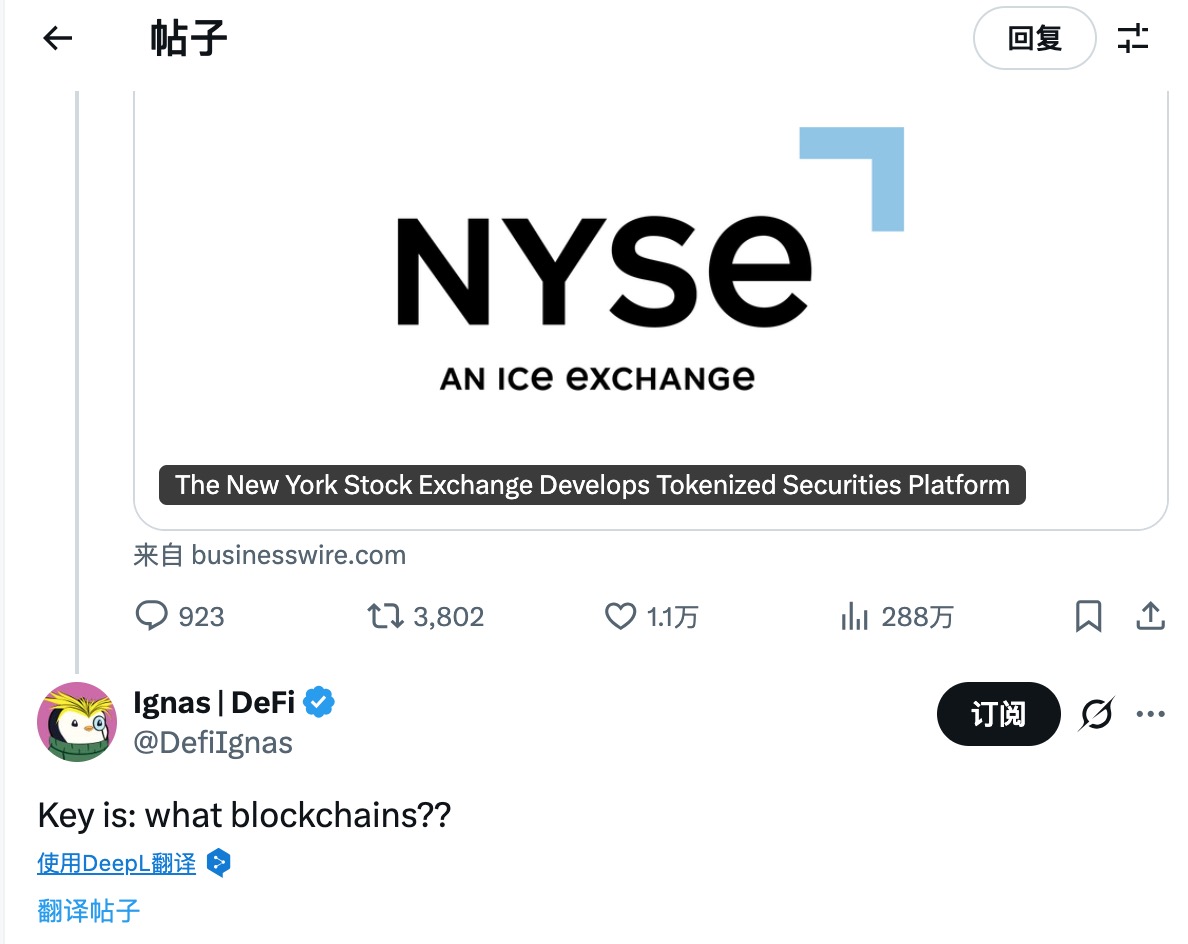
Nevertheless, in the historical context of financial evolution, truly transformative changes often begin with seemingly minor cracks within the old system. The NYSE's turn may be a glimmer of structural change emerging from its core engine room.
Faced with dual pressure from traditional competitors and the crypto world, the NYSE's choice is not merely defensive but aims to sail toward the depths of the tokenized value ocean with the strongest compliance as its vessel and the deepest liquidity as its sail. The endgame of this silent revolution will not be a zero-sum game. It points to a new multi-layered, multi-dimensional financial market structure: traditional financial giants bring credibility and liquidity, while the crypto world injects efficiency and innovation, ultimately benefiting every investor seeking value flow globally.
免责声明:本文章仅代表作者个人观点,不代表本平台的立场和观点。本文章仅供信息分享,不构成对任何人的任何投资建议。用户与作者之间的任何争议,与本平台无关。如网页中刊载的文章或图片涉及侵权,请提供相关的权利证明和身份证明发送邮件到support@aicoin.com,本平台相关工作人员将会进行核查。


