Author: JW, Techub News
Waking up, I thought I had escaped the "Monday flash crash," but the crypto market didn't let anyone off the hook, merely postponing the significant drop to Tuesday.
Last week, Bitcoin briefly climbed back above the $97,000 mark, and the weekly close was successfully above $95,000. Logically, this is a good signal. Many in the market had already begun to discuss whether "the second phase of the market is about to begin," and sentiment was slowly warming up.
However, the trade war reared its head once again.
With little warning, a significant pullback suddenly occurred. In just a few hours, Bitcoin quickly dipped, falling below $90,700 before barely recovering, currently hovering around $91,000; Ethereum dropped below $3,070 and returned to around $3,090; SOL sharply fell below $130, hitting a low of $127.9. According to Coinglass data, nearly $1 billion in liquidations occurred across the entire crypto market in the past 48 hours, with long positions accounting for as much as $566 million; over 320,000 people were liquidated in just 48 hours. For many traders who had just re-leveraged, this sudden blow came quickly and harshly, leaving almost no room for reaction.
European Market Falls First, Risk Sentiment Begins to Shift
In terms of timing, this round of declines clearly began to brew during the European trading session. On that day, major European stock indices closed almost all lower, putting overall pressure on risk assets.
The Euro Stoxx 50 index fell by 1.72%, the UK FTSE 100 index dropped by 0.39%, the French CAC40 index decreased by 1.78%, the German DAX30 index fell by 1.34%, and the FTSE Italy MIB index declined by 1.32%.
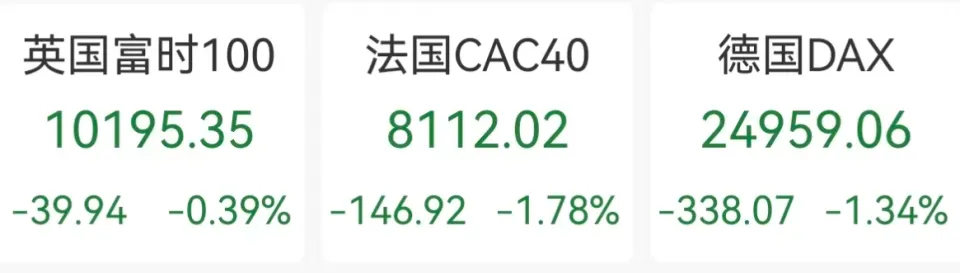
In recent years, the correlation between the crypto market and traditional markets has become commonplace. Especially after Bitcoin returned to high ranges, the overall risk exposure in the market is not low. Once external sentiment changes, the crypto market often reacts magnified.
This time, the trigger for the collective decline was still the familiar name "tariffs."
The Trade War, Once Again on the Table
Today, Trump issued a strong signal, threatening to impose new tariffs on countries opposing the "sale of Danish territories to the United States." As soon as the news broke, the cryptocurrency market plummeted, followed closely by U.S. stock futures.
In the afternoon, the situation escalated. Trump announced that he would impose tariffs of up to 200% on French wine and champagne. Earlier, he had already threatened to impose new tariffs on the entire EU and reiterated that one of his primary strategic goals is to "annex Greenland."
According to currently disclosed information, the U.S. plans to impose a new 10% tariff on Denmark, Norway, Sweden, France, Germany, the UK, the Netherlands, and Finland starting February 1; this rate will further increase to 25% on June 1. Moreover, these tariffs will not be lifted "until an agreement on the Greenland issue is reached."
Trump's message is straightforward: this agreement must be "a complete and thorough acquisition of Greenland."
For the market, the specific amount of tariffs is not the immediate concern. What truly raises alarms is that once this topic is brought to the forefront, it is difficult to quickly resolve.
Especially when discussions begin to extend from "tariffs" to "territory" and "sovereignty," the market will naturally choose to avoid risk.
As Long as Trump is in Office, the Trade War Will Not Disappear
It must be pointed out that as long as Trump is in office, the trade war will resurface unexpectedly and then gradually fade away. Perhaps this is part of Trump's "tariff strategy."
This is not entirely an emotional operation; it resembles a repeatedly used and proven negotiation tactic. By creating uncertainty through tariff threats, he puts pressure on opponents in advance, thus gaining the upper hand at the negotiation table.
The most recent similar incident occurred on October 10 last year when Trump threatened to impose a 100% tariff on Chinese goods, effective November 1, with 21 days until the official announcement. This timing is very "Trump-like." The timing of the event's announcement feels familiar, as it is a tactic he often employs. Subsequently, the S&P 500 futures dropped by 3.5% before the weekend close.
The threatening tone at the outset led the market to believe that things were getting serious. But the final outcome was clear to everyone; this was part of his negotiation strategy and very effective for him. In the October negotiations, both sides reached a new agreement, China lifted related restrictions, and that 100% tariff never actually materialized.
Familiar rhythm, almost replicated
If we place this event in the context of previous trade wars, we find that the rhythm has hardly changed.
This news was also released on a Saturday; and Monday happened to be a U.S. holiday, with the futures market not opening until Monday evening. The market reaction was similar to last time, forced to digest news repeatedly in a low liquidity environment but with highly concentrated sentiment.
Based on past experience, Trump's subsequent actions can even be roughly predicted:
On Friday, Trump released a vague message hinting at tariffs on a specific country or industry. As uncertainty increased, the market began to panic and decline. The initial focus started on Friday when he threatened tariffs on Denmark.
That evening, he announced a new high tariff exceeding 25%.
On Saturday and Sunday, during the market's closure, he repeatedly escalated tariff threats to apply pressure and maximize the event's impact.
Over the weekend, countries affected by the new tariffs publicly responded or expressed willingness to negotiate.
At 6 PM Eastern Time on Sunday, the futures market opened, and stock index futures fell due to tariff-related news.
On Monday and Tuesday, he continued to publicly apply pressure, but the market began to realize that the tariffs had not yet taken effect and were planned to take effect after February 1.
On Wednesday, bargain buying began to enter the market, triggering a rebound, but this was merely a rebound that would soon reverse, followed by another price drop.
It is expected that over the weekend, Trump will post that he is consulting with leaders of countries affected by the tariffs and is working to seek a solution.
On the following Sunday evening at 6 PM Eastern Time, the futures market opened significantly higher, with market optimism reignited, but the gains receded when the Monday spot market opened.
After the Monday opening, senior government officials, including Treasury Secretary Mnuchin, will appear in live broadcasts to reassure investors and emphasize progress in reaching an agreement.
In the next 2-4 weeks, several members of the Trump administration will continue to hint at progress in reaching a trade agreement.
The trade agreement is announced, and the market reaches a historic high.
Of course, this time is not a complete copy-paste. The biggest difference is that the goal of "annexing Greenland" is inherently much more complex than simple trade terms.
Whether on a political, military, or international relations level, this issue is difficult to resolve in a short time. This means that the related games may be prolonged, with strong statements and signals of easing becoming more frequent.
For the market, this does not mean that the direction has been determined, but it can be expected that volatility will not be small.
Summary
Looking back, Trump's negotiation style is actually very clear: timing, pressure intensity, and leaving a buffer window.
His goal is to ensure that these tariffs never truly take effect; what he wants is to reach an agreement. He often reserves two to three weeks of negotiation space before the tariffs actually take effect. The tariffs themselves are more of a bargaining chip than an end goal. This also explains why these significant announcements always occur on weekends or holidays.
If these tariffs were to be fully implemented and exist long-term, it would undoubtedly be a disaster for the global market. But based on past experience, he does not want things to reach that point.
In the last U.S.-China trade war, November 1 was originally the day the 100% tariff was to take effect, and on that very day, both sides announced that they had reached an agreement to cancel the tariffs. As for the investors who were liquidated beforehand, they can only consider it a market cost.
Overall, this time, Trump's plan regarding Greenland is clearly more aggressive than any previous trade friction, and the negotiation cycle may be longer. The market's turmoil may not end quickly.
But for traders, one thing remains unchanged: "News creates volatility, and volatility itself is an opportunity."
In this environment, directional judgment becomes secondary; what matters more is rhythm and position management. The market may not immediately trend, but volatility will certainly be present. And in a market that is repeatedly pulled, surviving itself is an advantage.
免责声明:本文章仅代表作者个人观点,不代表本平台的立场和观点。本文章仅供信息分享,不构成对任何人的任何投资建议。用户与作者之间的任何争议,与本平台无关。如网页中刊载的文章或图片涉及侵权,请提供相关的权利证明和身份证明发送邮件到support@aicoin.com,本平台相关工作人员将会进行核查。


