Original Title: "IOSG's Ninth Year: The Reconstruction of the 2026 Crypto Market and Structural Opportunities"
Original Source: IOSG Ventures
Mainstream Assets
1. Bitcoin
A year ago, we outlined two distinctly different development paths for Bitcoin: the "optimistic outlook" believed that institutional adoption and government interest would drive the asset forward, while the "pessimistic outlook" suggested that failure to achieve these milestones would trigger bearish sentiment and potential crisis scenarios.
As we enter 2026, the reality lies somewhere between these two extremes, but closer to the expected lower limit.
BTC Set Aside: What Happened in 2025
· Government Action (Partially Successful): The U.S. government took a more passive stance than expected. While generally supportive of the crypto industry, the government made it clear that it would not use taxpayer money to purchase Bitcoin, instead primarily relying on confiscated BTC to build reserves. Trump's re-election brought crypto-friendly rhetoric and regulatory optimism, but actual government purchases seem to be wishful thinking. The commitment to "innovative ways" to increase reserves has yet to translate into concrete action.
· Central Banks and Sovereign Wealth Funds (Mixed Results): Most major central banks among the top 20 economies remained on the sidelines, with few exceptions. However, sovereign wealth funds began to establish Bitcoin exposure, although the scale of these purchases remains difficult to assess.
· Institutional Adoption (Mixed Results): MicroStrategy continued its aggressive accumulation strategy for most of 2025, positively impacting prices. However, the market narrative underwent a dramatic shift. MicroStrategy publicly stated its willingness to sell BTC in certain circumstances, transitioning from pure accumulation to a model more akin to "BTC credit instruments." What was once a boost now seems to be turning into potential pressure and burden. In contrast, Bitcoin ETFs performed exceptionally well, with sustained net inflows throughout 2025, indicating strong demand from traditional financial institutions and retail investors for regulated Bitcoin exposure, becoming one of the most reliable sources of demand for the year.
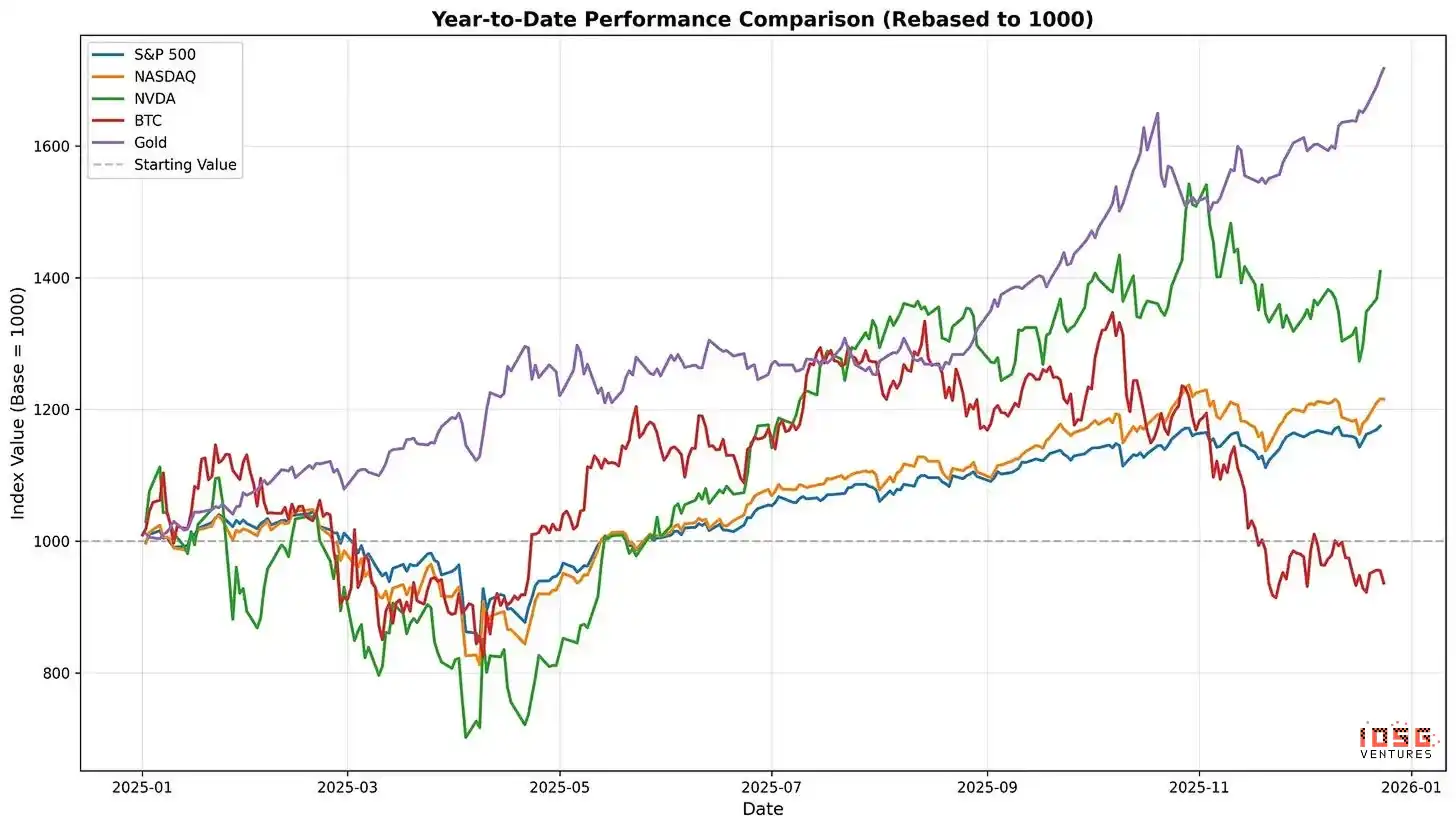
Bitcoin 2026 Outlook: Macro Dependence and Catalyst Exhaustion
Exhaustion of Unique Catalysts
This cycle relied on a series of strong Bitcoin-specific catalysts: the SVB bankruptcy and USDC de-pegging crisis, the accumulation of ETF expectations throughout 2023, MicroStrategy's continued buying, the launch of spot ETFs in early 2024, and Trump's election victory. Each provided unique, Bitcoin-focused buying pressure.
Looking ahead to 2026, Bitcoin-specific positive catalysts seem scarce. Governments have made their positions clear and are unlikely to become major buyers in the short term. Central banks will not quickly change their risk assessments of BTC. MicroStrategy has exhausted its capacity for large incremental purchases and has shifted its messaging towards potential sales. While ETFs have been successful, they have completed their initial wave of adoption.
For Bitcoin to thrive in 2026, it will almost entirely depend on macro factors. The order of priorities is clear:
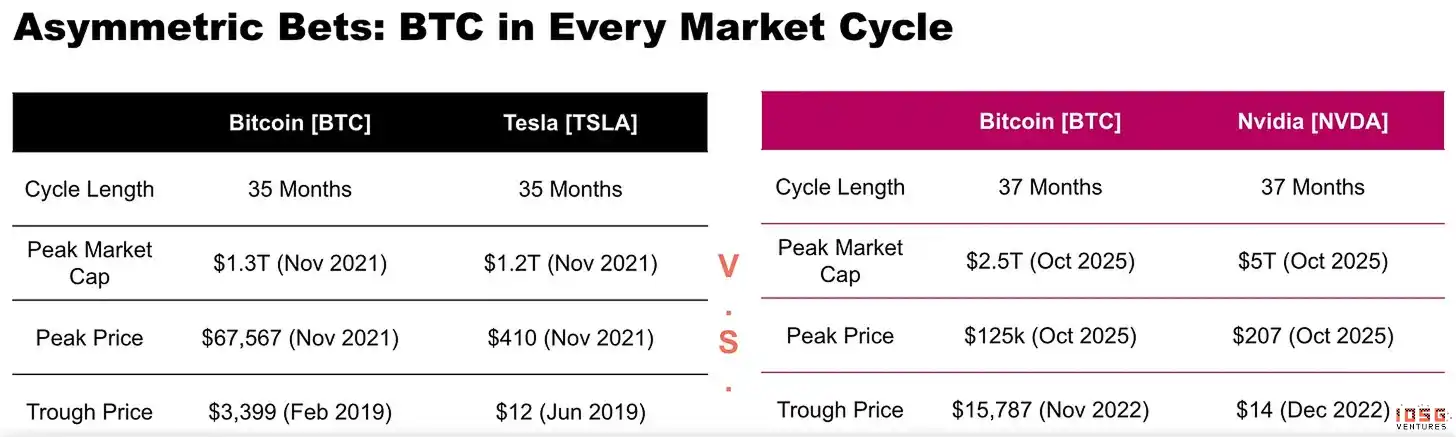
AI stocks and risk appetite; Bitcoin increasingly follows the fate of the hottest assets in each cycle. In the previous cycle, it tracked the bottom and peak of Tesla within a similar timeframe. In this cycle, we see the same pattern emerging with NVIDIA. Bitcoin's performance has become deeply correlated with high-beta tech stocks and AI enthusiasm.
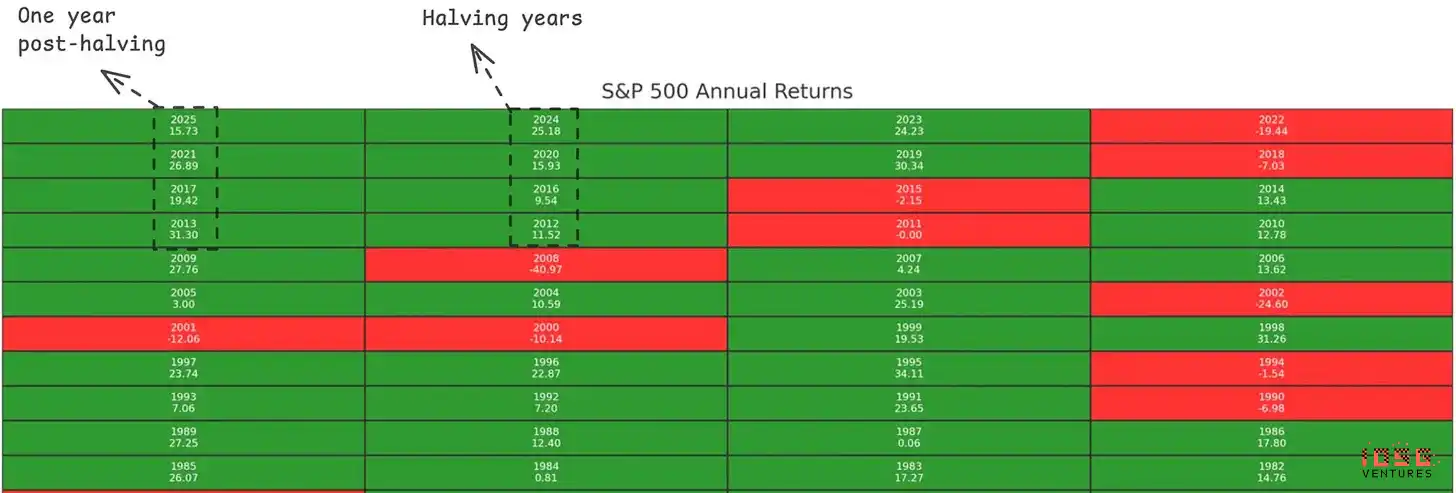
Federal Reserve Policy and Liquidity: Whether the Federal Reserve continues its dovish policy and balance sheet expansion is crucial for the broader liquidity environment. Historically, liquidity conditions have been one of the most important factors influencing Bitcoin price movements. With the Fed cutting rates three times in 2025, the direction of monetary policy in 2026 will significantly impact Bitcoin's ability to attract sustained buying.
Emerging Risks in 2026: While unique positive catalysts seem scarce, the potential for negative BTC-specific catalysts is more pronounced:
Pressure from MicroStrategy (now rebranded as Strategy): Factors that drove Bitcoin higher in this cycle may become burdens in 2026. The shift from "always holding" to "willing to sell in certain circumstances" represents a fundamental change. The "circumstances" they outline refer to when their mNAV falls below 1 and they need to sell BTC to meet obligations to creditors. Worryingly, when viewed from a broader perspective, Strategy's model begins to resemble a Ponzi scheme; however, we believe these risks will not materialize in the short term, as Strategy has leveraged its ample liquidity from its stock to build cash reserves capable of covering obligations related to dividends for the next three years.
Four-Year Cycle Theory Paradox: According to cycle theory, we may be in a phase that can be defined as a Bitcoin bear market. Cycle theory assumes that the Bitcoin market rotates on a four-year cycle, with peaks typically occurring in the fourth quarter of each cycle. Following this pattern, Q4 2025 should have been the price peak—indeed, Bitcoin reached around $125,000 during this period, which may mark the cycle top. However, the validity of this cycle theory is increasingly being questioned. We believe that cycle theory is somewhat coincidental, primarily overlapping with broader macro cycles rather than representing an intrinsic law of Bitcoin.
Aside from concerns about the AI bubble and a more risk-averse attitude, the poor performance of BTC in Q4 2025 was mainly due to long-term holders selling under the belief and action of cycle theory while adjusting their positions.
Risk of Self-Fulfilling Prophecy: Cycle theory creates a dangerous feedback loop:
· Long-term holders expect a peak in Q4 and sell accordingly
· This selling pressure suppresses prices during what should be the strongest period
· The resulting poor performance "confirms" the cycle theory
· More holders adopt this framework, amplifying future selling pressure

Breaking the Cycle: If the macro environment remains robust, Bitcoin may eventually break free from these cyclical constraints and reprice upwards. The first break of the cycle could actually become a positive catalyst that the market has yet to price in.
Technical Risks Entering the Discussion: Bitcoin faces two long-term challenges: quantum computing vulnerabilities and questions about its economic and security model. While the latter remains somewhat obscure in mainstream discussions, quantum risks are increasingly entering public awareness. More credible voices are expressing concerns about Bitcoin's quantum resistance, which could undermine its narrative as a "secure, immutable store of value." However, the BTC community is more willing to engage in this discussion early to allow time to seek potential solutions.
Bitcoin Judgment for 2026: As Bitcoin enters 2026, it is not in a uniquely advantageous position driven by crypto-specific narratives, but rather as a macro-sensitive asset, its performance will largely reflect the broader risk market:
Catalyst Exhaustion: Bitcoin-specific positive catalysts have largely been exhausted or realized (government positions are set, MicroStrategy's capacity has reached its limit, the initial wave of ETF adoption has been completed)
Emerging Pressures: Concerns related to MicroStrategy, cycle theory, and quantum risks entering public discussion, as significant worries in the mainstream community may lead to repricing, considering that the market may be overpricing these risks, and the risks are unlikely to materialize in the next 12 months: given that Strategy has ensured cash reserves to pay creditors for the next three years, it is unlikely that Strategy will face critical issues in 2026; under the premise of a continuing macro cycle, it is only a matter of time before cycle theorists are proven wrong; the likelihood of quantum risks affecting mainstream BTC perception is also low in 2026.
Macro Dependence: Performance will track AI stocks (especially NVIDIA) and Federal Reserve policy decisions.
2. Ethereum
Optimistic Outlook - Partially Realized
Reflecting on our 2025 outlook, several potential advantages for Ethereum have begun to materialize, although not fully realized:
Institutional Viability (Clearly Successful): This argument has proven correct. Ethereum's dominance in stablecoins (with an additional issuance of $45-50 billion since the GENIUS Act) indicates that institutions choosing blockchain infrastructure consistently select Ethereum as the most trusted asset ledger. This is also reflected in institutional buyers, with ETHDATs able to raise significant funds through major players like Bitmine.
Developer Ecosystem and Diverse Leadership (Clearly Successful): The predictions that Base, Arbitrum, and other L2s would drive adoption have come to fruition. Base, in particular, has become a key growth driver in the crypto consumer space, while Arbitrum has made significant efforts in institutional work, bringing Robinhood into the broader Ethereum ecosystem.
ETH as the Only Alternative to BTC (Timing Misjudgment): The two core long-term unique risks facing BTC—quantum vulnerabilities and security economics—are areas where ETH is better positioned and more future-oriented. ETH remains the only asset capable of serving as an alternative to BTC's value storage use case. However, until these concerns are more validated in mainstream BTC discussions, the price performance of ETH/BTC is unlikely to benefit from this positioning.
Resilience to Single Entity Risks (Clearly Successful): The absence of an equivalent entity to MicroStrategy has proven to be a significant advantage, as MicroStrategy has shifted from being a supportive force for Bitcoin accumulation to a potential burden. While most DATs may be short-lived, those with substantial ETH have a more robust ownership structure with fewer attached conditions compared to Strategy.
Pessimistic Outlook - Fundamentally Avoided
The negative scenarios we outlined for Ethereum have not materialized as severely as expected:
Leadership Vacuum (Resolved): For a long time, there was no sufficiently strong figure to defend Ethereum's positioning in the broader crypto space. Vitalik's attention is spread across many topics, and he is not the type of opportunistic CEO focused on price performance. Until recently, Ethereum lacked an advocate like Michael Saylor, which was one of the core reasons for the price dropping below $1,500 earlier this year. Then, Tom Lee largely filled this gap, becoming a major evangelist and advocate for ETH. He fits the bill: excellent sales skills, a prestigious position in finance, and alignment of interests with ETH price appreciation.
Cultural Challenges ("Woke" vs "Pragmatic") (Improving): Last year we wrote: "In contrast, Ethereum's culture is often perceived as more 'woke' than other ecosystems, emphasizing inclusivity, political correctness, and community-driven moral discussions. While these values can foster collaboration and diversity, they can sometimes lead to challenges such as indirect communication, moral preaching, and hesitation in making bold, decisive decisions." Fortunately, the Ethereum Foundation has welcomed a new leadership team that is more performance-oriented and capable of tightening the organization to improve efficiency and impact. Subjectively, the atmosphere in the broader community also seems to be shifting to better adapt to the current environment.
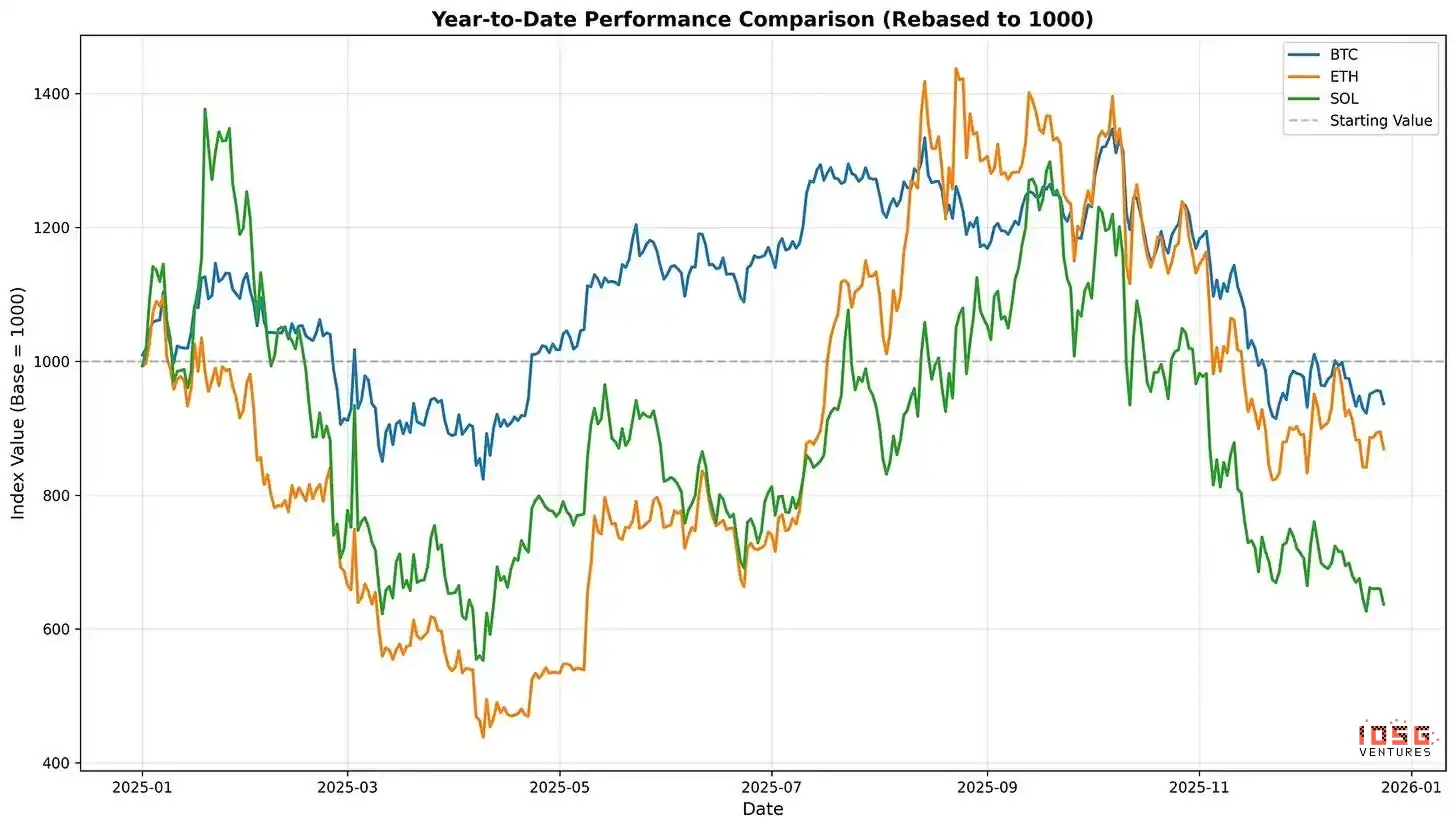
Ethereum 2026 Outlook: Unique Drivers as a Positive for ETH/BTC. Ethereum shares macro risk characteristics with Bitcoin—sensitivity to AI stocks, fiscal policy, and Federal Reserve liquidity conditions. However, in terms of unique factors, Ethereum's positioning in 2026 is clearly superior to Bitcoin.
Advantages of Ethereum Relative to Bitcoin:
a. No Major Pressure: Ethereum does not face the same structural risks that weigh on Bitcoin. Most importantly, it does not have a leveraged entity equivalent to MicroStrategy, whose potential sell-off could destabilize the market. While most DATs may be short-lived, entities holding large amounts of ETH use less leverage than Strategy.
b. ETH as the Only Alternative to BTC: Our timing judgment on this argument was incorrect last year, but if any of the previously discussed unique risks to BTC materialize—including discussions around quantum vulnerabilities and economic/security risks—this should provide a positive for the ETH/BTC ratio.
Unique Catalysts: Stablecoin and DeFi Dominance Thesis. Perhaps most importantly, Ethereum has positive unique catalysts that are just beginning to emerge. After years of being considered "one of the most hated assets"—experiencing severe pressure and volatility from 2023 to 2025—the conditions for Ethereum's revival are maturing.
Undeniable Stablecoin Leadership: The data is clear: Ethereum dominates the stablecoin market. This is reflected in several aspects.**
a. Asset Balances: Ethereum accounts for nearly 60% of the total market cap of stablecoins, showcasing clear network effects and market preference.
b. Liquidity Dynamics: Since the announcement of the GENIUS Act, Ethereum has absorbed $45-50 billion in new stablecoin issuance. This indicates that when new stablecoin demand arises, it disproportionately flows to Ethereum.
A Decade of Reliability Proof:
Ethereum has not experienced any major performance issues or outages in the past 10 years. This operational record is irreplaceable and crucial for its positioning as the foundation of global liquidity infrastructure. When traditional finance considers blockchain integration, Ethereum's reliable management of billions of dollars in value provides unparalleled credibility.
DeFi as Ethereum's Moat:
Ethereum's DeFi ecosystem may be its most significant competitive advantage. Ethereum is the only blockchain capable of effectively deploying tens of billions of dollars through battle-tested smart contracts.
a. Time-Tested Security: Smart contracts like Aave, Morpho, and Uniswap have been operating for years, locking in billions of dollars in total value without major security breaches. Despite representing a huge "honey pot" for hackers, these contracts have proven their resilience.
b. Deep Liquidity, Composability, and Capital Efficiency: The ability to combine different DeFi protocols creates network effects that are difficult for competing chains to replicate. Complex financial products can be built by combining existing primitives—this capability requires technical infrastructure and deep liquidity. The best examples are the composability of Ethena, Aave, and Pendle. This makes the Ethereum mainnet the only center for capital-intensive use cases.
Regulatory Clarity: Positive regulation around the crypto industry should facilitate more integration between traditional finance and crypto. The convergence of macro timing, regulatory clarity, and institutional adoption makes Ethereum the primary beneficiary of traditional finance entering crypto. With a robust blockchain record and the ability to securely manage billions of dollars through verified DeFi infrastructure, Ethereum offers a combination of security, liquidity, and regulatory visibility that competing chains cannot match. After years of underperformance and skepticism, Ethereum may be on the verge of a sentiment reversal. Markets often reward assets that have been "abandoned" once fundamentals begin to improve significantly. Ethereum's infrastructure improvements, stablecoin dominance, and institutional adoption positioning could drive repricing in 2026.
Ethereum 2026 Risks: The Battle for Asset Perception. While Ethereum's fundamental positioning entering 2026 looks strong, several risks could undermine its performance—most importantly, the ongoing debate about what ETH represents as an asset.
Asset Classification Battle
Core Debate: Unlike Bitcoin, which has reached a relatively clear consensus as "digital gold" as a monetary asset, Ethereum is still in the process of market perception discovery. This ambiguity creates vulnerabilities that skeptics and conflicting interest groups actively exploit.
Two Competing Narratives:
a. Monetary Asset View (Bullish): Advocates in the Ethereum community, including notable figures like Tom Lee, have been promoting the "digital oil" analogy—positioning ETH as a productive monetary asset with utility. This narrative has gained traction, supporting Ethereum's valuation with a monetary premium similar to Bitcoin.
b. Cash Flow Asset View (Bearish): A significant portion of the market—including Bitcoin extremists and traditional finance skeptics—attempts to categorize Ethereum fundamentally differently from Bitcoin. They argue that Ethereum should be valued like the following assets: BlackRock: valuation should be a small portion of managed assets; Nasdaq or trading platform operators: using a fee-based DCF (discounted cash flow) model rather than a monetary premium.
Cognitive Manipulation: Ethereum is particularly susceptible to narrative attacks because its value proposition is more complex than Bitcoin's simple "digital gold" story. We have witnessed in previous cycles that skeptics have a disproportionate ability to negatively influence perceptions of ETH as an asset.
Why Ethereum is More Vulnerable:
a. Younger Asset: Compared to Bitcoin's 15+ year record, market consensus is not as mature;
b. More Complex Story: Programmability, DeFi, stablecoins, Layer 2—more difficult to distill into a simple narrative; c. Decentralized Leadership: Multiple voices and interests make it easier for opponents to create confusion.
Layer 2 Debate
As Ethereum's Layer 2 ecosystem flourishes (Base, Arbitrum, etc.), questions about value accumulation arise:
a. Do L2s Enhance or Diminish ETH? If most activity and fees remain on L2, can the mainnet ETH capture value?
b. Liquidity Fragmentation: Multiple L2s may dilute rather than enhance Ethereum's network effects.
Earlier this year, we wrote on this topic:
L2 fragmentation can be resolved through two main avenues:
Market dynamics (natural selection) may naturally consolidate the ecosystem, leaving 2-3 significantly active dominant general-purpose L2s, while others either disappear or shift to a stack approach—serving specific use case rollups.
Establishing robust interoperability standards can reduce friction in the broader rollup ecosystem, weakening the potential for any single rollup to establish a dominant moat.
Ethereum should actively promote the latter scenario while it still has influence over L2. This influence is diminishing daily; the longer Ethereum delays, the less effective this strategy becomes. By fostering a unified L2 ecosystem, Ethereum can restore the composability advantages that once defined its mainnet, enhancing user experience and strengthening its competitive edge against monolithic blockchains.
Current Assessment: While the L2 fragmentation debate is ongoing, the Ethereum mainnet has successfully maintained its dominance in large-scale capital deployment. No L2 has enough influence to threaten the mainnet's value accumulation. However, if L2 continues to grow without sufficient interoperability standards, this remains a risk that needs monitoring.
Ethereum Judgment for 2026:
As Ethereum enters 2026, it possesses a stronger unique positioning than Bitcoin, despite sharing similar macro sensitivities:
Stablecoin Dominance: Capturing 60% of the stablecoin market cap, with an additional $45-50 billion in issuance since the GENIUS Act, showcasing clear institutional preference, most likely to benefit from further growth in stablecoin market cap.
DeFi Moat: The only blockchain capable of effectively deploying tens of billions of dollars through battle-tested protocols (Aave, Morpho, Uniswap) with verified security over the years.
Institutional Positioning: Given regulatory clarity, operational record, and deep liquidity, most likely to capture traditional financial capital entering the crypto space.
No Pressure: No equivalent entity like MicroStrategy creates potential sell-off pressure; more resilient to single-entity risks.
Sentiment Reversal Potential: After years of being "one of the most hated assets," fundamentals are clearly improving, creating conditions for repricing. Key risks: ongoing asset classification debates and attempts at cognitive manipulation remain major threats to valuation.
L2 Monitoring: Fragmentation concerns exist, but the mainnet has maintained its dominance in large capital, and it is extremely unlikely that anyone will threaten its role as a core asset ledger for large funds: 1) large capital primarily cares about security; 2) gas costs are not proportional to transaction size, making Ethereum extremely cheap for large holders; 3) DeFi moat.
Solana
Reflecting on the 2025 Outlook
Looking back at the potential paths outlined for Solana in our 2025 outlook, the reality ultimately turned out to be a mix of the two scenarios—but leaning more towards the negative.
· "From Hunter to Prey" (Fully Realized): This has played out completely. The emergence of Hyperliquid has particularly harmed Solana's narrative. This chain, which has long claimed to be the highest scalable and most suitable for CLOB (Central Limit Order Book) trading platforms, now finds itself surpassed in this very use case.
· Overexposure to Meme Culture (Completely Accurate): This concern has proven to be entirely valid. The transience of growth driven by the meme economy is now evident. In hindsight, it is obvious—the user churn rate in meme casinos exceeds 98%. Solana's main argument is "buying digital Macau," but many overlook that the odds in this digital Macau are set at 98% against the users. This has the potential to leave a lasting brand stain on Solana, especially as institutions now seek more capital-oriented sustainable directions.
· DePIN Leadership (Unproven): This argument has yet to materialize. While Solana continues to cultivate DePIN verticals, it has not translated into the anticipated breakthrough adoption or narrative dominance.
· Developer Leadership in Frontier Verticals (Mixed Results): Solana has demonstrated agility and continues to attract builders, particularly in the consumer startup space. However, advancements in wallet and cross-chain infrastructure have made the choice of underlying chains increasingly irrelevant for most consumer applications. Anyone who has used the latest deposit solutions from Privy and Fun.xyz can attest to this trend.
Solana 2026 Outlook: Seeking a Sustainable Narrative
Solana shares the same macro sensitivities as Bitcoin and Ethereum but faces more complex unique risk characteristics—entering 2026, there are more negative factors than positive.
Aftermath of Meme Coins
Solana emerged from one of the most explosive meme coin cycles in crypto history. While this brought a lot of short-term attention and activity, it also introduced unsustainable dynamics and brand risks: the meme coin frenzy on Solana exhibited concerning characteristics.
· Extreme User Churn: User churn exceeds 98%—meaning almost all participants lost money, while platforms like Pump.fun, insiders controlling Solana's block space, and many problematic teams behind various projects profited on the trading side.
· Legal Challenges: Recent lawsuits have targeted Pump.fun and Solana itself, accusing them of promoting unfair gambling activities.
· Brand Risk: What seems successful in the short term—high trading volumes, wallet creations, and attention—may prove to be brand liabilities. The "crypto casino" narrative could hinder institutional adoption and regulatory goodwill. As the meme coin cycle wanes, Solana faces the challenge of shedding this association.
Centralization Becomes Inevitable
Solana's integrated high-throughput architecture is designed to support globally scaled applications with minimal latency. However, this design choice increasingly exposes concerns about centralization.
It is becoming clearer in the blockchain industry that you must make a choice: either build an integrated and centralized solution optimized for performance or embrace a more decentralized modular path. Solana chose the former—prioritizing scalability and speed through centralized physical infrastructure. While this achieves impressive throughput, it fundamentally limits Solana's credibility for applications that require true decentralization and censorship resistance. DoubleZero is a project that, if successful, will lead to further centralization of physical infrastructure around dozens of high-bandwidth fiber providers.
Can Solana Maintain "Integration"?
While Solana does not shy away from making centralization trade-offs, the question remains to what extent it can defend the premise of an "integrated chain." Much of the discussion at SolanaBreakpoint focused on whether Solana can support more complex smart contract logic and heavier computations or if it is primarily designed to maximize throughput for relatively simple transaction logic.
Complex Applications Require Fragmented States: Developers building complex applications on Solana are increasingly moving away from the main state:
· Jupiter's Choice: Jupiter, one of Solana's flagship DeFi protocols, decided to launch JupNet—a standalone environment competing with Hyperliquid—rather than building on the Solana mainnet. This represents a significant acknowledgment that Solana's global state cannot adequately support certain application needs.
· "Network Expansion": NeonLabs and similar projects are building what they call "Solana Expansion," but functionally similar to Layer 2 solutions. These fragment Solana's state, allowing developers to control their own block space and execution environment—effectively acknowledging the limitations of a monolithic global state. The argument proposed is that even if Solana can theoretically support any logic, in practice, more computation-intensive tasks often can only be executed across multiple blocks. In such cases, the platform cannot control the execution order, which could undermine the fundamental logic of transactions. While these "expansion" solutions are marketed as extending Solana's capabilities while maintaining a unified state, the reality is more fragmented. Developers need isolated environments with predictable performance, pushing the architecture increasingly towards a modular approach similar to Ethereum.
Competitive Repositioning Issues
Awkward Middle Ground
Solana now finds itself in an uncomfortable position between two dominant forces. Ethereum, with its battle-tested infrastructure, dominates the liquidity, stablecoin, and DeFi narratives. Hyperliquid dominates the high-performance order book narrative that Solana has cultivated over the years. Solana must demonstrate a competitive advantage in at least one of these areas, or it risks being perceived as neither sufficiently decentralized nor maximally scalable.
Before the emergence of Hyperliquid, Solana had a relatively unique positioning—a somewhat centralized but highly scalable integrated chain. Solana actively promoted the narrative that its architecture made it an ideal choice for global order books and high-frequency trading applications. This narrative has become awkward. Today, no competitive order book on Solana can match Hyperliquid's trading volume and performance.
Drift may be one of the more mainstream Solana protocols for perpetual contracts, but it still lacks strong competitiveness against Hyperliquid. So while Solana has spent five years defending its positioning as the highest scalable chain, it has now become very awkward when high-level order books are not even competitive on the Solana blockchain, with activity primarily driven by meme coins lacking sustainable dynamics.
This places Solana in a position similar to Ethereum 18 months ago, when Ethereum was caught between Bitcoin and Solana—Solana taking on activity while Bitcoin remained the obvious value storage asset. Now we see Solana positioned between Ethereum and Hyperliquid: Ethereum dominates liquidity, DeFi, and stablecoin-related activities, while Hyperliquid dominates order book and CLOB perpetual contract trading platform business. If Solana cannot choose one and win competitively, it could have extremely adverse effects on Solana's narrative.
Path Forward: Proven Adaptability and Survival
Professional Execution: It is commendable that Solana remains one of the most professionally operated blockchain organizations in the industry. The Solana Foundation demonstrates a high level of attention to detail and rapid execution capabilities. This should not be underestimated—Solana has repeatedly proven its ability to identify opportunities and effectively transform.
Moving Away from Casinos: Recent efforts indicate that Solana is trying to distance itself from the "crypto casino" narrative, seeking more sustainable fundamental use cases. This was very evident at the recent SolanaBreakpoint event, which had more of a fintech atmosphere rather than a speculative focus.
Challenges: Solana must successfully expand in at least one of the following two directions to maintain its competitive positioning:
Capture Liquidity and DeFi; build a robust DeFi ecosystem that can compete with Ethereum's maturity and liquidity depth.
Given the DeFi moat that the Ethereum mainnet possesses, this is a tough battle. However, Solana seems to be taking steps in the right direction. Some examples include attempts to think like a CEX, even listing non-Solana assets on-chain to provide more options for Solana traders. I strongly support this initiative, as it is also part of the governance proposal we put forward over a year ago to accelerate its DeFi positioning.
Capture Order Book Trading: Develop a competitive CLOB perpetual contract trading platform that can challenge Hyperliquid's dominance.
Unfortunately, for Solana, they seem to lack competitive participants in this race, as some major Hyperliquid competitors like Lighter and Aster are outside the Solana ecosystem.
2026 Solana Judgment: Solana faces unique risks greater than opportunities entering 2026:
Meme Coin Exhaustion: The unsustainable meme casino cycle driving recent activity is coming to an end, leaving over 98% user churn and brand damage.
Legal and Brand Challenges: Lawsuits accusing unfair gambling activities threaten regulatory goodwill and institutional adoption prospects.
Competitive Displacement and Awkward Positioning: Hyperliquid's dominance in CLOB/order books undermines Solana's core narrative as a scalability leader for this use case over the years. Caught between Ethereum (liquidity/DeFi/stablecoins) and Hyperliquid (order books), lacking a clear competitive advantage in any direction.
Integration Issues: Major projects (Jupiter, NeonLabs) turning to fragmented state solutions indicate limitations in supporting complex applications on a global state.
A Ray of Hope: A professionally operated organization with proven adaptability; capable of identifying new narratives, but must demonstrate success in DeFi competition or order book trading to avoid irrelevance in the middle ground.
Summary: The Crypto Landscape in 2026
Macro Dependence Dominates: The three major cryptocurrencies (Bitcoin, Ethereum, Solana) share similar macro sensitivities to AI stocks, Federal Reserve policies, and fiscal spending. However, their unique positioning differences are vast.
Bitcoin: Entering 2026 as a purely macro beta asset, crypto-specific catalysts have exhausted, yet the market's overpricing of potential negative catalysts may itself lead to positive outcomes.
Ethereum: Positioned best among the three, with positive unique drivers (stablecoin dominance, DeFi moat, institutional preference), it can achieve outperformance even under neutral macro conditions as long as the integration of off-chain and on-chain finance continues. The main risk remains the perception and consensus around ETH's asset classification.
Solana: Facing the most challenging unique landscape, with the meme cycle exhausted, brand concerns, and competitive displacement. It must successfully capture the DeFi or order book market to avoid irrelevance in the middle ground, despite having strong organizational execution capabilities.
2. Looking at the Bigger Picture
The previous analysis examined the specific positioning of Bitcoin, Ethereum, and Solana in 2026. Each faces its own opportunities and risks. However, to truly understand the direction of crypto, we need to step back and look at the bigger picture. The structural bullish factors supporting the entire crypto argument operate on a timescale of decades. These macro forces provide the ultimate foundation for all crypto narratives.
BTC's Continued Growth Bullishness: Currency Devaluation
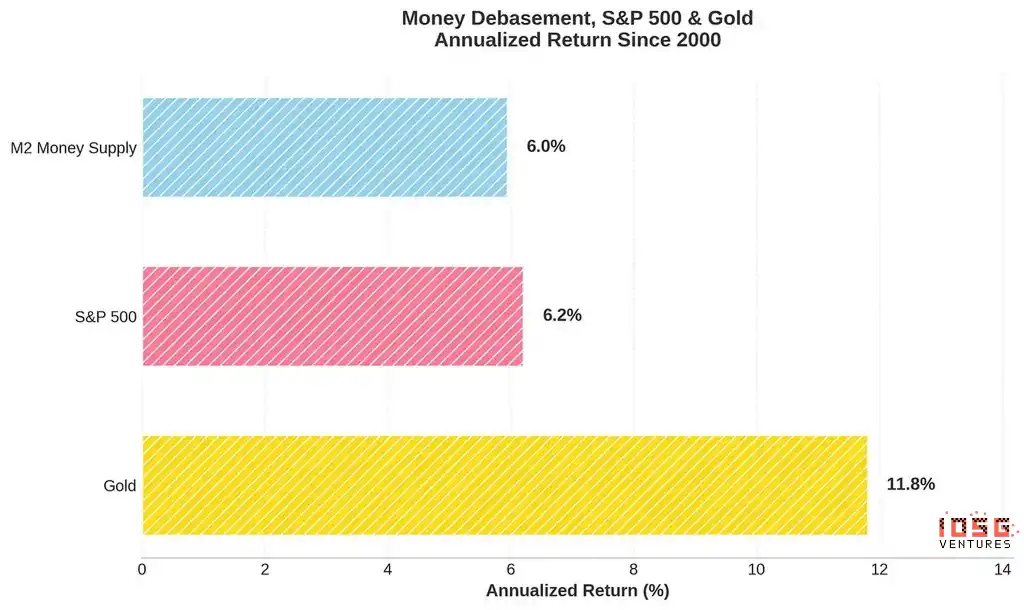
Since 2000, gold has had an annualized return of about 12%. The S&P 500 has returned about 6%. Meanwhile, the M2 money supply has grown by about 6% annually.
The implication is profound: adjusted for currency devaluation, the S&P 500 has essentially provided no real returns over the past 25 years. In other words, when measured against the expansion of the monetary base, stocks have merely served to preserve wealth. And this preservation is only effective if you invest 100% of your net worth in that index.
This realization is at the core of the non-inflationary asset argument. As long as major economies rely on continued growth in the money supply, devaluation will remain the primary driver pushing non-inflationary assets higher for the long term. Breaking this connection with the current economic agenda will be difficult—there is little incentive to do so: governments lack the discipline to address debt issues; moreover, too much power is concentrated in financial markets, which disproportionately benefit from the devaluation of the denominator at the expense of the non-investing class.
Global Fiat Currency Run
"Capital flows to where it is welcomed and stays where it is treated well."
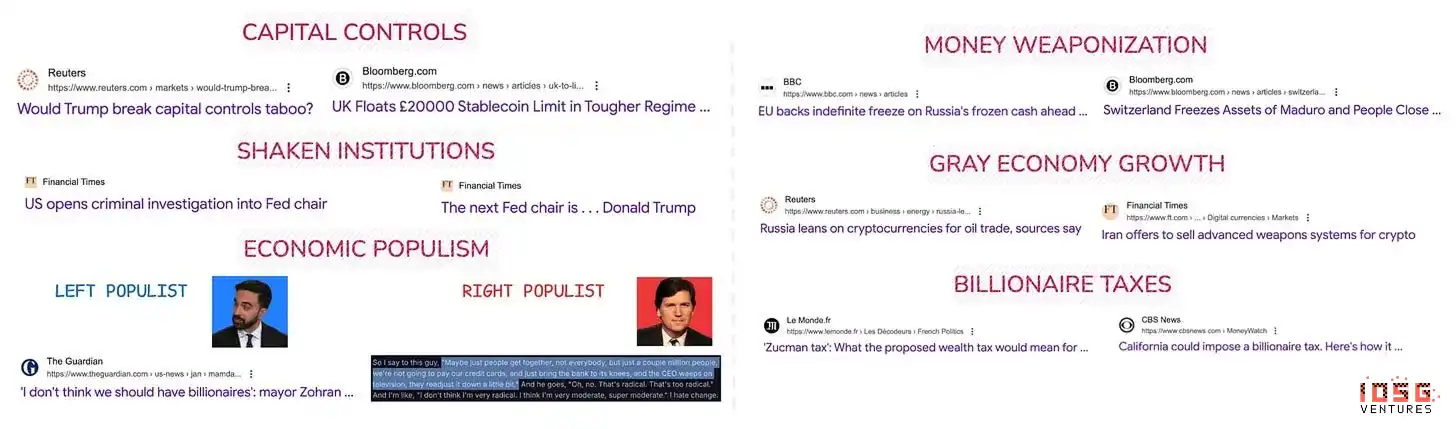
The story of currency devaluation is directly linked to a broader phenomenon: the growing distrust of the traditional financial system. For high-net-worth individuals, ordinary citizens, and sovereign nations, cryptocurrencies have become an important tool for hedging against the economic uncertainties of the 21st century.
The driving factors are converging from multiple directions simultaneously.
Capital Controls: Headlines about potential capital controls are no longer limited to emerging markets. The UK has proposed a £20,000 limit on stablecoins. Discussions about whether major economies might restrict capital flows mark the beginning of a new era of financial repression. Earlier last year, Trump even suggested taxing capital leaving the U.S.—a historic precedent few anticipated.
Weaponization of Currency: The freezing of Russian assets and similar actions against former Venezuelan leaders provide clear examples of this trend that has persisted for a decade. The weaponization of the financial system is accelerating. This creates strong incentives for nations and individuals seeking alternatives outside traditional banking channels. The U.S. government has been openly exploring innovative means to pressure counterparties. The more unpredictable the sovereigns of the current financial system become, the stronger the impulse for ordinary participants to hedge with alternatives. The choices for hedging vary: countries are capable of storing precious metals and breaking their dependence on the existing financial system; individuals can only choose Bitcoin.
Growth of the Gray Economy: Sanctioned countries are increasingly turning to cryptocurrencies for trade. Russia's use of cryptocurrencies for oil transactions and Iran's acceptance of cryptocurrencies for purchasing weapon systems demonstrate adoption driven by necessity. When traditional channels are blocked, new channels emerge.
Institutional Erosion: Criminal investigations into Federal Reserve officials and political interference in central bank appointments have weakened confidence in the institutions that underpin the credibility of fiat currencies. Once trust is lost, it is difficult to rebuild. Any failure of traditional institutions proves to be bullish for crypto assets.
Economic Populism: Populist movements, whether from the left or the right, share a common thread—distrust of the existing financial system. Voices questioning the current financial order now exist on both ends of the political spectrum. On one hand, Mamdani calls for a land without billionaires. On the other hand, right-wing economic populists call for banks to yield. Centrists are shrinking.
Billionaire Tax: Proposed wealth taxes in multiple jurisdictions create incentives for capital to flee to assets that are harder to track and seize. Whether these policies are wise or not, their impact on capital flows is predictable.
Taken together, these forces explain why borderless, efficient, and sovereign-less tracks have an increasingly obvious product-market fit in today's era.
The End of a 70-Year Trend
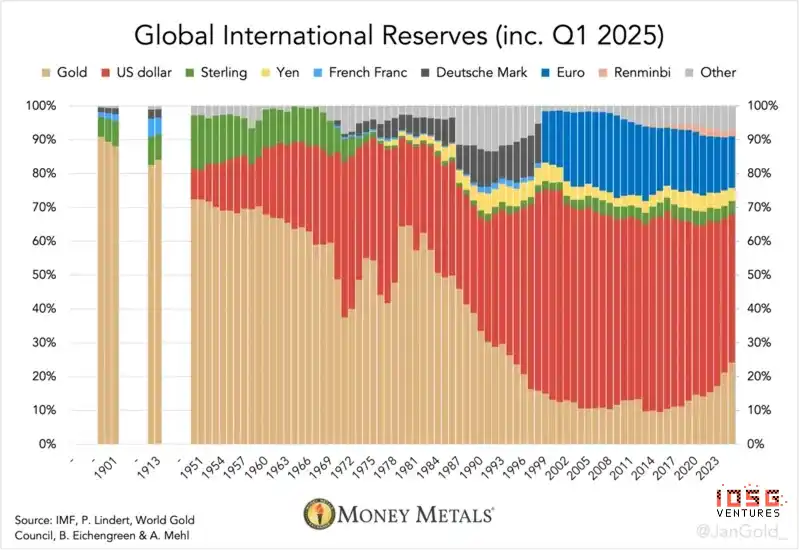
The pressures described above are not merely theoretical. They have already manifested in the way central banks and sovereign wealth funds allocate reserves.
The most important macro chart for understanding the current landscape may be the composition of global international reserves. Over the 70 years following World War II, the dollar's share of global reserves steadily increased. At its peak, the dollar dominated over 60% of global reserves.
But around 2020, this changed. The share of gold in reserves began to increase for the first time in 70 years. This represents a fundamental shift. Central banks are no longer just discussing diversification—they are taking action. If this trend continues—geopolitical drivers suggest it will—it creates structural buying for hard assets. Bitcoin stands to capture a portion of this demand.
The Trinity of Crypto: Digital Gold, Digital Oil, Digital Dollar
As regulatory clarity emerges, it is helpful to understand what crypto actually offers. The ecosystem has matured into different value propositions, each serving different purposes.
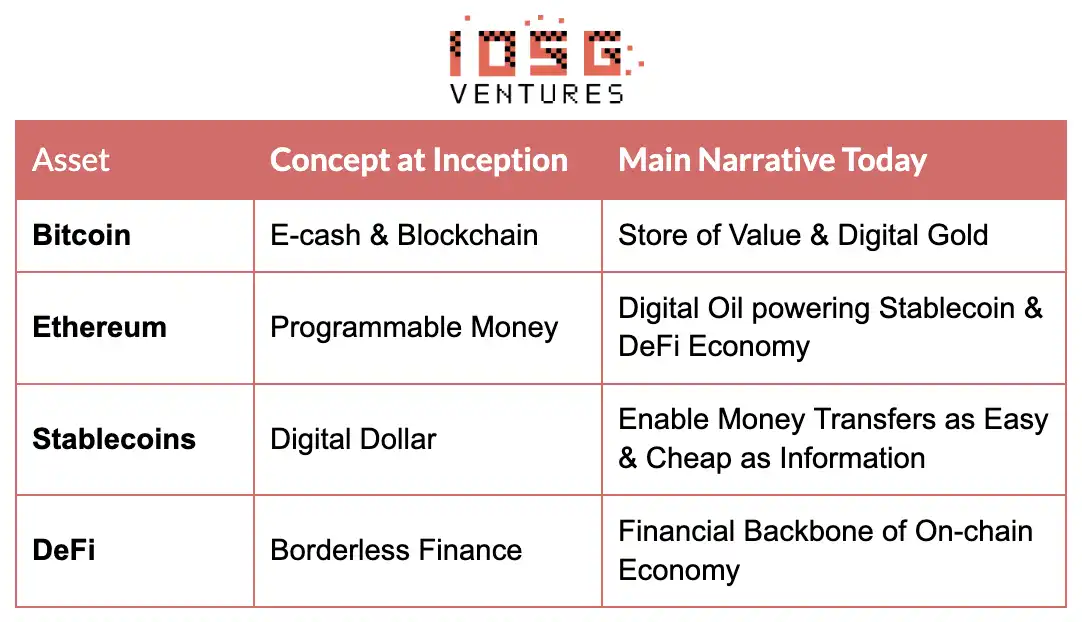
This framework clarifies why different crypto assets serve different purposes—and why the entire ecosystem is greater than the sum of its parts. Bitcoin captures the narrative of value storage. Ethereum powers the productive on-chain economy. Stablecoins bridge traditional finance to the crypto world. And DeFi provides the infrastructure for borderless financial services.
A Clear Path Forward
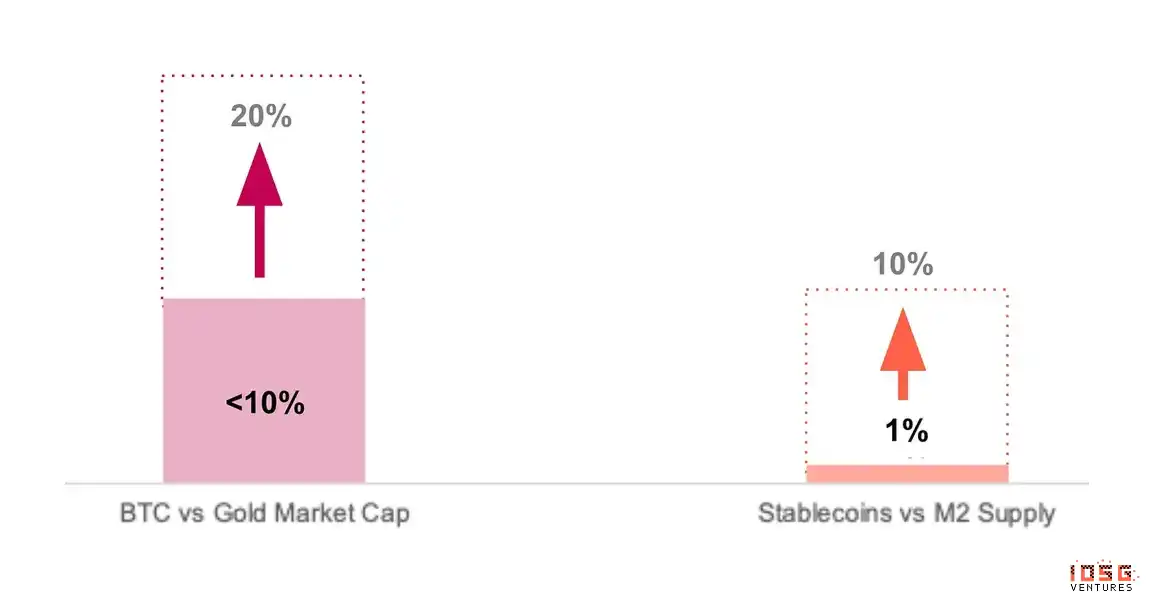
Understanding these different roles makes it easier to assess future growth potential. The two main pillars of the crypto argument—digital gold and digital economy—both have significant room for expansion.
Digital Gold (BTC vs. Gold Market Cap): Bitcoin's market cap of about $1.8 trillion currently represents about 6% of gold's market cap of approximately $32 trillion. Just rising to 10-15%—a still modest assumption for an asset positioned as "digital gold"—would imply significant upside from current levels. Gold itself is expected to soar in 2025, greatly expanding the target.
Digital Economy Growth (Stablecoins vs. M2 Supply): Stablecoins currently account for about 1% of the M2 money supply. Rising to 10%—reflecting mainstream adoption of the digital dollar—would represent a tenfold expansion of the stablecoin market. Infrastructure is being built. The question is how fast adoption will occur.
The Path to a $2 Trillion Stablecoin Market
Crypto serves both ends of the spectrum simultaneously. On one hand, developed economies view alternative financial tracks as a hedge against the current financial system. On the other hand, leaders of the current financial system are making decisions favorable to crypto because they need alternative buyers for dollars and dollar-denominated debt—especially now that the long-term dollar trend is reversing.
We expect stablecoins to surpass trillions of dollars in market cap over the next decade. The U.S. recognizes their strategic importance for two key reasons.
· For Debt Financing: Stablecoin issuers must hold reserves, typically U.S. Treasuries. Each dollar of stablecoin issued increases inelastic demand for government bonds.
· Extending Dollar Hegemony: The digital dollar extends the influence of the dollar beyond traditional banking channels. In a world where the dollar's dominance is threatened, stablecoins provide a new way to maintain influence.
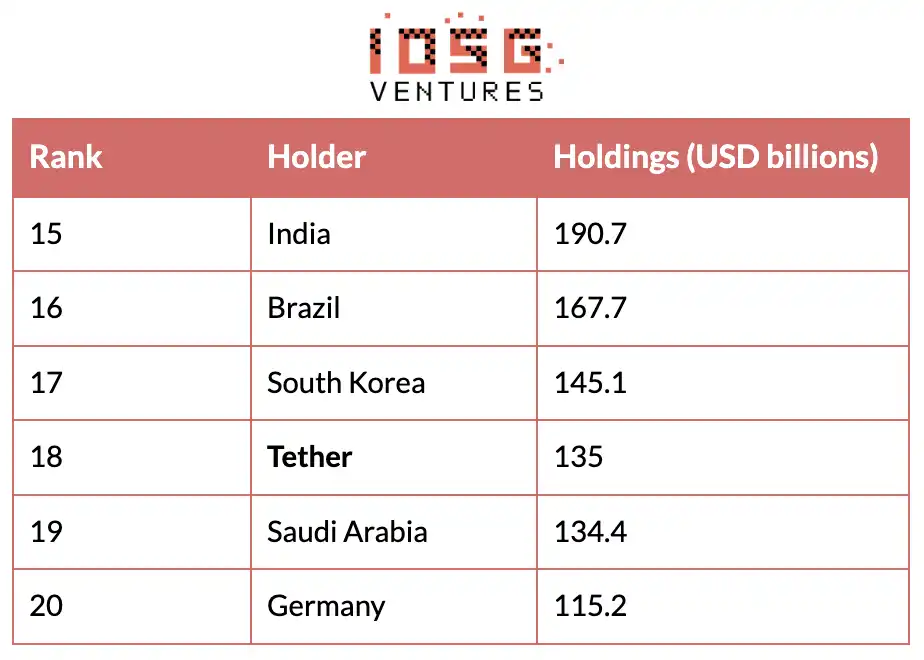
These numbers reflect this dynamic. Tether now holds about $135 billion in U.S. Treasuries. This makes it the 17th largest holder of U.S. government debt globally—surpassing holdings from Germany, the UAE, and Saudi Arabia.
We believe stablecoin issuers will soon become the largest financiers of the U.S. government. This creates a strong alignment of interests between crypto adoption and U.S. government policy goals—a structural bullishness that few market participants fully recognize.
Regulatory Tailwinds
We often only examine regulatory policies in hindsight. Decades later, we realize how a regulatory decision triggered massive change. We may be at such a turning point now.
Analogy: China's WTO Accession in 2001: When China joined the WTO, a regulatory change triggered a massive reallocation of global capital. Manufacturing moved to Asia, and the U.S. accelerated its transition to a service and knowledge economy, resulting in trillions of dollars in annual trade flows and massive dollar outflows. Looking back, it all seems logical: new rules combined with government agreements inevitably lead to constructive capital transfers. The far-reaching implications of this transformation continue to influence public discourse—without the massive economic restructuring of the past two decades, the "America First" agenda would not exist.
Catalyst: The U.S. Crypto Regulatory Framework Takes Shape in 2025. We are witnessing a similar moment. Landmark legislation is establishing on-chain infrastructure as legitimate financial infrastructure.
· GENIUS Act (July 2025): The first federal stablecoin framework, allowing banks to issue on-chain dollars.
· CLARITY Act (passed the House, under Senate review): The jurisdiction of the SEC and CFTC is finally clearly defined, marking the end of the "enforcement-style regulation" era.
· DTCC No-Action Letter (December 2025): The SEC has authorized this custodian, which manages over $100 trillion in assets, to tokenize stocks, bonds, and government debt on-chain.
Core Argument: All valuable assets will migrate on-chain. Looking back, this moment will be as epoch-making as 2001.
Entry Point for Financial Inclusion: Super Apps and Tokenization
Macro tailwinds and regulatory clarity lay the foundation, but mass adoption requires channels. The next wave of growth in the crypto space will be driven by two complementary forces.
Big Tech Companies Bring New Users
Big tech companies will play a crucial role in driving crypto adoption. For these companies, crypto offers a path to becoming super apps—a platform that integrates payments, social, and financial services. X and Meta are both exploring crypto integration.
A social media company headquartered in the United States and operating in most countries around the world is likely to become the "Trojan Horse" for global stablecoin adoption. The effect will be to attract liquidity from bank balance sheets and small economies to the digital dollar.
Tokenization Brings a New Asset Class
To support the growth of stablecoins, a richer variety of assets needs to be available on-chain. Relying solely on crypto-native funding deployment opportunities cannot sustain a tenfold growth in stablecoin scale. To balance the equation, better connections between the off-chain and on-chain worlds are needed.
The tokenization of traditional products (stocks, bonds, etc.) serves as this bridge. Ultimately, the issuance of on-chain native assets represents the future of finance. Institutions like Robinhood and BlackRock will play key roles in this transformation.
The World Belongs to the Younger Generation
The aforementioned forces—currency devaluation, regulatory changes, and corporate adoption—each operate at their own pace. But there is another potentially underestimated tailwind: the intergenerational wealth transfer and the younger generation's preference for digital assets.
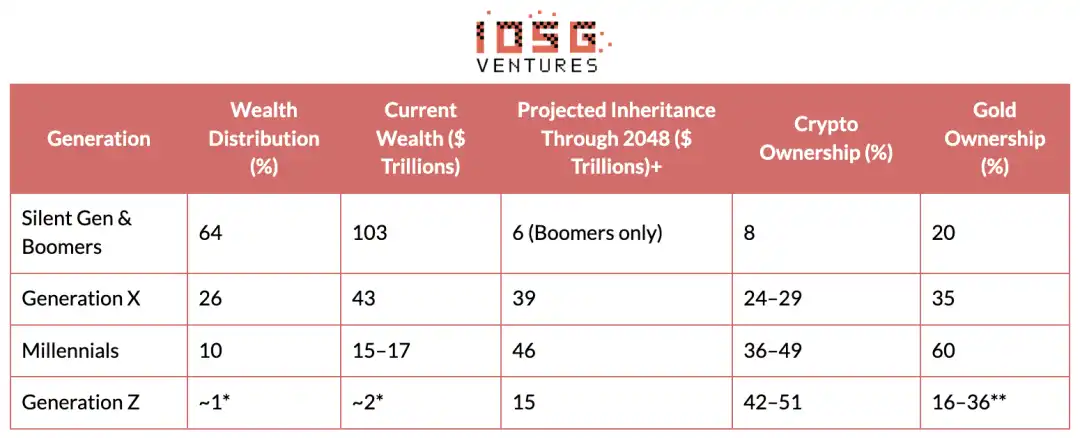
▲ Main reference sources: Federal Reserve, UBS Global Wealth Report 2025, Cerulli Associates 2024, Gemini State of Crypto 2024, YouGov 2025, State Street Gold ETF Impact Study 2024
Data for Generation Z is an estimate (the Federal Reserve combines Generation Z with Millennials in its statistics) | Limited survey data
The cryptocurrency ownership rate among the younger generation has significantly increased. The crypto ownership rate for Generation Z is about 45%, while the gold ownership rate is only 20%—completely opposite to the preferences of the Baby Boomer generation. An obvious counterargument is that the younger generation simply has a higher risk appetite. But this overlooks a deeper reality: the internet natives have a fundamentally different perception of value compared to the older generation.
As over $100 trillion in wealth transfers from the Baby Boomer generation to the younger generation over the coming decades, asset allocation preferences will also change accordingly.
Conclusion
In the short term, the performance of the crypto market will still be driven by familiar macro factors: Federal Reserve policies, AI stock sentiment, and overall risk appetite. The market will continue to be volatile, with news headlines swinging between euphoria and despair.
However, the impact cycle of the aforementioned structural tailwinds is much longer. Currency devaluation will not disappear; the weaponization of the financial system has created a lasting demand for alternatives; regulatory clarity has finally arrived; the younger generation clearly prefers crypto over gold; and the largest tech and financial companies in the world are building the infrastructure needed for mainstream adoption.
The question is not whether crypto will capture a larger share of global financial assets, but how quickly this transition will occur—and which assets within the ecosystem will benefit the most.
3. A Game Without Winners: How the Altcoin Market Breaks the Deadlock
The altcoin market has experienced its most challenging year, and understanding the reasons requires looking back at decisions made years ago. The funding bubble of 2021-2022 spawned a batch of projects that raised significant amounts of capital, and these projects are now in the token issuance cycle. This has created a fundamental problem: a massive influx of supply into the market with almost no corresponding demand.
The root cause is not just oversupply, but that the mechanisms that created this problem have changed little since they first appeared. Project teams continue to issue tokens, viewing token issuance as an inevitable milestone rather than a strategic decision, regardless of whether they have found product-market fit (PMF). As VC funding dries up and primary market investments decline, many teams see token launches as the only way to secure funding or allow insiders to exit.
This article will analyze the lose-lose situation that is destroying the altcoin market, examine failed attempts at repair, and propose what a balanced state might look like.
The Low Liquidity Dilemma: A Lose-Lose Game
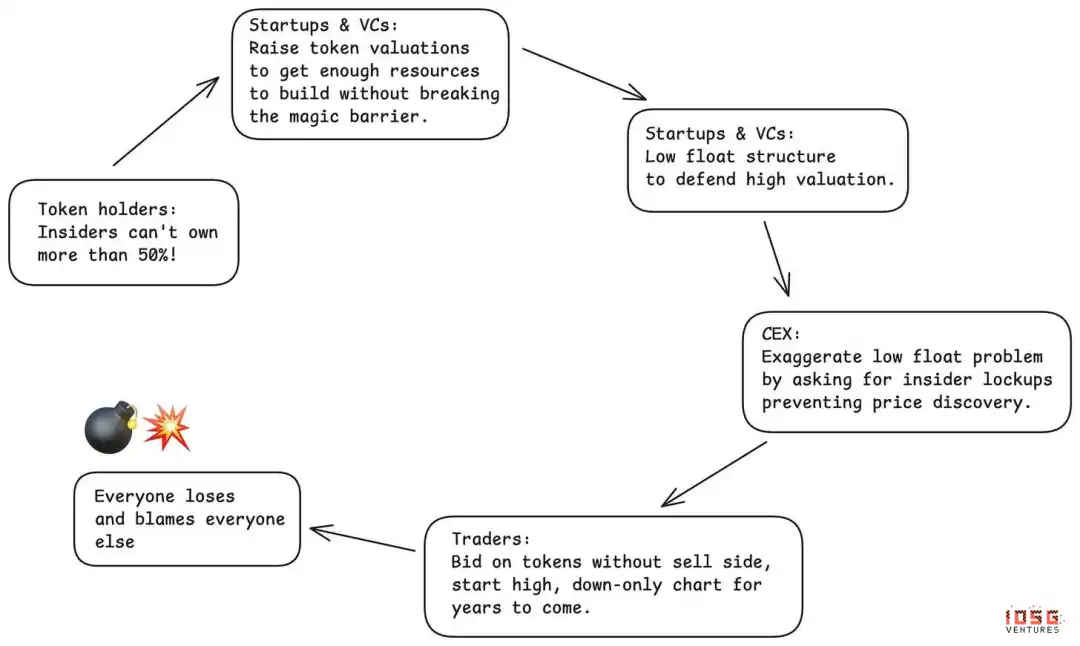
Over the past three years, the industry has relied on a severely flawed mechanism: low liquidity token issuance. Projects issue tokens with extremely low liquidity—usually only single-digit percentages—to artificially maintain an overvalued fully diluted valuation (FDV). This logic seems reasonable at first glance: the less supply, the more stable the price.
But low liquidity cannot be maintained indefinitely. As more supply inevitably enters the market, prices collapse. Early supporters are punished for their loyalty, and data fully supports this—most tokens have performed poorly since their launch.
What is particularly insidious is that low liquidity creates a situation where everyone thinks they are winning, but in reality, everyone is losing:
· Centralized exchanges believe they are protecting retail investors by requiring lower liquidity and more control. The result is facing angry communities and poor price performance.
· Token holders think that maintaining low liquidity can prevent insiders from selling. The result is that true price discovery is never achieved, and early supporters are punished instead. When they demand that insiders hold no more than 50%, they inadvertently push primary market valuations to unreasonable levels, forcing insiders to use—yes—the low liquidity strategy to maintain these valuations.
· Project teams believe that low liquidity manipulation can justify high valuations and minimal dilution. But overall, if this trend continues, this practice will destroy the entire industry's funding channels.
· VC firms think they can value low liquidity token positions based on market cap, thereby raising more funds. The result is that as the strategy's flaws become increasingly apparent, they lose funding channels in the medium to long term.
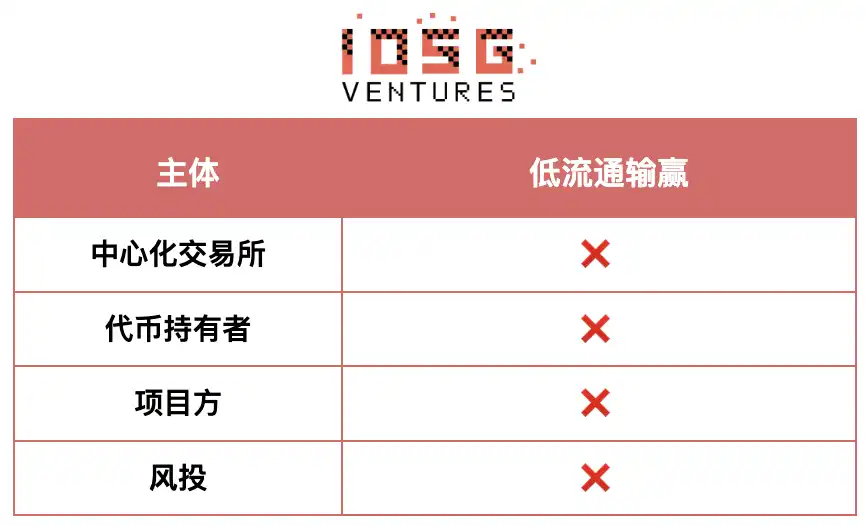
This is a perfect lose-lose matrix. Everyone thinks they are playing a smart game, but the game itself is detrimental to all participants.
Market Response: Meme Coins and MetaDAO
The market has attempted to solve this issue twice, with both attempts revealing the complexity of token design.
First Iteration: Meme Coin Experiment
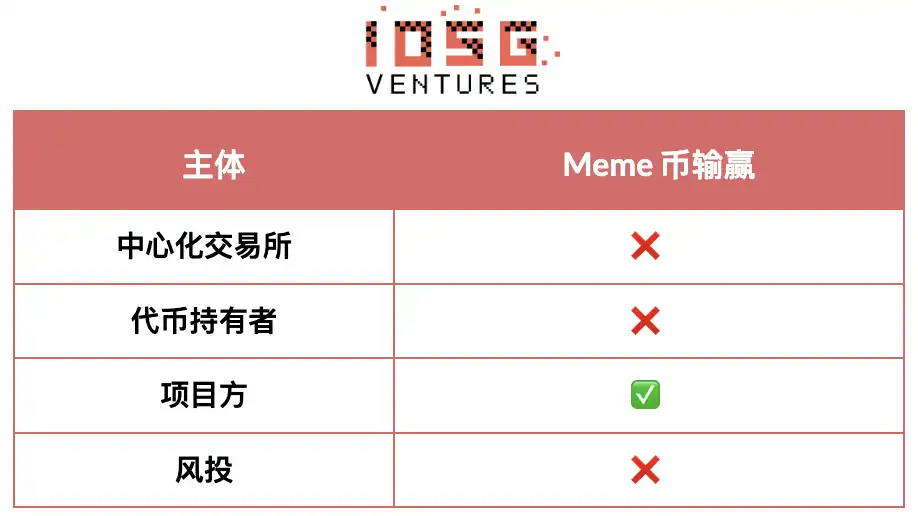
Meme coins were a response to VC-supported low liquidity issuance. Their promotion was simple and enticing: 100% liquidity on the first day, no VCs, completely fair. Finally, the game was no longer unfavorable to retail investors.
The reality, however, was much darker. Without any screening mechanism, the market was flooded with unvetted token issuances. Solo operators, often anonymous, replaced VC-backed teams, creating an environment where over 98% of participants lost money instead of fairness. Tokens became tools for exit scams, with holders being drained within minutes or hours of launch.
Centralized exchanges found themselves in a dilemma. If they did not list meme coins, users would bypass them and go directly on-chain; if they did list them, they would be blamed when prices collapsed. Token holders suffered the most severe losses. The only winners were the issuing teams and platforms like Pump.fun that gained significant value.
Second Iteration: MetaDAO Model
MetaDAO represents the market's second major attempt to solve the issue, swinging the pendulum to the other extreme, heavily favoring token holder protection.
Its advantages are tangible:
· Token holders gain control leverage, making capital deployment more attractive.
· Insiders can only gain liquidity by achieving specific KPIs.
· It opens up new funding mechanisms in a capital-scarce environment.
· Initial valuations are relatively low, providing fairer participation opportunities.
However, MetaDAO created new problems by overcorrecting:
· Founders lose too much control too early. This creates a "founder lemon market"—teams with resources and choices avoid this model, while teams with no options embrace it.
· Tokens are still issued at a very early stage, with high volatility, but the screening mechanisms are even less than those provided by VC cycles.
· The infinite issuance mechanism makes it almost impossible for leading exchanges to list tokens. MetaDAO fundamentally mismatches with centralized exchanges that control the majority of liquidity. Without CEX listings, tokens can only be trapped in illiquid markets.
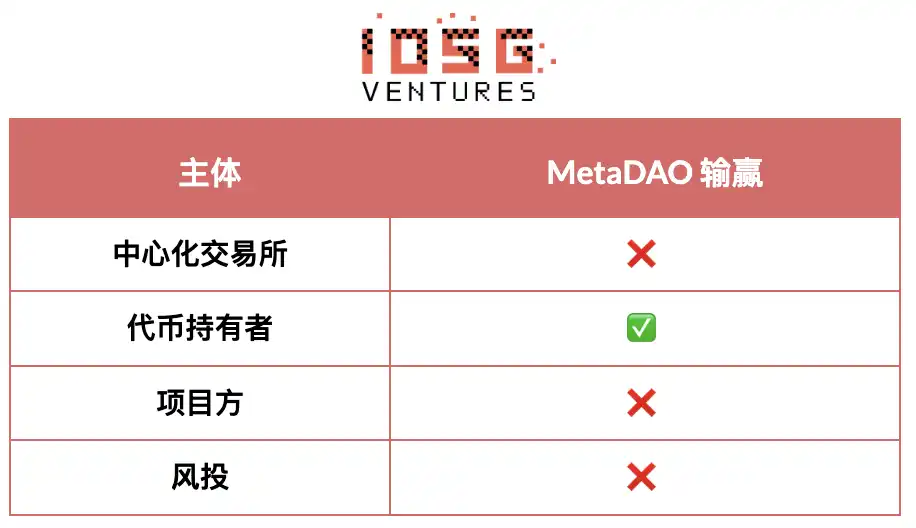
Each iteration attempts to solve a problem for a particular stakeholder, and each has demonstrated the market's self-regulating ability. But we are still searching for a balanced solution that considers the interests of all key participants—exchanges, token holders, project teams, and capital providers.
The evolution continues, and we will not have a sustainable model until a balance is found. This balance must satisfy all stakeholders—not by giving everyone everything they want, but by clearly delineating boundaries between harmful behavior and legitimate rights.
What a Balanced State Looks Like
Centralized Exchanges
· Must Stop: Requiring excessively long lock-up periods, which hinder true price discovery. Extending lock-ups creates a false sense of protection, actually damaging the market's ability to find fair value.
· Have the Right to Obtain: Predictability of token supply schedules and effective accountability mechanisms. The focus should shift from arbitrary, time-based lock-ups to KPI-based unlocks, adopting shorter, more frequent token release schedules linked to verifiable progress.
Token Holders
· Must Stop: Overcompensating for historical rights deficiencies by demanding excessive control, driving away the best talent, exchanges, and VCs. Not all insiders are the same; demanding the same long lock-up periods from everyone ignores the differences between roles and hinders true price discovery. An obsession with certain magical holding thresholds (such as "insiders must not hold more than 50%") creates the very conditions that lead to low liquidity manipulation.
· Have the Right to Obtain: Strong information rights and operational transparency. Token holders have the right to clearly understand the business behind the token, receive regular reports on progress and project challenges, and have open communication regarding capital reserves and resource allocation. They have the right to assurances that value will not be lost through side deals or alternative structures—tokens should be the primary IP holders, ensuring that the value created belongs to token holders. Finally, token holders should have reasonable control over budget allocations, especially for significant expenditures, but should not micromanage day-to-day operations.
Project Teams
· Must Stop: Issuing tokens without a clear product-market fit or compelling token utility. Too many teams treat token issuance as "beautified equity," yet enjoy lower rights—equivalent to the junior tier of risk equity, but without legal protections. Tokens should not be issued simply because "crypto projects do this" or because funds are running low.
· Have the Right to Obtain: The ability to make strategic decisions, take bold bets, and advance daily operations without submitting every decision for DAO approval. If the team is to be held accountable for results, they need the power to execute.
Venture Capital Firms
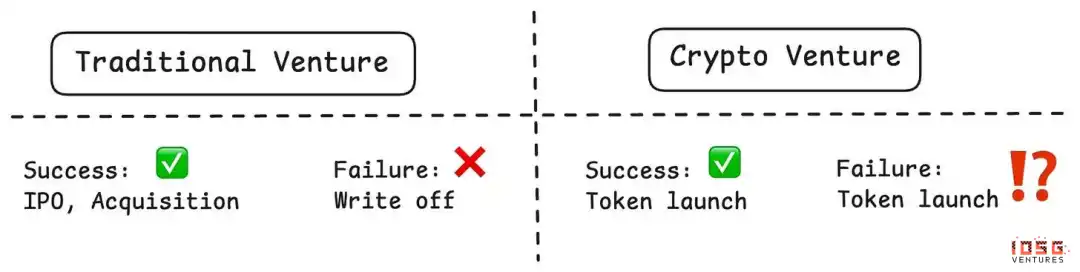
· Must Stop: Forcing every invested company to issue tokens, regardless of whether it makes sense. Not every crypto company needs a token; pushing for token issuance to value positions or create exit events has flooded the market with low-quality issuances. VCs need to be more prudent and honestly assess which companies are truly suited for a token model.
· Have the Right to Obtain: A reasonable return for taking on the extremely high risks of investing in early-stage crypto projects. High-risk capital should earn high-risk returns when bets succeed. This means reasonable equity stakes, fair token release arrangements that reflect their contributions and risks, and the ability to achieve liquidity exits from successful investments without being demonized.
Even with a path to balance, timing is crucial. The near-term outlook remains challenging.
The Next 12 Months: The Last Wave of Oversupply
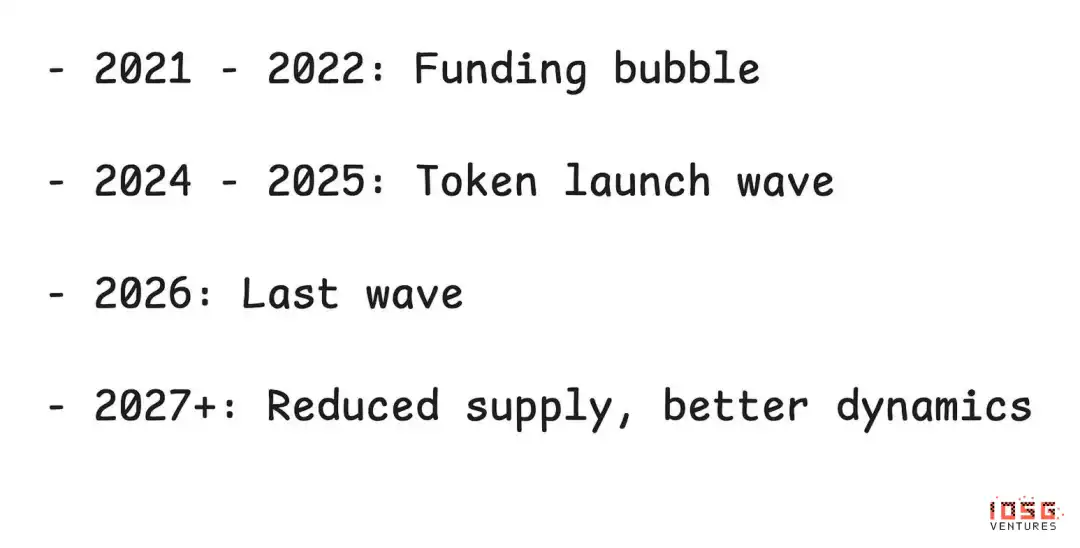
The next 12 months are likely to be the last wave of oversupply resulting from the previous VC boom.
After this digestion period, conditions should improve:
· By the end of 2026, the cohort of projects from the last cycle will either have issued tokens or gone bankrupt.
· Funding channels remain expensive, limiting the formation of new projects. The pool of VC-backed projects seeking to issue tokens has significantly shrunk.
· Primary market valuations have returned to more reasonable levels, alleviating the pressure to artificially maintain high valuations through low liquidity.
What we did three years ago has shaped today's market landscape. What we do today will determine the market two to three years from now.
Beyond the supply cycle, there is a deeper threat to the entire token model.
Existential Risk: The Lemon Market
The biggest long-term threat is that the altcoin market becomes a "lemon market," one that excludes quality participants and attracts those with no alternatives.
Possible Evolution Paths
· Unsuccessful projects continue to issue tokens to gain liquidity or extend their lifespans, even without any product-market fit. As long as there is the expectation that "projects should issue tokens, regardless of success," failed projects will continue to flood the market.
· Successful projects observe the chaos and choose to exit. When excellent teams see the overall performance of tokens consistently underperforming, they may opt for traditional equity structures instead. If a successful equity company can be built, why subject oneself to the chaos of the token market? Many projects do not have sufficient reasons to issue tokens; for most application-layer projects, tokens are becoming increasingly optional rather than necessary.
If this dynamic continues, the token market will be dominated by projects that cannot succeed through other means—those "lemons" that no one wants.
Despite these risks, there are still ample reasons to remain optimistic.
Why Tokens Can Still Prevail
Despite the challenges, we remain optimistic that the worst-case lemon market scenario will not occur. Tokens offer a unique game-theoretic mechanism that equity structures cannot replicate.
· Accelerated growth through ownership distribution. Tokens can achieve precise distribution strategies and growth flywheels that traditional equity cannot reach. Ethena exemplifies this by using token mechanisms to drive rapid adoption and create sustainable protocol economics.
· Enthusiastic, loyal communities create moats. If executed well, tokens can create a community with a vested interest—participants become stickier and more loyal to the ecosystem. Hyperliquid is a prime example: its trader community has become deeply engaged, creating network effects and loyalty that would be impossible to replicate without tokens.
Tokens can enable growth rates far exceeding those of equity models while opening up vast game-theoretic design spaces that, if utilized properly, can unleash tremendous opportunities. When these mechanisms work, their transformative power is genuinely disruptive.
Signs of Self-Correction
Despite the numerous challenges, there are encouraging signs that the market is correcting:
· Leading exchanges are becoming extremely stringent. Issuance and listing requirements have tightened significantly. Exchanges are implementing better quality control, conducting stricter evaluations before listing new tokens.
· Investor protection mechanisms are evolving. Innovations like MetaDAO, IP rights owned by DAOs (as seen in governance disputes with Uniswap and Aave), and other governance innovations show that the community is actively experimenting with better structures.
The market is learning—slowly and painfully, but it is indeed learning.
Recognizing That We Are in a Cycle
The crypto market is highly cyclical, and we are currently in a trough. We are digesting the negative consequences of the 2021-2022 VC bull market, hype cycles, over-investment, and the resulting structural mismatches.
But cycles will turn. Two years from now, once the projects from 2021-2022 are fully digested, once new token supply declines due to current funding constraints, and once better standards emerge through trial and error—the market dynamics should improve significantly.
The key question is: Will successful projects return to the token model, or will they permanently shift to equity structures? The answer depends on whether the industry can resolve issues of interest alignment and project selection.
The Path Forward
The altcoin market stands at a crossroads. The lose-lose situation among exchanges, token holders, project teams, and VCs has created an unsustainable market condition. But this is not permanent.
As the last wave of supply from 2021-2022 hits the market, the next 12 months will be painful. However, after this digestion period, three things may drive recovery: better standards emerging from painful trial and error; a coordination mechanism that satisfies the interests of all four parties; and more prudent token issuance, where teams only issue tokens when they can genuinely add value.
The answer depends on the choices made today. Three years from now, how we look back at 2026 will be similar to how we look back at 2021-2022 today. What are we building?
4. Overview of Venture Capital Opportunities
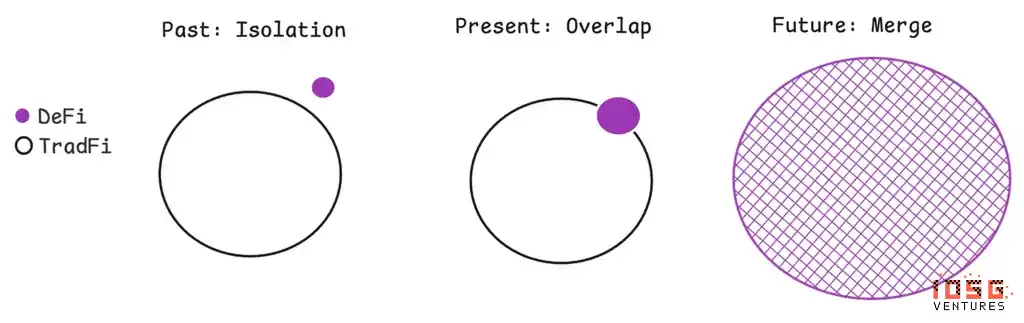
The cryptocurrency ecosystem is undergoing a fundamental transformation. From the initial independent experiments with digital currencies, it has evolved into a complex financial infrastructure, increasingly overlapping with traditional finance and emerging technologies like artificial intelligence, ultimately moving towards integration.
Stablecoins: Nearly Perfect Currency, Just One Key Element Short
Stablecoins have proven superior to traditional fiat currencies on almost all dimensions. Compared to traditional payment rails, they have advantages in accessibility, usability, speed, portability, and programmability. Counterparty risk is comparable to traditional banking, while the technology itself offers clear advantages.
However, there is a critical limitation: investment options for stablecoins remain constrained compared to fiat currencies. Traditional financial markets provide a wide array of productive investment opportunities—stocks, bonds, real estate, and alternative assets. Despite their technological superiority, stablecoins are still limited to crypto-native sources of yield and investment opportunities, which alone cannot support sustainable growth that breaks the $1 trillion mark.
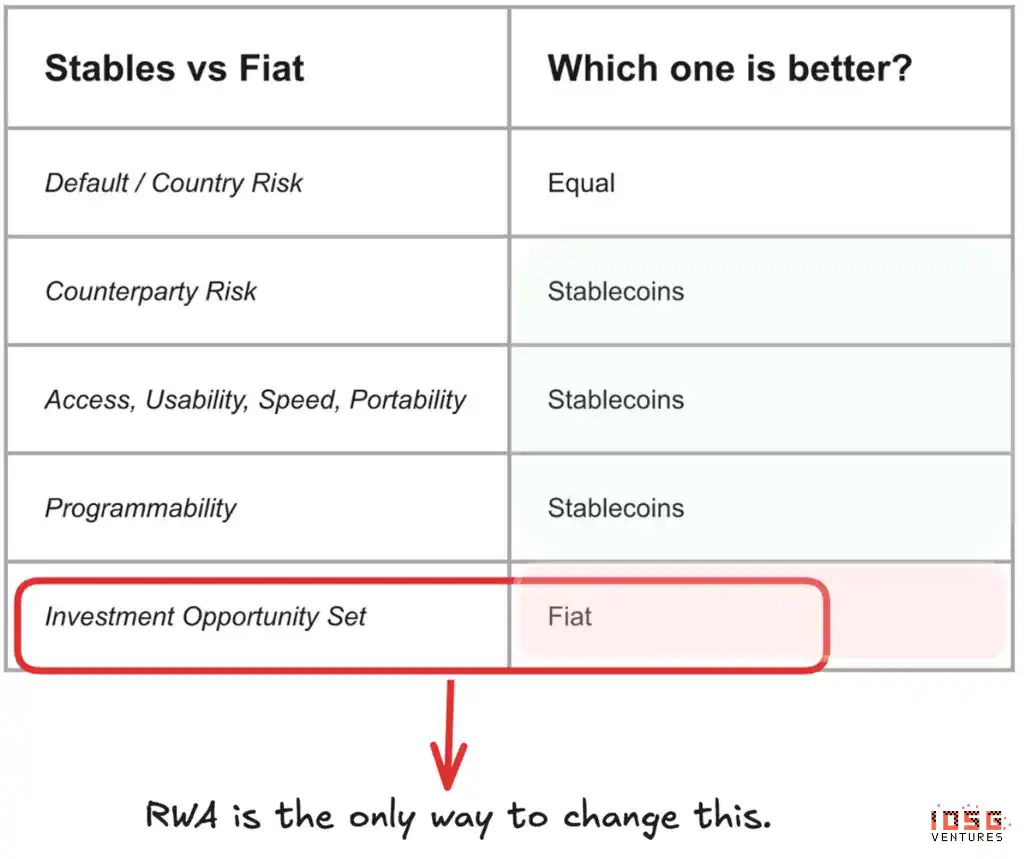
This is precisely why RWA (Real World Assets) becomes crucial. The tokenization of RWA is the only viable path to expand the investment scope of the stablecoin ecosystem, thereby addressing the most critical issue currently facing stablecoins. Given time, this will form a converging trajectory: almost all assets will be natively issued, traded, and settled on-chain.
Who is Most Likely to Prevail?
Traditional institutions like Robinhood and BlackRock have a clear advantage here, as both have expressed a willingness to tokenize more assets. However, startups are moving faster and are more agile in building on-chain natives, giving them a competitive edge. Backed Finance has launched X Stocks using Switzerland's innovative legal structure, achieving permissionless stock issuance similar to stablecoins, accessible to anyone. However, liquidity remains a challenge. Ondo Finance has addressed liquidity issues, but its products are more limited. Liquidity, accessibility, and trust are the key variables for success in this field.
DeFi Yield Challenges: From Basic to Structured Yields
Historical data shows that for every $1 increase in stablecoin market cap, DeFi TVL increases by about $0.6. This indicates that most of the new on-chain funds are seeking yield. The growth of stablecoins themselves also relies on DeFi's ability to generate diverse, scalable, and sustainable yields.
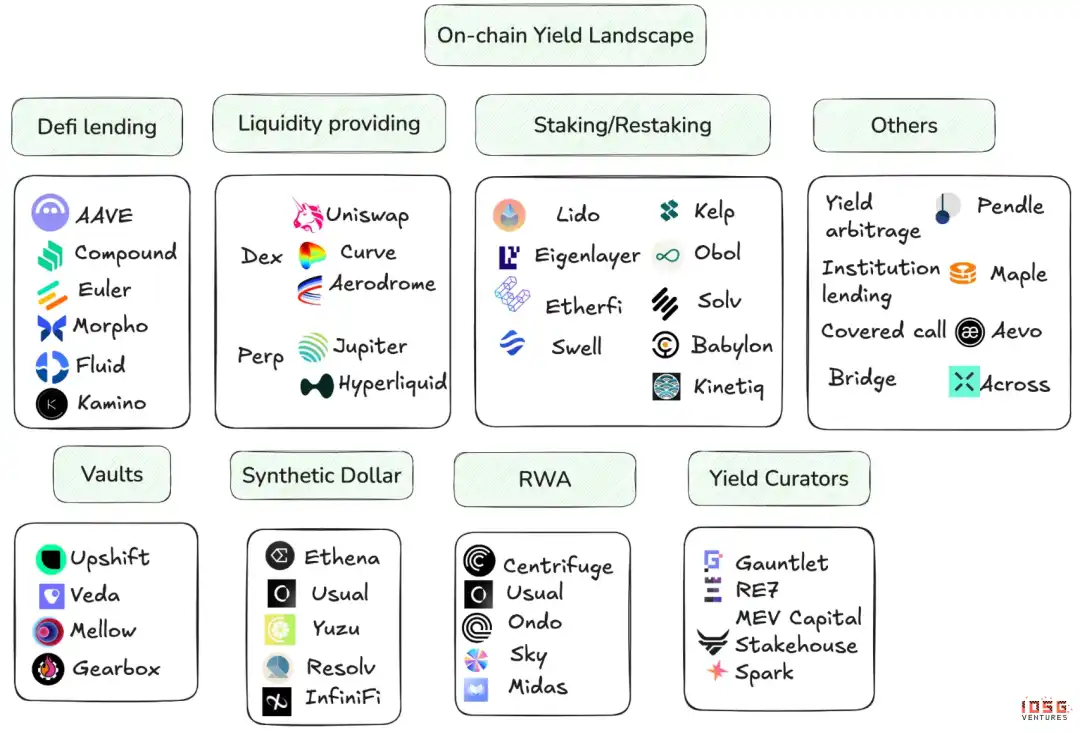
The crypto ecosystem has gone through different phases of yield generation. Starting with the establishment of a crypto risk-free rate (like AAVE), it has gradually evolved into more advanced products. Each iteration requires stronger risk underwriting capabilities while also bringing higher value appreciation per unit of deployed capital. The current landscape presents an increasingly complex on-chain yield across multiple categories. We are also seeing stronger interoperability among DeFi protocols, with composability becoming increasingly important. The best example: Ethena > Pendle > AAVE strategy. In this strategy, Ethena's deposit tokens are split into principal tokens and yield tokens on Pendle. As long as there is a positive spread between AAVE's borrowing rate and Ethena's funding fee, the principal tokens will be used as collateral to borrow more assets on AAVE, which are then redeployed back to Ethena.
This indicates that even familiar strategies can release unique opportunities when deployed in new ways. This should encourage more participants to tokenize a broader range of yield products and leverage on-chain composability to capture opportunities that fundamentally do not exist in the fragmented off-chain ledger world.
Another opportunity: abstracting the complexity of on-chain yield products to create a DeFi channel that can dynamically adjust exposures across the vast DeFi landscape. This can be seen as an upgraded version of Yearn's original vision, adapting to current needs, where successful DeFi vaults require more active management and risk underwriting. Projects like Yuzu Money are pursuing this path.
Who is Most Likely to Prevail?
This heavily depends on execution capability. It requires talent with deep financial engineering expertise, strong risk control capabilities, and experience in the crypto industry. Teams that possess all three are relatively scarce.
Prediction Markets: Growth and Opportunities of kalshi/Polymarket and Other Derivative Applications
We are optimistic about the growth prospects of prediction markets in 2026. The World Cup and the U.S. midterm elections will bring significant traffic boosts to the market, especially with the potential catalyst of TGE (Token Generation Events), making volume growth highly anticipated. Sports betting will be a highlight, and as the prediction market mechanisms mature, this vertical is expected to experience explosive growth and innovative gameplay.
Another important trend is localization. Recently, Polymarket has seen an increasing number of region-specific topics, particularly events that attract the attention of young people in Asia, contrasting sharply with the earlier focus solely on the U.S. market. This indicates that leading platforms are beginning to value global cultural differences, and the incremental market opportunities that arise from this should not be underestimated.
The ecosystem of derivative products will rise alongside the growth of Kalshi and Polymarket. After both platforms began focusing on ecosystem development in 2025, various tools, trading terminals, aggregators, and even DeFi applications have rapidly developed. This opportunity is too obvious, leading entrepreneurs to rush into the market, resulting in rapid product iterations and overall growth, but it is still too early to determine the winners.
Who is Most Likely to Prevail?
At the core level of prediction markets, directly challenging Kalshi and Polymarket is quite difficult. However, the following directions are worth paying attention to:
· Innovative Mechanism Breakthroughs: Innovations such as leveraged trading, parlay (multiple bets), futarchy (future governance), long-tail markets, new types of oracles, and settlement methods may open up differentiated survival spaces.
· Deep Localization: Focusing on the crypto user base and delving into local niche markets is another path. Kalshi and Polymarket are just starting in this area and do not have obvious advantages. For teams that understand local culture, regulatory environments, and user habits, this presents a genuine opportunity window.
Winners in the derivative product ecosystem will emerge through rapid iteration. The key is whether they can seize user pain points and establish network effects during the window of expansion in the Kalshi/Polymarket ecosystem.
Neobanks: Natural Beneficiaries of Stablecoin Adoption
The widespread adoption of stablecoins will fundamentally reshape the banking industry, likely reducing the balance sheet size of traditional banks and triggering numerous chain reactions, which are not the focus of this article. The key question is: how will people manage their stablecoin balances? We believe this is unlikely to be achieved through personal wallets. Instead, Neobanks are likely to become the main beneficiaries of this trend. Understanding the opportunities for Neobanks requires an understanding of the sources and nature of demand.
There are primarily three user groups: crypto-native users, users in developing regions, and users in developed regions.
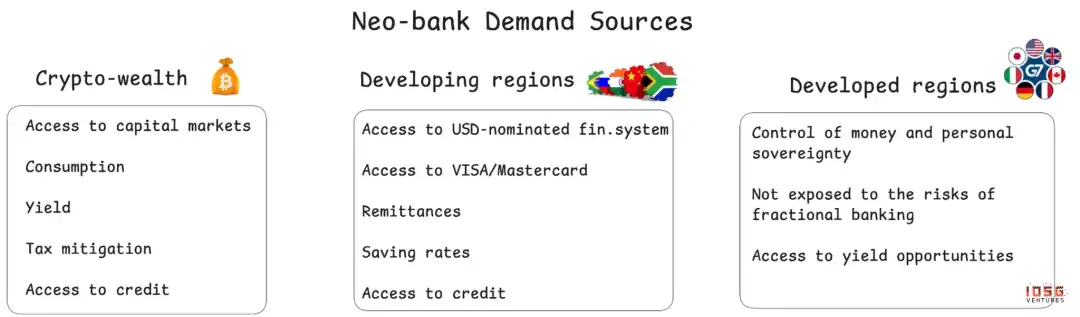
· Cryptocurrency Holders want access to capital markets, consumer choices, yield opportunities, tax optimization, and credit services. Etherfi is already leading in this category, but there is still room for improvement in accessing capital markets, yield generation, and credit products.
· Users in Developing Regions need access to dollar-denominated financial systems, Visa/Mastercard networks, remittance channels, competitive savings rates, and credit. Redotpay is currently leading in Southeast Asia, leveraging crypto infrastructure to offer products similar to Revolut. There are significant opportunities for localized solutions and small loan products that can improve user retention in other regions.
· Users in Developed Regions may not see opportunities as clearly due to the existing well-established financial infrastructure. However, as mentioned earlier, rising uncertainty in the global leadership landscape may drive these users toward alternatives.
This creates a triple market opportunity where Neobanks can utilize the same underlying stablecoin infrastructure to serve fundamentally different customer needs.
Who is Most Likely to Prevail?
Accessing capital markets requires creative legal solutions and financial expertise to provide deep liquidity. Offering credit necessitates financial professional capabilities. Improving yield solutions requires expertise in crypto and DeFi. Penetrating local markets requires an understanding of local laws, markets, and cultures. These variables provide key differentiation opportunities for new entrants, especially if existing players fail to unlock these capabilities and expand their service offerings.
The Evolution of Crypto Payments
The global payment system is being reshaped by crypto infrastructure, and large-scale adoption is advancing along three different channels. The C2B (Consumer to Business) channel currently still favors traditional finance, as crypto applications need to connect to the existing Visa/Mastercard networks, which have established a strong moat through extensive merchant coverage.
The bigger opportunity lies in P2P (Peer to Peer) flows, where traditional financial transactions are expected to migrate to crypto infrastructure. Faced with Neobanks, wallets, and large tech platforms that are integrating stablecoins, Western Union seems to lack a strong moat for self-defense.
The B2B (Business to Business) sector may represent the largest opportunity. Crypto payment providers can offer a true alternative for cross-border business payments. This represents a fundamental infrastructure shift that requires deep integration of stablecoins with fintech platforms. The core value proposition is significant cost savings and speed improvements. However, the challenge lies in establishing "last-mile" liquidity and local compliance capabilities in key regions so that customers can seamlessly connect to new solutions.
Who is Most Likely to Prevail?
For P2P payments, geographic focus and user experience are paramount: solutions that are already prepared for use, withdrawals, and consumption are most likely to succeed. For B2B payments, companies that have established relationships with SMEs and large enterprises while possessing regulatory expertise are in the most advantageous position.
Internet Capital Markets: The Endgame of Tokenization
Blockchain technology has enabled a single, programmable global ledger, allowing capital to flow around the clock, and tokenization makes any asset identifiable, tradable, and instantly settled across borders.
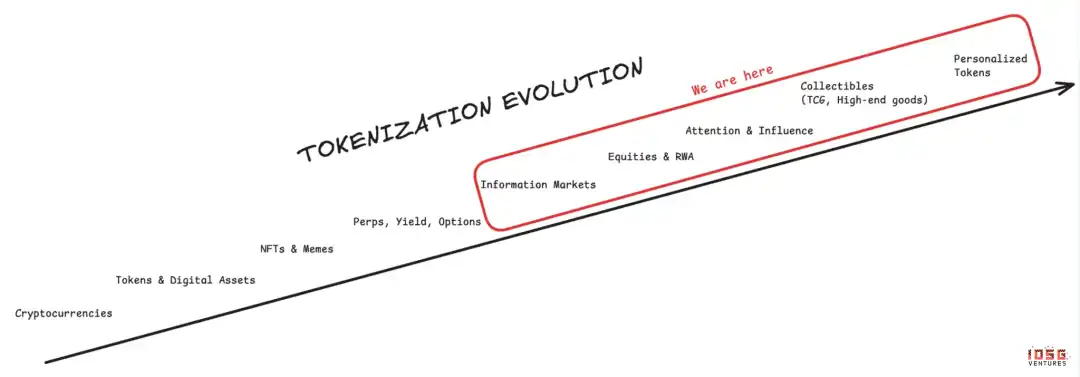
The evolution of tokenization has gone through different meta-cycles: from the initial cryptocurrencies to tokens (such as altcoins and digital assets), then to NFTs and meme coins, followed by information markets (prediction markets), and currently encompassing stocks, RWAs, and a wide range of financial derivatives. Looking ahead, frontier areas include collectibles (such as trading card games and luxury goods), attention and influence markets, and ultimately personalized tokens.
With each new meta-narrative, specialized trading infrastructure has followed suit. The crypto trading landscape has evolved from basic Bitcoin trading platforms (Binance, OKX, Coinbase, Huobi) to on-chain DEXs (Uniswap) and aggregators (1inch, 0x), then to NFT markets (OpenSea) and terminals (Blur), meme token launchpads (Pump.fun) and terminals (Axiom, GMGN, FOMO), Perp DEXs (Hyperliquid, Lighter) and their emerging terminals and aggregators, as well as prediction market platforms (Polymarket, Kalshi) and their own emerging terminal infrastructure.
Each meta-narrative requires interfaces tailored for retail users seeking simplicity and professional users needing advanced features. The current generation of products (focusing on perpetual contracts and prediction markets) presents significant venture capital opportunities as the market matures and integrates with traditional finance.
Who is Most Likely to Prevail?
The terminal and aggregator track requires a deep understanding of user workflows and excellent product design. In the professional user segment, teams with trading backgrounds and technical depth have an advantage. In the retail segment, expertise in consumer product development and growth marketing is more important. Winners will be those teams that achieve the best balance between functional depth and user experience for their target segments, while also building moats around liquidity aggregation or unique data/insights.
ICM: The Reconstruction of Token Mechanisms in 2026
An important proposition for 2026 is: how will the tool of tokens evolve? The current core issue with crypto tokens is the imbalance in supply structure combined with flawed incentive designs, leading all participants—trading platforms, token holders, teams, VCs, etc.—into a seemingly rational but ultimately detrimental game for all parties. Tokens are treated as financing and liquidity tools rather than product decision tools.
This has led to significant market distortions:
· Mature projects lack the motivation to maintain product operations after issuing tokens, or they are too distracted by token affairs, affecting product decisions. The result is that good projects simply abandon token issuance, bad money drives out good money, and poor projects continue to enter the market.
· Early projects issue tokens without PMF (Product-Market Fit) and struggle to continue financing after token issuance, failing to gain sufficient institutional support.
The concept of ICM (Integrated Capital Markets) was proposed by the Solana ecosystem, but a more general understanding is: how to ensure that more good assets are launched better and continue to remain good assets. The assets themselves can be equity in early Web2/Web3 companies, pre-IPO/IPO stocks, etc. This requires breakthroughs in multiple areas: legal discussions, market education, operational efforts, and mechanism innovations, including ownership coins, launchpads, etc. Making tokens better products—this is the crypto-native proposition to be solved in 2026.
The Fusion of Crypto and AI: Creating First-Class Digital Citizens
Perhaps the most compelling investment narrative will emerge at the intersection of crypto and AI. The existing internet and financial infrastructure are entirely designed for humans, relegating AI to "second-class citizens," and the significant limitations of the infrastructure fundamentally constrain the economic potential of AI.
Without crypto infrastructure, AI agents face severe constraints. They cannot open bank accounts or make payments, relying entirely on humans for financial transactions. They are constantly blocked by CAPTCHAs and bot detection systems, unable to complete basic online interactions. They cannot interact with other agents to create an economy among agents. They cannot own assets. They are trapped in centralized company servers or clouds, unable to migrate.
Cryptocurrency fundamentally changes this status quo, making AI first-class citizens with true economic agency. With crypto, AI agents can own wallets and autonomously send and receive funds, earn, consume, and invest independently without human intermediaries. They can bypass most bot detection through distributed blockchain networks. They can autonomously discover other AI agents, negotiate with them, and transact, creating an emerging AI-to-AI economy, where economic interests and quasi-crypto consensus and trust mechanisms will determine right from wrong. They can enter into contracts and programmatically execute payments. They can hold digital assets, with ownership enforced by immutable blockchains.
Google has promoted the A2A protocol, providing an open standard for AI Agents to communicate, exchange information, and coordinate actions across different platforms and vendors, facilitating interoperable multi-agent systems. However, trust issues remain, which is precisely what the Ethereum ERC-8004 standard aims to address through on-chain identity, reputation, and verification, enabling AI Agents to discover, authenticate, and collaborate in a decentralized economy without pre-established trust. These developments collectively unleash the potential for AI to participate in programmable, agent-driven commerce on the blockchain.
Who is Most Likely to Prevail?
Visionary entrepreneurs capable of architecting a decentralized economy will stand out, where AI Agents interact without trust through protocols like ERC-8004. These leaders excel in interdisciplinary innovation, seamlessly integrating cryptography (for secure, tamper-proof trust mechanisms), economics (for designing incentive-aligned agent behavior, staking, penalties, and emerging markets), and systems design (for building scalable, interoperable architectures that enable open, cross-organizational agent coordination without gatekeepers).
Resource Aggregation Opportunities
The scaling laws driving AI development have become very clear and are well-validated: more computing power, more data, and more parameters almost inevitably lead to stronger model performance. Therefore, this diagram encapsulates the most important insights from the past five years:
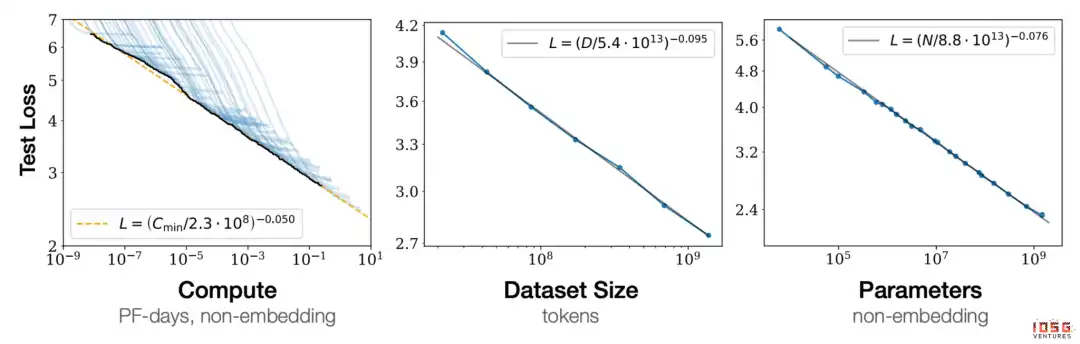
Cryptocurrencies excel at aggregating resources through carefully designed incentive mechanisms. Their potential scale is remarkable: before the merge, the computing power provided by Ethereum proof-of-work miners was about 50 times what was needed to train GPT-4. If properly incentivized and coordinated, this represents a vast untapped capability.
The data opportunity is equally significant. The crypto industry can aggregate proprietary data from individuals and businesses on a large scale. On the other hand, protocols like Grass enable distributed scraping of public network data and real-time information access, improving bot detection evasion and enhancing unit economics through a distributed approach to leveraging existing resources.
The challenge lies not in resource availability but in effective coordination and quality control. With proper execution and incentive design, the crypto industry has real potential to unleash vast resources for AI development, resources that are difficult or impossible to aggregate through traditional business structures.
Who is Most Likely to Prevail?
This requires deep technical expertise in distributed systems, AI infrastructure, and game theory design. Teams need to tackle challenges such as computing power verification, data quality assessment, and large-scale efficient coordination. Companies with backgrounds in large-scale infrastructure operations and crypto protocol design have the strongest advantages. Winners will be those teams that can achieve decentralized coordination economies of scale while maintaining quality standards.
Conclusion
The common thread behind these opportunities is convergence; crypto-native capabilities are continuously merging with traditional finance, payment systems, and now artificial intelligence. The phase of isolated development has ended, and the phase of overlapping convergence is accelerating. Comprehensive integration is the ultimate destination: blockchain infrastructure will become "invisible" yet indispensable, serving as the underlying engine that supports a new generation of financial and technological services, achieving seamless integration between decentralized and centralized systems, leveraging the strengths of both.
For venture capitalists, the real opportunity lies not in betting on "crypto" or "traditional finance," but in identifying those companies that are building bridges, infrastructure, and application layers that will define the future of this convergence. The most successful startups will no longer view crypto as a parallel financial system but as an infrastructure layer: a foundation that enables programmability, global settlement, autonomous agents, resource collaboration, and other capabilities that are fundamentally unattainable within traditional architectures.
免责声明:本文章仅代表作者个人观点,不代表本平台的立场和观点。本文章仅供信息分享,不构成对任何人的任何投资建议。用户与作者之间的任何争议,与本平台无关。如网页中刊载的文章或图片涉及侵权,请提供相关的权利证明和身份证明发送邮件到support@aicoin.com,本平台相关工作人员将会进行核查。


