Written by: Yue Xiaoyu
The prediction market is bound to be the biggest trend and opportunity in 2026.
It's important to note that two major events will take place in 2026: the World Cup and the U.S. midterm elections.
These two significant events will directly spark a new wave of excitement in the prediction market.
The three hottest areas in the prediction market are sports, cryptocurrency, and political events.
Currently, in the overall landscape of the prediction market, Polymarket can be said to be the dominant player, absolutely leading the pack.
Next is the compliant platform Kalshi, which has already captured a significant market share in the U.S.
Aside from that, the position of the second player has not yet been firmly established.
Currently, there are three popular candidates in the Binance ecosystem: Opinion @opinionlabsxyz, PredictFun @predictdotfun, and Probable @0xProbable.
So, which of these three will come out on top?
I used Polymarket as a benchmark to systematically compare and analyze the three projects.
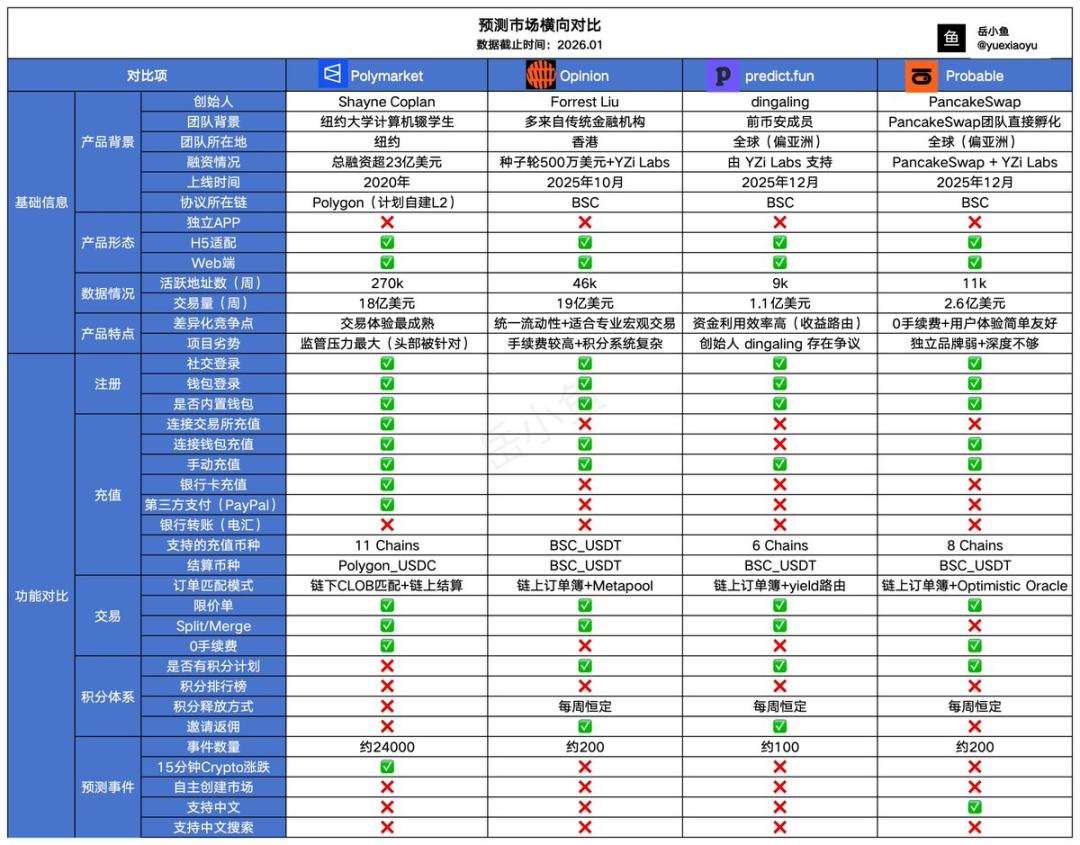
Product Background Comparison
Polymarket was founded by a computer science dropout from New York University.
The product was launched around 2020, but it really gained traction during the 2024 U.S. elections, with total funding exceeding $2.3 billion, making this project quite legendary.
This also highlights the opportunities present in our Web3 industry.
The founder of Opinion and the team mainly come from Hong Kong and many top financial institutions. They are also a project backed by Binance and launched in October 2025.
The founder of PredictFun was previously an employee at Binance and later worked on PancakeSwap and several other projects, also backed by Binance.
Probable is a project incubated directly by the PancakeSwap team and has also received investment from Binance.
Overall, the backgrounds of the three are quite similar, but Probable is undoubtedly a direct descendant of Binance and will likely receive significant support moving forward.
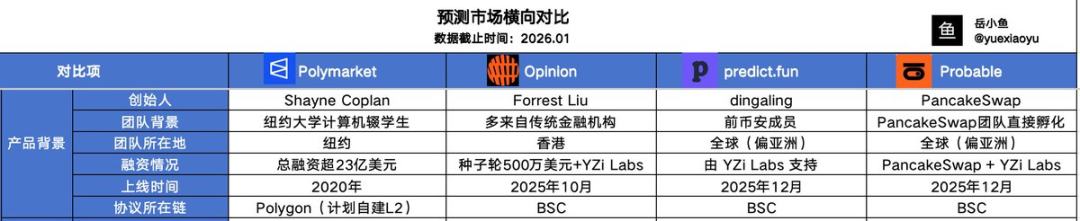
Product Form Comparison
Currently, none of the platforms have independent apps; they mainly operate on the web, and these projects have also developed H5, which is mobile-friendly.
We can take a closer look at the data to assess their current development status.
First is Polymarket, which has reached 270K weekly active addresses, with a trading volume of $1.8 billion and an average transaction volume of $6,666.
Next is Opinion, with 46K active addresses, a trading volume of $1.9 billion, and an average transaction volume of $41,304, which has already surpassed the leading player.
Of course, the core reason is its points system, which attracts many users looking to claim airdrops.
PredictFun has 9K active addresses and a trading volume of $110 million, showing a significant gap of over ten times compared to the first two.
Probable's scale is similar to PredictFi, with 11K active addresses and a trading volume of $260 million.
Overall, since Opinion launched earlier than the other two, after Polymarket sparked the prediction market craze, it directly attracted attention and liquidity that overflowed from the market.
Combined with the expectations of airdrops, it has established a significant competitive advantage.

Core Advantages and Disadvantages of the Products
First, let's look at the differentiated competitive points.
Polymarket's biggest advantage lies in its established moat, with the best liquidity and the most mature trading experience.
After all, it has been around since 2020 and has developed for five years.
So this is the biggest barrier.
Of course, its disadvantages are also quite obvious, as it is the leading prediction market and thus faces the greatest regulatory pressure.
Its development status also represents the ceiling of this track.
Then there's Opinion, whose differentiated competitive point is its concept of unified cross-market liquidity.
It also focuses more on macro predictions.
So overall, it is more suitable for professional traders.
However, its disadvantage is that the transaction fees are relatively high, and the points system is quite complex, with users still figuring out how to optimize their points.
PredictFun's differentiated competitive point is its high capital utilization efficiency, as it has a very innovative mechanism called yield routing.
In other prediction markets, when users place bets, the funds are locked in smart contracts, but it has created a new mechanism that allows these funds to be allocated to on-chain protocols for yield generation.
This increases the overall capital utilization efficiency.
However, this project also has its disadvantages; the founder's background is quite controversial, including some conflicts with CZ, and many of his past projects have failed, facing community criticism.
Thus, the founder is the biggest disadvantage of this project.
Lastly, Probable's advantage is that it has no transaction fees, thanks to the support of PancakeSwap, a leading protocol on BSC, which effectively provides it with liquidity, allowing it to offer zero fees.
Moreover, the overall user experience is simple and friendly, aligning well with PancakeSwap's style.
However, its disadvantages are also quite apparent; being incubated by PancakeSwap, it has a relatively weak independent brand identity.
Additionally, since this platform is relatively new, its overall trading depth is still insufficient.

Function Comparison - Registration and Deposit
After comparing the basic information of the four projects, we can take a closer look at the functional comparisons of these four platforms. I have divided it into several modules, which include the user journey: registration, deposit, trading, as well as a points system and specific prediction events.
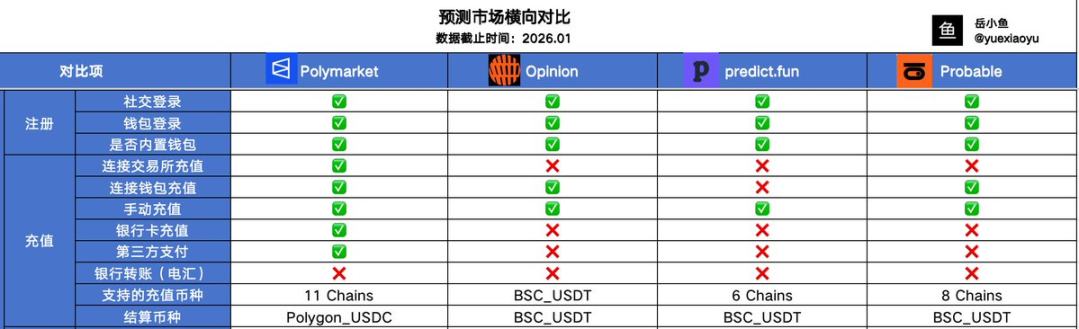
First, regarding registration, these platforms are basically consistent; they all support social logins and wallet logins, and based on the user's social account or wallet account, they create an internal wallet, so the registration experience is essentially the same.
Next, looking at deposits, Polymarket has the most diverse deposit methods. It supports not only wallet connections but also exchange account deposits, manual deposits, bank card deposits, and integrates third-party payments like PayPal and Google Pay.
I think this is a very mature aspect of Polymarket.
Because the prediction market is not limited to Web3 users, it is more like a killer application that can achieve mass adoption in Web3, so many users from outside the crypto space are also using this platform.
Being able to support traditional payment methods for deposits is very beneficial for external users to enter the prediction market and lowers the usage threshold.
Of course, in the end, it will settle as USDC on the Polygon chain, which will be uniformly used and settled on the platform.
Opinion does not support exchange payments or bank card third-party payments. Currently, it only supports deposits in USDT on the BSC chain, which is relatively singular, especially for crypto-native Web3 users, as it only supports one coin on one chain, requiring users to find cross-chain bridges or exchanges themselves.
So PredictFun and Probable perform relatively better; they can support assets from other chains for deposits, allowing for self-exchange.
Function Comparison - Trading
The order matching models of the platforms still have some differences.
Polymarket mainly uses an off-chain CLOB matching method, along with on-chain settlement.
Polymarket supports limit orders, and split merge also has zero fees.
The three on BSC all adopt a fully on-chain order book.
However, Opinion has proposed a concept called MetaPool, which aims for unified cross-market liquidity.
It has not yet been implemented, but if it can be realized, it would be very beneficial for professional traders.
PredictFun has created a yield routing mechanism that allows underlying assets to be placed in on-chain protocols for yield generation.
Probable may be relatively weaker overall in this mechanism, mainly using optimistic proofs.

Function Comparison - Points System
Polymarket does not have a points system, but the others do.
The points system is key for startup projects to accelerate their development through airdrop expectations.
This also indicates that these three projects will definitely issue tokens, with clear expectations for airdrops.
The more competitive the track, the more opportunities there are for ordinary users, and participation is essential.

Function Comparison - Prediction Events
Regarding the prediction events on the platform, Polymarket has the most events, with about 24,000.
Opinion has 200, PredictFi has 100, and Probable also has 200.
So the latter three are roughly similar in scale.
Moreover, currently, none of these platforms support self-service market creation.
Of course, in the future, they may consider creating decentralized prediction markets or initially implementing semi-permissioned market creation.
In terms of support for the Chinese market, Probable is currently performing quite well, supporting Chinese. (However, it does not yet support direct searches for prediction events in Chinese.)
After all, being in the BSC ecosystem, there are the most Chinese users, so their Chinese adaptation is relatively friendly.

In Summary
Trading Experience: Opinion > Probable > PredictFun
Liquidity: Opinion > Probable > PredictFun
Association with Binance: Probable > Opinion > PredictFun
Future Development Potential (personal opinion): Probable > Opinion > PredictFun
免责声明:本文章仅代表作者个人观点,不代表本平台的立场和观点。本文章仅供信息分享,不构成对任何人的任何投资建议。用户与作者之间的任何争议,与本平台无关。如网页中刊载的文章或图片涉及侵权,请提供相关的权利证明和身份证明发送邮件到support@aicoin.com,本平台相关工作人员将会进行核查。


