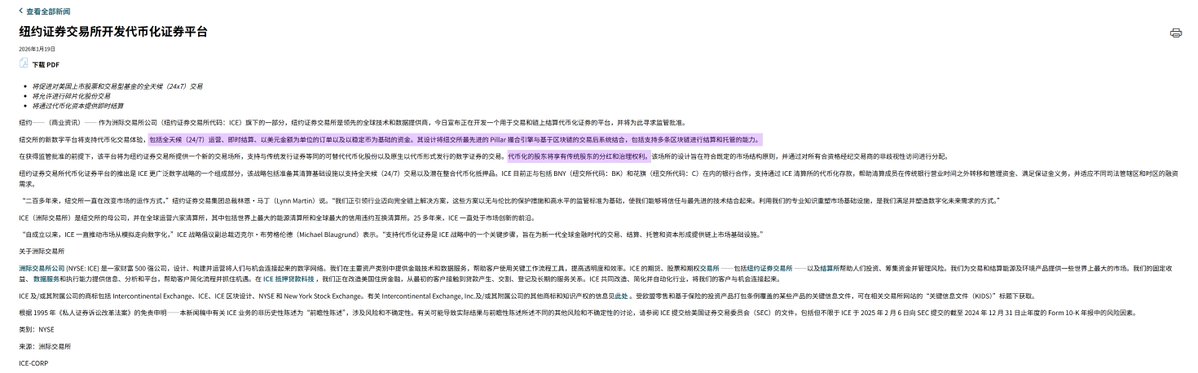
What you may not know about the tokenization of NYSE stocks, besides being 7x24 hours, what has really changed?
This matter has not yet been approved, and it is unknown when it will be approved. The platform itself is likely a combination of centralized and decentralized.
This platform can tokenize both the "old" US stocks and issue new tokenized stocks.
Both old and new platforms will coexist; the New York Stock Exchange will continue to have closing hours, while the new exchange will operate continuously. Liquidity will synchronize during opening hours through the shared Pillar engine and the fungibility of tokenized shares, allowing arbitrage to correct deviations. During non-opening hours, liquidity will mainly be provided by market makers and limit order books, with plans to introduce oracles to balance prices across different public chains.
It has not been determined which stablecoin will be used for trading, but compliant stablecoins are necessary and must be backed by fiat currency. There are considerations to collaborate with banks like BNY Mellon and Citi to adopt tokenized deposits, and the issuance of new stablecoins is not ruled out.
The issued tokens can be exchanged 1:1 with the underlying stocks, enjoying all the rights of the underlying stocks.
Some people say it will impact the current US stock tokenization exchanges, but this is not the case. The new platform will not directly face users; access will be through broker-dealers, meaning that qualified US stock tokenization exchanges can connect to this platform.
The 7x24 availability may not necessarily be beneficial for retail investors; it more reflects changes in volatility structure, including weekend event risks and overnight information shocks that will more directly impact prices. For example, the recent Greenland tariffs would erupt immediately without waiting for Tuesday.
This is the true RWA of US stock tokenization, but I still believe the ceiling will not be very high. Its greatest increment lies in the transformation of infrastructure such as trading hours + settlement funds 7x24 + fractional shares (ordering by amount) + faster settlement. For ordinary investors, aside from improved trading convenience and liquidity limits, it may not bring essential changes.
For market makers, T+0 and 7x24 greatly enhance capital turnover rates. However, it also increases inventory and margin pressure during non-opening hours, potentially widening spreads and increasing impact costs.
The New York Stock Exchange can create a platform and tokenize the rights of existing stocks into tradable or settlement forms, but the issuing company only truly utilizes this tokenization capability when choosing native digital securities. However, these tokenized stocks cannot be directly used for DeFi.
Non-native stock tokens that cannot connect to the new exchange pose significant challenges for trading platforms. It is a major challenge for platforms that lack compliance and capital scaling.
Exchanges like #Binance and #Bitget that have already connected to US stock tokenization are not without opportunities; they can acquire a clean, small US broker-dealer that already has NYSE membership. This is similar to acquiring a company with a payment license. Through this subsidiary, they can access the NYSE's tokenized platform. Alternatively, they can collaborate with compliant US broker-dealers, where the exchange provides the front-end interface and user traffic, while all backend trading routes to the compliant broker-dealer for execution on the NYSE.
The greatest potential of the system lies in 24/7 collateral management. Institutions can instantly use their tokenized US stocks as collateral on Sunday mornings, with real-time pricing and transfers conducted by the NYSE's clearinghouse to meet margin requirements for derivatives trading or to obtain liquidity. This releases the liquidity of trillions of dollars in dormant assets.
The NYSE will become the main 7x24 official oracle for global financial markets. Previously, weekend speculation on macro events in the crypto space relied on guessing or looking at poorly liquid over-the-counter derivatives. In the future, global assets, including those from the London and Tokyo exchanges, may need to reverse-anchor to the prices generated by the NYSE on weekends. This further solidifies the pricing hegemony of dollar assets.
The coexistence of new and old systems will create structural arbitrage opportunities, especially concentrated around opening hours, periods of thin liquidity, and when cross-venue or cross-chain settlement frictions occur.
@bitget VIP, lower fees, better benefits
免责声明:本文章仅代表作者个人观点,不代表本平台的立场和观点。本文章仅供信息分享,不构成对任何人的任何投资建议。用户与作者之间的任何争议,与本平台无关。如网页中刊载的文章或图片涉及侵权,请提供相关的权利证明和身份证明发送邮件到support@aicoin.com,本平台相关工作人员将会进行核查。


