Original|Odaily Planet Daily (@OdailyChina)
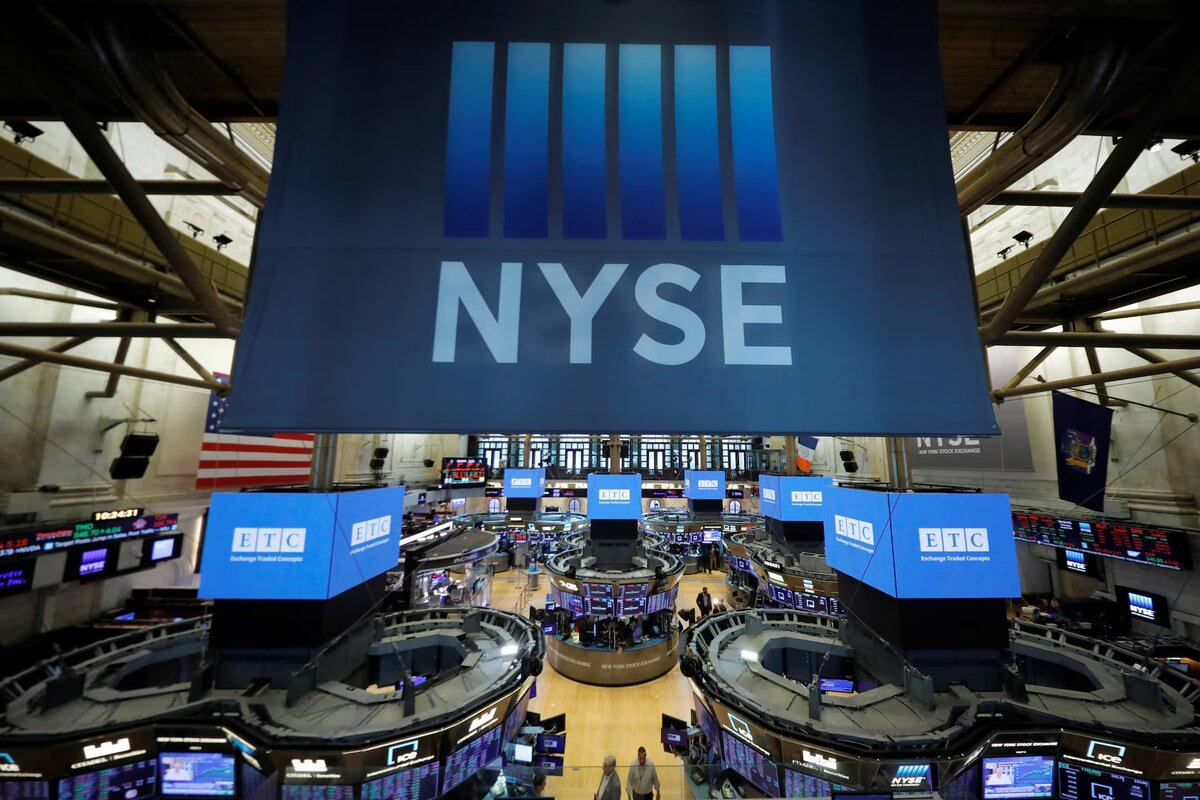
The “Flash Crash Monday” has not yet ended, and just now, the crypto market has received another heavy bombshell—according to multiple media sources, the New York Stock Exchange (NYSE) plans to launch a tokenized securities trading and on-chain settlement platform that supports 24/7 trading. After investing $2 billion in Polymarket last year, the ICE Group is once again leveraging its securities exchange to join the century's wave of cryptocurrency transformation. It is worth mentioning that as early as last September, the “competitor” Nasdaq had submitted a tokenized stock trading application to the SEC, and the NYSE's change is also interpreted as a response to competition among securities exchanges.
Odaily Planet Daily will briefly summarize market views related to this event in this article and explore its potential impact.
The NYSE is also taking action: A more aggressive “on-chain tokenization solution” than Nasdaq
After Trump took office, the regulatory environment for cryptocurrencies in the U.S. changed, leading to a flourishing development of crypto IPOs, stablecoins, PayFi, and DeFi, sweeping away the policy gloom of the Biden administration. According to statistics, last year, the trading volume of stablecoins reached $33 trillion, a year-on-year increase of 72%. Behind this is the substantial revenue profit earned by Tether and Circle, representing a massive liquidity that can guide into the stock securities market.
Moreover, unlike Nasdaq's submission of a tokenized stock trading application to the SEC last September, nearly half a year later, the NYSE's actions regarding “stock tokenization” are not just an application to regulatory authorities but a complete “on-chain solution.” Recommended reading: “The Self-Revolution of U.S. Stock Exchanges: Nasdaq Applies for Tokenized Stock Trading, Targeting a Trillion-Dollar Market”.
Specifically, the NYSE's “on-chain tokenization solution” includes the following three aspects:
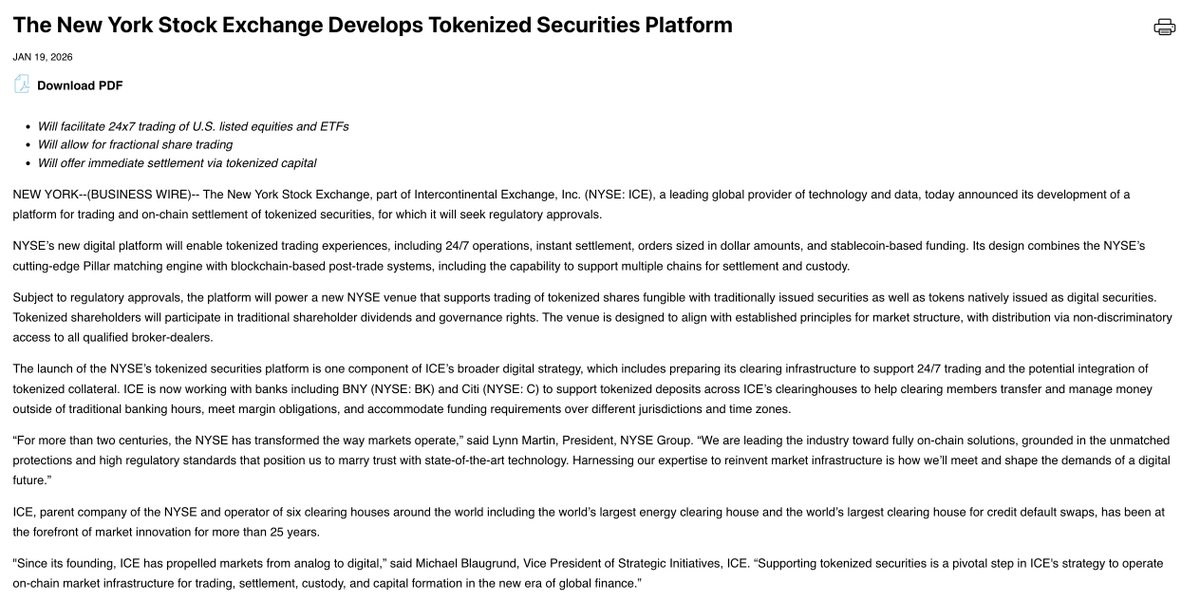
- It is a tokenized securities trading and on-chain settlement platform that plans to support 24/7 trading of U.S. stocks and ETFs, fractional trading, stablecoin-based fund settlement, and instant delivery, combining the existing matching engine of the NYSE with a blockchain settlement system.
- According to the NYSE's plan, tokenized stocks will have the same dividends and governance rights as traditional securities.
- The NYSE's parent company, ICE, is also collaborating with banking giants like BNY Mellon and Citigroup to explore tokenized deposit and clearing infrastructure to support cross-timezone, round-the-clock fund and margin management.
In comparison, if Nasdaq's application for stock tokenization seems like a “new wine in an old bottle” made in response to policy, then the NYSE's plan appears to be a “new retail trading platform” that connects all aspects of “brewing, packaging, distribution, and recycling.”
Most importantly, the NYSE's “stock tokenization” trading platform supports 24/7 trading, which was originally one of the advantages of various cryptocurrencies over securities stocks. Now, this advantage becomes a joke in the face of the massive asset targets and liquidity possessed by one of the world's largest stock exchanges, the NYSE.
As a result, there are some pessimistic views in the crypto market: “The RWA track of the cryptocurrency market and the increasingly tightening liquidity will face the harshest ‘father’; compared to the NYSE with an annual trading volume exceeding $100 trillion, crypto RWA projects can almost be said to be nonexistent.”
How crypto practitioners view it: Mixed impacts, the past is the past, and the present is the present
In 1792, 24 securities brokers signed the Buttonwood Agreement under a sycamore tree outside 68 Wall Street in New York, marking the birth of the NYSE's predecessor. At that time, limited investment targets and market activity meant that stock trading hours were flexible, with no strict continuous trading periods, and brokers mainly traded through auctions or informal methods.
On March 8, 1817, the organization officially changed its name to the New York Stock Exchange by drafting a charter.
In May 1887, the NYSE standardized stock trading hours to “Monday to Friday: 10:00 AM to 3:00 PM; Saturday: 10:00 AM to 12:00 PM.”
In 1952, Saturday trading was officially canceled.
In 1985, the stock trading opening time was moved to 9:30 AM, and the closing time was extended to 4:00 PM, forming the current 9:30–4:00 period, which has lasted for about 41 years.
If the NYSE's application for 24/7 trading of tokenized stocks is approved, it will mean that this “limited trading model” that has lasted for decades or even centuries is about to become history. From this perspective, the crypto market gains high recognition from the mainstream financial community.
Proponents' View: The Era Train is Whistling Towards Us
BTC OG and BankToTheFuture founder Simon Dixon posted, “Nothing can stop this (era) train. Tokens are IOUs for actual assets held by custodians, complementing DTCC claims. 24/7 trading can be achieved without tokens. This is an upgraded version of a surveillance state. You will own nothing but feel happy.” The accompanying image shows BlackRock CEO Larry Fink embracing Coinbase CEO Brian Armstrong.

Indian crypto KOL Open4profit posted, “(This will) allow the market to react immediately to global news; AI and algorithms will play a greater role in pricing and risk management; this is a significant change for the stock market, so pay close attention to liquidity changes.”
Marcin, co-founder of Redstone DeFi, sees “entrepreneurial opportunities” and stated: “This is a good start and aligns with what we are going to do next.”
Jake O, head of Wintermute OTC business, also highly affirmed this matter: “Traditional infrastructure can extend trading hours but cannot solve T+1/2 friction, nor can it eliminate the rent-seeking behavior that increases costs and delays. Ironically, cryptocurrencies solved this problem years ago: 24/7 trading, instant settlement, global access, no gatekeepers or ‘data fees’ from traditional banks. Integration is imperative: equity trading on-chain, settlement achieving atomization, the boundary between ‘crypto’ assets and ‘traditional’ assets will completely disappear. Welcome to the 21st century…”
Of course, some see it as an opportunity, while others view it as a threat.
Opponents' View: Exchanges Reap Profits, While the New Generation Suffers
Unlike the industry’s belief that the NYSE's move will stimulate the development of the crypto market and promote the popularization of cryptocurrencies, some industry insiders also see potential issues.
Investment firm L1D partner LouisT posted: “The entire global financial system is migrating on-chain, but for some reason, they don’t seem to be bidding for our ‘bear market’ tokens.” In other words, the traditional financial market does not buy into the so-called RWA assets of cryptocurrencies.
MoonRock Capital founder expressed concerns about the living conditions of the younger generation: “This is not good news for the baby boomer generation; your lives have become more difficult.” This likely refers to the fact that compared to the previous generation with ample incremental opportunities, the baby boomer generation faces a more complex investment environment and a 24/7 “liquidity gaming stage.”
BingX advisor Nebraskangooner also raised his doubts: “Why should the stock market trade 24 hours? No one wants this except the exchanges. (This matter) only benefits from the absence of after-hours trading interference, allowing stop-loss and take-profit points to truly take effect. I wonder what impact this will have on stock price movements after earnings reports?” This viewpoint focuses more on information impact and exchange profits.
Summary: Traditional Finance and Crypto Native Groups Still Have a Gap, Opportunities for Users and Entrepreneurs Remain
Finally, I would like to briefly share my personal views based on the above information:
First, based on the current information, the NYSE's related application may not be approved until the end of 2026, and the main approval authority remains the U.S. SEC, which presents an important time lag for crypto platforms.
Second, the main service targets of the NYSE's stock tokenization trading and on-chain settlement platform are likely still conventional investment institutions and compliant investors. For the crypto native community and global investors, they need not only functional requirements to be met but also the ability to achieve “KYC-free registered trading, global asset liquidity allocation, and higher-risk leverage” through stock tokenization and RWA platforms, which may be the advantage of crypto RWA projects.
Finally, the core purpose of the NYSE, Nasdaq, and others promoting stock tokenization remains trading volume and transaction fees, similar to how current CEXs continuously launch new token projects. In the short term, they may still need to learn from CEXs, DEXs, and even on-chain Perp DEXs, which is also the foundation for existing mature platforms to potentially stage a counterattack. At that time, the NYSE, Nasdaq, and other U.S. stock exchanges are not without the possibility of falling from grace. The key still lies in where liquidity is, where attention is, and where the user base is.
免责声明:本文章仅代表作者个人观点,不代表本平台的立场和观点。本文章仅供信息分享,不构成对任何人的任何投资建议。用户与作者之间的任何争议,与本平台无关。如网页中刊载的文章或图片涉及侵权,请提供相关的权利证明和身份证明发送邮件到support@aicoin.com,本平台相关工作人员将会进行核查。


