Entering 2026, X (Twitter) has been making frequent moves. While we cannot see if anxiety is written on Musk's face, we can see his anxiety reflected in his tweets.
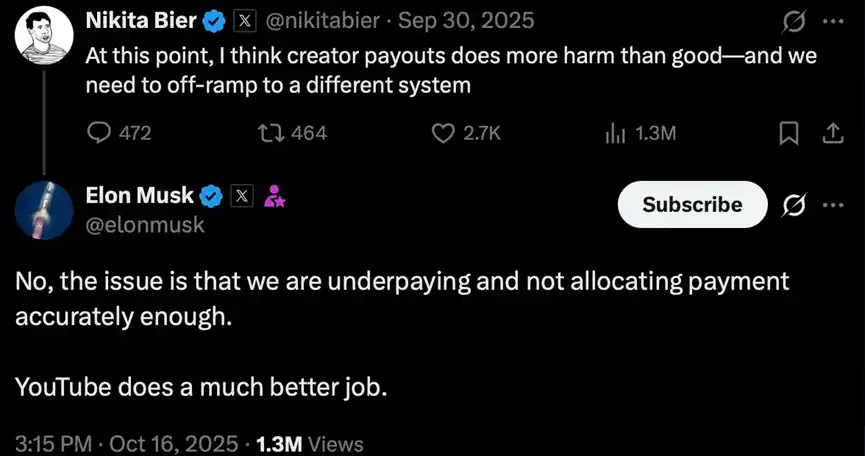
Musk said, "We are still paying creators too little, and the distribution is not good enough; YouTube does this much better than we do."
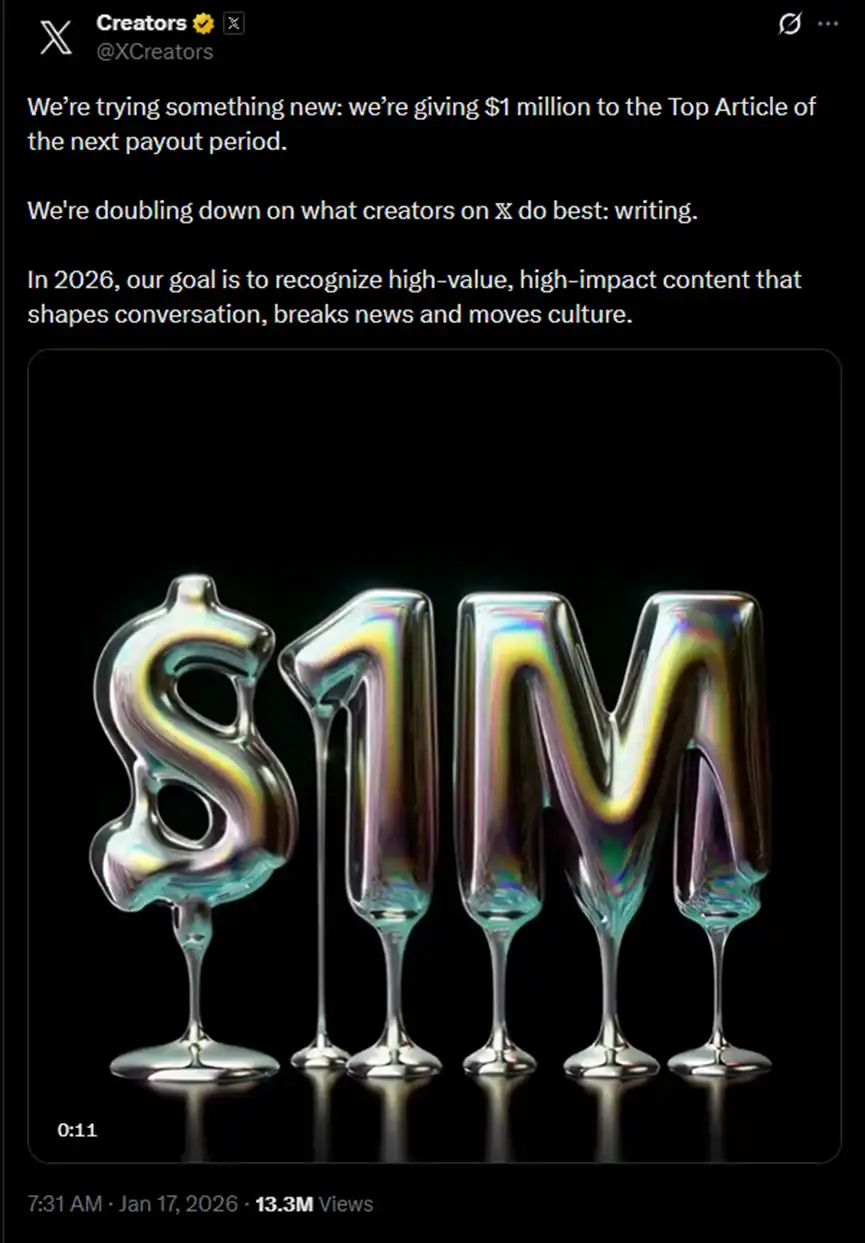
Last weekend, X officially launched a "Million Dollar Article Bounty" campaign, sparking a wave of "long-form content" on the platform.
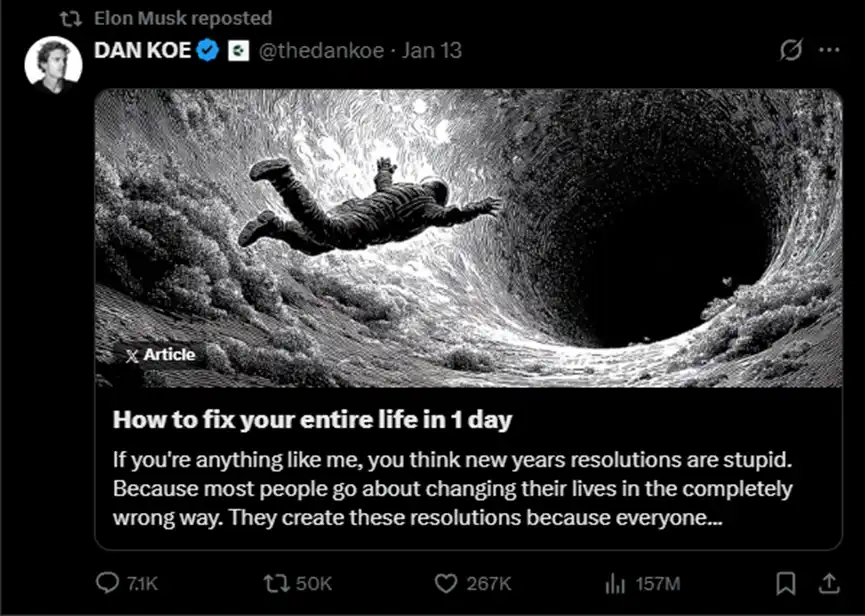
The most influential article so far is "How to Fix Your Life in One Day" by DAN KOE, which has garnered over 150 million views and received a retweet from Musk.
Musk has owned X for several years; why is he now vigorously promoting the creator ecosystem on X this year? In an era where global user reading habits are fragmented, why has he chosen to focus on long-form content? Can the revival of long content truly support Musk's ambition for an Everything App?
Musk's Anxiety
Every family has its own difficulties, and even geniuses face their own anxieties. The relentless pressure from competitors and X's financial performance have made Musk restless.
X is facing fierce competition in user growth and engagement, especially since Meta's Threads launched in 2023, which has seen rapid growth and has surpassed or closely approached X in several metrics.
According to the latest data released by data analytics company Similarweb in early January 2026, Threads' global daily active users (DAU) have exceeded X, averaging 143.2 million, while X stands at 126.2 million. In terms of growth trends, X's global DAU has decreased by 11.9% year-on-year, while Threads has achieved an astonishing growth of 37.8%. Even in X's home market of the United States, although X still leads with 21.2 million DAU compared to Threads' 19.5 million, the gap is rapidly narrowing, with Threads experiencing a year-on-year growth rate of 41.8%, while X has declined by 18.4%.
In terms of monthly active users (MAU), Threads also performs well. As of January 2026, its MAU has reached 320 million, growing from 350 million to 400 million in 2025. In contrast, while X still has about 611 million MAU, it has lost approximately 32 million users since Musk's acquisition. This ebb and flow undoubtedly puts immense pressure on Musk.
The decline in user data directly impacts X's core revenue source—advertising. According to public data, X's global advertising revenue fell to $2.5 billion in 2024, nearly halving from $4.4 billion in 2022. Although it is expected to slightly rebound to $2.26 billion in 2025, the overall downward trend remains evident, with some institutions predicting it will only recover to $2.7 billion by 2027.
Meanwhile, competitor Threads is viewed with high expectations by the capital market. Analysts predict that Threads' advertising revenue could reach $11.3 billion in 2026, several times that of X's estimated revenue. Although X achieved quarterly revenue growth by the end of 2025, the company remains in a loss position due to high restructuring costs.
While subscription users (X Premium) saw significant growth in 2025, their revenue contribution is far below Musk's initial vision of "50% of total revenue." Therefore, X has directly linked the growth of Premium subscriptions to creator earnings, aiming to provide higher earnings for creators and clearly basing earnings calculations on the impressions from paid users (Verified Home Timeline impressions), thereby incentivizing creators to produce high-quality content that attracts paid users, thus driving more users to subscribe to Premium services.
As a result, we ultimately witnessed this "Million Dollar Article Bounty" campaign initiated by Musk, which users in the Chinese community jokingly referred to as a "new concept essay competition" in the U.S. in 2026.
The Revival of Long Content
Musk's choice to focus on long articles as a breakthrough for X's creator ecosystem is not a whim but is based on a deep strategic consideration of X's platform positioning.
Currently, X's recommendation algorithm has a core metric—"regret-free user time," which measures the total time users effectively spend on a piece of content. Musk has explicitly stated that this mechanism naturally favors long-form content because it can "accumulate more user seconds," thereby enhancing the algorithmic weight of the content and the overall user engagement on the platform.
Long articles, due to their depth, context, and complete narrative, naturally extend user dwell time, contrasting sharply with the rapid consumption model of short posts or short videos. Recent algorithm updates have even introduced "content format weighting," clearly favoring long-form content that requires more creative effort and has a greater impact. This not only incentivizes creators but is also a data-driven decision: high-quality long articles can effectively reduce user exits to external links and keep users on the platform longer, while also providing more high-quality training data for Musk's AI project, Grok AI.
Musk has repeatedly emphasized his desire to make X "the world's primary news source," replacing traditional media by aggregating "collective wisdom" in real-time. The long article feature allows users to publish "complete articles or even books," enabling domain experts, eyewitnesses, and deep creators to share their complete insights directly on the platform, rather than fragmented information. Additionally, compared to other platforms' substantial subsidies for short videos, the incentive model for long articles is more easily realized through a subscription model, attracting more professional journalists and writers back to the X platform.
However, the question arises. You may ask, in today's world where global user reading habits are fragmented, why is Musk pursuing this "Renaissance" of long content?
It is undeniable that global users' digital reading habits are showing a clear trend of fragmentation, especially under the impact of short video platforms, with younger groups like Gen Z preferring to engage in "fragmented" reading multiple times a day, each lasting 5-10 minutes. However, data also shows that overall reading volume is actually increasing; as a counter-movement, "slow immersive reading" is on the rise, with people beginning to seek depth, emotional connection, and meaningful content consumption amid digital fatigue.
What X desires is not to become another TikTok-like entertainment platform, but to become a "lifestyle hub" like WeChat, deeply integrated into the daily lives of every American, which is Musk's long-cherished vision of an "Everything App." To achieve this, it is essential to greatly enrich the platform's content and service ecosystem, enhance users' "regret-free usage time," and provide them with more reasons to stay on the platform and complete more tasks.
The Ambition of the Everything App
All of Musk's efforts ultimately point to a grand goal: to transform X into an "Everything App" like WeChat. However, to realize this ambition, X has a long way to go.
Compared to WeChat, X has significant gaps in several key metrics. In terms of monthly active users (MAU), WeChat boasts over 1.4 billion users, while X has only 557 million, less than one-third of the former. This vast difference in user base makes it difficult for X to form the powerful "network effect" that WeChat has—where users cannot leave the platform because all their friends, family, and life services are there. WeChat has become an essential part of many people's daily lives, while X, in the eyes of most users, is still a social media platform for news and opinions, reminiscent of the old Twitter, the "American Weibo."
The gap is equally evident in user stickiness. WeChat users spend an average of 82 minutes per day on the app, while X users only spend 30-35 minutes. The reason behind this is that users can complete a multitude of "productive" tasks within WeChat, such as chatting, making payments, shopping, and accessing municipal services, while X's content consumption remains primarily passive browsing, leading to a "scroll and leave" experience.
Musk does not want X to become TikTok, so he first needs to eliminate the "scroll and leave" entertainment user experience. He needs high-quality, in-depth content to enhance user stickiness, attract and retain high-value users, and gradually integrate more services like payments and e-commerce based on content, ultimately paving the way for the "Everything App."
The grander the dream, the deeper Musk's anxiety will be.
免责声明:本文章仅代表作者个人观点,不代表本平台的立场和观点。本文章仅供信息分享,不构成对任何人的任何投资建议。用户与作者之间的任何争议,与本平台无关。如网页中刊载的文章或图片涉及侵权,请提供相关的权利证明和身份证明发送邮件到support@aicoin.com,本平台相关工作人员将会进行核查。