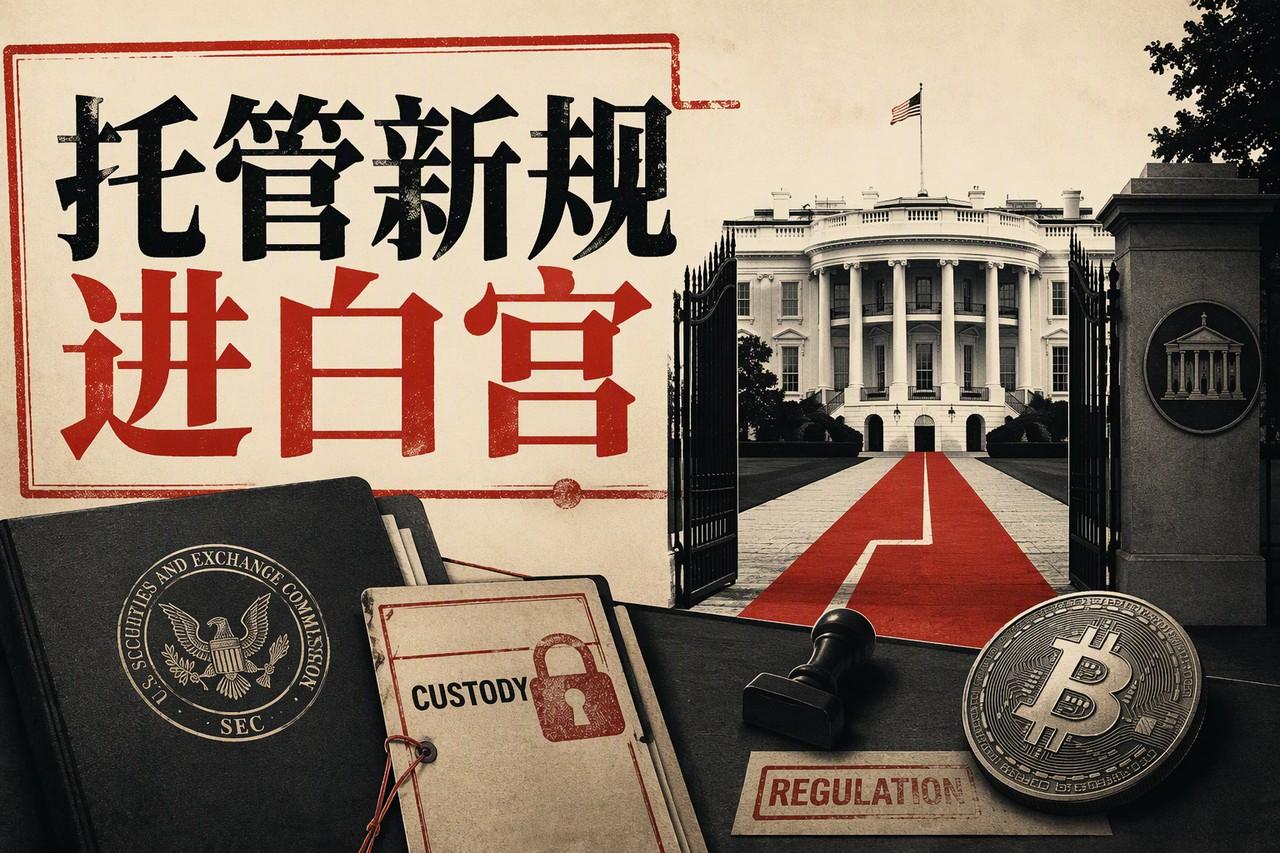
From January 13 to 15, Eastern Standard Time, the legislative process in the U.S. surrounding H.R.3633, the Digital Asset Market Clarity Act of 2025, took a sharp turn: on January 13, the Senate draft was publicly released, and on January 15, the Senate Judiciary Committee chose to postpone discussions on the controversial Section 604 just before the meeting. On the same day, the 119th U.S. Congress officially introduced H.R.3633 in the House of Representatives, bringing this regulatory framework for digital assets and tokenization to the forefront. In just three days, the legislative scene showcased a collision between the tightening of federal regulation and Wall Street and the crypto industry's push for clear rules and innovation space. Concurrently, Bitcoin spot ETFs recorded a net outflow of approximately $395 million, while Ethereum spot ETFs maintained a net inflow for five consecutive days, reflecting the market's complex emotions under regulatory uncertainty. The real question surrounding this procedural setback is: is this merely a technical hiccup in the timeline, or is it a microcosm of the long-standing tug-of-war over U.S. digital asset regulation?
A Sudden Stop in Three Days: How CLARITY Went from "Debut" to "Postponement"
Looking back at the timeline, when the Senate draft was released on January 13, the CLARITY Act was still seen as an important step at the federal level to fill the regulatory puzzle for digital assets, tokenization, and related tokens. Two days later, on January 15, the plot took a sharp turn as the Senate Judiciary Committee chose to express reservations about Section 604 and postponed its review instead of directly voting to reject the entire bill. On the same day, the 119th U.S. Congress formally introduced H.R.3633 in the House of Representatives, thus advancing the same-named bill into the legislative track of another chamber, leading to simultaneous negotiations between the House and Senate around the same framework.
The Judiciary Committee's approach is particularly intriguing. It focused its firepower on Section 604 but chose to hit the "postpone discussion" button rather than directly declaring the bill dead. This stance seems more like an attempt to reserve space for subsequent negotiations and amendments. The procedural delay means that the rhythm of the hearings has been disrupted, and the textual negotiations surrounding the controversial clause are likely to continue behind the scenes for some time before returning to the agenda in a revised form. For the bill itself, this undoubtedly extends the timeline but also signals that the related issues can no longer be avoided; even in the face of opposition, a federal-level response must be provided. It is important to emphasize that, as of now, the public has no access to the specific text of Section 604, nor can they see the Judiciary Committee's written opposition. All attempts to "dissect" this clause from a technical detail perspective are destined to remain ambiguous and restrained in an information vacuum.
The Battle for Regulatory Authority: The Tug-of-War Between Federal Uniformity and Innovation Space
The core contradiction surrounding the CLARITY Act is, in fact, the tension between federal regulatory authority and the industry's demand for innovation. At the federal level, there is a desire to establish a unified regulatory framework for digital assets, tokenization, and related tokens through this bill, aiming to fill the gaps and gray areas in existing rules against the backdrop of increasingly frequent intersections between ETFs, on-chain assets, and traditional finance. With the launch of Bitcoin and Ethereum spot ETFs and the accelerated narrative around tokenized assets, the pressure on regulatory agencies is no longer about whether to regulate but rather how to provide an executable and coordinated institutional answer in the face of an expanding array of asset and business types.
In contrast to this vision, there are concerns from the industry and some lawmakers about the excessive constraints on innovation space. They believe that a top-down federal bill, once implemented with uniform rules, could create friction with the licensing systems and industry self-regulatory standards that have been in operation in various states for years. From licensing access to custody responsibilities and cross-state business boundaries, the layered requirements could raise the bar for innovation. The Judiciary Committee's reservations about certain clauses largely reflect a latent vigilance against this "over-unification." At this stage, the boundaries of the controversy still mainly revolve around the public narrative of "how to balance regulatory intensity and innovation space," rather than delving into any unverified compliance framework details. The real focal point of the struggle is to what extent the federal government can and should reshape the power distribution in this emerging market.
Goldman Sachs Takes the Stage: Wall Street's Patience and Calculations on Tokenization
As the legislative process wavers, Wall Street has begun to express its position in its own language. Goldman Sachs CEO David Solomon publicly stated that the CLARITY Act is "crucial" for the field of tokenization and related tokens, but also reminded all parties that "there is still a long way to go." This seemingly neutral assessment reflects two clear signals. On one hand, large financial institutions clearly hope to obtain a clear and predictable regulatory environment for tokenization; only when the rules are explicitly written into federal law can business layouts involving on-chain settlement, asset tokenization, and corresponding tokens truly enter long-term planning in terms of performance and capital allocation. On the other hand, Goldman Sachs is also acutely aware that in the highly politicized and multi-party contested reality of digital assets, the process from draft to executable regulation will inevitably involve a long tug-of-war, revisions, and compromises.
Placing Goldman Sachs' statement in a larger industry context makes it easier to understand the caution in its wording. In recent years, traditional financial institutions have increasingly experimented with tokenized assets, on-chain settlement, and custody services. Rather than seeking "regulatory relaxation," they are looking to expand new businesses within a calculable and hedgable institutional framework. Clarity is more important than leniency because only after the boundaries of authority and responsibility are delineated can institutions introduce client funds on a large scale within a compliant framework. In stark contrast, the hesitation and delays within Congress regarding specific clauses create a sense of dislocation: the capital markets have already advanced along the tokenization mainline, while the legislative body is still repeatedly tugging over the precise location of regulatory red lines. This difference in rhythm also lays the groundwork for subsequent market reactions.
ETF Hot and Cold Differentiation: The Meaning of Funds Voting with Their Feet
As the controversy surrounding the CLARITY Act intensifies, the flow of funds at the ETF level is providing another dimension of feedback. According to existing data, Bitcoin spot ETFs have recently seen a net outflow of approximately $395 million, while Ethereum spot ETFs have maintained a net inflow for five consecutive days. The stark differentiation between the two is particularly striking and provides a lens through which to understand how the market is facing regulatory uncertainty. One interpretation is that the outflow of funds from Bitcoin ETFs reflects, to some extent, a defensive posture against short-term policy noise and concerns about the "digital gold" narrative being overdrawn at the current price range. At a time when regulatory battles are heating up and legislative rhythms are fluctuating, some institutions prefer to lock in profits or reduce position exposure.
In contrast, the sustained net inflow into Ethereum spot ETFs showcases another logic. For many funds, Ethereum is not just an asset but also the foundational layer for tokenization, on-chain finance, and smart contract applications. In the mid- to long-term narrative surrounding "compliant tokenization," Ethereum is naturally placed in a more advantageous position. Under this assumption, even if the federal regulatory path becomes more complex in the short term, the long-term demand surrounding tokenization infrastructure still supports the willingness of funds to increase their holdings in Ethereum ETFs. Of course, attributing the aforementioned flows solely to the impact of the CLARITY Act is clearly too hasty. The current data appears more like a composite projection of emotions and expectations, mixed with reactions to the regulatory process and constrained by multiple variables such as asset cycles and market structure adjustments, necessitating a restrained approach to causal relationships.
Section 604 Remains a Mystery: The Information Black Box Amplifies Imagination Space
Among all the points of contention, Section 604 is undoubtedly the biggest black box at present. What is confirmed is that the Senate Judiciary Committee has concentrated its opposition on this clause and postponed the overall discussion for this reason, yet the full text of the clause remains elusive, and there are no accompanying official reasons for opposition. This absence of information leaves a vast space for interpretation. Surrounding this "key clause," some market participants and media have begun to speculate that it may touch upon token issuance mechanisms, custody responsibility determinations, or, to some extent, redraw the boundaries between federal and state regulation. If these sensitive dimensions are adjusted, the power structure of the entire industry landscape may be forced to reorganize.
The problem is that, in the absence of any official documents, all "in-depth dissections" surrounding specific compliance obligations, technical clauses, and even KYC/AML details carry a high degree of inferential color. The more one delves into the minutiae of the text, the higher the risk of distortion. Rather than repeatedly magnifying details in front of the black box, it is better to take a step back and approach from a more prudent observational angle: how will the parties redraw lines between "protecting investors" and "supporting innovation" in the upcoming processes of amendments and hearings? Which responsibilities will be further centralized at the federal level, and which spaces will continue to be left for the market and states? The trade-offs presented in these public processes are the key clues for judging the final form of the CLARITY Act.
Postponement Does Not Equal Rejection: The Chronic Battle of U.S. Crypto Regulation
Revisiting the timeline from January 13 to 15, the CLARITY Act went from the Senate draft's release to key clauses being obstructed, and then to the formal introduction of the House version, presenting an intermediate state that is far from finalized. Regulatory, judicial, and capital markets have still not reached a consensus on the positioning of digital assets. The procedural blockade by the Judiciary Committee on Section 604 exposes the high difficulty of federal legislation in the emerging asset field and indirectly indicates that the regulatory framework in this area can no longer be easily set aside. What is more likely to emerge in the future is not a one-time landing of a "large and comprehensive" bill but rather a fragmented process composed of amendments, hearings, pilot programs, and localized legislation, with each small step accompanied by tug-of-war and compromise.
Looking ahead, several observation points are worth continuous tracking: first, the textual direction of Section 604 during the amendment process—will it be a technical adjustment or a substantive rewrite touching on the boundaries of regulatory authority? Second, can the House and Senate find an operable middle ground on how federal regulatory authority interacts with state-level and industry self-regulatory mechanisms? Third, how will Wall Street and the crypto industry compete for discourse power in hearings and lobbying activities, and who will gain an agenda-setting advantage in the regulatory framework for tokenization and related tokens? For investors and practitioners, before regulatory "clarity" truly arrives, asset prices are likely to continue being influenced by policy expectations, but more important than short-term fluctuations is the early understanding of how "compliant tokenization" may reshape the industry landscape, capital structure, and business models in the mid- to long-term.
Join our community to discuss and grow stronger together!
Official Telegram community: https://t.me/aicoincn
AiCoin Chinese Twitter: https://x.com/AiCoinzh
OKX Benefits Group: https://aicoin.com/link/chat?cid=l61eM4owQ
Binance Benefits Group: https://aicoin.com/link/chat?cid=ynr7d1P6Z
免责声明:本文章仅代表作者个人观点,不代表本平台的立场和观点。本文章仅供信息分享,不构成对任何人的任何投资建议。用户与作者之间的任何争议,与本平台无关。如网页中刊载的文章或图片涉及侵权,请提供相关的权利证明和身份证明发送邮件到support@aicoin.com,本平台相关工作人员将会进行核查。