Original | Odaily Planet Daily (@OdailyChina)
Author | Ethan (@ethanzhangweb3)_

Last night, a product update from X officially stirred quite a commotion in the InfoFi community.
On January 15 at 22:39, the X platform announced the revocation of API access for the InfoFi application, which immediately affected several applications relying on "posting incentives." With the API cut off, some projects announced the cessation of related functions or adjustments to their business direction, and related tokens represented by InfoFi saw a significant decline, with multiple InfoFi-related tokens (KAITO, COOKIE) recording double-digit drops in a short period. Community members provided a rather straightforward summary—"The era of easy rewards is over."
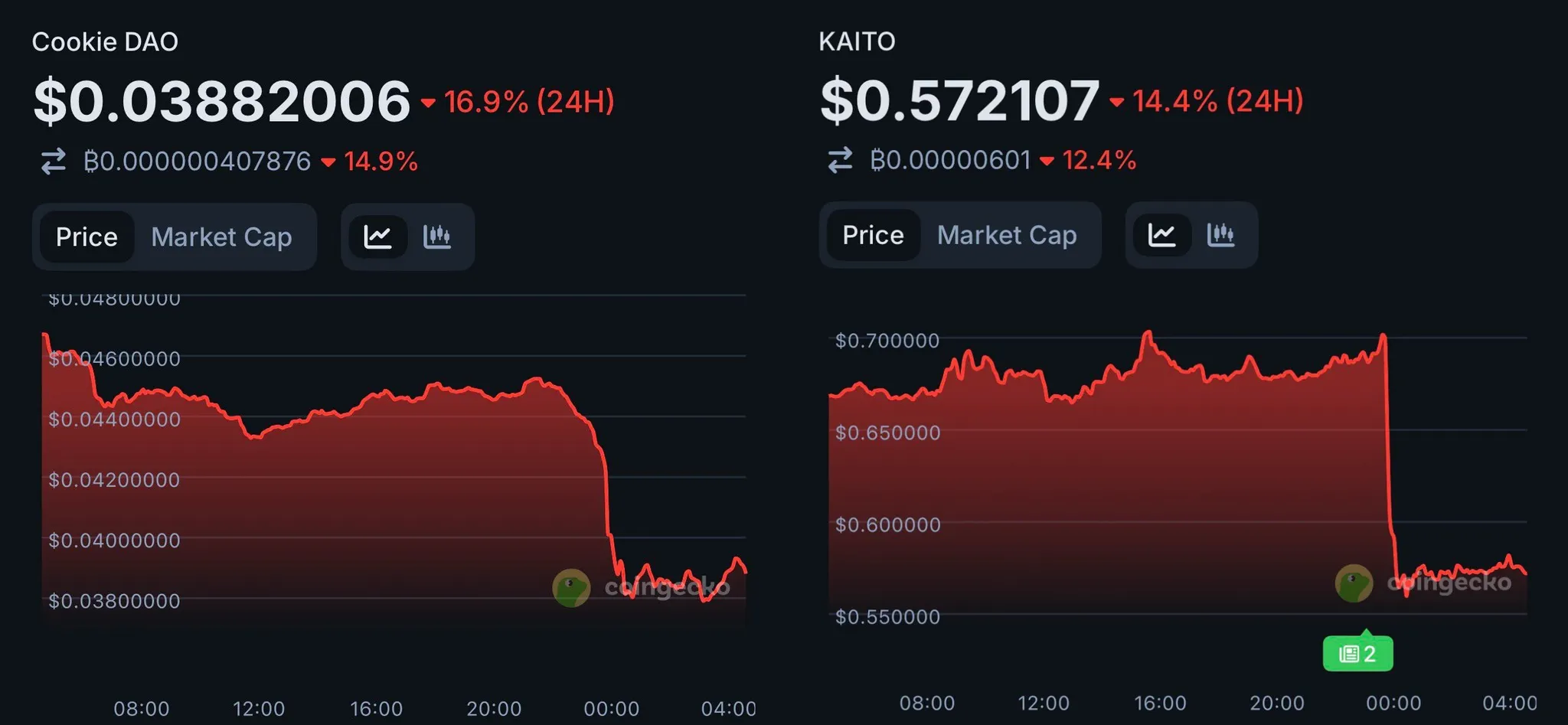
The drastic reaction of InfoFi-related applications and tokens indicates that this change has far-reaching implications beyond routine rule adjustments, altering the operational foundation of related applications and triggering a market chain reaction. This is not a mere fine-tuning but a clear statement from X regarding a type of application model.
What happened: X officially denies the InfoFi incentive model
This time, X did not leave much room for explanation regarding InfoFi.
X's product head Nikita Bier stated on the platform that X is revising its developer API policy and will no longer allow any applications that "reward users for posting on X" to continue accessing the API. In his statement, such applications were directly named as InfoFi and were also one of the main sources of recent AI-generated spam content and reply pollution on the platform.
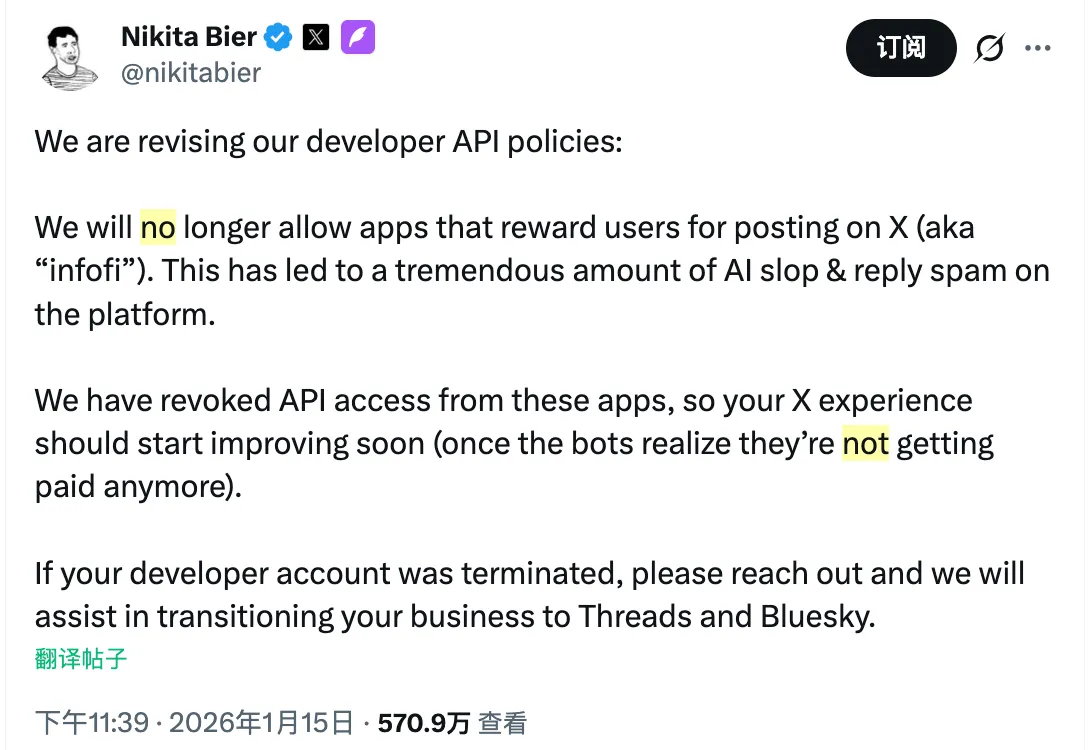
Unlike previous platform governance approaches of "first announcing, then observing," this time X's action is quite direct—the API access for related InfoFi applications has been revoked. The official reason given is not complicated: external incentive mechanisms are driving a large influx of task-oriented, templated content into the information stream, severely affecting the platform experience. Once bots realize that "posting no longer brings in money," X believes the content environment will quickly self-correct.
Notably, Nikita Bier specifically added a weighty statement: InfoFi applications previously paid millions of dollars for API access, but X does not need this revenue.
This statement itself almost provides a qualitative judgment on InfoFi's business model. From the execution strength and official wording, this adjustment is not aimed at individual projects abusing the API but is a clear and unavoidable denial of the core model of InfoFi, which involves "external incentives directly intervening in platform content production."
For the teams whose developer accounts were terminated as a result, X's official "aftermath plan" is equally thought-provoking: the platform will assist in transitioning their business to Threads and Bluesky. In other words, X has not attempted to transform or absorb this incentive mechanism but has clearly chosen to remove it entirely from its ecosystem.
What is denied is not the content, but the incentive path of InfoFi
If viewed solely from the official statement, this adjustment seems to be a routine governance action against AI-generated spam content. However, in the context of InfoFi, this reason clearly does not suffice to explain X's resolute attitude.
The key issue may not lie in "whether the content is valuable," but rather in who produces the content and for what reason. The core logic of InfoFi is to directly drive users to complete posting, replying, and interaction behaviors on the platform through external tokens or points incentives. This model indeed increased activity in the short term but quickly alienated content production into "task execution," where posting is no longer an expression of opinion but a necessary step to receive rewards.
When the incentive itself detaches from the platform governance system, the platform inevitably loses control over the motives and quality of the content. InfoFi applications do not care whether a reply adds informational value; they only care if it meets the conditions for "settlement"; for X, this means the information stream is being taken over by an external economic system.
From this perspective, AI-generated spam content is merely a result, not a cause. What truly touches X's bottom line is the structural issue of "third-party incentives directly embedded in the platform's content distribution system." Once this model is tacitly accepted, the platform's content order, recommendation logic, and even user relationships will gradually be influenced by incentive designers.
This also explains why X has left almost no room for InfoFi to be reformed in this adjustment. This means that, in X's judgment, InfoFi is not an ecological participant that needs correction but rather a content production path that is no longer allowed to exist.
Thus, this API withdrawal is X's proactive reclamation of its content sovereignty: when external incentives conflict with platform experience, X chooses to cut off the former rather than relinquish control over the information stream.
From "suspension" to "reconstruction": the collective shift of InfoFi projects
X's API withdrawal did not remain at the policy level but quickly triggered a chain reaction on the InfoFi project side.
According to Odaily Planet Daily, the first to respond clearly was Cookie DAO. The team announced the official cessation of operations for the Snaps platform and the termination of all ongoing creator incentive activities after communicating with the X team about API and usage policies. Cookie stated in the announcement that this was a "difficult and sudden" decision, but the starting point was not to abandon InfoFi but to ensure that its data layer and core product remain compliant.
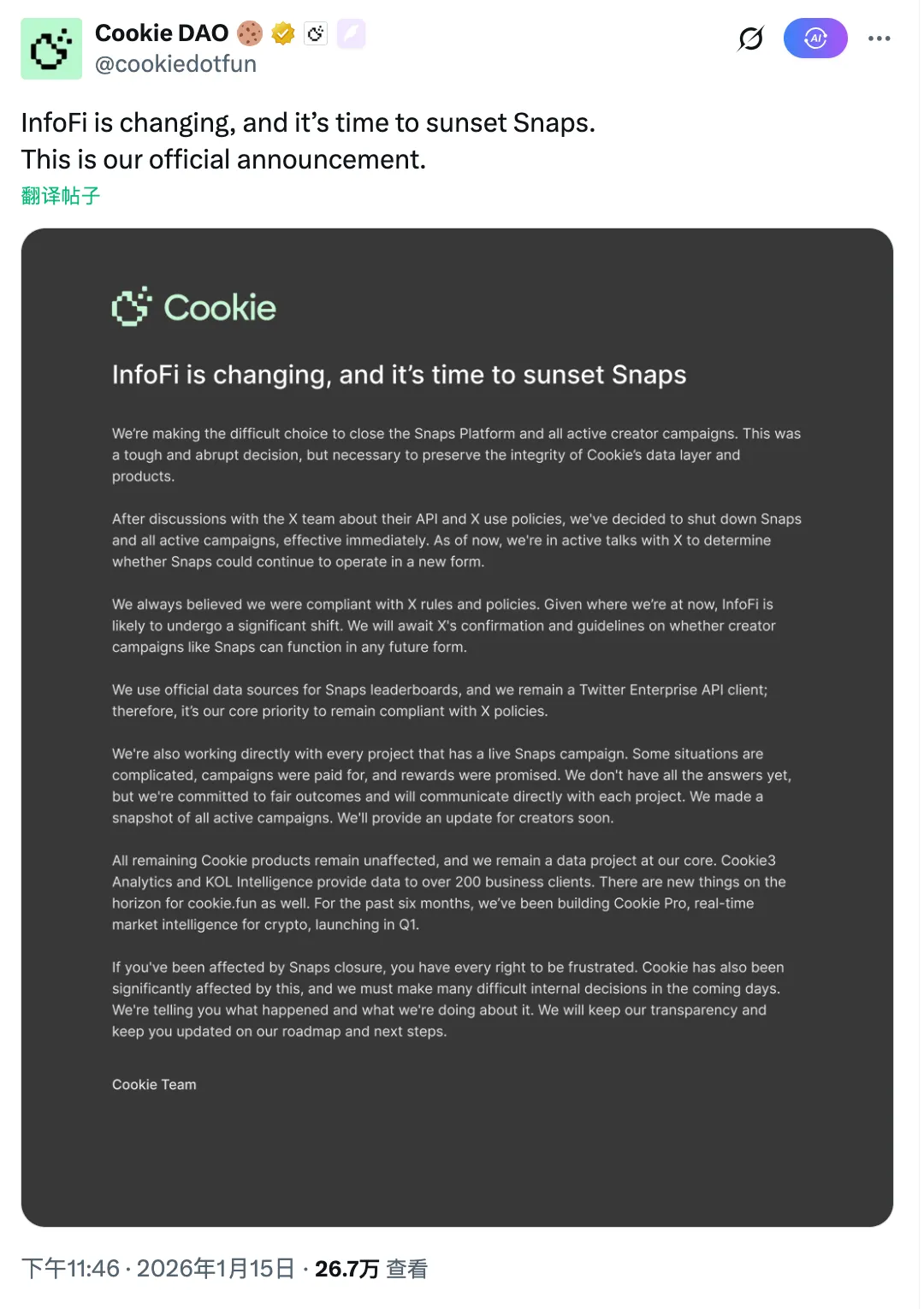
From the statement, the shutdown of Snaps appears more like a passive loss-cutting choice in response to the event shock. On one hand, Cookie emphasizes that it has always used official data sources and remains an enterprise-level API client of X; on the other hand, the team also clearly states that InfoFi is undergoing structural changes, and whether Snaps can exist in a "new form" still awaits further guidance from X. This wording itself reveals a high degree of uncertainty regarding the sustainability of the original incentive model.
In contrast, Kaito's adjustment seems more proactive. Kaito announced the cessation of operations for Yaps and the incentive leaderboard while launching a brand new Kaito Studio, clearly bidding farewell to the "open, unlicensed incentive distribution" path. According to the official statement, Kaito Studio will be closer to a traditional tiered marketing platform, where brands choose creators to collaborate based on established standards, and the platforms covered will expand from X to multiple social channels like YouTube and TikTok.
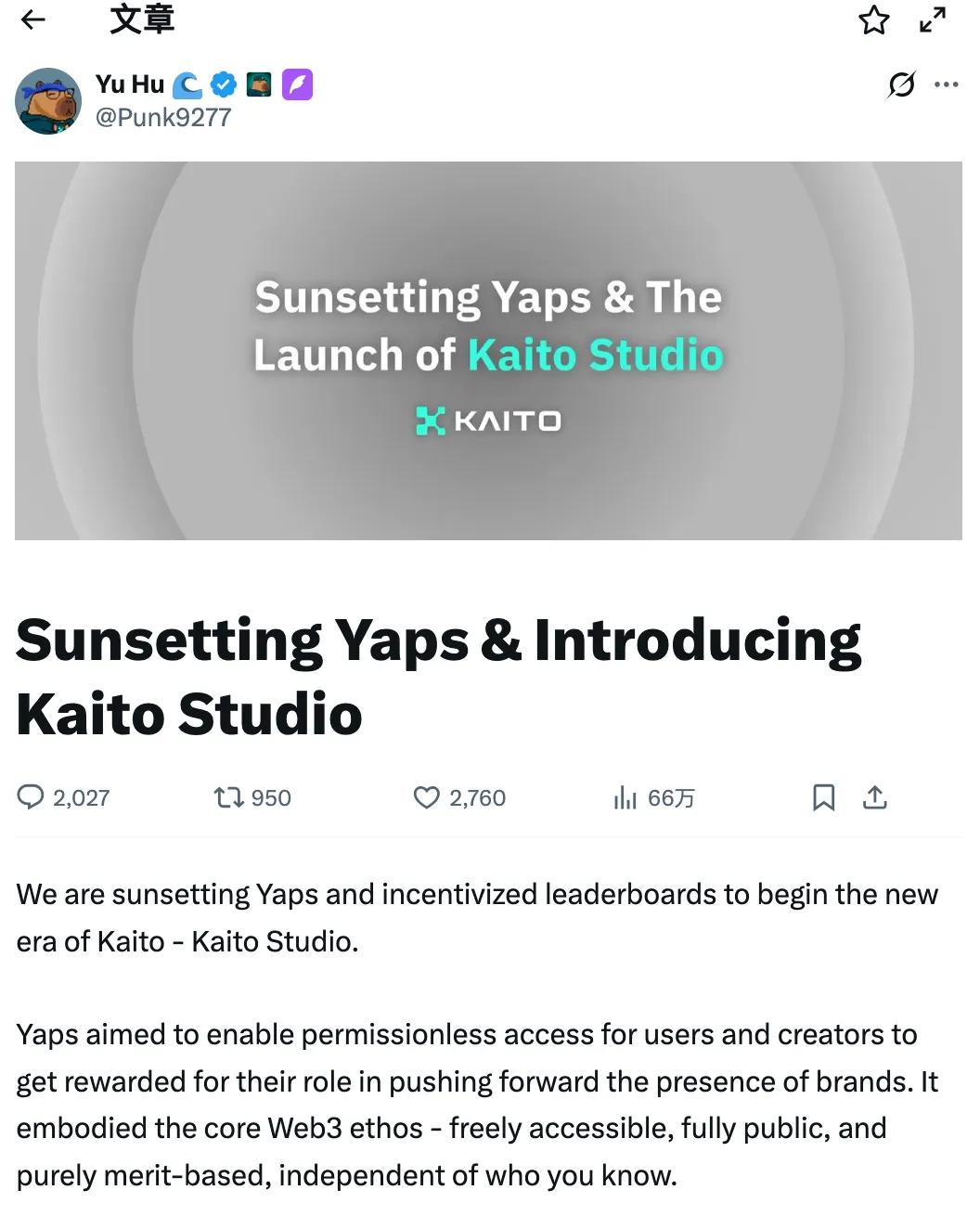
In explaining the reasons for the transformation, Kaito did not shy away from the issues inherent in the InfoFi model. It pointed out that even after continuously raising thresholds and introducing screening mechanisms, low-quality content and click-fraud behaviors remain difficult to avoid; after communicating with X, the team also agreed that the "completely unlicensed incentive distribution system" no longer meets the common needs of the platform, brands, and creators. From the lines, it can be inferred that the end of Yaps may be a proactive abandonment of the original InfoFi route.
However, regardless of the circumstances, looking at both events together reveals a clear trend: when the platform layer explicitly tightens interfaces and incentive boundaries, InfoFi projects must either choose to pause aggressive strategies and return to data and tool attributes or completely reconstruct their business logic to align more closely with traditional marketing and content collaboration models.
Currently, although token prices have fluctuated, the "collective collapse" of InfoFi projects has not yet occurred. What can be confirmed is that the set of strategies relying on the platform API and directly driving posting and interaction through external incentives is becoming increasingly difficult to operate.
Conclusion: The era of easy rewards is over, but InfoFi's issues remain
From the reactions of InfoFi projects, this change is not simply a "ban" or "failure." Whether Cookie returns to a data-layer positioning or Kaito shifts to a Studio model closer to traditional marketing, it indicates that InfoFi has not disappeared; it just can no longer exist in the form of "platform-based incentive arbitrage."
The so-called "era of easy rewards is over" does not mean that content is being quantified or influence is being priced, but rather that the open incentive path relying on APIs, where posting and replying themselves serve as settlement objects, is coming to an end. Against the backdrop of tightened platform sovereignty, the marginal space for this model is rapidly being compressed.
As for the migration to Threads or Bluesky, it seems more like a buffer solution rather than the answer itself. The real question is whether future InfoFi can find its irreplaceable value position without taking over the platform's content production rights.
X is merely the first platform to clearly press the button, but the signal it has released is already clear enough: content sovereignty is returning to the platform.
免责声明:本文章仅代表作者个人观点,不代表本平台的立场和观点。本文章仅供信息分享,不构成对任何人的任何投资建议。用户与作者之间的任何争议,与本平台无关。如网页中刊载的文章或图片涉及侵权,请提供相关的权利证明和身份证明发送邮件到support@aicoin.com,本平台相关工作人员将会进行核查。


