Author: Merrick_R
Yuki recommends: How does MicroStrategy's structure of "borrowing money to buy coins - raising premiums - then borrowing money" actually work, and when will it fail? From Michael Saylor's personal background to convertible bond arbitrage, ATM issuance, and what might happen when premiums disappear, this article lays out the company's most critical "lifelines."
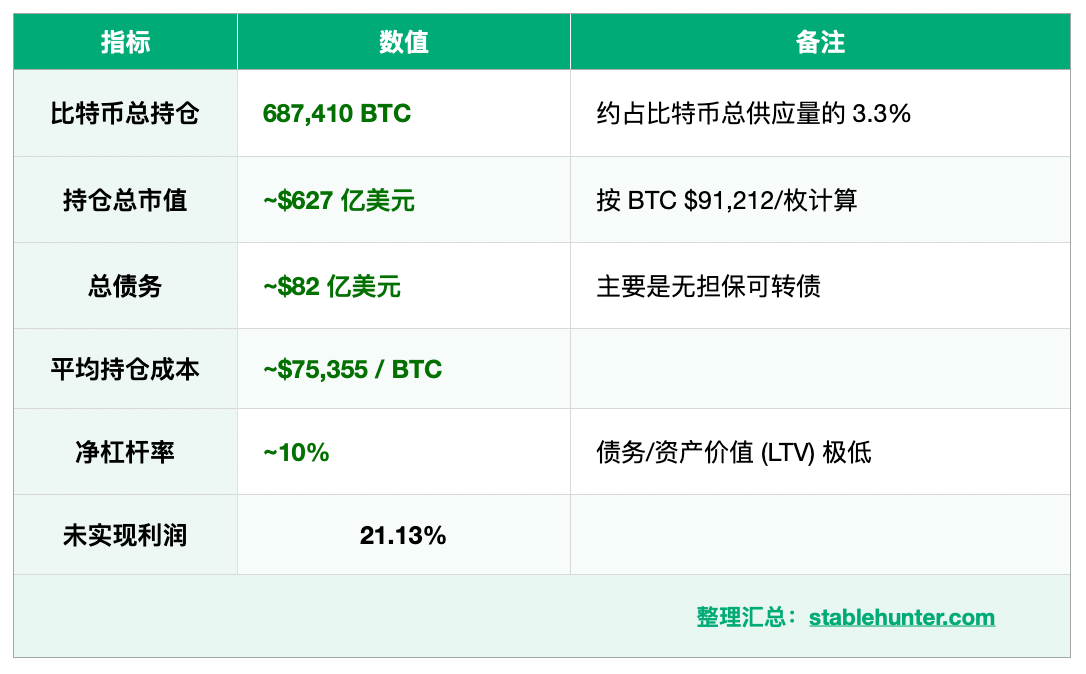
As of early 2026, Strategy (formerly MicroStrategy, stock code: MSTR) is no longer just a traditional business intelligence (BI) software provider but has evolved into a unique "Bitcoin Development Company" in the global financial market. The company holds over 687,410 bitcoins, valued at approximately $62.7 billion, and its balance sheet has effectively become a "shadow ETF" for Bitcoin, layered with an extremely complex capital leverage structure.
In this article, we will deeply analyze how MicroStrategy utilizes the mechanism humorously referred to by the market as the "Infinite Money Glitch" (i.e., through convertible bond arbitrage and high premium issuance) to transform a stagnating software company into the world's largest corporate Bitcoin treasury.
Additionally, we will explore the "death spiral" path and endgame scenarios they may face if Bitcoin prices remain low. In a bull market, MSTR's excessive gains come from two layers of amplification: rising coin prices and expanding premiums; in a bear market, it will also be hit by two layers of backlash: falling coin prices and collapsing premiums.

1. Pioneer of Data Mining and Darling of the Internet Bubble
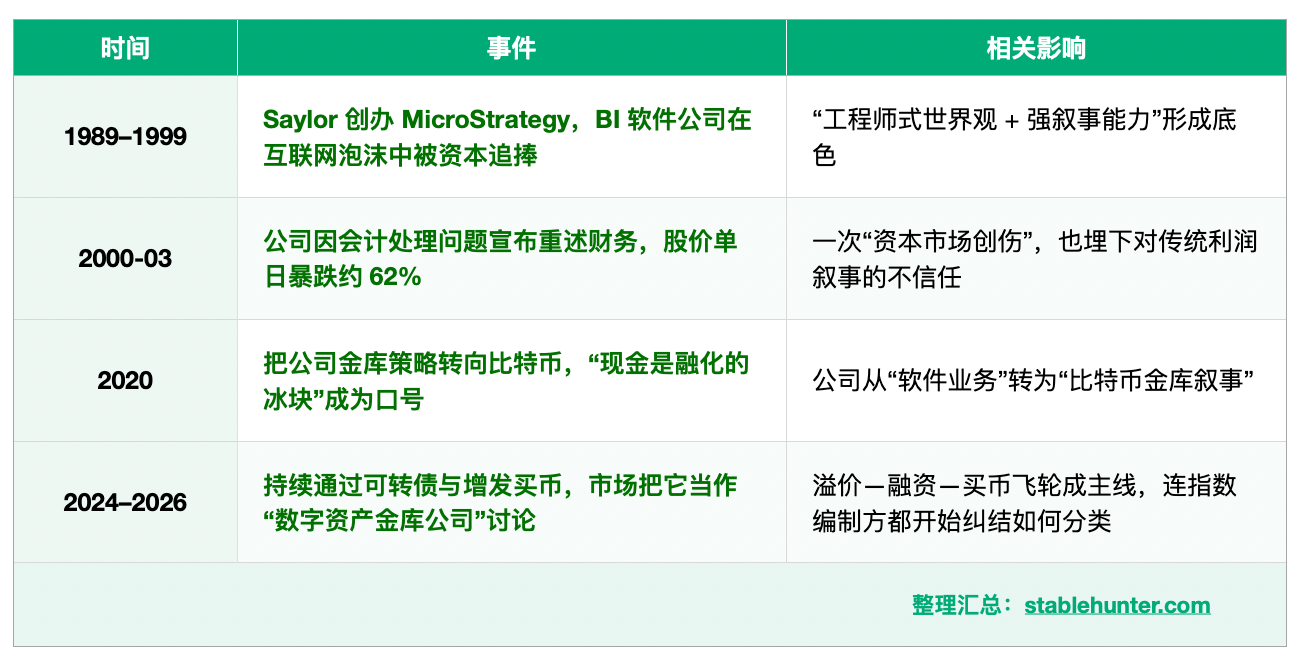
In 1989, at just 24 years old, Saylor co-founded MicroStrategy with MIT alumnus Sanju Bansal. The company's core vision was to leverage data mining technology to help businesses extract business intelligence from vast databases. Throughout the 1990s, MicroStrategy rapidly rose to prominence with its relational online analytical processing (ROLAP) technology, winning blue-chip clients like McDonald's and successfully going public in 1998.

With the expansion of the internet bubble from 1999 to early 2000, MicroStrategy was seen as a key player in B2B internet infrastructure. The company's stock price skyrocketed from $7 to $333 (adjusted) within a year, and Saylor's personal wealth peaked at $7 billion, making him the richest person in Washington D.C.
However, disaster struck on March 20, 2000. MicroStrategy announced a restatement of its financial statements for the past two years due to an audit. This restatement effectively acknowledged that the company had engaged in misconduct regarding revenue recognition, revising previously reported profits into losses.
On the day the news broke, MicroStrategy's stock plummeted 62%, erasing hundreds of billions in market value, and this event is widely regarded as the "first domino" in the collapse of the internet bubble.
The U.S. Securities and Exchange Commission (SEC) initiated civil fraud charges against Saylor and his executive team. The SEC's investigation revealed that MicroStrategy had significantly exaggerated its revenue and profits to meet Wall Street's earnings expectations in the frenzied environment of the time.
2. Michael Saylor: From MIT Genius to SEC Charges
To understand MicroStrategy's radical bets today, one must trace back to the character background of Michael Saylor. He is not a traditional CEO; he resembles a system engineer with a messianic complex.
Born in 1965 into an Air Force family, Saylor grew up near Wright-Patterson Air Force Base. This militarized upbringing instilled in him a strong sense of discipline but also planted seeds of a certain dictatorship and worship of "absolute power" in his later style of action. While studying at MIT, he became obsessed with system dynamics, attempting to use mathematical models to explain the rise and fall of the Roman Empire. This mindset of "optimizing social systems through engineering" directly led him to view Bitcoin as "Digital Energy" rather than merely a financial asset.
Ironically, Saylor was once a fierce opponent of Bitcoin. In 2013, he tweeted: "Bitcoin's days are numbered; it will suffer the same fate as online gambling, it's just a matter of time."
This near-bankruptcy experience left Saylor with a profound sense of nihilism regarding "fiat currency profits." He realized that under traditional accounting standards, profits could be manipulated and were fragile. This traumatic memory may be the psychological root of his complete abandonment of cash and embrace of "absolute truth" Bitcoin 20 years later.
In 2020, faced with the unlimited quantitative easing (QE) brought on by the COVID-19 pandemic, Saylor looked at the $500 million in idle cash on the company's balance sheet and reached a famous conclusion: "Cash is a melting ice cube."
He then completed a 180-degree cognitive turnaround. Instead of opting for stock buybacks or dividends, he decided to convert the entire company balance sheet into Bitcoin. This was not just an asset allocation but a high-stakes corporate transformation.
3. The Melting Ice Cube Theory
By mid-2020, MicroStrategy had $500 million in cash on its books, most of which was invested in short-term government bonds. After observing the rapid expansion of the Federal Reserve's balance sheet (from $4 trillion to $7 trillion), Saylor reached a startling conclusion: cash is trash.
He calculated that the real inflation rate was not the 2% shown by the CPI but closer to the growth rate of the money supply (M2), which was about 15% - 20% per year. This meant that MicroStrategy's hard-earned $500 million cash reserve was actually losing purchasing power at a rate of $75 million to $100 million per year. He described this in a report to the board as a "melting ice cube."

Saylor's choices were:
Distributing dividends/buybacks: Returning cash to shareholders. This would effectively admit that the company had no growth potential and was self-liquidating.
Acquiring other companies: In a context of high tech valuations, acquisitions often destroy value.
Seeking alternative reserve assets: Gold, real estate, or art.
Saylor ultimately chose Bitcoin. He believed real estate lacked liquidity, gold's supply was still increasing annually (and was difficult to move), while Bitcoin was the world's only asset with a fixed supply (21 million) that could be transmitted at the speed of light over the internet.
From the "online gambling theory" in 2013 to the "digital gold theory" in 2020, Saylor's transformation was not gradual but rather an epiphany. He spent thousands of hours during the pandemic researching macroeconomics and Bitcoin technology, ultimately overturning his previous beliefs. On August 11, 2020, he announced that MicroStrategy had purchased 21,454 bitcoins for a total price of $250 million. This was not just an asset allocation but a complete rebranding of the company's identity.
4. How Does the Infinite Money Glitch Work?
What is most striking (and feared) about MicroStrategy is not its act of buying Bitcoin but the way it buys. Saylor created a capital cycle mechanism humorously referred to by the market as the "Infinite Money Glitch," using low-cost capital from the capital markets to continuously increase Bitcoin holdings.
The core of this mechanism lies in the alternating use of convertible bonds and market (ATM) equity issuance.
4.1 Core Engine: Convertible Bond Arbitrage
MicroStrategy issued a large number of convertible bonds with extremely low interest rates (usually 0% - 1%). These bonds give holders the right to convert the bonds into stock at a specific price in the future.
Why would anyone buy 0% interest bonds? The buyers are mainly hedge funds (such as Calamos, Millennium Management, Linden Advisors, etc.). They are not looking to hold the bonds to maturity but to engage in convertible bond arbitrage:
Buy bonds: Hedge funds buy MSTR's convertible bonds.
Short the stock: Simultaneously, they short MSTR's stock in the open market.
Gamma trading: This combination creates a "synthetic call option" or "volatility long" position. Hedge funds profit from the volatility of MSTR's stock price through dynamic adjustments to their hedge ratios (Delta Hedging), regardless of the direction of the stock price movement.
Benefits to MicroStrategy:
Extremely low-cost capital: The company borrowed billions at nearly 0% interest.
Use of funds: All the funds raised were immediately used to purchase Bitcoin.
Stock price support: Rising Bitcoin prices drive up MSTR's stock price, increasing the likelihood of converting bonds into stock, which in turn allows the company to issue new bonds or stocks at higher prices.
4.2 Booster: ATM Equity Issuance and Premium
Since MSTR's stock typically trades at a premium relative to its net asset value (NAV) of held Bitcoin, Saylor leveraged this for ATM (At-The-Market) equity issuance.
The mathematical logic of premium appreciation (Accretion): Suppose MSTR's NAV per share (the value of held Bitcoin) is $100, but the stock price trades at $200 (2.0x premium).
MicroStrategy sells 1 new share at $200, receiving $200 in cash.
The company uses this $200 to buy Bitcoin worth $200.
Originally, the Bitcoin value per share was $100, but now the new incoming funds have brought in $200 worth of Bitcoin, resulting in an average dilution that actually increases the amount of Bitcoin per share (BTC per Share).
This is what Saylor refers to as "Intelligent Leverage." As long as a premium exists, any equity dilution effectively increases the Bitcoin holdings per share for existing shareholders. The company even invented a non-GAAP metric for this: BTC Yield, to measure this enhancement effect.
Overview of MicroStrategy's Debt and Bitcoin Holdings (January 2026)
5. Will MicroStrategy Face a Crisis?
The biggest concern in the market regarding MicroStrategy is whether a crash in Bitcoin prices could trigger a "death spiral" or forced liquidation due to its debt structure. To answer this question, it is essential to distinguish between solvency risk and liquidity risk.
5.1 Forced Liquidation Risk: The Overestimated "Margin Call"
There are common rumors that MSTR will face a "margin call," which is largely a misunderstanding.
Unsecured Nature: The vast majority of MicroStrategy's debt (convertible bonds) is unsecured. This means that this debt does not have Bitcoin pledged as collateral to creditors.
No Forced Liquidation Line: For convertible bonds, if Bitcoin prices fall, causing the stock price to drop below the conversion price, creditors have no right to demand early repayment from the company, nor do they have the right to seize Bitcoin. They can only hold the bonds until maturity and receive back the principal and minimal interest.
Minimal Secured Debt: MicroStrategy has had a small amount of bank loans secured by Bitcoin (such as Silvergate loans), but this portion is very small, and the company has a massive amount of unencumbered Bitcoin to supplement collateral, making it nearly impossible to trigger liquidation.
Conclusion: A simple drop in Bitcoin prices before the debt maturity date (as early as 2027) will not lead to forced liquidation or bankruptcy for MicroStrategy.
5.2 The Real Risk: Premium Compression and Refinancing Dilemma (2025 Case Study)
The real risk lies not in an instantaneous crash but in the disappearance of the premium. The market turmoil at the end of 2025 provided a perfect stress test case.
Review of the 2025 Liquidity Crisis: In December 2025, affected by global liquidity tightening, Bitcoin retraced from a high of $126,000 to around $80,000.
Premium Collapse: MSTR's stock price fell far more than Bitcoin, causing its premium relative to NAV to compress rapidly from over 200% to near parity (1.0x NAV).
Flywheel Stagnation: Once the premium disappears, ATM equity issuance loses its "enhancement" effect and even turns into dilution. The company can no longer buy Bitcoin at low cost by issuing new shares.
Short Sellers Strike Back: Notable short-selling firms (such as Jim Chanos) pointed out that MSTR's premium was "financial nonsense" and heavily shorted the stock.
Cash Reserve Moat: In the face of this crisis, MicroStrategy not only did not sell Bitcoin at the end of 2025 but instead built a cash reserve of $1.44 billion. This fund is specifically used to cover interest expenses and preferred stock dividends for the next two years. This move significantly reduced the likelihood of the company being forced to sell Bitcoin due to short-term cash flow disruptions.
Ultimate Risk—Long-term Stagnation: If Bitcoin remains stagnant or declines between 2027 and 2030, and MSTR's stock price continues to languish, the company will face refinancing risks as debts come due.
At that time, if it cannot issue new bonds or stocks, the company may have to sell Bitcoin to repay over $8 billion in principal due. This is what is referred to as "slow death." However, considering the value of the Bitcoin held by the company (over $60 billion) far exceeds its debt ($8 billion), even if it sells Bitcoin to repay debts, the company can still survive, albeit at a reduced scale.
6. Endgame Scenarios: From "Shadow ETF" to "Bitcoin Development Company"
MicroStrategy has made it clear that its endgame is not merely to be a passive Bitcoin holder (Proxy) but to transform into a Bitcoin Development Company.
6.1 Strategic Restructuring: Why a "Development Company"?
With giants like BlackRock and Fidelity launching Bitcoin spot ETFs (IBIT, FBTC), the scarcity value of MicroStrategy as a "shadow ETF" is being diluted. To maintain a premium relative to ETFs, Saylor must endow MSTR with additional value attributes.
The three pillars of a development company:
Capital Market Arbitrage: Continue to leverage the "Infinite Money Glitch" to create returns (Alpha) for shareholders that exceed Bitcoin itself. This is something ETFs cannot do (ETFs can only passively track).
Technology and Infrastructure: Develop software applications based on the Bitcoin blockchain. For example, MicroStrategy Orange, a decentralized identity (DID) protocol based on Bitcoin. This marks the company's attempt to combine its original business (enterprise software) with Bitcoin to create real business revenue.
Financial Services (Bitcoin Banking): In the future, MicroStrategy may leverage its vast Bitcoin reserves to issue Bitcoin-pegged financial products, even acting as the "Goldman Sachs" or "J.P. Morgan" of the Bitcoin economy, providing treasury management services for other companies.
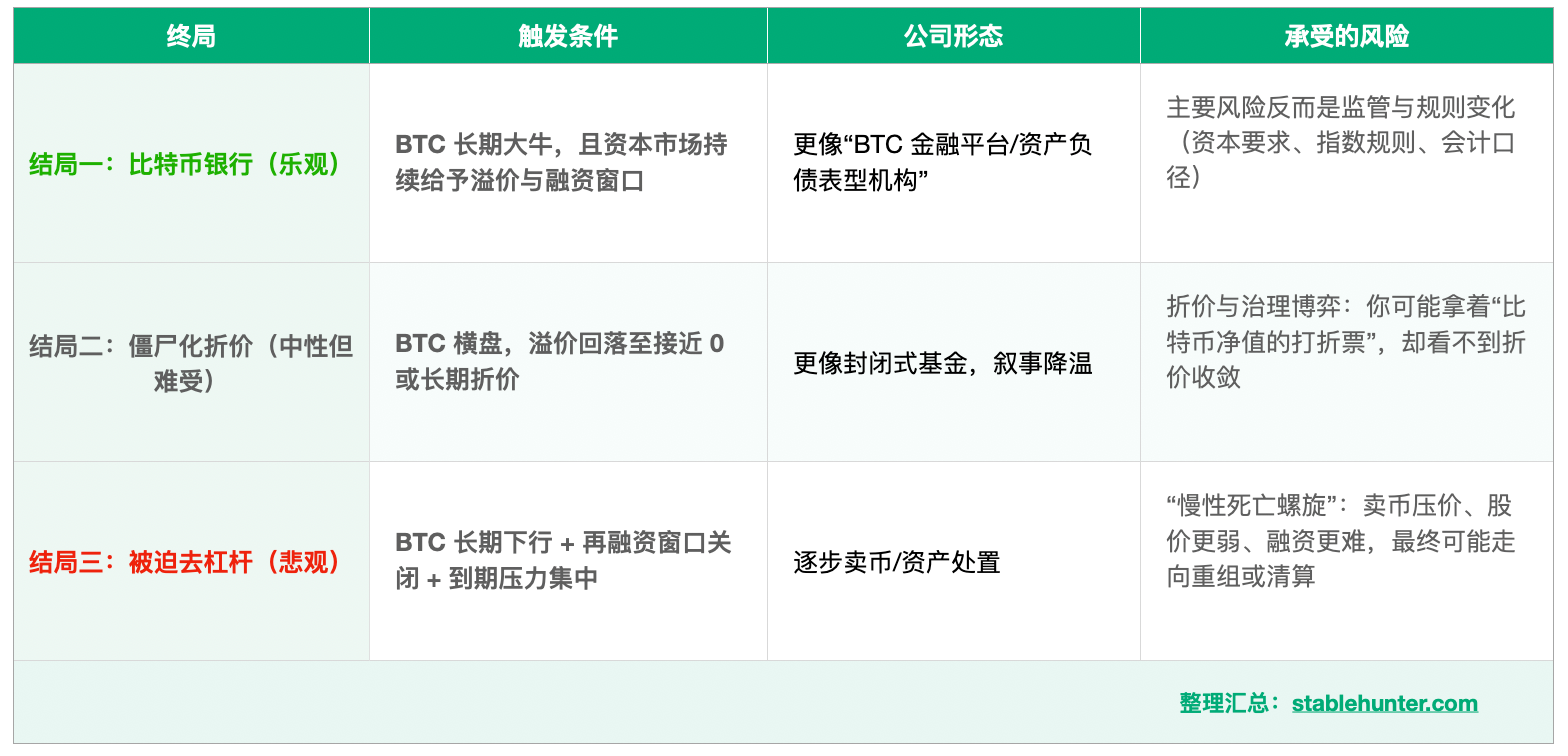
6.2 Three Endgame Scenarios: There Is No "Comfortable Middle Ground"
The next critical juncture in MicroStrategy's evolution is being included in the S&P 500 index. This will bring in trillions of dollars in passive buying, greatly enhancing the stability and liquidity of its stock price.
However, from a long-term perspective, we can lay out the endgame in a comparative table, which helps us better identify risks (not predict price movements).
7. Final Thoughts
MicroStrategy is one of the boldest experiments in modern financial history. Michael Saylor transformed a mediocre software company into an ark carrying 680,000 bitcoins.
MicroStrategy's debt structure is meticulously designed, with very low short-term repayment risks. The so-called "liquidation line" is a false proposition in the face of unsecured convertible bonds. However, its model is highly dependent on the premium of MSTR's stock price relative to NAV. The premium compression at the end of 2025 serves as a wake-up call: once the market is no longer willing to pay a premium for Saylor's "leverage magic," MicroStrategy will degrade into a closed-end fund with high management fees (interest expenses).
If Bitcoin reaches millions of dollars as Saylor predicts, MicroStrategy will become one of the highest-valued companies globally, and its debt will be wiped out like a drop in the ocean. If Bitcoin fails, MicroStrategy will be left with a pile of unpayable junk bonds and a textbook-level corporate cautionary tale. There is almost no middle ground. As Saylor's own philosophy states: in the world of thermodynamics, there are no compromises, only transfers of energy.
Insights for Observers:
MSTR is not Bitcoin: It is a leveraged bullish option on Bitcoin. When Bitcoin rises, it rises even more; when Bitcoin falls, it not only drops in price but also in premium, resulting in a "double whammy."
Focus on Premium Rates: MSTR's lifeline is not the price of Bitcoin but the premium rate. Once the premium hits zero, Saylor's magic turns into ordinary debt.
Winners and Losers: Saylor has bet not only his fortune but also his reputation as an entrepreneur. He will either become the J.P. Morgan of the new era or the next laughed-at madman.
免责声明:本文章仅代表作者个人观点,不代表本平台的立场和观点。本文章仅供信息分享,不构成对任何人的任何投资建议。用户与作者之间的任何争议,与本平台无关。如网页中刊载的文章或图片涉及侵权,请提供相关的权利证明和身份证明发送邮件到support@aicoin.com,本平台相关工作人员将会进行核查。


