Half a month ago, the Lighter TGE witnessed a new "wealth creation story" for many.
According to community statistics, the airdrop scale of Lighter ranks 10th in cryptocurrency history, with a total value of up to $675 million. On social media, screenshots of profits are flooding in: some turned a few thousand dollars into five-figure airdrops, while others received returns ten times beyond expectations due to early continuous interactions. Despite the project team conducting a rather strict witch hunt before the snapshot, most early participants and users still enjoyed this wave of dividends and benefits.
Currently, the price of $LIT is stable around $2.5-$3. Although it hasn't replicated the crazy market conditions seen during the TGE of Hyperliquid and Aster, Lighter's success undoubtedly adds fuel to the Perp DEX track.
Behind this celebration, the editor at Rhythm is curious: how much did these users who gained decent profits actually invest? What are their strategies? Thus, Rhythm BlockBeats interviewed several early users of Lighter with completely different backgrounds and strategies; their stories may provide some inspiration for your interactions with the next batch of Perp DEX.
Their Costs and Profits
Cha Bu Si (@mdzzi), a name almost everyone knows in the Chinese Perp DEX circle. As a major player in Hyperliquid, he is also the first testing user and a top user in the Chinese community of Lighter.
His connection with Lighter began during the testnet phase in September 2024, before Hyperliquid had issued its token. "So I never thought about the Lighter airdrop; I just thought it was fun," Cha Bu Si recalled. At that time, he simply went to claim the testnet faucet daily, received 500 USDC in test tokens, and started testing trades without spending any real money or investing too much effort.
In fact, Cha Bu Si even became the user with the highest trading volume on the Lighter testnet. With such simple operations, he earned over ten thousand points after the testnet ended.
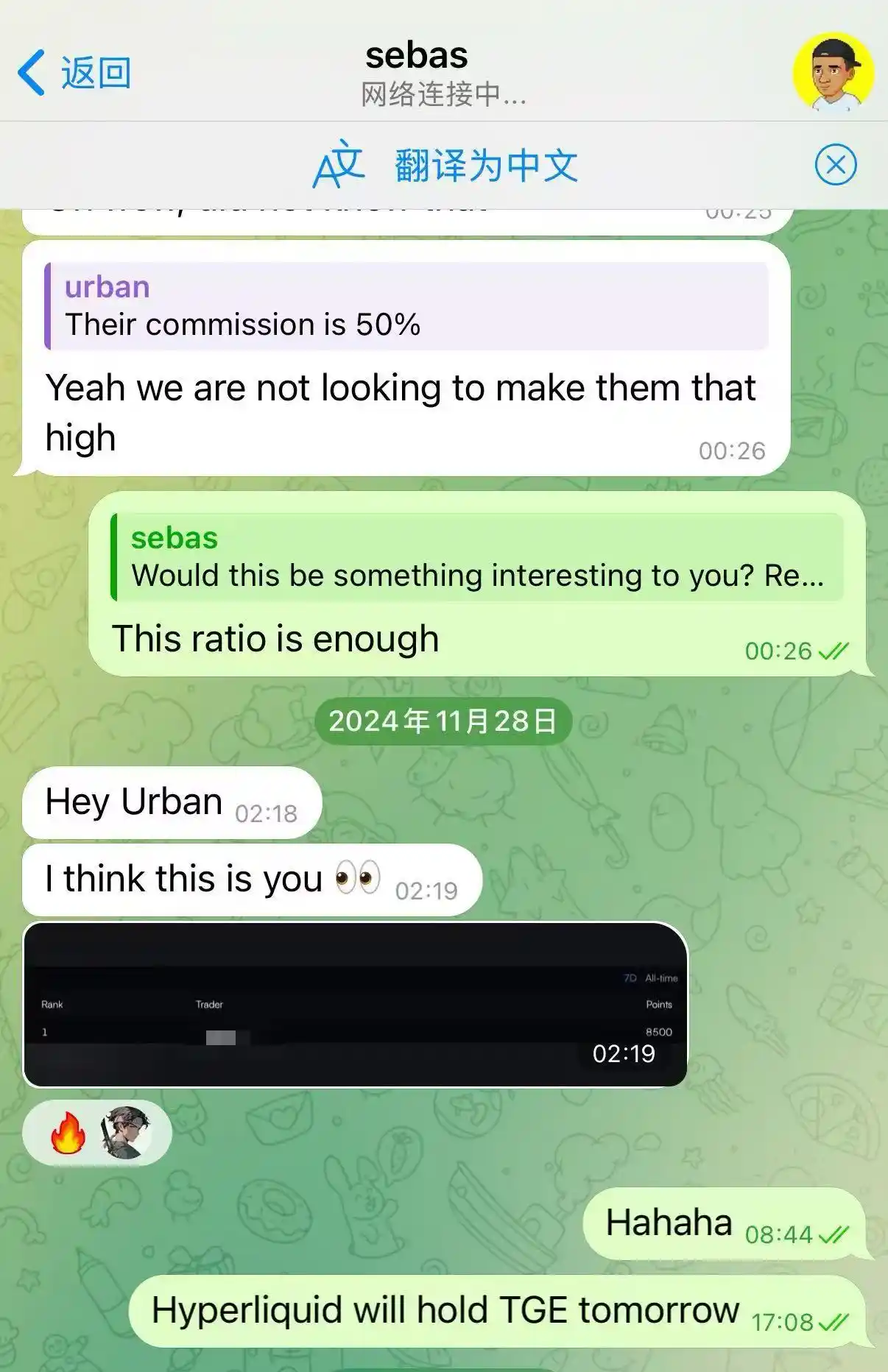
The image shows Lighter staff member Sebas privately messaging Cha Bu Si, asking if the account ranked first was his.
At that time, Lighter was still an obscure project, and team members often lurked in various Spaces to engage with users, actively DMing active users on CT in both Chinese and English communities.
Cha Bu Si's acquaintance with the Lighter team also happened during a Twitter Space in September 2024. In that Space, Cha Bu Si invited some well-known OGs from the Hyperliquid community, including the Turkish big shot NMTD, who later received nearly $100 million in airdrops, as well as active users from communities in Korea and other regions, to discuss the future of Perp DEX and the development of Hyperliquid. "Not many people came, just twenty or thirty, but the Lighter staff were listening and found our discussion interesting."
After that Space, the Lighter team proactively contacted Cha Bu Si to discuss the future of the Perp DEX track and their views on Hyperliquid, even directly asking if he would attend TOKEN 2049 in Singapore and if they could meet.
"I was quite cautious at the time, wondering why this person was so familiar; could he be a scammer?" Cha Bu Si admitted that his initial wariness prevented him from having a deeper conversation. However, as he continued to interact, he found that the team was indeed serious about their work, and their background was solid, especially their attempt to combine ZK technology with Perp DEX, which piqued Cha Bu Si's interest. He began to participate seriously in the project, communicating some product details and offering suggestions.
After the testnet ended and the mainnet entered the alpha phase, Cha Bu Si naturally became one of the first users to deposit real money for trading. "Actually, I had reduced my trading; I probably only made a dozen trades, but they gave a lot of points." Most of his points came from early participation, and even though his involvement later decreased, these early points secured him a decent share of the airdrop.
Interestingly, in January of this year, the Lighter team even offered Cha Bu Si a position to manage Lighter's APAC market, but he declined. "On one hand, the product experience was still quite average at that time, with few tokens, and the market already had mature products like Hyperliquid, which drew everyone's attention away."
Besides Cha Bu Si, Jiu Fei Te (@Dex_Jiufeite) is also a trader friend that the Rhythm BlockBeats editor has known for a long time. In December 2024, after Hyperliquid issued its token and performed well, Jiu Fei Te decisively sold part of his HYPE and used the profits to continue trading on Lighter.
He started participating in Lighter in April 2025, shortly after the project launched, and the efficiency of earning points was still quite good, "about two to three thousand in trading volume could earn one point." Jiu Fei Te clearly remembers that the rule at that time was that you needed to accumulate 300 points to get your own invitation code, which became his first small goal for continuous interaction.
Unlike many players who purely brush volume for airdrops, Jiu Fei Te has his own "trading system," which covers the costs he incurred on Lighter. Ultimately, Jiu Fei Te earned 900 points. According to Lighter's distribution rules, 1 point corresponds to 20 $LIT, and at a price of $3, his airdrop is worth about $54,000.
Lighter is a zero-fee Perp DEX, which makes many people think that brushing Lighter has no cost. However, Jiu Fei Te found that this does not mean trading is completely cost-free: there are still hidden trading costs like spreads and slippage.
He observed that many people use scripts for batch hedging trades to earn points but often overlook a key issue: "If you hedge entirely with market orders, the slippage caused by delays may not be lower than the fees." He specifically compared the comprehensive execution costs of Lighter with several other DEXs and found that as depth gradually decreases, the actual trading execution costs significantly increase, especially for relatively low-volume altcoins on the Lighter platform.
Replicable Interaction Techniques, Usable Methods for Ordinary People
Although the airdrop rules for each project are unique, the underlying logic for successfully capitalizing on them is similar. Through in-depth communication with these "veterans," we have summarized some universally applicable interaction experiences in the Perp DEX track. These methods not only apply to Lighter but can also be transferred to other potential airdrop projects.
Cha Bu Si's advantage on Lighter is his "linear narrative" in the track; he has been focused on the Perp DEX track since entering the space. "I have been watching this track develop and have benefited from its growth. As the track's valuation increases, my wealth has also grown." He admits there is an element of luck involved, but more importantly, it is about continuous attention and knowledge accumulation in the track.
"Back in September 2024, who could know how this would turn out? If I said I was optimistic at that time, it would really be hindsight. I was simply interested in the product, found the white paper interesting, and even discussed technical details with a friend from Tsinghua who studies ZK."
This "not using it just for airdrops" mindset allowed Cha Bu Si to seize the earliest window. Therefore, his advice is to participate in some low-cost early projects, exploring continuously like gold miners during the gold rush. "If the cost is too high, it becomes gambling. Keep the cost as low as possible and be brave enough to explore things that others haven't; you might find unexpected surprises."
This advice is quite practical on Lighter because during the testnet phase, the Lighter team actively DM'd many users on Twitter inviting them to participate in testing, but many missed out due to excessive wariness. "Indeed, many people didn't think that such a team would use a relatively old-fashioned way of 1-on-1 DMs for marketing; actually, some projects do this too. They might use their official accounts to DM you early on, and as a result, you miss out. There are quite a few such cases," Cha Bu Si laughed, "Everyone thinks, how could such a good opportunity come to me? It is precisely this kind of thinking that causes them to miss good chances."
Jiu Fei Te can also be considered a "veteran" in the Perp DEX track, having entered the crypto space in 2016 and started trading contracts in 2018. From the earliest DYDX and GMX to later Aevo, Drift, Hyperliquid, and Lighter, he has experienced almost all mainstream products on the market, so he places great emphasis on product experience.
Hyperliquid is a typical case. Jiu Fei Te initially tried it after seeing recommendations from other CT users, but what really kept him was the product experience. "The on-chain trading experience is particularly good; compared to the DYDX batch of products, Hyperliquid is really exceptional. Although I had also played with Drift and Aevo on Solana, the smoothness of Hyperliquid left a deep impression on me."
This strategy of "only interacting with usable products" has helped him avoid wasting time on many low-quality projects. Good products not only offer a better user experience but often also indicate that the project team is more serious, leading to higher airdrop probabilities and values. "I never promote things I don't use; I only promote projects that I have deeply experienced and confirmed to be good."
Choosing good products, thoroughly researching the rules, and sharing the optimal solutions with friends can also earn commissions. Friends are more likely to use his invitation code, which is another significant advantage for Jiu Fei Te in the Perp DEX track. He doesn't simply send invitation links everywhere; instead, he studies the invitation mechanisms of each platform very thoroughly.
"I will tell you all the mechanisms and rules of the platform; what is what, no hiding." His logic is clear: no matter what, if you want to brush a certain project, there will always be the question of whose link to use. "So I will tell you all the rules, helping you find your optimal solution. You can get the best commission from me, and I can also get the invitation reward; it's a win-win."
Should $LIT be sold at launch or held onto?
Regarding this airdrop, Cha Bu Si has not sold his $LIT yet; he even bought some himself: "I am quite optimistic about its roadmap, doing L2 on Ethereum and integrating DeFi like Aave into a unified account, which may be more imaginative than Hyperliquid building its DeFi ecosystem with its own HyperEVM."
From a valuation perspective, he also made a comparison: "Hyperliquid's scale is already quite large, so doubling it is relatively difficult. However, I think doubling $LIT is not a big problem." Of course, he emphasized that this is not investment advice. "After all, everyone's consensus is different, and it's hard to say. I don't sell because my cost is very low, almost negligible. But if you want to buy, I think you should think twice."
Like Cha Bu Si, Jiu Fei Te also believes that his interaction costs are basically minimal, so he hasn't sold his $LIT holdings. Based on his optimism about Lighter, he has also gradually opened some long positions in $LIT.
"The funds I use to brush other Perp DEXs are basically from the Hyperliquid airdrop, and the $LIT airdrop from Lighter will be reinvested into the next Perp DEX." This strategy of "using airdrops to fund airdrops" allows Jiu Fei Te to invest costs more comfortably in subsequent projects without worrying about losses.
As a professional arbitrage player, Sam's strategy is the most aggressive; he basically sells the airdrop as soon as he receives it. His logic is simple: since he initially participated to arbitrage, he should exit promptly after realizing profits, rather than adopting an investor mentality and betting on price increases.
Sam entered the market much later than Cha Bu Si and Jiu Fei Te; he started brushing Lighter around September 2025. As a professional airdrop hunter, after finishing with Aster, he was looking for new opportunities, so they turned their attention to Lighter.
In Sam's calculations, as long as they don't get liquidated, they can incur a loss of about $20-30 to earn 1 to 2 points, which includes trading slippage, spreads, hedging costs, etc. In the OTC market, the off-exchange trading price for 1 point is about $55, which later even rose to nearly $100.
"This means that we calculated Lighter's ROI to be about 2-3 times. Even though we didn't participate early, there is still a clear arbitrage space and a very favorable investment output ratio, so we decided to participate with significant funds," Sam explained, which allowed him to achieve decent returns even when entering the project later.
"When I entered, I calculated the costs and returns, aiming for an ROI of 2-3 times. That's my goal. Once I reach it, I exit without being greedy." The advantage of this strategy is that the risk is controllable, while the disadvantage is that it may miss subsequent surges. However, for professional airdrop hunters, stable returns are more important than betting on large price increases.
Finding the Next Alpha Opportunity
Having mastered these techniques, the next question is naturally: which Perp DEXs are worth paying attention to and interacting with next? We asked these two "veterans" what projects they are currently focusing on and received some interesting answers.
Cha Bu Si is cautious about the subsequent opportunities in the Perp DEX track.
"I might rarely pay attention to Perpetuals anymore because Hyperliquid is already very mature and user-friendly. Coupled with projects like Aster and Lighter, they have already captured 80% of the benefits in this track." He believes that users entering later have been "filtered very cleanly"; they are either those who didn't get a chance before or old users who have already enjoyed the benefits and continue to participate.
"This is somewhat similar to the later stages of Layer 2, a false data boom." Cha Bu Si admitted that he is somewhat worried about this phenomenon. When the airdrop expectations of a track are overly consumed, most incoming users are there just to inflate their volume, while real users become increasingly scarce, making it harder for project teams to determine who are genuine users and who are just there for the airdrop.
His strategy has shifted to finding new tracks that have not yet been extensively mined. "Just like when Perp DEXs first emerged, now we need to look for the next direction that hasn't been popularized by KOLs." This line of thinking is indeed worth referencing; when everyone is competing in one track, the real Alpha often lies elsewhere. The high returns of early Perp DEXs were precisely because there were fewer participants, and project teams valued real users. Once it becomes a volume inflation game for everyone, that advantage disappears.
In contrast to Cha Bu Si, Jiu Fei Te is still deeply involved in the Perp DEX track, but his selection criteria are very strict, focusing only on projects with clear features and advantages.
"EdgeX is quite good, mainly because it's very convenient to operate during my commute." Jiu Fei Te values its mobile app experience, and since it is incubated by the well-known market maker Arbor Group, he feels its feasibility is good.
In April of this year, Jiu Fei Te entered both Lighter and Variational, focusing on their respective features: Lighter's advantages are zero fees and extremely low latency, providing a great trading experience; while Variational adopts a unique Request for Quote model instead of the common CLOB mechanism, which has clear advantages and characteristics that other platforms lack.
Additionally, Jiu Fei Te was particularly impressed by Extended, which features a tokenized treasury, a unified margin mechanism, future support for fiat deposits and withdrawals, and a vision to integrate prediction markets, spot trading, lending, and other closed-loop trading ecosystems. He also specifically mentioned that the team is very reliable, with frequent document updates and a great trading experience on the product page.
In this not-so-new Perp DEX track, there are still many ordinary people who can achieve considerable returns through early participation, continuous interaction, and rational investment. We also found that several interviewees provided a few replicable paths.
Cha Bu Si represents deeply engaged early participants. They don't just inflate volume but truly accompany a track, understand the project, participate in the community, and even provide suggestions and feedback to the team. Such users often discover good projects early and are more likely to gain recognition and additional rewards from the team.
Jiu Fei Te represents professional trading players. He has his own trading system that allows him to cover the costs of airdrop hunting through real trading, and he thoroughly studies the invitation mechanisms to earn commissions. The advantage of such players lies in sustainability; they won't lose everything due to the failure of a single project. His "using airdrops to fund airdrops" strategy has created a positive cycle for him in this track.
Sam represents professional arbitrage players. He accurately calculates costs and returns, allowing him to achieve stable returns through arbitrage even when entering the project later. The core abilities of such players are risk control, data calculation, and capital management.
Who will be the next Alpha opportunity? There is no standard answer to this question. But by staying alert, curious, and rational, we may all seize the next opportunity when it arises.
This article thanks the interviewees: Cha Bu Si, Jiu Fei Te, Sam
免责声明:本文章仅代表作者个人观点,不代表本平台的立场和观点。本文章仅供信息分享,不构成对任何人的任何投资建议。用户与作者之间的任何争议,与本平台无关。如网页中刊载的文章或图片涉及侵权,请提供相关的权利证明和身份证明发送邮件到support@aicoin.com,本平台相关工作人员将会进行核查。


