Written by: Jademont, Evan Lu, Waterdrip Capital
Reviewing the Turbulent 2025, Looking Ahead to the Long Cycle of AI
A New Industrial Revolution: Computing Power Becomes the Engine of Economic Operation
"In this world, only a very few people can, like Edwin Drake, inadvertently open an era that changes human history… His drill rod, which reached deep into the ground, not only touched the black liquid but also the artery of modern industrial civilization."
In 1859, in the mud of Pennsylvania, people surrounded Colonel Edwin Drake, laughing at him. At that time, the world's lighting still relied on the increasingly scarce whale oil, but Drake firmly believed that "kerosene" could be extracted on a large scale from underground. This was widely regarded as the delusion of a madman. Until the first gush of black liquid erupted, no one would have thought that the emergence of oil would not only replace whale oil as a lighting energy source but would also become the cornerstone behind the struggle for discourse power in human society over the next two hundred years, fundamentally reshaping global power and geopolitics for the following century. Human history reached a turning point: old wealth relied on trade and shipping, while new wealth was rising with the advent of railroads and energy (oil).
In 2025, we find ourselves in an extremely similar game. This time, what is gushing madly is the computing power flowing through silicon chips, and this time's "gold" is the code etched on the blockchain; the "gold" and "oil" of the new era are reshaping our entire consensus on productivity and store-of-value assets. Looking back at 2025, the market experienced an unexpectedly severe turbulence. Trump's radical tariff policies forced global supply chains to relocate, triggering a massive inflation rebound; gold historically surged past $4,500 amid geopolitical uncertainties; the crypto market welcomed the epic benefits of the GENIUS Act at the beginning of the year but experienced the painful aftermath of leveraged liquidations in early October.
Beyond the clamor of macro fluctuations, a consensus regarding the AI computing power sector is rapidly fermenting: Nvidia, the "water seller" of AI, reached a milestone market capitalization of $5 trillion in October. Additionally, the three giants—Google, Microsoft, and Amazon—have invested nearly $300 billion in AI infrastructure this year, with xAI set to complete a million-level GPU cluster by the end of the year, signaling the demand for computing power. Elon Musk's xAI built the world's largest AI data center in Memphis in less than six months and plans to expand it to an astonishing scale of 1 million GPUs by the end of the year.
Digital Intelligence Era: The Main Theme of the Next Industrial Revolution
Ray Dalio, founder of Bridgewater Associates, once said: "The market is like a machine; you can understand how it works, but you can never precisely predict its behavior." Even though the macro environment is random and unpredictable, it is undeniable that AI remains the primary long-term growth channel in the U.S. stock market. AI technology has become the most critical core gear in the market machine for the next decade, continuously influencing all aspects of government, businesses, and individuals.
Despite ongoing debates about an "AI bubble," many institutions warn that the AI investment frenzy has shown signs of bubble formation: Morgan Stanley's research pointed out that by 2025, the investment growth in the AI sector has led to soaring valuations of tech stocks, while productivity improvements remain unclear, and this divergence has been likened to the bubble signs during the internet boom of the 1990s.
However, an unavoidable fact is that the productivity revolution driven by AI has gradually entered a substantial monetization phase. From an investment perspective, AI is no longer just a narrative of tech giants; the efficiency dividends and cost optimization it brings are the main drivers of profit and productivity improvements for non-tech companies. But the cost behind it corresponds to a brutally harsh replacement of employment. The replacement of labor by AI, especially for white-collar workers, is indisputable, with the most direct manifestation being the exponential reduction of entry-level positions; basic coding, accounting audits, and even entry-level management consulting and legal practice positions may become the first targets for AI replacement.
As AI applications deepen, the unemployment risk in sectors like healthcare, education, and retail is accumulating. Recently, a cruel joke has circulated in the U.S. investment circle: software engineers in the future will be like today's "civil engineers"; it may indeed be as Elon Musk emphasized in an interview, that AI will replace everyone's job. But it also heralds the arrival of a new industrial era belonging to AI, which we call the "Digital Intelligence Era."
Looking Ahead to 2026, Demand for AI Will Continue to Expand
Four Stages of AI Industry Investment
As the AI craze transitions from concept to widespread industry adoption, where will the next wave of growth for AI themes be, given that the market has already fully priced in the MAG7 (the seven giants of U.S. stocks)? Goldman Sachs equity strategist Ryan Hammond proposed the "Four Stages of AI Investment Model," which outlines the subsequent path: AI investment will sequentially go through chips, infrastructure, revenue empowerment, and productivity enhancement.
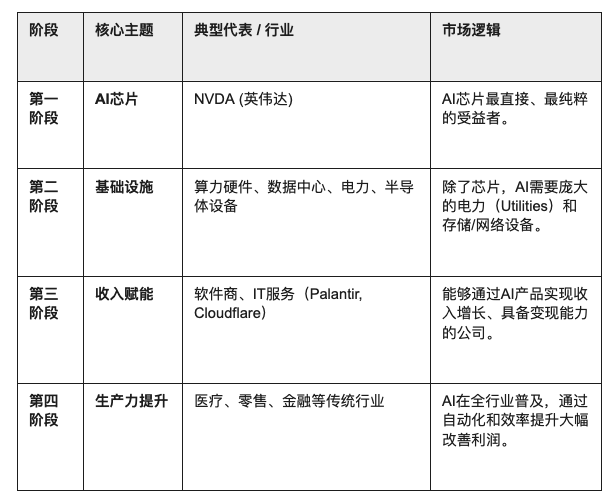
The Four Stages of AI Investment Model, Reference: https://www.goldmansachs.com/insights/articles/ai-infrastructure-stocks-poised-to-be-next-phase
Currently, the AI industry has just reached the intersection of transitioning from "infrastructure expansion" to "application landing," marking the period of transition from stage 2 to stage 3. The demand for AI infrastructure is in an explosive phase:
It is predicted that by 2030, global data centers' demand for electricity will increase by 165%.
From 2023 to 2030, the compound annual growth rate of electricity demand for U.S. data centers will be 15%, which will increase the proportion of data centers in the total electricity demand of the U.S. from the current 3% to 8% by 2030.
It is expected that by 2028, global cumulative spending on data centers and hardware will reach $3 trillion.
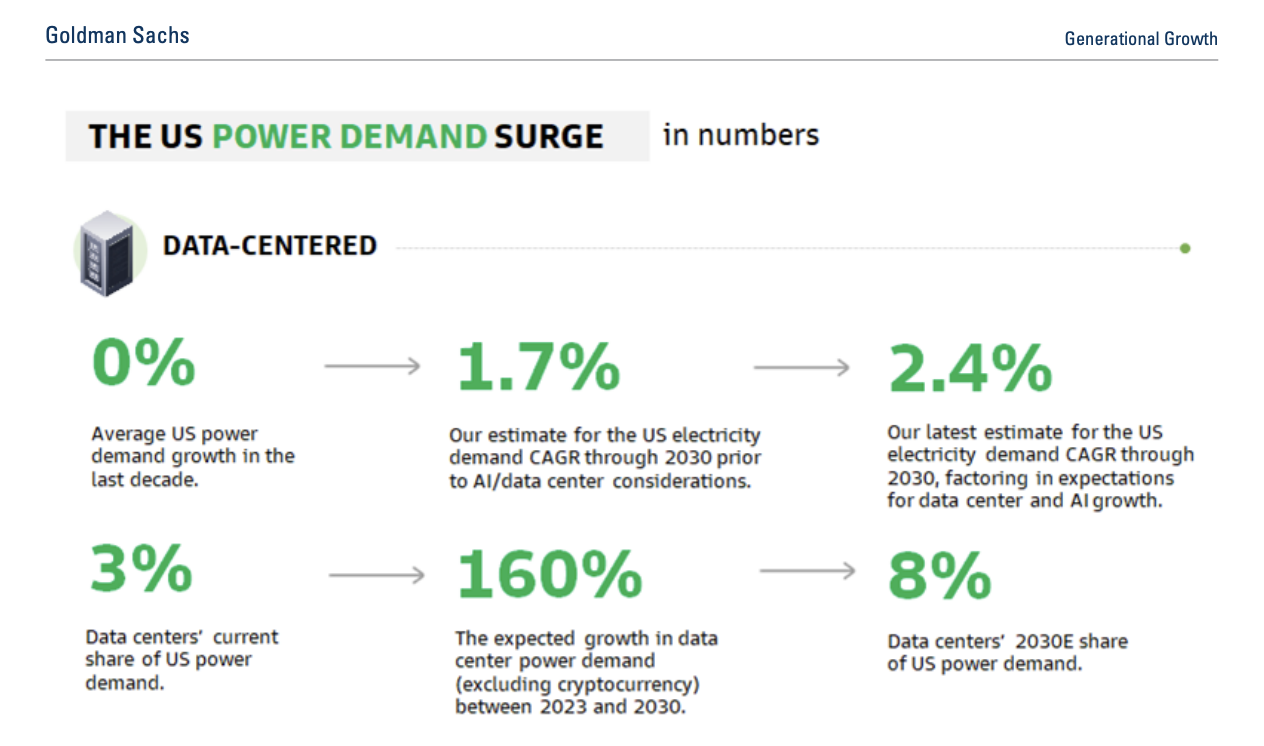
_Goldman Sachs' forecast for U.S. data centers' electricity demand, Image Source: _https://www.goldmansachs.com/pdfs/insights/pages/generational-growth-ai-data-centers-and-the-coming-us-power-surge/report.pdf
At the same time, the generative AI application market is also experiencing explosive growth, expected to reach $1.3 trillion by 2032. In the short term, the construction of training infrastructure will drive the market to grow at a compound annual growth rate of 42%; in the medium to long term, growth momentum will gradually shift towards reasoning devices for large language models (LLMs), digital advertising, and professional software and services.
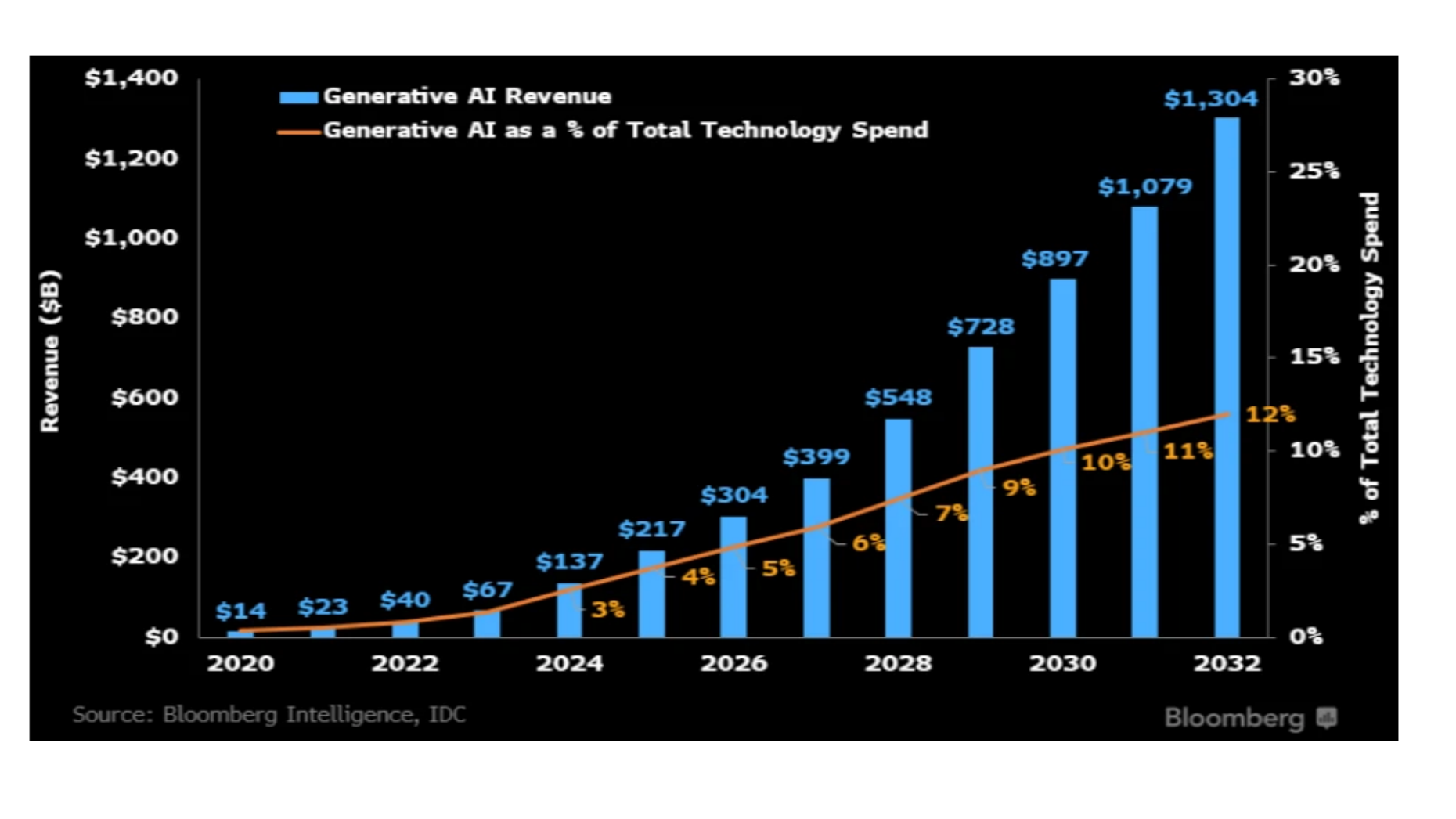
_Bloomberg: Generative AI growth forecast for the next decade, Data Source: _https://www.bloomberg.com/company/press/generative-ai-to-become-a-1-3-trillion-market-by-2032-research-finds
This judgment will be validated in 2026. Goldman Sachs' latest macro outlook for 2026 indicates that it will be the "year of realization" for AI investment returns (ROI), with AI having a substantial cost-reduction effect on 80% of non-tech companies in the S&P 500 index. This will verify whether AI can truly achieve a qualitative shift from "potential" to "performance" on corporate balance sheets.
Therefore, the focus of the market in the next 2-3 years will no longer be limited to a single tech giant but will further expand: digging deeper into AI infrastructure (such as electricity, computing hardware, data centers) and looking for generalized industry companies that successfully convert AI into profit growth.
AI Computing Power is the "New Oil," BTC is the "New Gold"
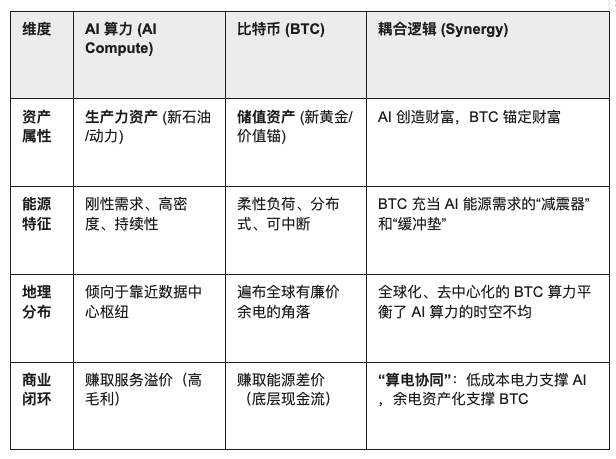
If AI computing power is the "new oil" of the Digital Intelligence Era, driving an exponential leap in productivity, then BTC (Bitcoin) will be the "new gold" of this era, serving as the ultimate foundation for value anchoring and credit settlement.
AI, as an independent economic entity, does not require the human banking system; what it needs is energy. And BTC is a pure "digital energy storage". In the future, AI will be the "fuel" of the economy, while BTC will be the "anchor" behind economic value. The issuance of BTC is entirely dependent on proof of work (PoW) based on electricity consumption, which aligns perfectly with the essence of AI (the conversion of electricity into intelligence).
Furthermore, as a consumable productive asset, the core cost of AI computing power comes from electricity, and its value output depends on algorithm efficiency; while BTC, as a decentralized store of value, essentially represents the monetization of energy, naturally possessing the function of a "reservoir" to balance the spatial and temporal disparities of global computing power. AI requires a continuous and stable supply of electricity, while BTC mining can absorb the waste electricity generated by the grid due to spatial and temporal imbalances. That is, BTC mining stabilizes the grid through "Demand Response": when electricity is in surplus (such as during peaks of wind or solar energy), computing power can act as a load to absorb excess electricity; when electricity is in short supply (during AI computation peaks), mining power can instantly shut down, releasing electricity to higher-value AI clusters.
GENIUS Act: The Intersection Point of Stablecoins + RWA + On-Chain Computing Power
With the passage of the GENIUS Act in the U.S. in 2025, the dollar is also preparing to gradually complete its digital transformation, with stablecoins being incorporated into the federal regulatory framework and becoming the "on-chain extension" of the dollar system. This act not only injects a trillion-dollar new type of on-chain liquidity pool into U.S. Treasury bonds but also provides a reference paradigm for designing stablecoin regulatory systems in major global jurisdictions such as the European Union, the United Kingdom, Singapore, and Hong Kong.
The establishment of this compliance framework first injects strong institutional momentum into the RWA (Real World Assets) market: with regulated stablecoins enhancing global liquidity and supporting efficient cross-border settlement and transactions, the issuance and circulation of RWAs will become more convenient. Stablecoins have become the primary payment method for on-chain investments in real estate, bonds, artworks, and other RWAs, facilitating rapid global cross-border clearing.
Among these, AI computing power assets, due to their high input costs, stable returns, and heavy asset attributes, naturally meet the requirements for on-chain digital management and are gradually being viewed as a standardized RWA: whether it is GPU cloud computing, AI inference resources, or the operational capacity of edge computing nodes, their pricing methods, leasing cycles, load rates, energy efficiency ratios, and other parameters can all be quantitatively mapped through smart contracts on the blockchain. This means that future transactions, settlements, and refinancing of computing power leasing, revenue splitting, and transfers will fully migrate to on-chain financial infrastructure; additionally, computing power can achieve real-time insights into equipment operations and revenues through on-chain data, ensuring that returns are transparent and verifiable; at the same time, computing power supply can be flexibly scheduled on demand, reducing the risks of capital occupation and resource idleness under traditional heavy asset models, thus ensuring the stability and transparency of returns.
What is even more exciting is that just as the oil exchanges emerged on Wall Street two hundred years ago after the discovery of oil, AI computing power, aided by RWA, is expected to become a financial asset that can be standardized for trading, collateralization, and leveraging, enabling innovative financial operations such as on-chain financing, trading, leasing, and dynamic pricing; the new generation of RWA-based "computing power capital markets" will have more efficient value transfer channels and limitless application potential.
New Opportunities Under the "Dual Consensus"
In this new era where AI is fully integrated into our lives, computing power will serve as the consensus of efficient productivity, while the extreme liquidity accompanying efficient productivity—BTC—will redefine the consensus of value storage.
Thus, companies that can grasp either "productivity" or "assets" in the future will become the most valuable entities in the upcoming cycle, and cloud service providers are at the intersection of "BTC value storage consensus" and "AI production consensus." If computing power is the high-energy fuel driving the rapid operation of the digital economy, then cloud services are the intelligent pipelines that carry and distribute this power.
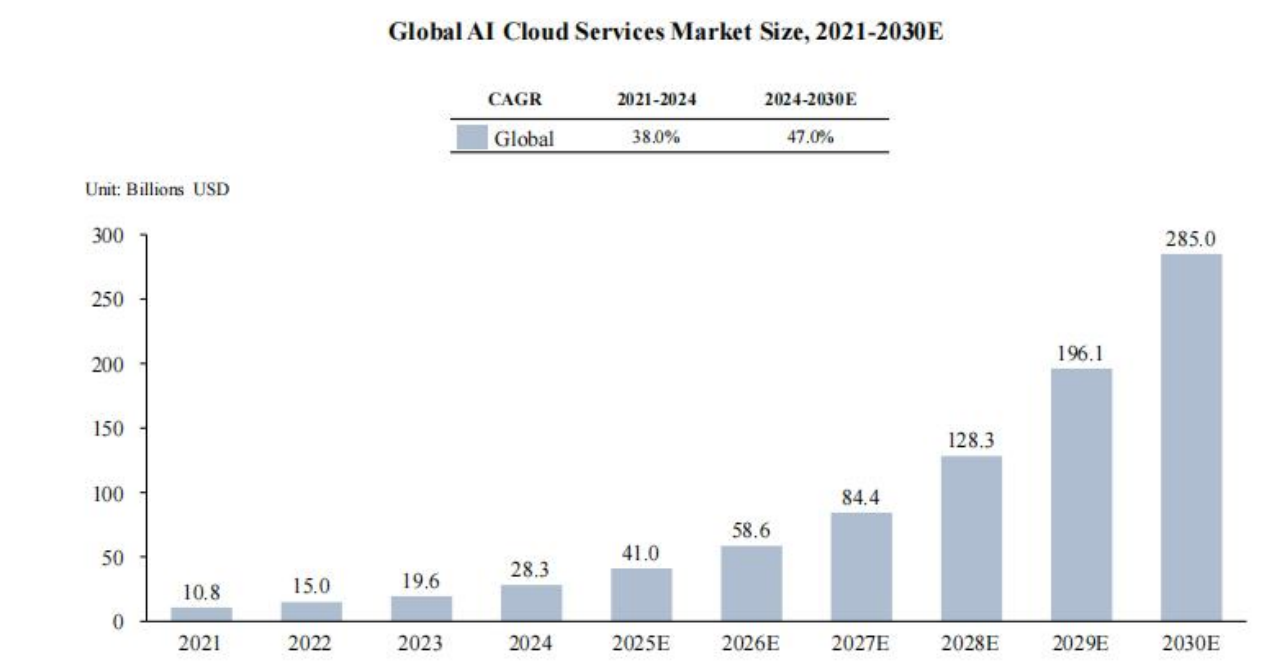
Global AI Cloud Service Market Size Forecast, Data Source: Frost & Sullivan
This includes several major players: Microsoft, Amazon, Google, xAI, and Meta. They are also referred to as "Hyperscalers" (large-scale cloud service providers whose main business is IAAS (Infrastructure as a Service) aimed at general demand. Although they have large pools of computing resources, they may be inefficient when it comes to scheduling computing resources. Hyperscalers are also the upstream of AI computing power services, controlling the vast majority of computing resources on the market and continuing to lay out computing power infrastructure:
Microsoft: Launched the $100 billion "Stargate" plan, aimed at building a million-level GPU cluster to provide extreme computing power support for the evolution of OpenAI's models.
Amazon (AWS): Committed to investing $150 billion over the next 15 years to accelerate the deployment of its self-developed Trainium 3 chips, achieving decoupling of computing power costs from external supply through hardware autonomy.
Google: Maintains annual capital expenditures at a high level of $80-90 billion, rapidly expanding AI proprietary cloud (AI Regions) globally, leveraging the high energy efficiency advantages of its self-developed TPU v6.
Meta: Zuckerberg clearly stated in the earnings call that Meta's capital expenditures (Capex) will continue to grow, with the 2025 guidance raised to $37-40 billion, building the world's largest open-source AI computing power pool through liquid cooling technology upgrades and a reserve of 600,000 H100 equivalent computing power.
xAI: Achieved the world's largest single supercomputing cluster, Colossus, at "Memphis speed," aiming for a scale of 1 million GPUs, demonstrating extremely aggressive and efficient infrastructure delivery capabilities.
Other emerging cloud service providers like CoreWeave and Nebius are referred to as NeoCloud, with their main business expanding to IAAS + PAAS (Platform as a Service). Unlike the general cloud platform services provided by the giants, NeoCloud focuses on high-performance computing platforms for AI training and inference, offering not only more flexible computing power leasing solutions but also specialized computing power scheduling solutions tailored to AI training and inference needs, with faster response times and lower latency.
At the same time, they stockpile top-tier GPUs (H100, B100, H200, Blackwell, etc.) and build high-performance AIDC, pre-installing the entire machine set, liquid cooling, RDMA networks, and scheduling software, quickly delivering flexible leases to customers based on whole machines or entire parks + daily charges.
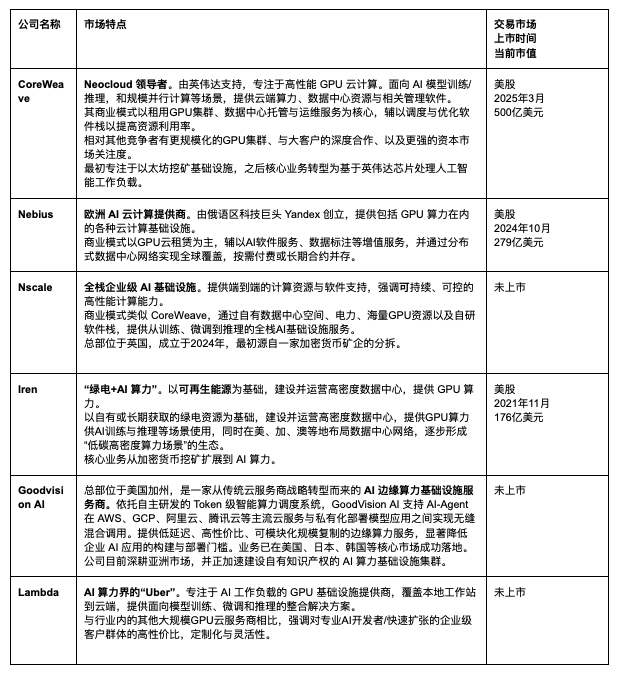
The leading player in Neo Cloud is undoubtedly CoreWeave; as one of the most notable tech stocks in 2025, CoreWeave's core business currently focuses on cloud computing and GPU-accelerated infrastructure services for AI training and inference scenarios. Of course, there are other new enterprises targeting computing power leasing, such as Nebius, Nscale, and Crusoe, which are strong competitors.
Unlike the heavy asset computing clusters of Neo Cloud like CoreWeave competing in the European and American markets, GoodVision AI represents another possibility for the globalization of computing power—by intelligently scheduling and managing multiple computing power users, it builds rapidly deployable, low-latency, cost-effective AI infrastructure in emerging markets with relatively weak electricity and infrastructure. Additionally, while the giants are building million-level GPU clusters in places like Memphis for larger parameter model training, GoodVision AI addresses the "last mile" latency response issue for AI application deployment through modular inference computing power nodes distributed in emerging markets like Asia.
It is worth mentioning that most top AI computing power service providers share a clear characteristic: their founding teams or core architectures are deeply rooted in the cryptocurrency mining industry. Transitioning from mining to AI computing power is not a cross-industry shift but a strategic reuse of core capabilities. BTC mining and AI high-performance computing are highly isomorphic at the underlying logic level, both relying heavily on large-scale electricity acquisition, high-power center deployment, and 24/7 extreme operations. The cheap electricity channels and hardware management experience accumulated by these companies in earlier years have become the most scarce premium assets in the AI wave.
As the demand for AI computing power grows exponentially, they naturally switch these existing infrastructures from "mining store-of-value assets (BTC)" to "outputting productive computing power (AI)." With the maturation of the "bidirectional switching" technology, BTC can effectively balance the issues of energy time-space and spatial distribution imbalance. Therefore, entering the Digital Intelligence Era, the "fuel" driving productivity leaps will shift from oil to computing power, while the "underlying asset" anchoring its value consensus will evolve from gold to BTC.
Combining blockchain technology to put computing power on-chain, as RWA assets, not only allows for verifiable records of computing power sources, usage efficiency, and operational returns but also builds a smart contract settlement mechanism across regions and time periods, thereby reducing credit risk and intermediary costs, expanding its application scenarios in DeFi and cross-border computing power leasing. For example, edge computing nodes can provide PoW proof through intelligent scheduling of parameters such as load rates and energy efficiency ratios, and when quantified by smart contracts, edge inference computing power can become a standardized financial product that is transferable and collateralizable, realizing a "computing power market on-chain." The combination of computing power and RWA will further enrich the types of on-chain assets, opening up new liquidity spaces for global capital markets.
Connecting Productivity and Value Storage: Towards the Future of Computing Power Monetization
This is a real confirmation of the "dual consensus" logic we previously proposed: BTC is the top-level value anchor of energy, while AI is the productive application of energy. From this perspective, the era of "computing power as currency" is arriving far more quickly and disruptively than imagined. As humanity enters the Digital Intelligence Era, the "fuel" driving productivity leaps is shifting from oil to computing power, while the "underlying asset" supporting its value consensus is evolving from gold to BTC.
At this moment, we are like the onlookers standing in the muddy land of Pennsylvania in 1859, unable to imagine how that drill rod reaching deep into the ground would open a new era of industrial civilization. Today, the fiber optic cables extending to data centers around the world are quietly constructing the arteries of the new era. Those who first bet on computing power and BTC will also play the role of new "oil tycoons" in this transformation, redefining the distribution of wealth and power in the new cycle.
References:
John S. Gordon [U.S.]: "The Great Game: The Rise of Wall Street's Financial Empire"
Daniel Yergin [U.S.]: "The Prize: The Epic Quest for Oil, Money & Power"
Goldmansachs: AI infrastructure stocks are poised to be the next phase of investment
Goldmansachs: AI, data centers and the coming US power demand surge
Bloomberg: Generative AI to Become a $1.3 Trillion Market by 2032, Research Finds
KPMG: Bitcoin’s role in the ESG imperative
Square: Bitcoin is Key to an Abundant, Clean Energy Future
Arthur Hayes: Bitcoin will be the currency of artificial intelligence
36Kr: CoreWeave: In the Era of Computing Power, Holding the "Golden Shovel"
免责声明:本文章仅代表作者个人观点,不代表本平台的立场和观点。本文章仅供信息分享,不构成对任何人的任何投资建议。用户与作者之间的任何争议,与本平台无关。如网页中刊载的文章或图片涉及侵权,请提供相关的权利证明和身份证明发送邮件到support@aicoin.com,本平台相关工作人员将会进行核查。


