A year ago, an article titled "Payment for Order Flow on Solana" unveiled a dark corner of the Solana fee market, sparking phenomenal attention on English Twitter.
PFOF (Payment for Order Flow) is already a mature business model in traditional finance. Robinhood leveraged this model to launch "zero-commission trading," quickly breaking away from many established brokerages. This strategy not only allowed Robinhood to rake in substantial profits but also forced industry giants like Charles Schwab and E-Trade to follow suit, changing the landscape of retail brokerage in the United States.
In 2021 alone, Robinhood generated nearly $1 billion in revenue through PFOF, accounting for half of its total revenue that year; even by 2025, its quarterly PFOF revenue was still in the hundreds of millions. This highlights the enormous profits behind this business model.
In traditional markets, market makers have a strong preference for retail orders. The reason is simple: retail orders are often considered "non-toxic," as they are usually based on emotions or immediate needs and do not contain precise predictions of future price movements. Market makers can profit from these orders by capturing the bid-ask spread without worrying about becoming counterparties to informed traders (such as institutional investors).
Based on this demand, brokerages (like Robinhood) bundle user order flows and sell them in bulk to market-making giants like Citadel, thus collecting hefty rebates.
While regulation in traditional financial markets somewhat protects retail investors, the SEC's National Market System Regulation mandates that even packaged orders must be executed at no less than the market's best price.
However, in the unregulated on-chain world, applications are exploiting information asymmetry to induce users to pay priority fees and tips that far exceed actual on-chain demand, quietly pocketing these premiums. This behavior essentially imposes a lucrative "invisible tax" on unsuspecting users.
Monetizing Traffic
For applications that control a large number of user entry points, the means of monetizing traffic are far more diverse than one might think.
Front-end applications and wallets can determine where users' trades go, how they are executed, and even how quickly they are processed on-chain. Every "checkpoint" in the lifecycle of a transaction hides business strategies to "squeeze out" user value.
Selling User Access to Market Makers
Like Robinhood, applications on Solana can also sell "access rights" to market makers.
RFQ (Request for Quote) is a direct manifestation of this logic. Unlike traditional AMMs, RFQ allows users (or applications) to directly request quotes and execute trades with specific market makers. On Solana, aggregators like Jupiter have already integrated this model (JupiterZ). In this system, the application can charge connection fees to these market makers or more directly, bundle and sell retail order flows. As on-chain price spreads continue to narrow, the author anticipates that this "selling heads" business will become increasingly common.
Additionally, a certain alliance of interests is forming between DEXs and aggregators. Prop AMMs (proprietary market makers) and DEXs heavily rely on the traffic brought by aggregators, and aggregators are fully capable of charging these liquidity providers while returning part of the profits as "rebates" to front-end applications.
For example, when the Phantom wallet routes a user's trade to Jupiter, the underlying liquidity providers (like HumidiFi or Meteora) may pay Jupiter for the execution rights of that trade. After receiving this "toll fee," Jupiter then returns a portion of it to Phantom.
Although this speculation has not been publicly confirmed, the author believes that under profit-driven motives, this "profit-sharing unspoken rule" within the industry chain is almost a natural phenomenon.
Bloodsucking Market Orders
When a user clicks "confirm" and signs in their wallet, this transaction is essentially a "market order" with slippage parameters.
For the application side, there are two ways to handle this order:
Positive route: Sell the "backrun" (tailing arbitrage) opportunities generated by the transaction to professional trading firms, sharing the profits. Backrun refers to when a user's buy order on DEX1 drives up the token price on DEX1, and arbitrage bots subsequently buy on DEX2 within the same block (without affecting the user's buy price on DEX1) and sell on DEX1.
Negative route: Assist sandwich attackers in targeting their own users, driving up the users' execution prices.
Even taking the positive route does not mean the application side is acting ethically; to maximize the value of "tailing arbitrage," the application side has the incentive to deliberately slow down the transaction's on-chain speed. Driven by profit, the application side may also intentionally route users to pools with lower liquidity, artificially creating larger price fluctuations and arbitrage opportunities.
Reports indicate that some well-known front-end applications on Solana are engaging in the aforementioned practices.
Who Takes Your Tips?
If the above methods still carry some technical barriers, then the opaque operations regarding "transaction fees" can be described as "not even pretending."
On Solana, the fees paid by users are actually divided into two parts:
Priority Fee: This is the fee within the protocol, directly paid to validators.
Transaction Tip: This is a payment of SOL to any address, usually paid to "landing service providers" like Jito. The service provider then decides how much to distribute to validators and how much to rebate back to the application side.
Why are landing service providers needed? Due to the complexity of communication during congestion on the Solana network, ordinary transaction broadcasts can easily fail. Landing service providers act as "VIP channels," promising users successful on-chain transactions through specialized optimized links.
The complex block builder market and fragmented routing system of Solana have given rise to this special role, creating excellent rent-seeking opportunities for the application side. The application side often induces users to pay high tips to "guarantee success," then shares this premium with the landing service providers.
Transaction Flow and Fee Landscape
Let's look at some data. During the week from December 1 to 8, 2025, Solana's entire network generated 450 million transactions.
Among them, Jito's landing service processed 80 million transactions, dominating the market (93.5% of the builder market share). Most of these transactions were related to swaps, oracle updates, and market maker operations.
In this vast pool of traffic, users often pay high fees to "seek speed." But is all this money really used to accelerate transactions?
Not necessarily. Data shows that low-activity wallets (usually retail investors) pay exorbitant priority fees. Considering that the blocks at that time were not full, these users were clearly overcharged.
The application side exploits users' fear of "transaction failure" to induce them to set extremely high tips, then pockets this premium through agreements with landing service providers.
Negative Example: Axiom
To illustrate this "harvesting" model more intuitively, the author conducted an in-depth case study of Axiom, a leading application on Solana.
Axiom generates the highest transaction fees on the network, not only because it has many users but also because it charges the most aggressively.
Data shows that the median priority fee (p50) paid by Axiom users is as high as 1,005,000 lamports. In contrast, high-frequency trading wallets only pay about 5,000 to 6,000 lamports. This represents a 200-fold difference.
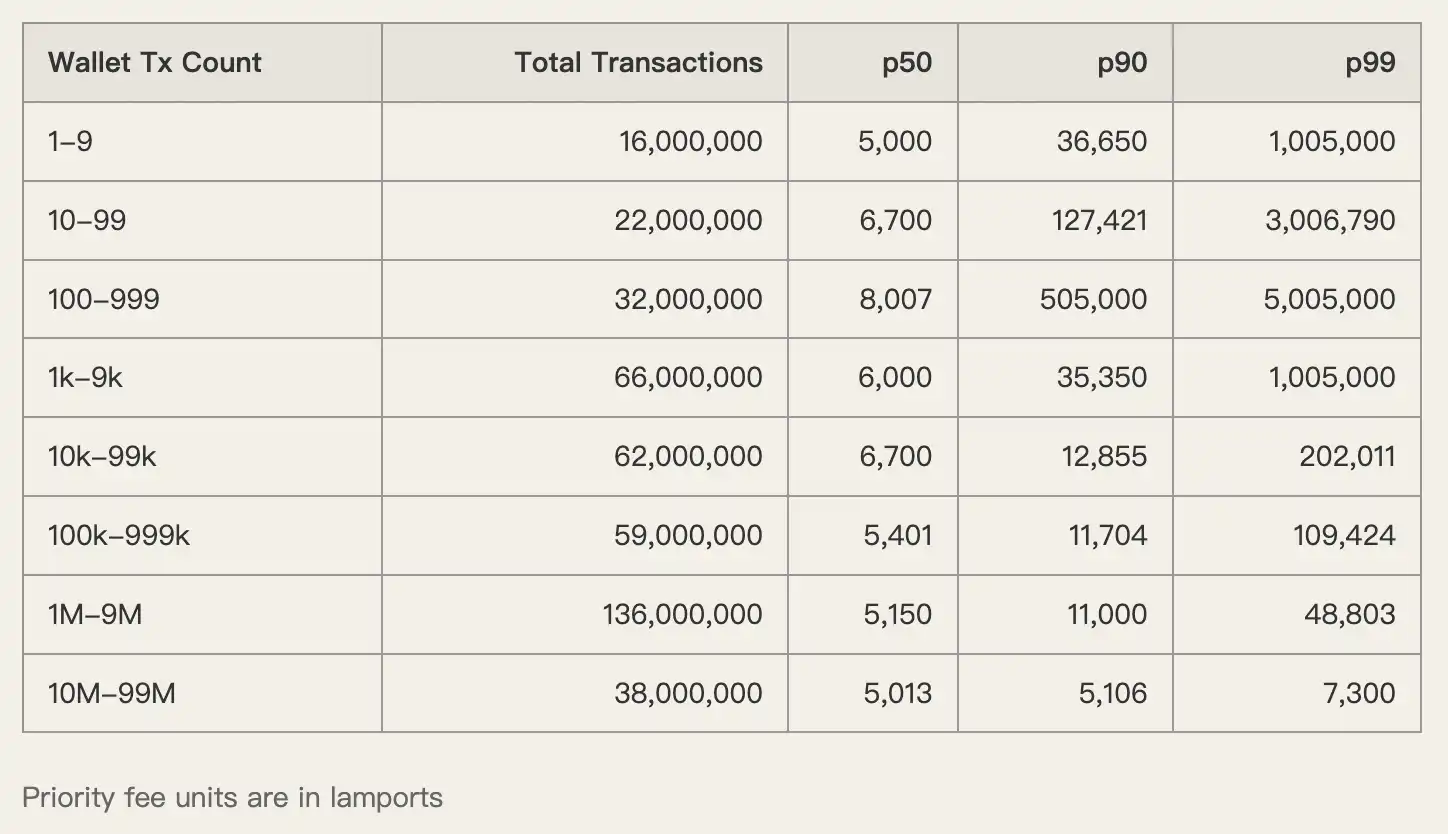
The same is true for tips.
Axiom users pay tips on landing services like Nozomi and Zero Slot that far exceed the market average. The application side is exploiting users' extreme sensitivity to "speed," completing double charging without any negative feedback.
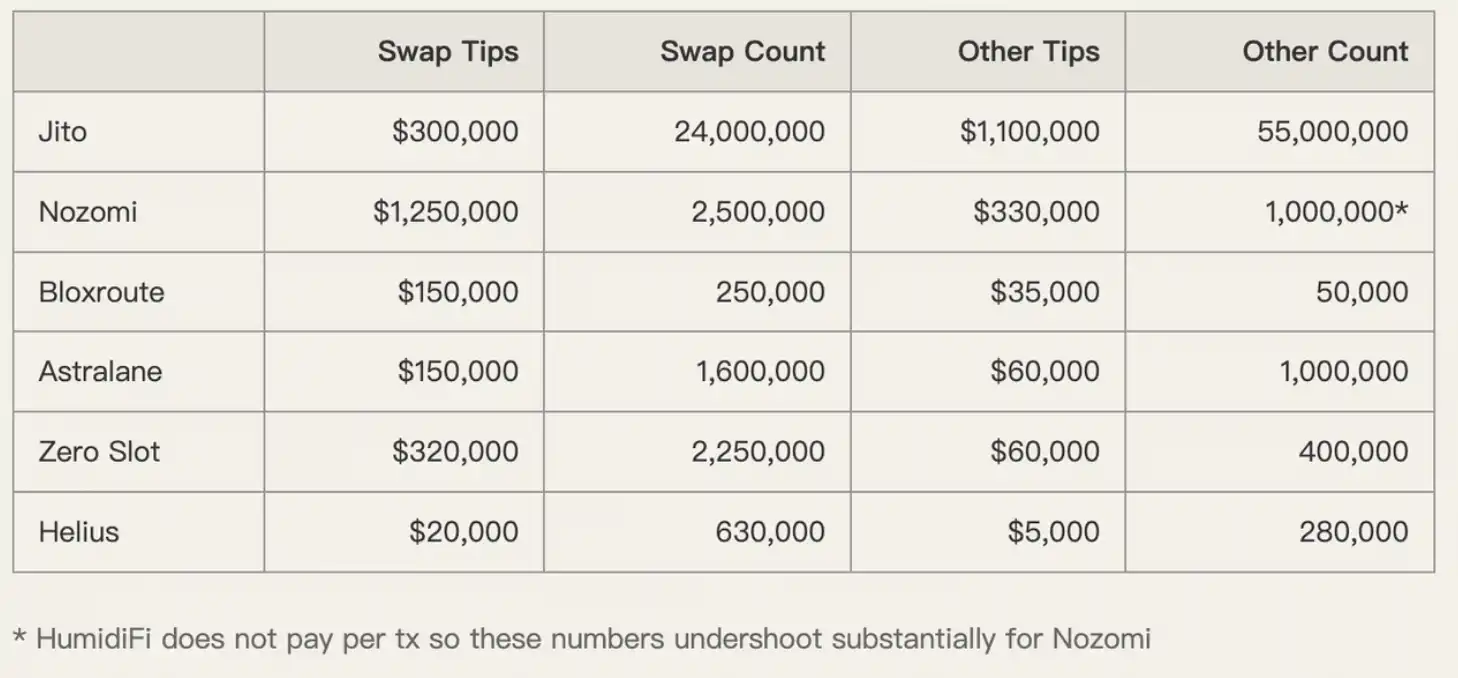
The author bluntly speculates: "The vast majority of transaction fees paid by Axiom users ultimately end up in the pockets of the Axiom team."
Regaining Fee Pricing Power
The severe misalignment of user incentives and application incentives is the root cause of the current chaos. Users do not know what constitutes a reasonable fee, while the application side is happy to maintain this chaos.
To break this situation, we need to start from the underlying market structure. It is expected that the introduction of Solana's Multiple Concurrent Proposers (MCP) and Priority Ordering mechanisms around 2026, along with the widely proposed dynamic base fee mechanism, may be the key to solving the problem.
Multiple Concurrent Proposers (MCP)
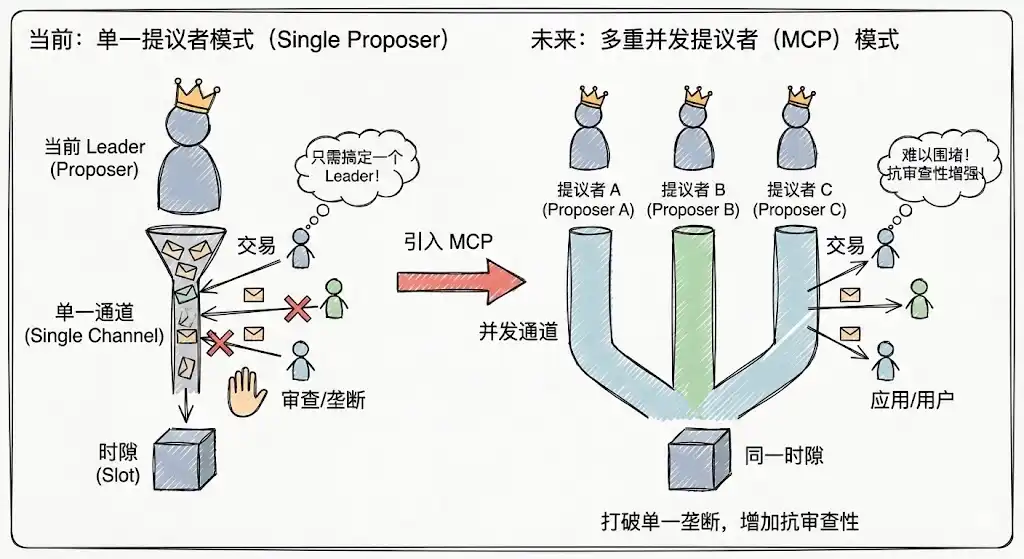
The current single proposer model in Solana easily leads to temporary monopolies, as the application side only needs to deal with the current leader to control transaction packaging rights in a short time. With the introduction of MCP, multiple proposers will work concurrently in each time slot, significantly increasing the cost of attacks and monopolies, enhancing censorship resistance, and making it difficult for the application side to block users by controlling a single node.
Priority Ordering Mechanism
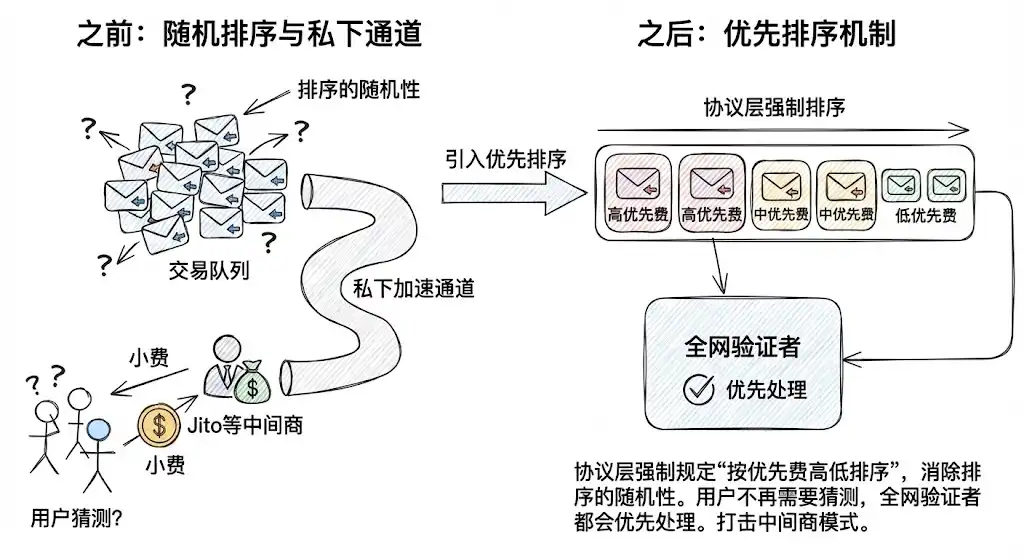
By mandating "ordering by priority fee" at the protocol level, the randomness of ordering (jitter) is eliminated. This weakens the need for users to rely on private acceleration channels like Jito just to "guarantee success." For ordinary transactions, users no longer need to guess how much tip to give; as long as they pay within the protocol, all network validators will prioritize processing based on deterministic rules.
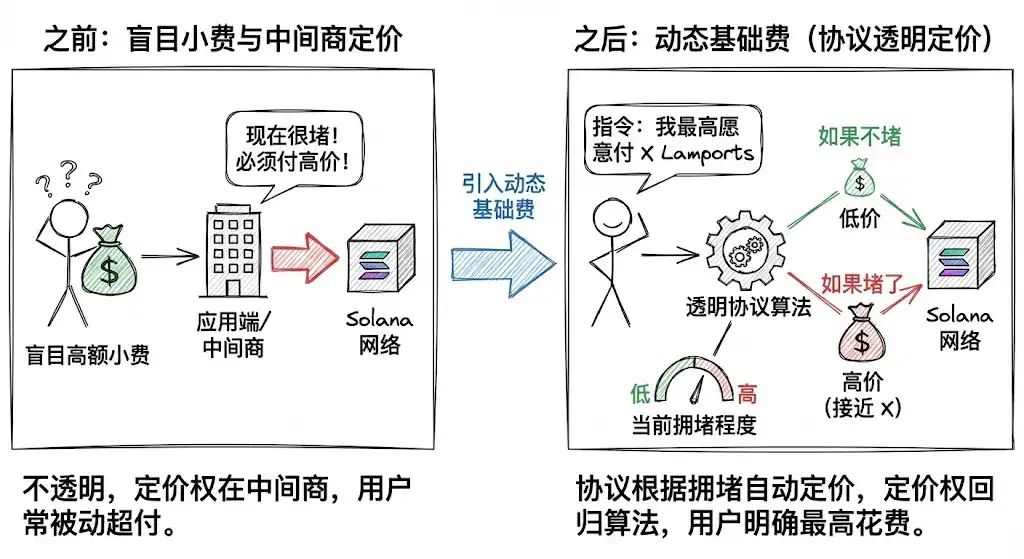
Dynamic Base Fee
This is the most critical step. Solana is attempting to introduce a concept similar to Ethereum's dynamic base fee.
Users will no longer blindly give tips but will explicitly instruct the protocol: "I am willing to pay a maximum fee of X lamports for this transaction to be processed on-chain."
The protocol will automatically price based on the current level of congestion. If there is no congestion, it will charge a low price; if congested, it will charge a high price. This mechanism will reclaim the pricing power of fees from the application side and intermediaries, returning it to a transparent protocol algorithm.
Meme culture has brought prosperity to Solana but has also left deep-rooted issues, fostering a restless profit-seeking gene. For Solana to truly realize the vision of ICM, it cannot allow applications that control front-end traffic and protocols that control infrastructure to collude and act recklessly.
As the saying goes, "Clean the house before inviting guests." Only through upgrades to the underlying technical architecture, using technological means to eliminate rent-seeking soil, and developing a fair, transparent market structure that prioritizes user welfare can Solana truly possess the confidence to integrate and compete with traditional financial systems.
免责声明:本文章仅代表作者个人观点,不代表本平台的立场和观点。本文章仅供信息分享,不构成对任何人的任何投资建议。用户与作者之间的任何争议,与本平台无关。如网页中刊载的文章或图片涉及侵权,请提供相关的权利证明和身份证明发送邮件到support@aicoin.com,本平台相关工作人员将会进行核查。


