Author: Squid
Translation: AididiaoJP, Foresight News
Part One: What is the Current Market Sentiment?
"What excites you the most about cryptocurrency?"
"What areas are you investing in?"
When attending conferences, I always ask these questions to venture capitalists and hedge fund peers. They usually have the most macro insights into industry trends. However, the answers received at the Breakpoint conference last December were not uplifting.
Most responses focused on the market consensus tracks:
For example, "stablecoins," "perpetual contracts," "prediction markets," "real-world assets (RWA)," "digital banking."
Some answers also revealed deeper concerns:
For instance, "there's nothing to be excited about," "non-crypto businesses using blockchain infrastructure," "taking a break to observe."
Overall, it seems that people's bets are leaning more towards industry "maturity" rather than "innovation." A pervasive nihilistic sentiment underlies these conversations.
This sentiment is rarely explicitly stated, but most people can feel it. It stems from the endless scams, the listing of low liquidity high valuation projects, exchange token hype, and KOL marketing games. This sentiment reflects the current state of the industry but cannot predict the future; it can even be said that the future is likely not a continuation of today.
Betting on mature tracks or areas with clear product-market fit (PMF) is essentially a subconscious "hedging behavior," rooted in this nihilism. Participants want to avoid the worst aspects of the industry and are unwilling to take risks for innovation in an environment where tokens are generally underperforming.
I believe that by 2026, these directions will not be good liquidity trading choices:
The problem is that market efficiency remains low, and this inefficiency continues to support the prices of many altcoins. Industry maturity means prices will revert to fundamental values—this will likely lead to a decline in most tokens in the medium to short term. Unless you short, it is hard to find investment opportunities based on fundamentals.
Trading trend continuation in areas with existing PMF, while reasonable in direction, is difficult to operate in liquidity markets due to the persistent "adverse selection" problem. Most of the time, if you buy tokens in consensus tracks, you are either buying low-quality follow-up varieties or entering at absurd valuations.
For example: You say you are optimistic about prediction markets in 2025? Which token did you actually buy?
Part Two: What is the Value of Cryptocurrency?

Industry maturity means moving towards fundamental pricing. But this exposes a core issue: the scale of fundamentals is too small to support current valuations and is hard to drive the market.
So, what exactly is driving token prices? The following chart provides a rough division of cryptocurrency market capitalization by asset class, adjusted for clarity:
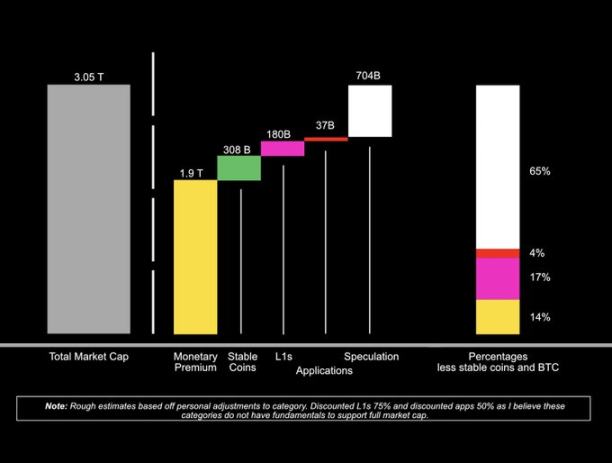
Two main adjustments were made:
- A 75% discount applied to the Layer 1 sector overall
- A 50% discount applied to the application sector overall
This reflects a viewpoint: a significant portion of these two asset classes lacks the fundamentals to support current valuations.
After adjustments, two points stand out:
1. Market Size Cannot Support Grand Narratives
Despite the attention on the application layer, the actual market size remains very small. Last year, the total on-chain transaction fee revenue was about $10 billion, and not all revenue belongs to token holders. In a global context, this number is negligible. It can even be said that the total valuation of the entire on-chain application ecosystem, before adjustments, is less than that of a single delivery company, DoorDash.
2. Even After Declines, Speculative Premiums Still Dominate Altcoin Valuations
Looking deeper:
Fundamentals
Fundamentals determine the price floor. For most tokens, this floor is far below current prices. Even at current valuation levels, the market capitalization of the vast majority of tokens is still driven by speculative premiums—value assigned by people expecting to sell at high prices in the future. This premium is highly correlated with overall market volatility and naturally diminishes over time. The more mature the track, the smaller the speculative space.
This situation is unlikely to change in the short term. Therefore, as speculative premiums fade, the performance of most existing altcoins will lag behind Bitcoin. The faster the industry matures, the quicker this weakness will manifest.
Layer 1
Layer 1 remains an important category, but the rules of the game have changed. The winning public chains are likely already established. Minor performance improvements are unlikely to shake the established network effects of liquidity, developer ecosystems, and distribution channels. New general-purpose public chains will no longer receive the premiums seen in past cycles. Application-specific chains will gradually be valued according to "application" metrics.
Revenue and Applications
The direction of "focusing on revenue" is correct but often misunderstood in the crypto space. People often discuss revenue multiples, but very few crypto businesses have a lasting moat. Much of the revenue comes from incentives, and cash flow has historically been weak. Even if a business is strong and cash flow is stable, it is often unclear whether the token can effectively capture that value. A low valuation multiple does not mean it is a good target.
The application layer still holds the greatest long-term potential, but truly solving problems takes time. From a liquidity investment perspective, there are huge opportunities here, but the timeline may be longer than the market generally expects.
"People always overestimate short-term changes and underestimate long-term transformations." — Amara's Law
The core conclusion remains unchanged: no matter how attractive the revenue narrative is, and no matter how much capital bets on industry maturity, speculation remains the main driver of market capitalization. Expanding fundamentals to a sufficient scale will take time; until then, valuations will still be set by expectations rather than cash flow.
Part Three: Trading Directions to Watch in 2026

In a single asset or market, speculative premiums will fade over time. This is an old story in the crypto world—AI agents, early DeFi, and NFTs have all gone through such cycles.
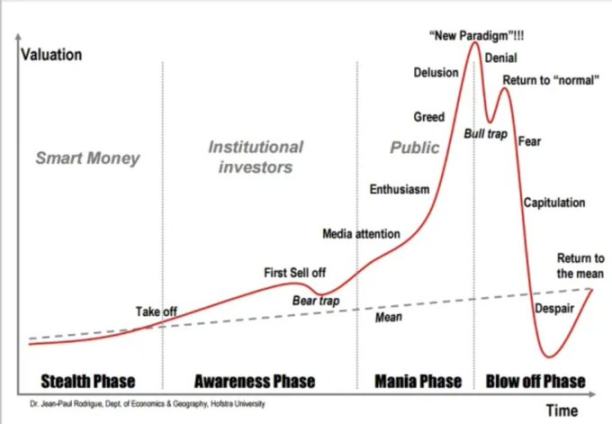
Speculation always flows towards areas where valuations are unclear, narratives are still forming, and market sizes are undefined (with limitless imaginative space).
In a nutshell: Bet on innovation.
Assets most likely to absorb speculative premiums in 2026 typically possess the following characteristics:
- Can create entirely new assets or markets on-chain
- Have a viable path to achieve "currency premium"
- Are difficult to value due to novelty or unclear cash flow attribution (this is also a key reason for the currency premium narrative)
- Have some barriers: technical thresholds, cognitive barriers, or access barriers (hard to arbitrage + better distribution)
- Align with larger global trends—market size is limitless
These conditions will delay the arrival of market efficiency, extending the window for mispricing, thus leaving room for speculation.
Specific Tracks and Projects to Watch
1. uPOW (Utility Proof of Work)
uPOW shifts mining output from pure inflation to outputs with actual utility, transforming "mining for distribution" into "adding value to assets." This direction has been discussed for a long time, and the underlying technology is now approaching feasibility. The uPOW project is novel and hard to value, representing a new class of productive assets with the potential to achieve currency premiums. Currently, two projects are of particular interest:
@nockchain: An early project that needs time to develop, aligns with this theme, and benefits from zero-knowledge proofs and privacy narratives.
@ambient_xyz: In the pre-mining phase, expected to launch this year. It has a strong cyberpunk style, providing computing power for evergreen large language models using POW.
2. Ownership Tokens
The era of "atmosphere coding" has arrived. Small teams developing short-cycle, niche MVPs will become the norm, with some growing into real companies. The lightweight financing process and the growth empowerment effect of tokens will continue to hold value. The core issue with these tokens is the claim to business value, but various mechanisms are already exploring solutions. Opportunities exist both in the tokens themselves and in the launch platforms. Two to watch:
- @MetaDAOProject: Recommended multiple times, a clear leader in this field.
- @StreetFDN: Earlier stage, positioned to serve offline startups.
3. Distributed Training and Computing Power Markets
Distributed training remains one of the most promising areas of AI x Crypto, with slower-than-expected rollout progress. Leading teams have begun testing, hoping for a full launch this year. Beyond the project tokens themselves, they are more likely to spawn secondary applications and token ecosystems based on them. True liquidity opportunities may lie there, even though project tokens may also rise. Leading teams:
- @NousResearch
- @primeintellect
- @pluralis
4. Social Metaverse
Digital social spaces continue to evolve. Product-market fit remains elusive, but experiments are ongoing. This field is expected to continue trial and error this year. The winners may not have emerged yet, but currently, keep an eye on:
- @zora: Demonstrating strong resilience, with huge potential for synergy between its creators and content tokens.
- @trendsdotfun: A Solana ecosystem project reaching the Asia-Pacific market, not yet widely noticed.
- @tryfumo: Included because it proves—execution itself is a moat.
- @ShagaLabs: Focused on metaverse data—more similar projects are expected.
5. Solana: @solana ($SOL)
General-purpose public chains have matured. As network effects strengthen, the importance of marginal technical improvements is less than that of existing liquidity, developer ecosystems, and distribution channels. The winners are likely already determined.
Solana has a strong core ecosystem, a rare long-term vision for builders and capital, and a reliable roadmap for continuous expansion. The next round of speculation will occur on existing infrastructure. Regardless of the specific narrative, Solana is structurally prepared to accommodate a large amount of such activity.
I believe the areas with limited opportunities are: robots, meme coins.
Conclusion
Nihilism is not insight; it is a lagging emotional response to price trends, a symptom of industry problems rather than a prophecy of the future.
In times of low sentiment, capital retreats to "mature trades" and consensus narratives to avoid risk. But in the crypto space, just like in other industries, hedging cannot bring excess returns.
The industry is still structurally in the "pre-fundamentals" stage, with price discovery dominated by speculative capital rather than cash flow. This situation will change more slowly than people imagine.
Speculative bubbles always follow innovation. Believe in innovation, try new applications, spend time communicating with builders, and bet on innovation.
免责声明:本文章仅代表作者个人观点,不代表本平台的立场和观点。本文章仅供信息分享,不构成对任何人的任何投资建议。用户与作者之间的任何争议,与本平台无关。如网页中刊载的文章或图片涉及侵权,请提供相关的权利证明和身份证明发送邮件到support@aicoin.com,本平台相关工作人员将会进行核查。