Original | Odaily Planet Daily (@OdailyChina)
Author|jk
While most emerging public chains are still struggling with cold starts, BNB Chain faces a different challenge: how to activate a mature ecosystem that already has a large user base?
In the second half of 2025, Nina Rong took on this challenge. As the new head of growth for BNB Chain, the core question she needs to answer is: with the infrastructure already in place and a user base already formed, what should be the next step?
This is not an easy position. The competition in the public chain space has long evolved from "who is faster" to "who can truly retain users." The comparison of technical parameters has gradually given way to the competition of ecosystem experience, which is often harder to quantify and replicate.
In this conversation, Nina did not shy away from the industry's real dilemmas: the high cost of user education, the information gap between quality products and users, and developers' understanding of public chains often lagging behind the pace of technological iteration. But she also brought a clear methodology: rather than making users "learn to use blockchain," it is better to make blockchain as invisible as cloud computing, allowing users to "go on-chain without realizing it."
Odaily Planet Daily sat down with Nina to discuss BNB's growth strategy and future direction. The full interview is as follows:
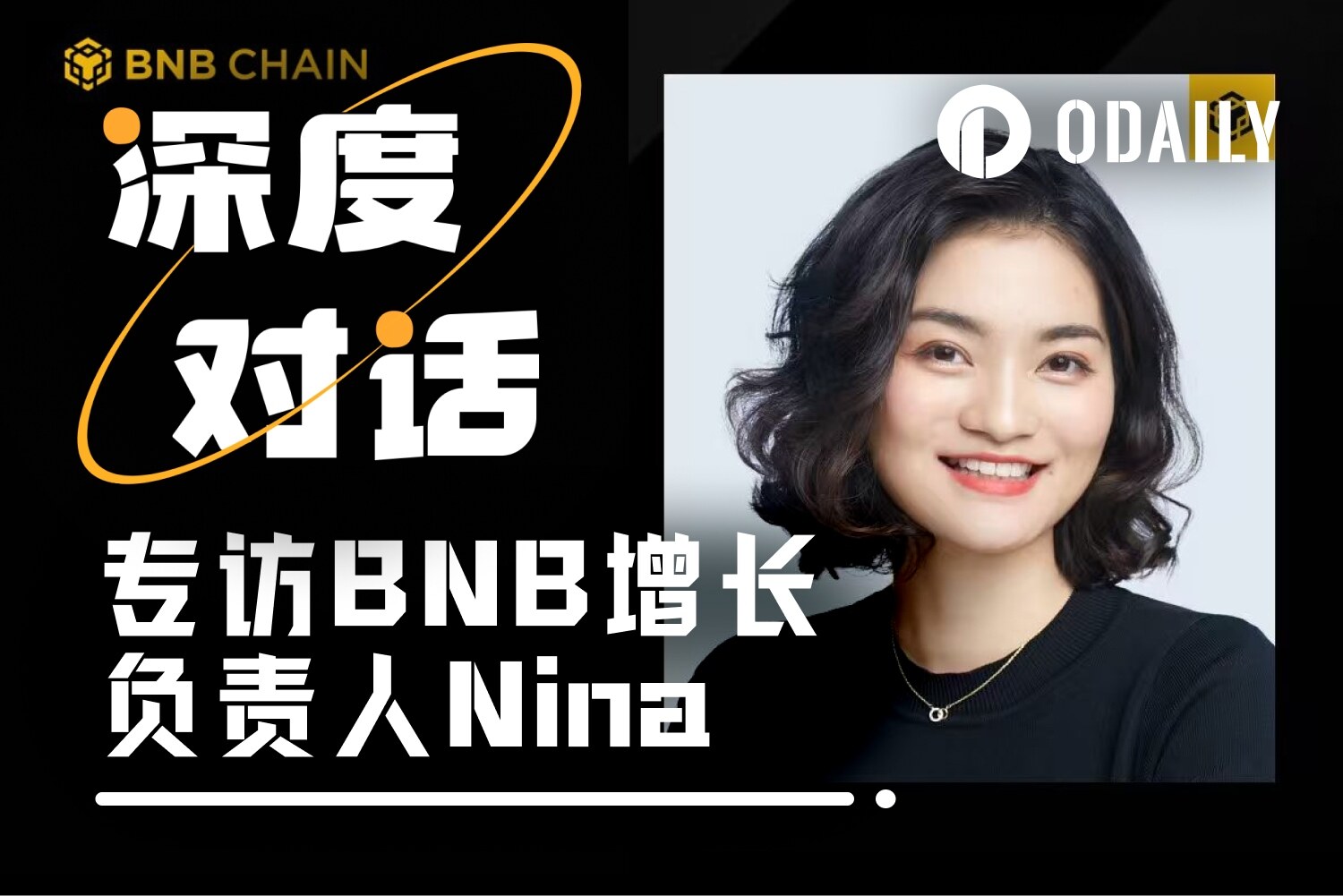
Q1: Nina, your recent entry into the company has attracted a lot of attention on Twitter; what motivated this career change? What is the core advantage of BNB Chain that attracts you?
Nina Rong: Many people might think I "jumped to BNB Chain," but that's not the case. I left Arbitrum in March this year and had about six months of rest in between. The opportunity at BNB Chain came after that, and frankly, it has a very strong appeal to me.
In my view, BNB Chain is one of the few public chains in the current market that still has enormous untapped potential. Its foundation is very solid. It possesses three key elements: user scale, institutional resources, and a developer ecosystem, and there are not many projects launched in the past 12 months that meet all three criteria.
From a longer-term perspective, it will only become increasingly difficult to rebuild such a foundation in the future. Therefore, I believe BNB Chain already has all the conditions necessary for success; the key now is whether we can effectively, prudently, and continuously execute to truly unleash these advantages.
Q2: How do you define the growth focus of BNB Chain in the next one to two years?
Nina Rong: From a vision perspective, BNB Chain's goal is very clear—to truly bring the next billion Web3 users on-chain. Therefore, users are always the most important link.
At the same time, we are also very aware that BNB Chain is essentially a developer-focused infrastructure product and does not directly target end users. The connection between users and us is more indirectly achieved through wallets, DeFi applications, and various on-chain products.
So in our growth strategy, we will simultaneously promote two things: on one hand, continuously enhance the activity and overall scale of users on BNB Chain;
on the other hand, attract more excellent developers and teams to join the ecosystem, allowing them to build products that are truly used by users based on BNB Chain.
Q3: In terms of the developer ecosystem, will BNB Chain have a clearer focus on specific tracks?
Nina Rong: From an ecosystem perspective, we will not "close the door" on any opportunities. But if I had to say which directions we value more, I believe trading and AI are two very important tracks.
AI is still in a relatively early stage, and this is not just BNB Chain's judgment, but the entire industry, and even human society, still needs time to settle. However, its potential is very clear in the medium to long term.
In the trading field, we have already seen a very clear Product-Market Fit. The definition of trading itself is very broad, including Meme, NFT, as well as more traditional asset forms like stocks and RWA. Essentially, applications and infrastructure built around "value exchange" have always been the core of the public chain ecosystem, which is why we place a high value on the trading track.
Q4: In the process of "guiding the next billion users on-chain," what is the current biggest bottleneck? How will BNB Chain respond?
Nina Rong: Compared to one or two years ago, the overall bottleneck in the industry is gradually decreasing. Regulatory uncertainty has seen significant improvement over the past year, which is a positive signal.
However, the core issues that still exist are: the high cost of user education and the relatively high threshold for using Web3. In terms of user experience, the entire industry has not yet achieved a state where "ordinary users with no background" can enter without barriers.
From BNB Chain's perspective, we do not want users to "realize they are using blockchain." Ideally, blockchain should be like cloud computing, becoming an invisible infrastructure. Just like when using mobile apps today, users do not care which cloud server the application is running on.
Therefore, we will work very closely with developers in the ecosystem to help them make their products more user-friendly, thereby bringing more people on-chain without increasing the users' understanding costs.
Q5: As the head of growth, what are your "three fires" upon taking office?
Nina Rong: The first thing is definitely talent recruitment.** You may have seen my recruitment posts on Twitter; I hope that those interested in blockchain and who resonate with our vision can join the BNB Chain ecosystem. This does not necessarily mean joining BNB Chain itself; it could also mean joining projects within the ecosystem. We have many opportunities, and I hope to be a bridge connecting talent with the ecosystem. Only by attracting more excellent talent can this ecosystem continue to develop.
The second thing is better developer services. I believe that truly good developer services allow developers' products to be discovered by high-value users. There is a common problem in the industry: many good products lack users, and users also find it hard to discover good products. As an ecosystem player, we can serve as a bridge for showcasing and linking, allowing seriously built projects to receive timely market feedback.
Q6: How do you view developers' current understanding of BNB Chain? Are there any new plans for developer experience that you can reveal in advance?
Nina Rong: In fact, many people do not realize that the core developers of BNB Chain are not very willing to step into the spotlight. They prefer to work quietly and do not express themselves publicly.
What I hope to change is to encourage more technical personnel to clearly explain the underlying technology of BNB Chain. Over the past five years, BNB Chain's performance has significantly improved. We are about to achieve a block time of approximately 450 milliseconds, which is among the best in Layer 1. However, many people's understanding of BNB Chain still lingers in 2020 and 2021.
I hope more technical personnel can communicate directly with frontline developers, quickly obtain feedback, and iterate on products. Since we are serving developers, we must truly understand their needs.
For example, recently Etherscan closed some chains' Free API, and the developer community has been discussing this. Free API is infrastructure for developers, so BNB Chain quickly launched its own Free API. We hope developers can build with peace of mind, rather than being stuck by these basic issues.
At the same time, we currently have a Kickstarter program, where projects built on BNB Chain can apply for cloud service credits, audit fee reductions, and other support. For early developers, we encourage participation in hackathons; for relatively mature projects and entrepreneurs, they can participate in YZi Labs (formerly Binance Labs) One Billion Builder Fund.
Between hackathons and funds, I hope to build a platform that allows developers to test products and obtain user feedback in a risk-free environment, enabling users to discover interesting new applications rather than treating them as investment targets.
Q7: How do you view the role of Memes in the public chain ecosystem?
Nina Rong: I believe Memes are a type of asset with real PMF, and the public chain ecosystem should not close its doors to them.
At the same time, we are also very clear that public chains should not participate in the issuance or success judgment of Memes. Which Memes can succeed and which cannot should be entirely determined by the market. One of the charms of crypto comes from its grassroots nature and uncertainty, and this randomness is something that no individual or team can, or should, dominate.
Q8: How will your successful experience at Arbitrum influence your work at BNB Chain?
Nina Rong: This was a question I asked myself before joining. But after two or three weeks in the position, I gave up that idea (laughs).
I prefer to return to first principles rather than replicate past success paths. Different projects have different foundations, resources, and community cultures; if I rely on past paths, it may limit my judgment. So I focus more on the goals themselves and then break down what needs to be done.
Of course, industry knowledge and connections have been very helpful to me personally, but not limited to this job; it applies to my entire career.
Q9: How do you define the core product value of BNB Chain compared to other L1/L2s?
Nina Rong: I believe the core value of BNB Chain lies in: a large-scale user base that has a long-term trust foundation in the ecosystem.
This trust is not easy to establish and will only become scarcer in the future. The BNB ecosystem has been deeply cultivated in the industry for five to six years, forming a very strong system. Developers are willing to build here, and users are willing to continue using products within the ecosystem, which is an extremely important and hard-to-replicate advantage.
Q10: How would you describe your leadership style?
Nina Rong: I prefer to see myself as an enabler.** My core responsibility is not to get involved in every detail of execution but to provide a platform, resources, and space for more professional people to leverage their strengths.
In the public chain ecosystem, BD, marketing, and technology are highly intertwined; no important task can be completed independently by a single team. Therefore, I place great importance on cross-team communication mechanisms, hoping that different functions can collaborate seamlessly and freely exchange ideas.
Q11: What kind of ecosystem do you hope BNB Chain will become in two years?
Nina Rong: I hope BNB Chain can become an ecosystem that is extremely friendly to retail users. Users should be able to seamlessly enter and easily use applications built on BNB Chain, while also being able to easily find products that truly suit them.
If I had to summarize it with a label, I hope BNB Chain becomes the industry’s “invisible but indispensable infrastructure.”
Q12: If you could go back to when you first entered the crypto industry in 2021, what advice would you give yourself?
Nina Rong: I would tell myself: do more research and observe more. In this industry, a person's ceiling largely depends on their understanding. Once you enter a specific position, you often get occupied with a lot of execution work, making it difficult to take the time for systematic research. So now I really cherish the time I can spend on independent research; it is extremely important to me.
Q13: What career advice do you have for young people wanting to enter Web3 today?
Nina Rong: The most important point is: the ability to learn proactively.
Web3 is a field where textbooks can never keep up with industry development, and there are no ready-made paths to replicate. Everyone must find the information acquisition method that suits them best; some do it through reading research reports, some through communication with others, and some through hands-on practice. The key is not the method, but whether one continuously and proactively builds their own cognitive system.
Q14: How do you maintain motivation during industry downturns?
Nina Rong: For us, bear markets are actually very exciting times. In bull markets, the market holds the initiative, and teams often struggle to keep up; whereas bear markets provide time for reflection, review, and planning direction. Bear markets are the real time to build.
免责声明:本文章仅代表作者个人观点,不代表本平台的立场和观点。本文章仅供信息分享,不构成对任何人的任何投资建议。用户与作者之间的任何争议,与本平台无关。如网页中刊载的文章或图片涉及侵权,请提供相关的权利证明和身份证明发送邮件到support@aicoin.com,本平台相关工作人员将会进行核查。


