Written by: Wu Says Blockchain
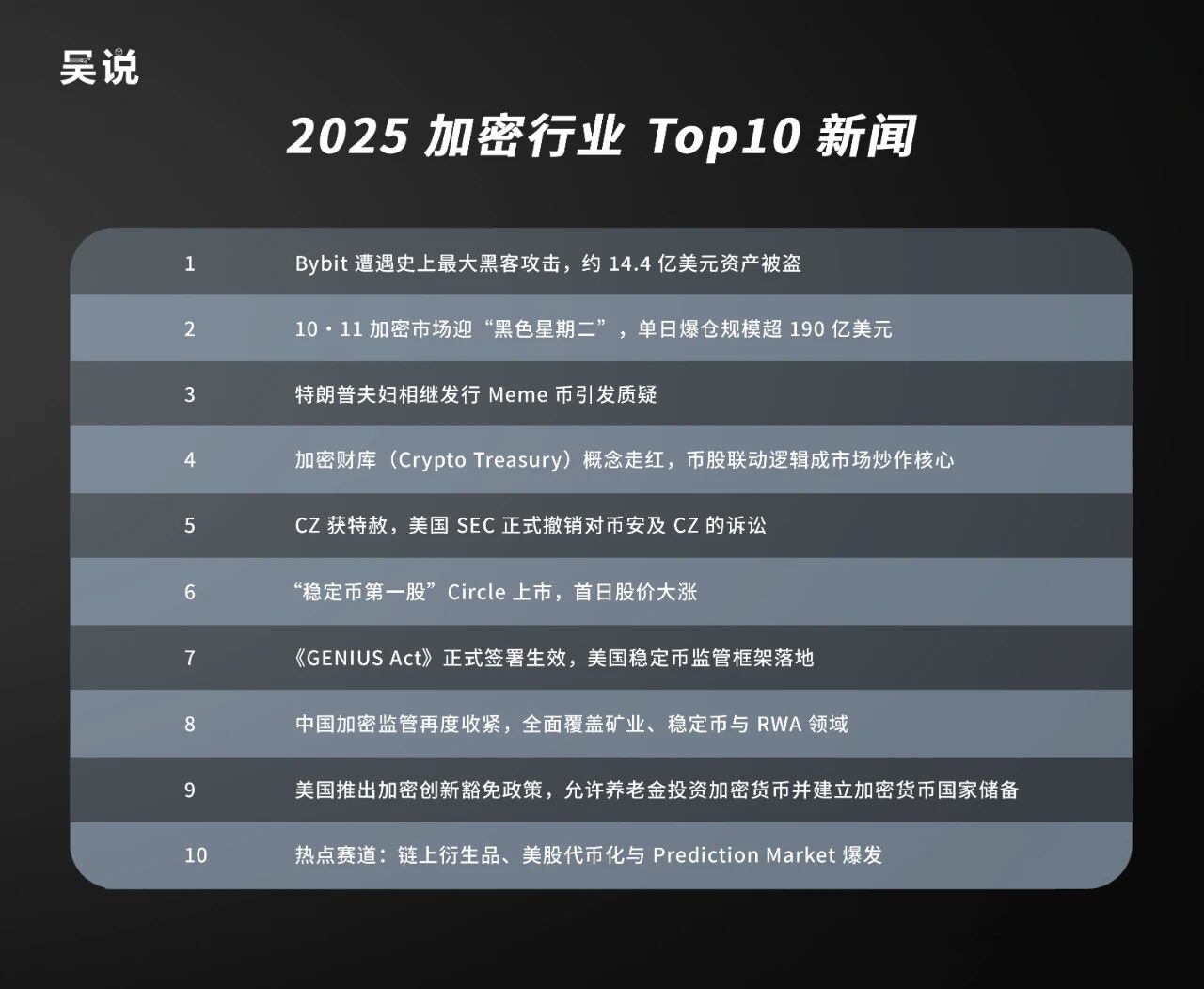
1. Bybit Faces Largest Hacking Attack in History, Approximately $1.44 Billion in Assets Stolen
On February 21, 2025, leading cryptocurrency exchange Bybit experienced the largest hacking incident in the industry's history. The attackers infiltrated the platform's Ethereum multi-signature cold wallet using precise techniques of front-end tampering and multi-signature deception, stealing approximately $1.44 billion worth of ETH and staking derivatives. Following the incident, Ethereum's price dropped nearly 4% within four hours, with over $450 million in liquidations across the network within 24 hours. With support from various parties, Bybit fully compensated the stolen funds using its own assets after the attack.
Bybit stated that after the hacking incident in February, it has completed a new round of security system upgrades. This upgrade includes nine security audits conducted jointly by internal and external teams, strengthening wallet operation processes and cold wallet security mechanisms, integrating MPC and HSM technologies, and obtaining ISO/IEC 27001 information security certification. Currently, Bybit is still tracking the stolen funds through the "LazarusBounty" program, having issued over $2.3 million in bounties.
2. Crypto Market Faces "Black Tuesday" on October 11, with Liquidations Exceeding $19 Billion in a Single Day
On October 11, 2025, the crypto market experienced its most severe drop of the year, referred to as "Black Tuesday." Influenced by disappointing macroeconomic data and excessive leverage, the prices of major cryptocurrencies plummeted sharply in a short period. Bitcoin fell over 13% within 24 hours, rapidly dropping from a high of approximately $117,000 to below $110,000, hitting a low of $105,900, a nearly 20% retracement from the historical high of $126,250 set earlier in the week; Ethereum saw intraday losses exceeding 20%, reaching a low of about $3,380; well-known tokens like Ripple (XRP) and Binance Coin (BNB) dropped over 30%, with some small-cap altcoins nearly going to zero within minutes. The market's extreme volatility triggered a chain reaction of liquidations, with cryptocurrency data platform Coinglass reporting a total liquidation amount of $19.358 billion for the day, affecting approximately 1.66 million traders, setting a record for the largest single-day deleveraging in crypto history. Other analysts estimated that the actual liquidation scale could be between $30 billion and $40 billion. This crash also impacted the decentralized finance (DeFi) sector, with the synthetic stablecoin USDe issued by Ethena Labs severely decoupling from the dollar, dropping to as low as $0.62 on some decentralized exchanges, a decoupling of 38%.
After the October 11 crash, BitMine Chairman Tom Lee stated in an interview with CNBC that this event was the largest liquidation event in crypto history. The subsequent issues, including the theft of Balancer and other DeFi protocol failures, further impacted market confidence, with expectations that the market would need several weeks to digest the related effects. However, the number of problematic projects currently is limited and does not constitute systemic risk. By the end of 2025, the overall crypto market remained in a sluggish state.
3. Trump and Melania Launch Meme Coins, Sparking Controversy
In January 2025, former U.S. President Donald Trump and his wife Melania each launched a meme coin bearing their names. On January 18, Trump announced the launch of his personal meme coin TRUMP on his Truth Social account. After the news was confirmed, the total market cap of TRUMP coin briefly reached $50 billion; on January 20, Trump reposted information about his wife Melania Trump's official token $MELANIA on the same social account. Leveraging Trump's political influence and traffic advantage, both tokens attracted a large number of retail investors for trading in their early stages. By the end of the month, the price of TRUMP coin had fallen from a historical high of $75.35 to $4.93, a drop of over 90%; the market cap of $MELANIA evaporated by 99% from its peak.
4. Crypto Treasury Concept Gains Popularity, Coin-Stock Linkage Becomes Market Speculation Core
In the first half of 2025, the concept of crypto treasury continued to gain traction, becoming one of the core narratives driving market sentiment. This concept focuses on the logic of companies incorporating crypto assets into their balance sheets, intensifying the speculative linkage between traditional capital and the crypto market. Several institutions seized the opportunity to explore innovative products like tokenized stocks, attempting to bridge the trading barriers between blockchain and traditional U.S. stock markets. Leading platforms like Coinbase actively promoted compliance filings for related products, making coin-stock linkage one of the hottest market narratives of the year, attracting significant cross-border capital into the crypto space.
By the end of the month, Ethereum treasury company BitMine Immersion (BMNR) announced that its total holdings of crypto assets and cash reached approximately $13.2 billion, including 4.066 million ETH (about 3.37% of Ethereum's total supply), 193 BTC, and $1 billion in cash.
Due to the continued sluggishness of treasury companies by the end of the year, many treasury companies had long-term net assets below their market value. At the end of the year, Ethereum treasury company FG Nexus sold approximately 10,000 ETH to accelerate share buybacks and enhance shareholder value.
5. CZ Granted Clemency, U.S. SEC Officially Withdraws Lawsuit Against Binance and CZ
On September 28, 2024, after CZ was released from prison, on May 30, 2025, the U.S. Securities and Exchange Commission (SEC) officially withdrew its lawsuit against Binance and its founder Changpeng Zhao, marking the end of one of the agency's last enforcement actions in the crypto space. On October 23, 2025, Trump pardoned the convicted Binance founder Changpeng Zhao. Previously, the SEC had initiated a lawsuit against Binance for violating securities regulations, raising widespread concerns in the industry about regulatory uncertainty. Bloomberg reported that this signaled a significant shift in the regulatory approach of the agency towards cryptocurrency.
6. "First Publicly Traded Stablecoin" Circle Goes Public, Stock Price Soars on First Day
In October 2025, Circle, the issuer of the world's second-largest stablecoin USDC, successfully listed on the New York Stock Exchange, becoming the "first publicly traded stablecoin." This IPO is seen as an important milestone for the stablecoin industry integrating into the mainstream financial system. Circle emphasized its compliance development path in its prospectus and plans to further expand payment network collaborations with traditional financial systems. On its first day of trading, Circle's stock price saw significant gains, with its market cap surpassing $10 billion.
By the end of the month, the total market cap of the USDC stablecoin reached $76.3 billion, accounting for 24.7% of the total stablecoin market cap of $308.5 billion. The stock price of $Circle was reported at $82.64, up 29.12% from the opening price of $64, but down over 70% from its peak of $298.99.
7. The "GENIUS Act" Officially Signed into Effect, U.S. Stablecoin Regulatory Framework Established
In mid-2025, the U.S. officially signed the "Cryptocurrency Asset Innovation and Regulation Act" (the "GENIUS Act"), which is the first federal-level legislative document systematically regulating stablecoins in the U.S. The act clearly includes payment-type stablecoins anchored to fiat currencies within the regulatory scope, setting clear requirements for the qualifications of issuing entities, the composition of reserve assets (limited to highly liquid assets), information disclosure, and regular audit obligations, thereby preventing systemic risks in the stablecoin sector from an institutional level. The implementation of the "GENIUS Act" fills the regulatory gap for stablecoins in the U.S. and serves as an important reference model for global stablecoin regulation.
The stablecoin market reached $310 billion on December 12, 2025, a year-on-year increase of approximately 70%. USDT and USDC together accounted for about 80% of market activity, with multiple studies showing that institutional use of stablecoins is shifting from speculation to actual operational scenarios, primarily for cross-border settlements and corporate payments. Industry analysts predict that if large financial institutions integrate more widely, the supply of stablecoins could reach $2 trillion by 2028.
8. China Tightens Crypto Regulation Again, Fully Covering Mining, Stablecoins, and RWA Sectors
On November 29, 2025, the People's Bank of China held a coordination mechanism meeting on November 28, emphasizing that virtual currencies do not have the same legal status as fiat currencies, do not have legal tender status, and should not and cannot be used as currency in market circulation; related business activities are considered illegal financial activities. Stablecoins are a form of virtual currency that currently cannot effectively meet customer identification, anti-money laundering, and other requirements, posing risks of being used for money laundering, fundraising fraud, and illegal cross-border fund transfers.
On December 5, 2025, seven major industry associations, including the China Internet Finance Association, the China Banking Association, and the China Securities Association, jointly issued a risk warning, reiterating the domestic prohibition of any form of virtual currency and RWA token issuance, trading, and financing. Relevant institutions are prohibited from conducting business related to virtual currencies and real-world asset tokens. The public should remain highly vigilant against various forms of virtual currency and real-world asset token business activities.
In 2025, China continued its strict regulatory tone in the crypto space, further expanding the regulatory scope to the three core areas of mining, stablecoins, and RWA (real-world assets). Regulatory authorities have intensified efforts to crack down on illegal activities such as virtual currency trading speculation and mining through enhanced inspections and improved inter-departmental coordination mechanisms, clearly prohibiting the issuance and circulation of stablecoins domestically, while strictly controlling cross-border transactions of RWA-related crypto products.
9. U.S. Introduces Crypto Innovation Exemption Policy, Allowing Pension Funds to Invest in Cryptocurrencies and Establishing National Crypto Reserves
On December 2, 2025, SEC Chairman Paul S. Atkins stated in an interview with CNBC that the SEC expects to release an "innovation exemption" for the crypto industry "in about a month." He mentioned that the original timeline was delayed due to the government shutdown, but the SEC has now resumed normal operations and will continue to promote a regulatory framework that supports crypto innovation to reverse the resistance stance of the past several years. Atkins also indicated that the SEC plans to introduce new policies next year to improve the market environment for IPOs.
On March 7, 2025, David Sacks, the White House's AI and crypto affairs head, tweeted that Trump had signed an executive order to establish a strategic Bitcoin reserve, with funds sourced from Bitcoin obtained by the federal government through criminal or civil asset forfeiture procedures, not involving taxpayer funds. These Bitcoins will serve as a value storage tool and will not be sold. Additionally, the executive order established a U.S. digital asset reserve for storing confiscated digital assets other than Bitcoin, but will not further acquire new assets. This reserve will be managed by the U.S. Treasury.
On August 7, 2025, the White House announced that President Donald J. Trump signed an executive order allowing 401(k) investors to access alternative assets such as private equity, real estate, and digital assets to enhance returns and diversify risks. The order requires the Secretary of Labor to review and clarify the fiduciary responsibilities and related procedures for alternative asset investments in 401(k) and other defined contribution plans governed by ERISA, and to collaborate with federal agencies such as the Treasury Department and the Securities and Exchange Commission to promote regulatory adjustments. It also instructs the SEC to amend regulations to facilitate the allocation of such assets in retirement savings plans.
10. Hot Tracks: On-Chain Derivatives, Tokenization of U.S. Stocks, and Prediction Markets Explode
In 2025, hot tracks represented by on-chain derivatives, tokenization of U.S. stocks, and prediction markets developed rapidly in the cryptocurrency field.
In the on-chain derivatives sector, Hyperliquid added approximately 609,700 new users in 2025, with a cumulative trading volume of about $29.5 trillion and 198.9 billion transactions; annual revenue was approximately $844 million, with net inflows of $3.87 billion, and the current TVL is about $4.15 billion. New entrants like ASTER and Lighter are gradually increasing their market share in this sector, leading to intensified market competition.
Regarding the tokenization of U.S. stocks, Ondo Finance and Ondo Foundation have launched over 100 tokenized U.S. stocks and ETFs on Ethereum, providing 24/7 on-chain trading for qualified investors in the Asia-Pacific, Europe, Africa, and Latin America, while not opening to the U.S. and U.K. to ensure compliance. Ondo Global Markets' total trading (CEX+DEX+Mint/Redeem) has surpassed $5.5 billion, with Mint/Redeem trading volume exceeding $1.3 billion. Currently, the TVL of Ondo's tokenized assets reaches $384 million, with the highest tokenized ETF being the SPDR S&P 500 ETF at $27 million, and the highest tokenized stock being Circle Internet Group at $16.2 million.
In the prediction market sector, the parent company of the New York Stock Exchange, ICE, invested $2 billion, raising Polymarket's valuation to $8 billion, while its competitor Kalshi reached a valuation of $5 billion under the leadership of a16z and Sequoia Capital. Ethereum co-founder Vitalik Buterin stated that prediction markets can serve as a "rational tool" in many emotional topics. He pointed out that while prediction markets theoretically may create adverse incentives, in reality, small-scale prediction markets do not lead to large-scale harm; the stock market itself also carries similar risks. Compared to the emotional agitation and lack of accountability on social media, prediction markets constrain opinions with real funds, which is more conducive to approaching the truth in the long run and providing more credible probability expectations. Vitalik also noted that the fixed price range of 0–1 makes prediction markets less affected by "hot potato" effects and excessive speculation compared to traditional markets.
免责声明:本文章仅代表作者个人观点,不代表本平台的立场和观点。本文章仅供信息分享,不构成对任何人的任何投资建议。用户与作者之间的任何争议,与本平台无关。如网页中刊载的文章或图片涉及侵权,请提供相关的权利证明和身份证明发送邮件到support@aicoin.com,本平台相关工作人员将会进行核查。


