"Weekly Editor's Picks" is a "functional" column of Odaily Planet Daily. Based on the extensive coverage of real-time information each week, the Planet Daily also publishes many high-quality in-depth analysis articles, but they may be hidden among the information flow and trending news, passing you by.
Therefore, our editorial team will select some quality articles worth spending time reading and saving from the content published in the past seven days every Saturday, providing you with new insights from the perspectives of data analysis, industry judgment, and opinion output, as you navigate the crypto world.
Now, let's read together:

Investment and Entrepreneurship
2025 Asset Review: Why Bitcoin Will Significantly Underperform Gold and US Stocks?
When the growth curve of silicon-based intelligence is steeper than the scarcity curve of "digital reserves," the global excess liquidity will preferentially flow to productive assets with nonlinear growth potential, rather than purely digital assets.
Gold hedges against systemic collapse, while Bitcoin is currently viewed more by the market as an overflow of systemic liquidity. The US stock market is in a parabolic acceleration phase driven by AI. ETFs are weakening Bitcoin's volatility.
Why is the US Embracing Crypto? The Answer May Lie in $37 Trillion of Debt
Stablecoins are responsible for distribution, while Bitcoin is responsible for absorption; the US is diluting debt pressure with crypto assets.
2025: The Darkest Year for the Crypto Market, Yet the Dawn of the Institutional Era
The crypto market is shifting from retail speculation to institutional allocation, with core data showing institutional holdings at 24% and retail investors exiting at 66%—the turnover is complete, and new rules are coming.
Long-term practitioners and investors do not predict short-term prices but identify structural trends.
MSTR Bottom-Fishing or Waiting? Three Key Questions You Must Understand About Strategy
Strategy's "cash flow crisis" can at least be delayed until the second half of 2027.
MSCI is conducting public consultations and will announce its final decision on January 15 next year (the final moment for taking over MSTR stock).
Over 80% of New Tokens Peak at TGE: The Root Causes and Remedies of Web3's False Prosperity
Only 15% of tokens have increased compared to their FDV at TGE. The median FDV of tokens has dropped by 71% compared to their issuance (the median market cap has dropped by 67%).
High financing, active communities, and exchange listings—these criteria for evaluating project quality have little impact on the price trends of project tokens.
To survive in 2026, projects are best advised to: set financing targets between $300,000 and $5 million; set issuance prices between $0.01 and $0.05; prioritize product; be able to explain in one sentence why the token exists; ignore vanity metrics; embrace industry realism; and if unable to expand independently, seek an acquirer.
Also recommended:
Pantera Capital: 12 Predictions for the Crypto Market in 2026
The Harsh Coming of Age in the Crypto World: A Review of Crypto Indices in 2024-2025
Redphone 2026 Prophecy: The Silicon Era Arrives, Crypto Becomes the "Last Free Port"
Stablecoins
The top 1000 wallets contribute about 84% of the trading volume, showing a high degree of centralization.
Prediction Markets
The more complex the prediction environment, the higher the win rate of collective consensus.
Airdrop Opportunities and Interaction Guide
Hot Tracks, New Interaction Opportunities: Three Prediction Markets YZi Labs is Optimistic About
Popular Interaction Collection | PiP World Test Token Trading; ETHGas Earn Points (December 26)
Meme
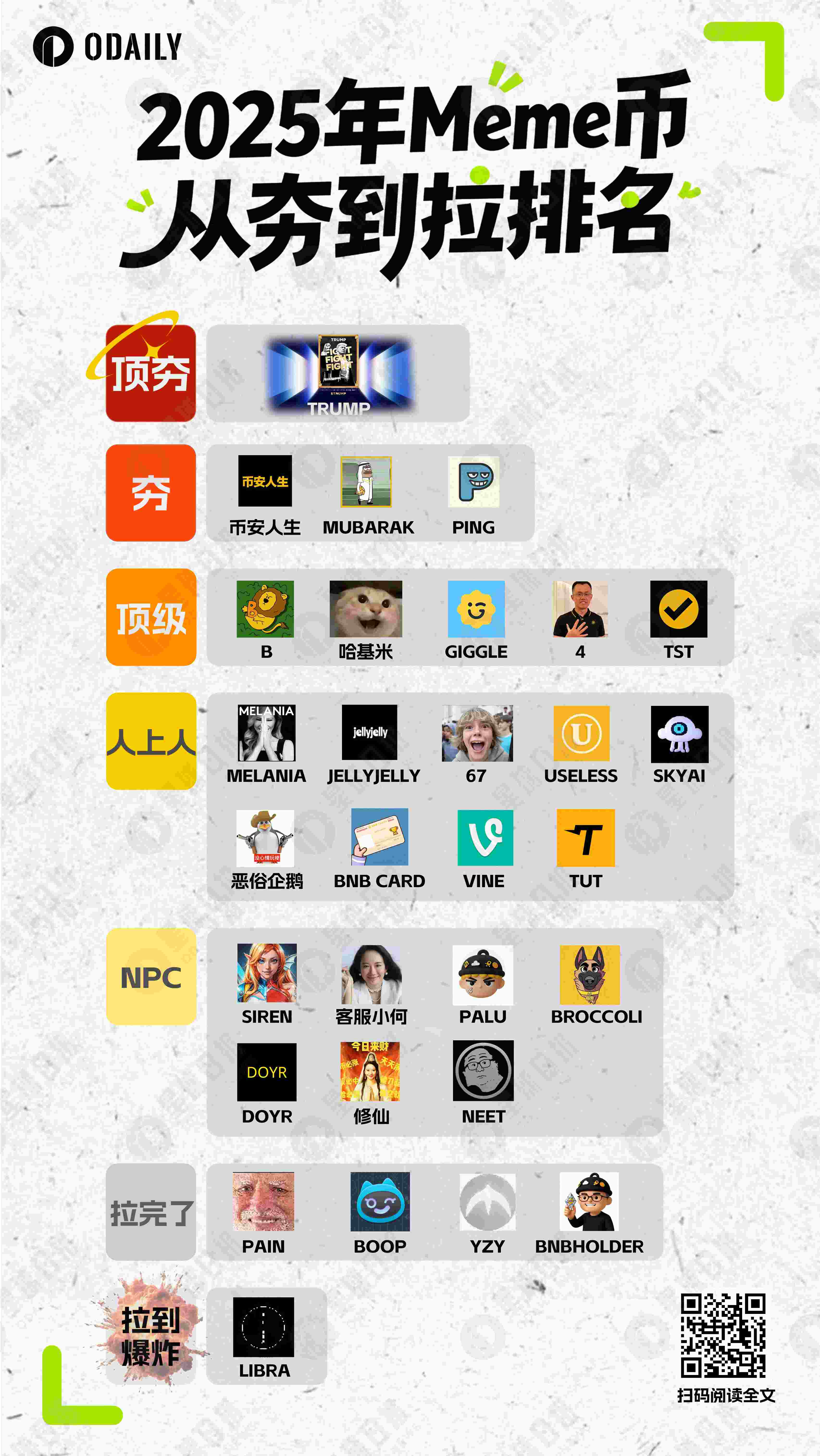
2025 Meme Coin "From Boom to Bust" Ranking
Bitcoin
2025 Bitcoin Protocol Layer Comprehensive Review
In 2025, Bitcoin's technological evolution presents three core characteristics: preemptive defense (against quantum threats), functional layering, and infrastructure decentralization.
Ethereum and Scalability
The Birth of ETHGas and Block Space Pricing
ETHGas redefines Ethereum block space from transaction fees that fluctuate with demand to a priceable resource, allowing large-scale users to lock in cost and time certainty through block space futures and pre-confirmation mechanisms.
By introducing block space futures and validator-supported pre-confirmations, ETHGas brings a structure to Ethereum similar to traditional financial markets, enabling applications and institutions to plan, hedge, and operate in a more certain environment.
ETHGas releases important signals about the direction of Ethereum's evolution: Ethereum is transitioning from a purely technical protocol to a settlement layer centered on economic management, where time and block space begin to have clear value.
Also recommended: "Ethereum's 'Second-Level' Evolution: From Fast Confirmation to Settlement Compression, How Does Interop Eliminate Waiting Time?".
Multi-Ecosystem
The Economic Account Behind Polymarket's Exit from Polygon
Polymarket plans to migrate from Polygon and launch an Ethereum Layer 2 network called POLY. Polymarket's choice to exit Polygon is not surprising; one is a hot application layer representative, while the other is a gradually declining old layer, and the market heat and value expectations between the two are mismatched. Building a Layer 2 network allows Polymarket to customize underlying features based on its platform needs, thus adapting more flexibly to future upgrades and iterations.
In addition to contributing economically to Polygon (about 1/4), Polymarket also activates stablecoins and adds behavioral value for retained users.
The Polymarket TGE is approaching, making this the best time for migration.
CeFi & DeFi
The Crypto Super App Revolution: When Coinbase Breaks Financial Boundaries
Last week, Coinbase launched a new product touted as the "Future of Finance." One app can achieve five major functions: 5×24 hour stock trading, centralized exchange and on-chain cryptocurrency trading, futures and perpetual contract trading, prediction markets, all equipped with an AI financial analyst. All functions can be operated via mobile, and users' single account balance can be instantly switched between different asset classes.
This is not just a simple addition of functions but breaks the artificially divided boundaries of financial asset categories due to regulatory and technical limitations. The core driving force behind this transformation is that the funds scattered across different applications are essentially idle funds. Platforms that integrate liquidity are more efficient. As for the asset discovery problem, it leverages social trading (with built-in dynamic information flow).
Coinbase and Robinhood are gradually becoming new banks.
Why Do DeFi Users Reject Fixed Rates?
TradFi has credit markets, while DeFi relies on money markets.
Lenders need a premium to lock in funds, but borrowers are unwilling to pay this fee. This is why fixed-rate markets continuously evolve into one-sided markets. Floating-rate markets prevail because they align with participants' actual behavior. They are money markets provided for liquid funds, not credit markets for long-term assets.
DeFi protocols adopt money market assumptions when designing credit products and then deploy them into a liquidity-oriented ecosystem; the mismatch between user assumptions and actual capital behavior keeps fixed-rate lending in a niche market.
From Aave to Ether.fi: Who Captured the Most Value in the On-Chain Credit System?
At Aave and SparkLend, the interest fees paid by the treasury to the lending protocols actually exceed the revenue generated by the treasury itself. This fact directly challenges the mainstream narrative that "distribution is king." Aave not only earns more than the various treasuries built on top of it but also surpasses the asset issuers used for lending, such as Lido and Ether.fi.
On its own, lending seems to be a low-margin business; however, within the complete credit stack, it is the layer with the strongest value capture capability relative to all other participants—treasuries, issuers, and distribution channels.
The controversy over fee flows has sparked heated discussions: Who really owns the Aave brand? If you believe that Aave Labs will remain highly aligned with Aave DAO in long-term interests, and that the current friction is merely a communication and process error, then the price pullback driven by sentiment may be a good entry window; however, if you think that the controversy reveals not an isolated issue but rather a structural contradiction of long-term unclear rights and lack of institutional constraints between the team and the protocol, then this turmoil may just be the beginning.
As DeFi matures, with protocol revenues becoming substantial and brands and front-ends starting to possess commercial value, some structural contradictions between protocols and products, teams and communities will surface.
Also recommended: "From Options Derivatives to Prediction Markets, A Quick Overview of Coinbase's 2025 Crypto Acquisition Landscape".
Weekly Hot Topics Review
In the past week, the U.S. Treasury Secretary promoted the "merger of Main Street and Wall Street," integrating cryptocurrency into the mainstream financial system;
Additionally, in terms of policy and macro markets, the Shenyang police uncovered an illegal currency exchange case involving individuals who sold BTC and USDT to Mexican drug dealers; Victory Securities: prohibiting virtual asset accounts from mainland China IP addresses from executing buy operations; Caixin: there are special legal risks in issuing and using U cards domestically; the White House and the U.S. Department of Energy jointly launched the "Genesis Plan," with CoreWeave, NVIDIA, OpenAI, xAI, and others selected as the first batch of companies; the U.S. has ended the previous government's investigation into Chinese chip trade, with no additional tariffs on Chinese chips for the next 18 months; Wall Street's 15 major investment banks' outlook has been summarized by AI as "precarious," with JPMorgan warning of AI bubble risks;
In terms of opinions and voices, Etherealize co-founder: the crypto industry must make substantial progress before Trump leaves office; Pantera partner looks ahead to 2026: tokenized gold, stablecoin payments, etc., may reshape the structure of the crypto industry; Michael Saylor: supports the free use of the Bitcoin network but opposes modifying the underlying protocol; Polymarket determined that Trump's claimed Trump Gold Card sales were "fake"; VanEck: recent Bitcoin miner capitulation may indicate a bottom is near; CryptoQuant CEO comments that Tom Lee's views differ from those of his fund: possibly because Tom Lee is in the sell-side research field and has to be bullish; Arthur Hayes: the altcoin season always exists, investors misjudge due to not holding appreciating assets; Hurun Report: high-net-worth individuals' willingness to invest in digital currencies is heating up, with a 25% increase in allocation willingness over the next year; Vitalik predicts: within the next 15 years, there may be bug-free code;
Regarding institutions, large companies, and leading projects, JPMorgan's core recommendations for U.S. stocks in 2026: the crypto industry is completely excluded, and only Google remains among the seven AI giants; Strategy increases cash reserves and pauses Bitcoin purchases; Ethereum plans to conduct two hard forks in 2026, with L1 Gas limits possibly raised to 200 million; Kalshi: launched Kalshi Research and provided internal data to researchers;
In terms of data, spot gold and silver reached new highs; Bitcoin miner revenue has decreased by 11% since mid-October, facing capitulation risks; Ethereum has become the settlement layer for global dollar liquidity, processing about $90 billion to $100 billion in stablecoin transfers daily; the market cap of Ethena stablecoin USDe has shrunk by nearly half since the "1011 crash";
In terms of security, Trust Wallet extension was hacked; a 23-year-old man impersonated Coinbase personnel to defraud users of $16 million in cryptocurrency; quantum computing in 2026 will not lead to the collapse of cryptocurrencies but requires vigilance against "collect first, decrypt later" risks…… Well, it has been another eventful week.
Attached is the portal for the "Weekly Editor's Picks" series.
See you in 2026~
免责声明:本文章仅代表作者个人观点,不代表本平台的立场和观点。本文章仅供信息分享,不构成对任何人的任何投资建议。用户与作者之间的任何争议,与本平台无关。如网页中刊载的文章或图片涉及侵权,请提供相关的权利证明和身份证明发送邮件到support@aicoin.com,本平台相关工作人员将会进行核查。


