Written by: Glendon, Techub News
Last night, a report from Bloomberg sparked attention in the industry. As major global banks accelerate their involvement in the cryptocurrency asset class, Wall Street giant JPMorgan Chase & Co. is considering offering cryptocurrency trading services to institutional clients. Sources revealed that the bank is evaluating what products and services its market division can provide to expand its influence in the cryptocurrency space, which may include spot and derivatives trading.
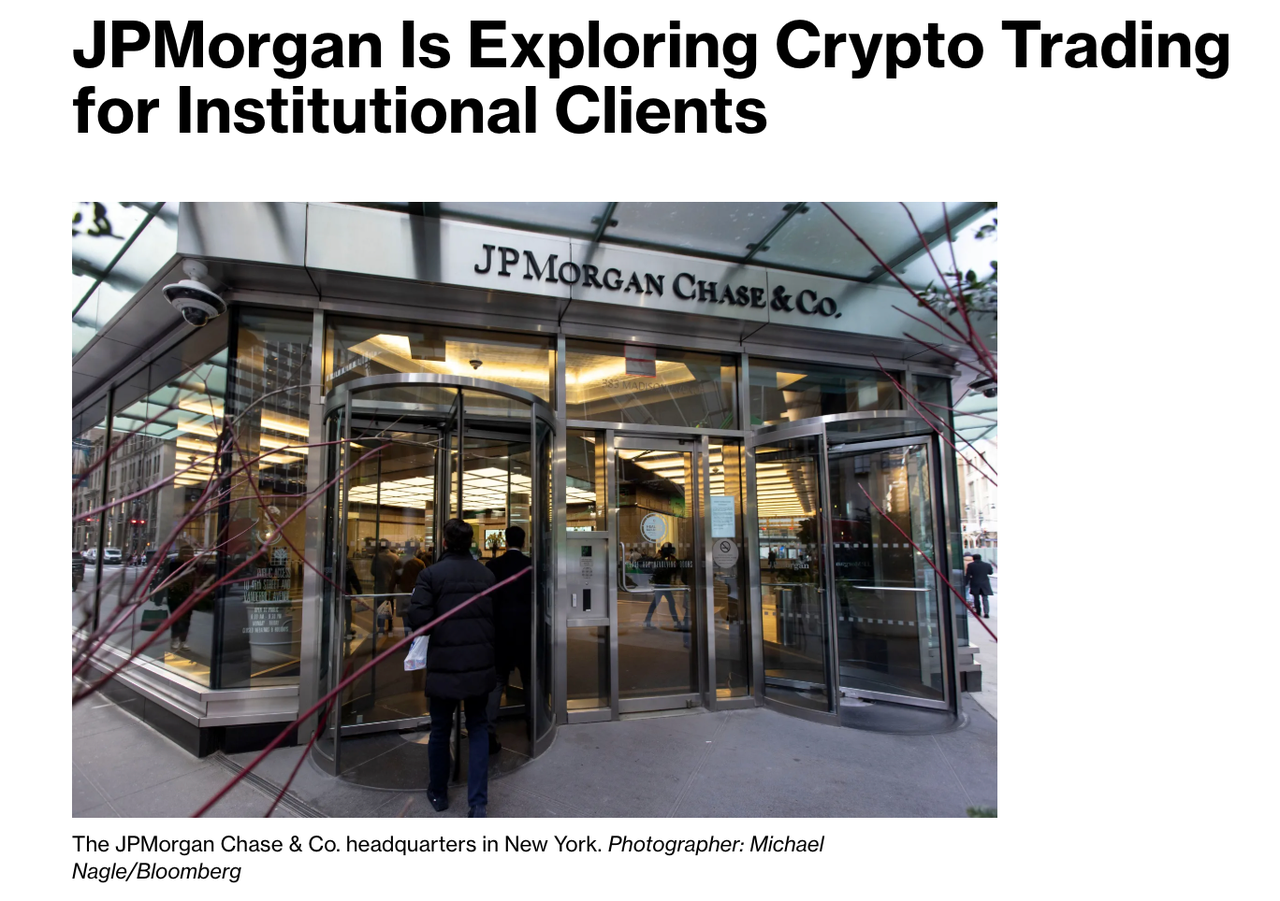
Although a JPMorgan spokesperson has not yet responded to the news, and specific implementation plans remain unclear, this move clearly signals one thing: this financial giant is steadfastly deepening its engagement in the crypto industry.
Looking back over the past decade, JPMorgan's journey in the cryptocurrency space can be described as a transformation from a "staunch opponent" to a "strategic embracer." As one of the core hubs of the global financial system, JPMorgan's exploration in the cryptocurrency field serves as a classic example of traditional finance's layout. At several key stages, including blockchain platforms, stablecoin systems, and tokenized assets, it has implemented some impactful initiatives. This article will outline the development history of its cryptocurrency business.
Blockchain Technology Application: From Internal Experiments to Infrastructure
For JPMorgan, 2015 marked both the beginning of its entry into the blockchain industry and a year of accelerated technological exploration. A key milestone occurred in September 2015 when JPMorgan, along with Goldman Sachs, State Street Bank, and six other banks, jointly established the R3 consortium to systematically explore the application of blockchain in financial settlements. The core goal was to reshape financial infrastructure using blockchain technology to address the "old problems" of low efficiency, high costs, and lack of transparency in traditional finance.
In October 2016, after more than a year of technical research and testing by its blockchain team, JPMorgan collaborated with startup EthLab to develop Quorum, a private blockchain platform based on Ethereum. This platform adopted the Ethereum Virtual Machine architecture while restricting node permissions, becoming the first bank-grade blockchain system to pass regulatory sandbox testing. The platform focuses on privacy protection and performance optimization, supporting high throughput and low latency transactions, and later became the underlying technology for JPM Coin. The launch of this platform marked JPMorgan's official transition from the exploration phase of blockchain technology to the practical application phase, laying the groundwork for its subsequent layout in the cryptocurrency and tokenized asset fields.
Building on this, JPMorgan's blockchain initiative—the Interbank Information Network (IIN)—was officially launched in October 2017. This was JPMorgan's first scalable peer-to-peer network supported by Quorum. IIN minimizes friction in cross-border payment processes, allowing payments to reach beneficiaries with fewer steps and faster speeds. As of data disclosed in 2019, the IIN bank network covered over 400 banks.
In simple terms, JPMorgan's early layout in blockchain followed a "test and push" rhythm: first deeply participating in the formulation of industry standards through the R3 alliance, then implementing actual business based on the Quorum platform and IIN cross-border payment network, gradually moving from the technical validation phase to the scalable application phase.
Stablecoin System: From JPM Coin to Compliance Innovations in Deposit Tokens
Although JPMorgan began engaging with blockchain technology early on, its exploration in the cryptocurrency field started in 2019. Prior to this, JPMorgan's attitude towards cryptocurrencies was not friendly, and it could even be described as resolutely opposed. In September 2017, JPMorgan CEO Jamie Dimon bluntly stated at a Barclays conference, "Bitcoin will eventually blow up; it's a complete fraud," and even said, "If JPMorgan has a trader involved in Bitcoin trading, I would fire him for his stupidity." This statement directly led to a 2% drop in Bitcoin's price that day. In the following years, Jamie Dimon's resistance to cryptocurrencies did not ease, but the internal view of cryptocurrencies at JPMorgan was not entirely aligned with the CEO's stance.
The shift in JPMorgan's position occurred in February 2019, a milestone moment. At that time, JPMorgan announced the launch of JPM Coin (JPMD), an institutional-grade stablecoin pegged 1:1 to the US dollar. This was the first stablecoin issued by a major US bank, operating on a private chain, primarily serving cross-border payment business between compliant institutional clients to enhance the efficiency of fund flows within the banking system. This move was also seen as a symbolic event marking Wall Street's formal entry into the crypto space.
In October of the same year, JPM Coin was officially launched. After six years of development, it achieved a critical leap from internal experimentation to an open ecosystem, a process that almost became a microcosm of traditional finance embracing the industry.
During this period, JPMorgan joined forces with ConsenSys and completed the merger of Quorum in August 2020. After the merger, JPMorgan handed over the management of the open-source blockchain platform Quorum to ConsenSys, while the Quorum brand and technology roadmap remained independent and open-source, with JPMorgan continuing to participate as an important user and contributor. In the same year, JPMorgan created a new business unit, Onyx (renamed Kinexys in 2024), incorporating all blockchain and digital currency operations to strengthen its business layout in the crypto field. According to data released by JPMorgan in 2024, Kinexys has processed over $15 trillion in transaction volume, averaging over $2 billion in transactions daily.
As we move into 2025, this year is undoubtedly a key year for JPMorgan in advancing towards an open ecosystem. Against the backdrop of increasingly open regulatory policies in the US, JPMorgan piloted the issuance of deposit tokens JPMD on the Base blockchain under Coinbase in June, providing payment solutions and marking the first time commercial deposits were put on-chain. Subsequently, the bank launched JPMD to more institutional clients, continuing to expand its digital asset footprint.
On December 18, JPMorgan officially deployed JPM Coin to Base, marking the first large-scale access of this Wall Street giant to the public chain ecosystem. It is important to note that JPM Coin is not a traditional stablecoin but a digital mapping of bank deposits that accrue interest. Currently, it is primarily used for collateral and margin payments in crypto trading, indicating that traditional finance is gradually aligning with DeFi.
During this period, JPMorgan also registered the euro deposit token stock code "JPME." From initially being used only for cross-border payments between institutional clients to its first attempt to integrate into the DeFi ecosystem, JPMorgan's "permissioned stablecoin" model retains the bank's risk control capabilities while leveraging the programmability of blockchain, creating a compliant channel for traditional institutions to participate in the crypto economy.
Crypto ETFs and Tokenized Assets: Deepening Layout in Alternative Investment Markets
JPMorgan's attitude towards cryptocurrency ETFs has also undergone a transformation from caution to openness. Since the approval of the Bitcoin spot ETF in January 2024, JPMorgan has become a significant participant in BlackRock's Bitcoin spot ETF (IBIT). Moreover, in the revised S-1 form submitted by BlackRock to the US Securities and Exchange Commission (SEC) at the end of 2023, JPMorgan Securities was designated as the authorized participant (AP) for the ETF. Additionally, at the end of November this year, JPMorgan launched a structured note linked to IBIT.
According to JPMorgan's submitted 13F filing, as of the third quarter of this year, its total holdings in the iShares Bitcoin Trust ETF (IBIT) reached 5.28 million shares, a 64% increase from the 3.22 million shares held in June, clearly indicating that JPMorgan significantly increased its investment in the spot Bitcoin ETF during the third quarter.
In the tokenization field, JPMorgan's efforts are notably more substantial. In October 2025, JPMorgan completed a tokenization pilot for a private equity fund on its own blockchain platform, marking an important step in advancing blockchain financial infrastructure. JPMorgan also explicitly stated plans to launch the "Alternative Investment Fund Tokenization Platform" Kinexys Fund Flow for institutional clients in 2026, which will broadly cover various alternative asset classes such as private equity, credit, and real estate.
Earlier this month, JPMorgan made another move, with its asset management division announcing the launch of the first tokenized money market fund based on the Ethereum blockchain, "My OnChain Net Yield Fund" (abbreviated as MONY), with an initial investment of $100 million, open to qualified investors. Additionally, JPMorgan's Kinexys is collaborating with Singapore's DBS Bank to develop a cross-chain interoperability framework for tokenized deposits, aiming to support 24/7 transfers between public and permissioned chains.
From the series of initiatives mentioned above, it is evident that JPMorgan is significantly deepening its layout in the entire crypto field, especially in the tokenization market, actively promoting the transition of more traditional assets from "static holding" to "dynamic circulation" models. Its layout also highlights that cryptocurrencies are rapidly being integrated into the core channels of the traditional financial system.
Now, JPMorgan is considering providing institutional cryptocurrency trading services, which will not only be a key step for this giant in the crypto field but also signifies that the integration process of Wall Street's traditional financial system with cryptocurrencies is accelerating.
In fact, as early as October, the head of JPMorgan's digital asset market business revealed that the bank plans to enter the cryptocurrency trading business. Furthermore, JPMorgan announced that by the end of this year, it will allow institutional clients to use their held Bitcoin and Ethereum as collateral for loans, a plan that will be rolled out globally, relying on third-party custodians to ensure the security of the pledged tokens. This move indicates that the bank has regarded digital assets as collateral on par with traditional assets such as stocks, bonds, and gold. Notably, yesterday, JPMorgan accepted Ethereum as collateral for loans.
Looking back at JPMorgan's decade-long development in the crypto business, from initial conservative observation and cautious exploration to later proactive layout and innovation; from exploring blockchain platforms and cross-border payments to the successful launch of the deposit stablecoin JPM Coin, and now to a comprehensive layout in tokenized assets and cryptocurrency trading, JPMorgan has precisely kept pace with the evolution of the global financial landscape. Soon, when cryptocurrency trading services and platforms like Kinexys Fund Flow are successfully implemented, JPMorgan may no longer be limited to a simple participant but will occupy a more significant position in the crypto field.
免责声明:本文章仅代表作者个人观点,不代表本平台的立场和观点。本文章仅供信息分享,不构成对任何人的任何投资建议。用户与作者之间的任何争议,与本平台无关。如网页中刊载的文章或图片涉及侵权,请提供相关的权利证明和身份证明发送邮件到support@aicoin.com,本平台相关工作人员将会进行核查。


