Author: Liang Yu
Editor: Zhao Yidan
According to a report by Sina Finance on December 18, Standard Chartered Hong Kong and Ant International announced a partnership to launch a multi-currency tokenized deposit service based on blockchain technology, supporting corporate clients in real-time fund transfers in Hong Kong dollars, Renminbi, and US dollars 24/7. This service is implemented under the framework of the Hong Kong Monetary Authority's distributed ledger technology regulatory incubator and the Ensemble project.
Both parties utilize Ant International's Whale platform to achieve account tokenization, enabling around-the-clock multi-currency settlement and instant liquidity management. Mahesh Kini, Global Head of Cash Management at Standard Chartered Hong Kong, stated that this move marks the commercialization of blockchain technology in the cash management sector, effectively enhancing corporate fund efficiency.
This is not merely a technical upgrade. It occurs at a delicate moment: the global banking industry's attitude towards blockchain has shifted from cautious observation to active embrace, with Hong Kong striving to secure its position as a global digital asset hub. Is this a perfect compliance demonstration, or a "Trojan horse" that could reshape the foundations of banking?
When a century-old international bank collaborates with a fintech giant to "move" corporate deposits onto the blockchain, what the outside world sees is a revolution in efficiency, while behind the scenes, traditional finance and digital-native forces are forming alliances in the new era.
I. Hong Kong's Bet: Why Here, Why Now?
The announcement of the collaboration between Standard Chartered Hong Kong and Ant International in December 2025 quickly became a hot topic in the Asian fintech circle. According to both parties' statements, the service is conducted under the framework of the Hong Kong Monetary Authority's distributed ledger technology regulatory incubator and the Ensemble project, utilizing Ant International's Whale platform for account tokenization.
The timing of this announcement is no coincidence. In June 2025, Hong Kong had just released the "Hong Kong Digital Asset Development Policy Declaration 2.0," systematically proposing the four major policy axes of "LEAP." The collaboration between Standard Chartered and Ant can be seen as a direct implementation of the "legal and regulatory optimization" and "tokenized product expansion" axes.
The Hong Kong Monetary Authority has reduced policy uncertainty for this innovation by establishing a clear regulatory sandbox. What is happening in Hong Kong is a precise institutional experiment: it attempts to prove that cutting-edge technological applications can emerge while strictly ensuring financial security.
On a deeper level, this collaboration answers a core question in Hong Kong's digital finance competition: what is Hong Kong's differentiated advantage compared to Singapore and New York? The answer seems to be: leveraging its unique position under "one country, two systems" to act as a "conversion interface" between the traditional financial system and the digital financial world.
Ankur Kanwar, Head of Transaction Banking for Standard Chartered in Singapore and ASEAN, provides a representative comment, stating that tokenized deposits have the potential to enhance settlement efficiency, create new financial use cases, and bring tangible benefits to clients. This collaboration is an important step in supporting Singapore (and Hong Kong) to grow into a leading digital financial center.
II. The Essence of the Debate: Are Tokenized Deposits an Evolution of Banks or a Replacement for Stablecoins?
To understand the value of this collaboration, it is essential to clarify a fundamental question: what exactly are tokenized deposits? How do they fundamentally differ from existing stablecoins in the market? This is not only a technical issue but also a watershed in regulatory attitudes and business logic.
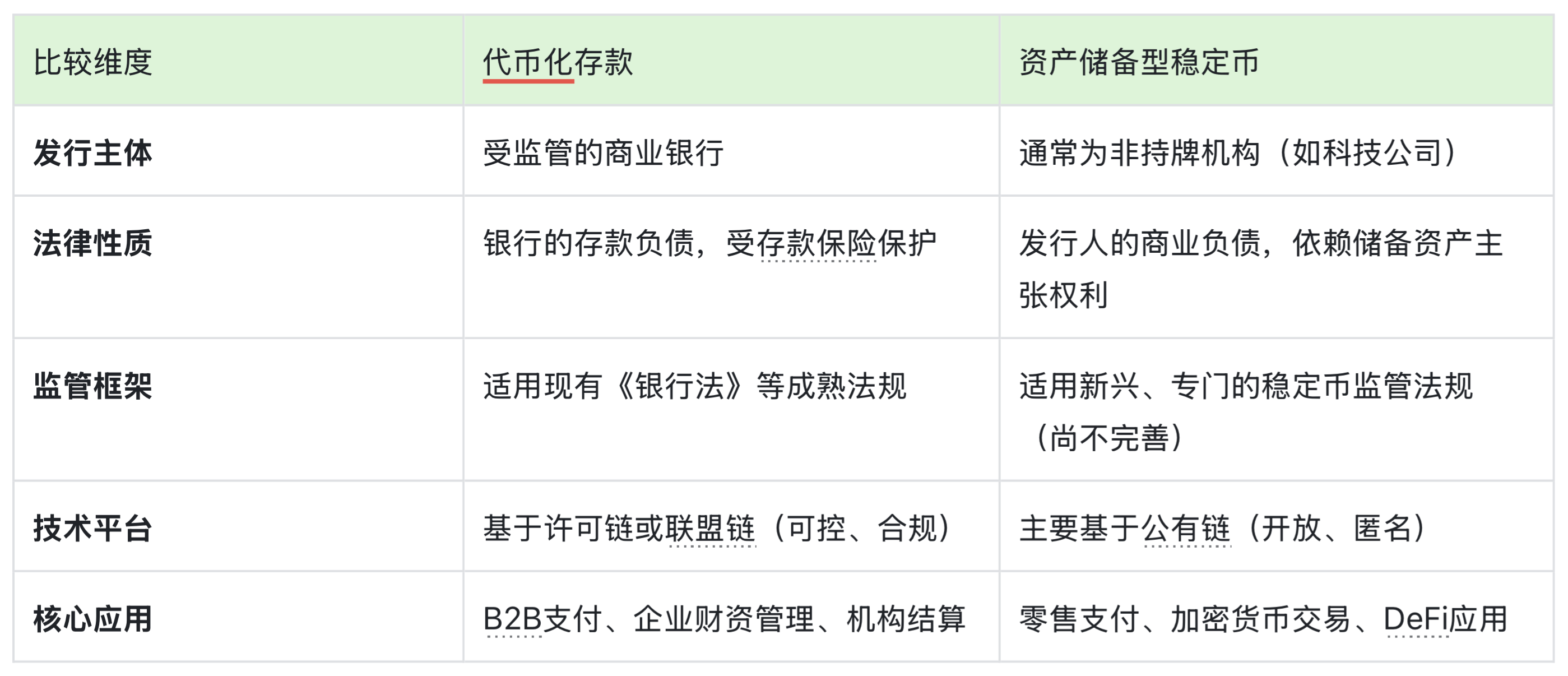
The legal core of tokenized deposits has never changed—they remain liabilities of commercial banks to depositors, protected under the existing Banking Law system, with their value anchored to the central bank's fiat currency system. In contrast, most stablecoins are commercial liabilities issued by tech companies, with their value dependent on the reserve assets held by the issuer.
This difference in legal nature determines their distinctly different development paths and regulatory treatments. Tokenized deposits follow a "regulatory-first" compliance path, while stablecoins have experienced wild growth on public chains. An important advancement in Hong Kong's "Policy Declaration 2.0" is the clear distinction between "virtual assets" and "digital assets," shifting the policy focus towards the on-chainization of assets that serve the real economy.
The choice made by Standard Chartered and Ant has technically achieved the "on-chain expression" of bank deposits, but within the legal and regulatory framework, it is firmly rooted in the traditional financial system. This may hint at a mainstream direction for the future of digital finance: innovation does not necessarily require the overthrow of the system; it can also be a digital enhancement of the existing system.
To clearly illustrate the differences in their legal and technical characteristics, here is a core comparison between tokenized deposits and asset-backed stablecoins:
III. The Commercial Game: Who is Leading This Collaboration?
On the surface, this appears to be a win-win collaboration between a bank and a tech company. However, a deeper analysis of both parties' motivations reveals subtle gamesmanship and their respective far-reaching strategic considerations.
For a multinational bank like Standard Chartered, this is primarily a defensive counterattack. Digital banks and fintech companies are eroding the bank's core payment and cash management business. Through tokenized deposits, Standard Chartered can offer 24/7 real-time services that traditional systems cannot provide, creating a technological moat to solidify relationships with corporate clients.
Mahesh Kini's statements reveal the bank's core demand: to meet the growing need for "timely" liquidity from enterprises. Banks are transforming from simple fund custodians to real-time dispatch centers for global corporate fund flows.
Ant International's role is more complex. It is both a client and a technology solution provider. Through the Whale platform, Ant is "productizing" its capabilities in blockchain and payments for traditional financial institutions. This marks an important elevation in its strategy: from building its own financial ecosystem to becoming an infrastructure service provider for the financial industry.
Kelvin Li, General Manager of Technology at Ant International, reflects this positioning in his remarks: "By combining Standard Chartered's deep banking service capabilities with Ant's expertise in tokenization and global payments, the new solution can provide smoother and safer access to working capital for its global operations."
In this collaboration, the bank provides compliance credit and a customer network, while the tech company offers technological capabilities and an innovative culture. Both sides are probing each other's boundaries and learning each other's language. What may ultimately emerge is a new type of financial service that is neither a traditional bank nor a tech company—a hybrid.
IV. Global Competition: The Collective "On-Chain" Migration of the Banking Industry
The collaboration between Standard Chartered and Ant is not an isolated case but a prominent wave in the global digital transformation of the banking industry. In 2025, mainstream financial institutions collectively shifted from passive defense to active exploration of blockchain technology.
As early as May 2025, HSBC launched Hong Kong's first bank-provided tokenized deposit service and completed its first interbank transfer. Across the Atlantic, BNY Mellon has incorporated tokenized deposit testing into its core planning for payment system modernization. JPMorgan has been even more aggressive, announcing that it will offer dollar deposit tokens to institutional clients via public blockchain.
Even in relatively conservative Britain, a pilot project for tokenized deposits in pounds initiated by the Financial Association has already started, with plans to continue until mid-2026.
The driving force behind this global wave is clear and urgent. According to industry analysis, the market size of blockchain financial products reached approximately $189 billion in the third quarter of 2025, showing significant year-on-year growth. More critically, pilot data indicates that tokenization technology can reduce cross-border payment processing times from days to minutes while significantly lowering operational costs and risks associated with funds in transit.
In this global competition, Hong Kong, through the collaboration between Standard Chartered and Ant, has secured an important position in the Asian market. However, the competition is far from over, as Singapore, the UAE, and other regions are also advancing similar projects. The true prize in this competition may be the authority to set standards for future global digital financial infrastructure.
V. Risks and Limitations: Overlooked Challenges
Amidst optimistic expectations, the challenges and limitations faced by tokenized deposits are often underestimated. These challenges arise not only from a technical perspective but also involve structural adjustments within the financial system.
First is the impact on the existing cross-border payment system. Tokenized deposits bypass some traditional clearing intermediaries, potentially affecting the revenue models and regulatory transparency of the current international payment system. Balancing efficiency improvements with system stability is a challenge that regulators must confront.
Second is the issue of technical barriers and fair competition. Developing and maintaining blockchain systems requires substantial investment, which may further exacerbate the "Matthew effect" in the banking industry, concentrating resources in leading banks and putting smaller banks at risk of marginalization.
Third is cross-chain interoperability and liquidity fragmentation. Different banks and regions may adopt different technical standards, creating new "on-chain islands." How to enhance efficiency while avoiding liquidity fragmentation across multiple chains is a technical and governance challenge that needs to be addressed.
Finally, there is the need for cross-border coordination of laws and regulations. Tokenized deposits inherently possess cross-border attributes, but countries have vastly different regulatory attitudes towards digital currencies. A tokenized deposit product compliant in Hong Kong may face entirely different legal interpretations in Singapore, the EU, or the United States.
These challenges remind us that technological breakthroughs are just the beginning; institutional adaptation and social acceptance are a much longer process.
VI. Future Outlook: Programmable Finance and the Redefinition of Banks
The "ice-breaking" collaboration between Standard Chartered and Ant may signal the direction of evolution in the financial industry over the next decade. Its impact will extend far beyond enhancing corporate fund management efficiency, potentially triggering a rethinking of the essence of banking.
Corporate financial management is shifting from static record-keeping to dynamic programming. In the future, financial directors may no longer need to manually allocate funds but can preset rules through smart contracts, allowing funds to operate automatically like programs. Complex operations such as accounts receivable management, supply chain financing, and dynamic discounting may all achieve full automation.
The interaction interface between banks and clients may undergo fundamental changes. Traditional online banking interfaces may be replaced by a combination of "wallet + smart contracts." The core competitiveness of banks will shift from branch distribution and client manager relationships to the ability to optimize fund flow algorithms and build cross-chain settlement networks.
This transformation will redefine the competitive landscape of the banking industry. Future winners may be those "dual-brain" institutions that can maintain the stability of the financial system while flexibly embracing technological change—half cautious bankers, half agile tech experts.
Hong Kong plays a unique role in this transformation process. It is neither completely technology-driven like Silicon Valley nor as conservative as traditional financial centers. Hong Kong's experiment may explore a middle path: allowing technological innovation to smoothly integrate into the existing system while ensuring financial security.
As the largest and oldest financial asset—bank deposits—begins to migrate onto the blockchain steadily, the seeds of transformation have already been sown. For enterprises, this means unprecedented fund efficiency; for banks, it is a self-reform that must be undertaken to avoid regression; for Hong Kong, this is a crucial battle to consolidate its position as an international financial center.
This experiment, which began in the Hong Kong Monetary Authority's sandbox, may ultimately change the way global funds flow. Those enterprises and financial institutions that first understand and adapt to this change will seize the initiative in the era of programmable finance.
Some sources of information:
· "Standard Chartered Partners with Ant on Whale Platform to Test Tokenized Deposits"
· "Standard Chartered Tokenizes Ant International's HKD, RMB, and USD Accounts through Whale"
· "Tokenized Deposits: Compliance Innovation in Blockchain Technology"
免责声明:本文章仅代表作者个人观点,不代表本平台的立场和观点。本文章仅供信息分享,不构成对任何人的任何投资建议。用户与作者之间的任何争议,与本平台无关。如网页中刊载的文章或图片涉及侵权,请提供相关的权利证明和身份证明发送邮件到support@aicoin.com,本平台相关工作人员将会进行核查。


