Written by: Clow
670,000 bitcoins, accounting for approximately 3.2% of the global total supply.
This is the number of bitcoins held by MicroStrategy (now renamed Strategy Inc.) as of mid-December 2025. As the world's first publicly traded company to adopt bitcoin as its primary reserve asset, this former business intelligence software provider has completely transformed into an "operational enterprise focused on structured financial design for bitcoin."
The name change is not just a rebranding but a complete strategic shift towards the ultimate declaration of "bitcoin standard."
However, entering the fourth quarter of 2025, with increasing market volatility and potential changes in index compilation rules, this model, described by founder Michael Saylor as a "revolutionary financial innovation," is facing the most severe test since its inception in 2020.
So, where does MicroStrategy's money come from? Can its business model be sustained? What are the biggest risks?
01 From Software Company to "Bitcoin Bank"
In 2025, MicroStrategy officially changed its name to Strategy Inc., marking a complete transformation of its identity.
The core logic of the company is not complicated: leverage the premium of its stock relative to the net asset value of bitcoin to continuously finance and increase its bitcoin holdings, thereby achieving a sustained increase in the bitcoin per share held.
In simpler terms: as long as the market is willing to give MSTR stock a higher valuation than the bitcoin it holds, the company can issue new shares to buy more bitcoin, allowing the corresponding bitcoin quantity for each existing shareholder to increase rather than decrease.
Once this "flywheel effect" is initiated, it creates positive feedback: stock price rises → issue shares to buy bitcoin → BTC holdings increase → stock price continues to rise.
However, this flywheel has a fatal premise: the stock price must remain consistently above the net value of bitcoin. Once this premium disappears, the entire model will come to a halt.
02 Where Does the Money Come From? Financing "Three Axes"
There is much curiosity about the source of funds for MicroStrategy's continuous bitcoin purchases. By analyzing the 8-K filings submitted to the U.S. Securities and Exchange Commission (SEC), it is clear that its financing model has evolved from the early single convertible bonds to a diversified capital matrix.
First Axe: ATM Program — A Money-Making Machine Capturing Premiums
MicroStrategy's core source of funding is its At-the-Market (ATM) program for Class A common stock (MSTR).
The operational logic is simple: when the trading price of MSTR stock is higher than its net asset value of bitcoin, the company sells new shares to the market and uses the cash obtained to purchase bitcoin.
In the week from December 8 to December 14, 2025, the company raised approximately $888.2 million in net proceeds by selling over 4.7 million shares of MSTR stock.
The charm of this financing method lies in the fact that as long as the stock price is above the net value of bitcoin, each new issuance is "enriching" rather than dilutive for existing shareholders.
Second Axe: Perpetual Preferred Stock Matrix
In 2025, MicroStrategy took an important step in capital tool innovation by launching a series of perpetual preferred stocks to attract investors with different risk preferences.

In a single week in December, these preferred stocks raised $82.2 million from STRD.
These preferred stocks are typically structured as "capital return type" dividends, which are tax attractive for investors as they allow for the deferral of tax obligations for at least ten years.
Third Axe: "42/42 Plan" — An Ambition of $84 Billion
MicroStrategy is currently in the execution phase of its ambitious "42/42 Plan."
The plan aims to raise $42 billion through equity issuance and $42 billion through fixed-income securities over three years from 2025 to 2027, totaling $84 billion, all for the purpose of purchasing bitcoin.
This plan is an upgraded version of the previous "21/21 Plan," reflecting management's extreme confidence in the capital market's ability to absorb its securities. This large-scale capital operation effectively turns MicroStrategy into a closed-end fund with leveraged exposure to bitcoin, but its operational company structure provides it with financing flexibility that traditional funds do not possess.
03 The Truth Behind the "Selling Bitcoin" Rumors
Recently, rumors have circulated in the market that MicroStrategy might sell its bitcoins, which seem unfounded in light of financial data and on-chain evidence.
In mid-November and early December 2025, on-chain data monitoring tools (such as Arkham Intelligence) observed large-scale asset transfers from wallets controlled by MicroStrategy. The data showed that approximately 43,415 bitcoins (worth about $4.26 billion) were transferred from known addresses to over 100 new addresses. This caused panic on social media, leading to a temporary drop in bitcoin prices below $95,000.
However, subsequent professional audits and clarifications from management indicated that this was not a reduction in holdings but rather a normal "custodian and wallet rotation." MicroStrategy diversified its assets from traditional platforms like Coinbase Custody to more defensive addresses to reduce credit risk from a single custodian and enhance security. Arkham's analysis pointed out that such operations typically involve security needs for address refreshing rather than asset liquidation.
MicroStrategy's Executive Chairman Michael Saylor has publicly refuted these rumors multiple times and clearly stated in December's Twitter and CNBC interviews: "We are buying, and the scale of our purchases is quite large."
In fact, the company increased its holdings by 10,645 bitcoins at an average price of $92,098 each in the second week of December, directly disproving the selling rumors.
Additionally, the company's recent establishment of a $1.44 billion USD Reserve further proves that it does not need to liquidate bitcoins to pay dividends or debt interest, as this reserve can cover at least 21 months of financial expenditures.
04 The Overlooked Software Business
Although bitcoin trading occupies the public spotlight, MicroStrategy's software business remains an important foundation for maintaining its status as a publicly traded company and covering daily financial expenses.
In the third quarter of 2025, the total revenue from the software business was $128.7 million, a year-on-year increase of 10.9%, exceeding market expectations.
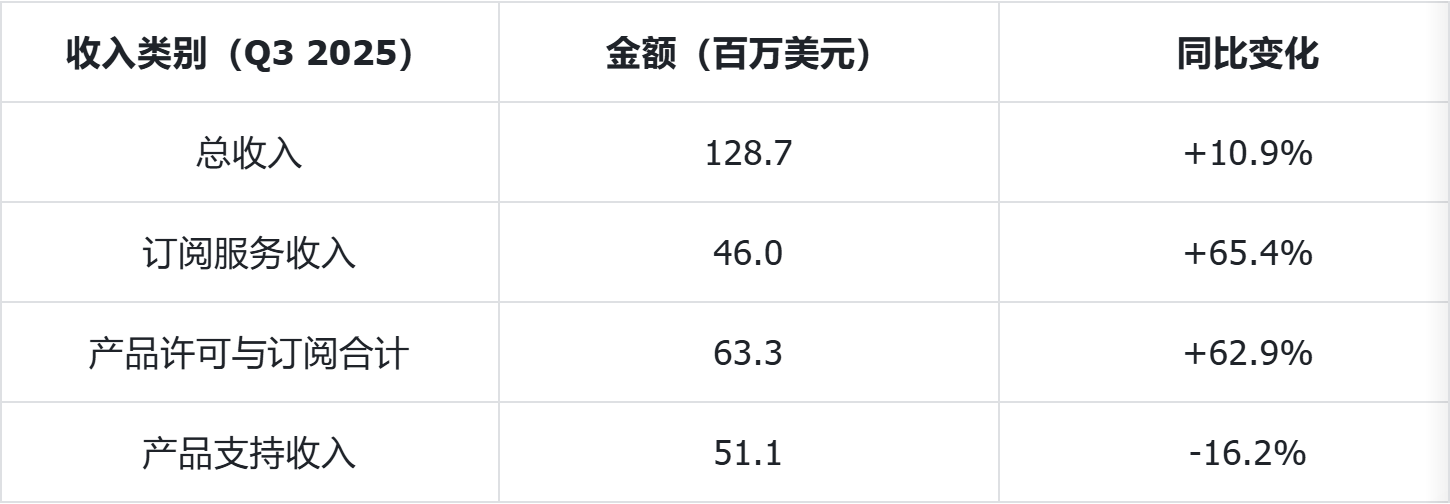
Although subscription revenue saw significant growth, the business did not generate positive operating cash flow in the first six months of 2025 due to the company's ongoing investments in AI research and cloud infrastructure. The free cash flow for Q3 was negative $45.61 million, indicating that the company was still operating at a loss, and its continued accumulation of bitcoin relies entirely on external financing.
Starting January 1, 2025, MicroStrategy adopted the ASU 2023-08 standard, requiring the revaluation of bitcoin holdings at fair value, with changes recorded in the current net profit. This change made the company's reported earnings highly volatile. In Q3 2025, due to the rise in bitcoin prices, the company recorded an unrealized gain of $3.89 billion, bringing the quarterly net profit to $2.8 billion.
05 Three Damocles Swords Hanging Overhead
Although MicroStrategy has reduced the risk of short-term forced liquidation through complex financial designs, it still faces several systemic risks that could shake its foundations in the future.
Risk One: MSCI Index Exclusion
The most immediate risk facing MicroStrategy comes from the review by index compiler MSCI.
MSCI has initiated a formal consultation proposing to reclassify companies with digital assets exceeding 50% of total assets as "investment vehicles" rather than "operating companies." Since bitcoin holdings constitute the vast majority of MicroStrategy's assets, if this rule is passed, MicroStrategy will be excluded from the MSCI Global Standard Index (GIMI).
Such exclusion could force passive funds to sell off shares worth between $2.8 billion and $8.8 billion. This large-scale forced sell-off would directly suppress its stock price, thereby compressing the NAV premium of MSTR. If the NAV premium disappears or even turns into a discount, its "flywheel" of buying bitcoin through stock issuance will come to a complete halt.
Risk Two: NAV Premium Compression and Financing Stagnation
The entire logic of MicroStrategy's accumulation is based on the market's willingness to pay a premium above its net asset value.
By the end of 2025, this premium exhibited extreme instability. In early December, due to market concerns over index exclusion, MSTR traded at an 11% discount to the value of its bitcoin holdings.
When the stock is at a discount, any new equity financing will dilute the bitcoin holdings per share for existing shareholders, forcing the company to halt asset accumulation and even face creditor challenges regarding asset integrity. MicroStrategy had previously suspended its ATM program for the first time in September 2025, reflecting management's high sensitivity to valuation multiples.
Risk Three: Debt Pressure and Theoretical Liquidation Price
As of the end of Q3 2025, MicroStrategy's total debt was approximately $8.24 billion, with annual interest payments of about $36.8 million, while preferred stock dividends amounted to $638.7 million annually.
Although its convertible bonds do not include bitcoin collateral clauses, reducing the direct "liquidation" risk due to market downturns, the company's ability to repay debts will be tested if bitcoin prices experience extreme declines.
06 Conclusion
MicroStrategy's situation at the end of 2025 vividly illustrates the opportunities and challenges faced by a company attempting to redefine its financial boundaries.
Its intention to continue accumulating bitcoin has not changed, and by establishing a $1.44 billion USD reserve, the company has built a defensive wall against potential liquidity winters.
However, MicroStrategy's greatest risk does not stem from the volatility of bitcoin prices themselves, but from its link to the traditional financial system — namely, its index status and NAV premium.
If institutions like MSCI ultimately decide to exclude it from the traditional equity category, MicroStrategy must find a way to prove to investors that it remains a "bitcoin-backed structured financing platform" with growth vitality independent of passive inflows from indices.
Whether the future "42/42 Plan" can proceed as scheduled will depend on its ability to continuously create attractive yield products for institutional investors during the financialization process of bitcoin while maintaining at least minimal financial dignity amid the pains of transforming its software business to the cloud.
This is not just an experiment for MicroStrategy, but a microcosm of the entire cryptocurrency industry's integration process with the traditional financial system.
In this unprecedented gamble, the only certainty is: no one knows the ending of this story.
免责声明:本文章仅代表作者个人观点,不代表本平台的立场和观点。本文章仅供信息分享,不构成对任何人的任何投资建议。用户与作者之间的任何争议,与本平台无关。如网页中刊载的文章或图片涉及侵权,请提供相关的权利证明和身份证明发送邮件到support@aicoin.com,本平台相关工作人员将会进行核查。


