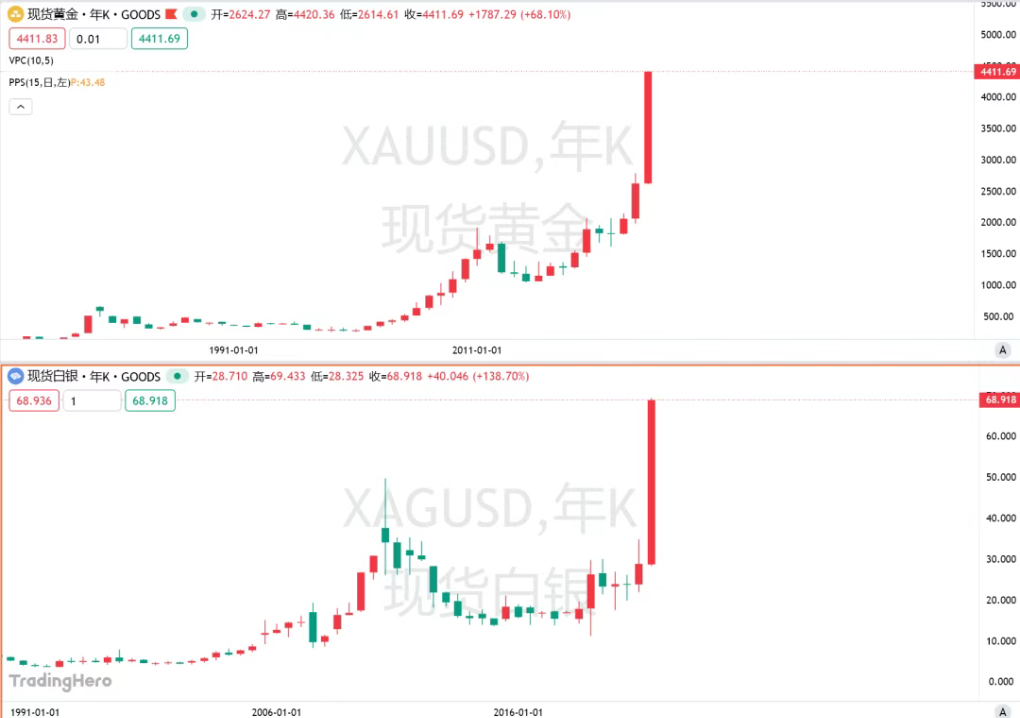
On December 22, 2025, the global precious metals market witnessed history. The spot price of gold in London broke through the $4400 per ounce mark for the first time, while the spot price of silver also rose above $69. As of that day, gold had accumulated an increase of approximately 68% for the year, while silver's increase reached an astonishing nearly 139%.
This is the first time since 1980 that gold, silver, and copper have all set historical highs in the same calendar year.

1. Market Status: Historic Breakthrough and Structural Changes
● The precious metals market is experiencing an unprecedented collective frenzy. As of December 22, the spot gold price reached a high of $4435.28 during the day, continuing to set historical records. Silver performed even more impressively, breaking through the $69 mark and soaring to a historical high of $69.44.
● The structural changes in the market are also significant. The gold-silver ratio, which measures how many ounces of silver can be purchased with one ounce of gold, has narrowed sharply from a high of 105 in April to around 64. This ratio is approaching a nearly five-year low, indicating that silver's performance has significantly outpaced gold.
2. Drivers of the Rise: Multiple Factors Resonating
1. Macroeconomic Policies and Interest Rate Expectations
● Recent weak inflation and employment data in the U.S. have strengthened market expectations for the Federal Reserve to continue its accommodative monetary policy into 2026. Federal funds futures pricing indicates that the market expects two rate cuts (a total of 50 basis points) next year. As a non-yielding asset, gold's appeal significantly increases in a low-interest-rate environment.

2. Weakening Dollar and Safe-Haven Demand
● The U.S. dollar index has fallen by approximately 9% in 2025, marking its worst annual performance in eight years. Meanwhile, ongoing conflicts in the Middle East and uncertainties surrounding Russia-Ukraine negotiations continue to stimulate safe-haven buying in the market.

3. Central Bank Gold Buying Surge
● Global central bank demand for gold has remained high for four consecutive years. According to the World Gold Council, in the first three quarters of 2025, global central banks net purchased 634 tons of gold. The market expects the total net purchase for 2025 to reach 850 tons. This buying behavior has been described by Professor Li Huihui of Lyon Business School as not for "reserve diversification," but for "survival."
4. Unique Industrial Demand for Silver
● Unlike gold, industrial demand is a unique driver behind silver's surge. In 2025, industrial silver accounted for over 60% of demand. The photovoltaic industry (with a compound annual growth rate of 17%), the electric vehicle industry (13%), and the explosive expansion of global AI data centers together form the three pillars of silver demand growth.
● However, the supply elasticity of silver is quite limited; it takes about ten years from the decision to mine a new silver mine to its first output.
3. Historical Trend Review: Similarities and Differences
1. Comparison with Historical Highs
● Gold has set over 50 historical highs this year, with an annual increase of over 60%. This increase is second only to the records set during the 1979 second oil crisis and the period of high inflation in the U.S..
● Looking back at history, during the precious metals bull market in 1980, silver prices soared from about $11 to $50 in just two months, followed by a sharp correction. While the current rise in silver is strong, "strictly speaking, it has not yet reached the 'true parabolic' level of 1980."
2. Changes in Market Structure
● The biggest difference from previous cycles is the "spotification" of pricing power. The main buyers today are no longer hedge funds engaged in swing trading, but rather "national teams" and "physical hoarders."
● These buyers often take gold bars back to their countries after purchase, rather than allowing them to circulate in the market, leading to an extreme depletion of liquid assets in the market.
4. Impact on the Macroeconomy
1. Reflecting Changes in the Global Credit System
● Professor Li Huihui refers to gold as the "thermometer of monetary credit." The core driving force behind the recent rise stems from the "collapse of sovereign trust" and the "acceleration of de-dollarization." Gold is transitioning from an investment "asset" to being regarded by institutions as the last high-quality "collateral" for allocation.
2. Transmission to the Real Economy
● High gold and silver prices have begun to suppress some real demand. For example, India's jewelry demand in the first three quarters of 2025 fell by 26% year-on-year. However, on the other hand, the rigid demand for silver from industries such as photovoltaics, electric vehicles, and AI data centers has provided price support.
3. Financial Market Interlinkages
● In the Asian market, the non-ferrous metals sector led the way in 2025 with an increase of over 70%. In the first three quarters, 141 listed companies in the non-ferrous metals industry achieved a total revenue of 2.82 trillion yuan, with a total net profit attributable to the parent company of 151.288 billion yuan, a year-on-year increase of 41.55%.
5. Institutional Perspectives and Future Outlook
1. Mainstream Institutional Predictions
For the future market, Wall Street institutions generally hold an optimistic view:
● Goldman Sachs predicts that by the end of 2026, gold prices could reach $4900 per ounce, while also noting significant upside risks.
● HSBC has set a target price for gold at $5000.
● For silver, there is a wide divergence in institutional predictions, with the mainstream range concentrated between $60 and $70 per ounce, and optimistic scenarios looking at $80 to $100.
2. Risk Warnings
Analysts have also pointed out potential risks:
● Technical indicators for silver have shown overbought conditions, and with low market liquidity at year-end, prices may experience significant volatility.
● If the Federal Reserve cuts rates fewer times than the market expects, the upward trajectory of gold may face resistance.
● The global aluminum market is expected to experience a surplus of 1.1 million tons in 2026, accounting for 1.5% of global primary aluminum demand.

The surge in the precious metals market in 2025 is the result of multiple macro factors resonating with industrial changes. The current bull market in precious metals is not merely a traditional safe-haven or anti-inflation trend, but rather a product of the convergence of accommodative monetary cycles, high fiscal deficits, and a global manufacturing recovery.
Wang Leyi, Chairman of Zhaojin Group, candidly stated: "The gold industry is undergoing a profound 'value return,' and its new cycle of 'value reassessment' has already begun. Fluctuations in gold prices within historical high ranges will become a new normal."
After reaching historical highs, the market will shift from a broad-based rally to structural differentiation. For investors, understanding the deep logic driving the precious metals market—the reconstruction of the global monetary credit system, the resource demands of industrial revolutions, and changes in market microstructures—may be more important than merely speculating on peaks. In this uncertain era, the brilliance of gold and silver is not just a market frenzy, but a reflection of profound changes in the global economy.
Join our community to discuss and grow stronger together!
Official Telegram community: https://t.me/aicoincn
AiCoin Chinese Twitter: https://x.com/AiCoinzh
OKX benefits group: https://aicoin.com/link/chat?cid=l61eM4owQ
Binance benefits group: https://aicoin.com/link/chat?cid=ynr7d1P6Z
免责声明:本文章仅代表作者个人观点,不代表本平台的立场和观点。本文章仅供信息分享,不构成对任何人的任何投资建议。用户与作者之间的任何争议,与本平台无关。如网页中刊载的文章或图片涉及侵权,请提供相关的权利证明和身份证明发送邮件到support@aicoin.com,本平台相关工作人员将会进行核查。