Ajie stared at the winding K-line of ETH on the screen, feeling like his brain cells were about to twist into a pretzel.
"Is this the darkness before dawn, or the… more dusk after dusk?" he muttered to himself, feeling that his investment mood was more volatile than the K-line fluctuations.
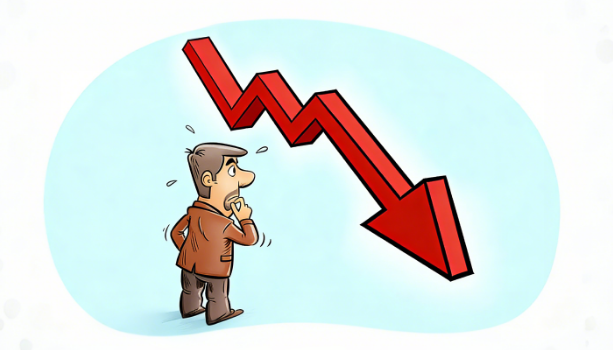
As a newcomer who had just entered the circle for three months, he jumped back and forth every day between "the feeling of a surge" and "the anxiety of a drop." Yesterday, he heard Zhang San say, "Good news is coming soon," and today he saw Li Si analyze, "Support has been broken." Ajie felt like he was not trading but participating in a large metaphysics seminar.
Until one Wednesday afternoon, when the market was relatively stable and the group chat was unusually quiet. Ajie opened the trading software for the Nth time, staring blankly at the ETH that had been consolidating for a long time, his fingers unconsciously sliding across the screen. Suddenly, a small icon in the corner of the interface, which was not very eye-catching but glimmering slightly, caught his attention—“AI Interpretation of K-line.”
“Oh? AI can look at this too? Let’s see what AI has to say?” he mumbled, driven by a curiosity of "there's no loss anyway," and clicked on it.
The interface was clean and simple, prompting him to upload or select the K-line chart he wanted to analyze. Ajie chose the 1-hour chart of ETH and clicked "Start Analysis."
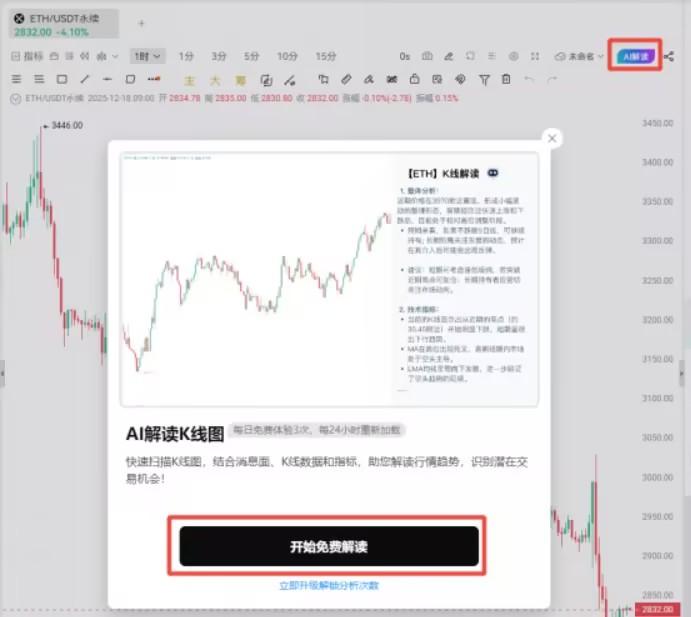
What happened next surprised him.
Instead of an immediate pop-up of complex and difficult-to-understand terminology, a gentle loading animation appeared, as if the AI was "observing" and "thinking." A few seconds later, a clearly structured report unfolded like a scroll, with the first sentence boldly setting the tone:
“【ETH • 1 Hour】Core Viewpoint: Currently in a downtrend.”
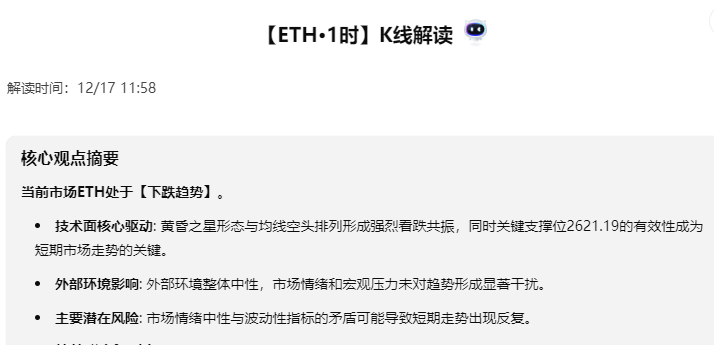
Ajie's spirits lifted. The tone was calm and assertive, unlike the guesses in the group that always included "maybe," "possibly," or "I feel."
The AI analysis began, and it didn't sound like a cold machine report; it felt more like an experienced old trader wearing glasses, patiently explaining the story of the chart under the light:
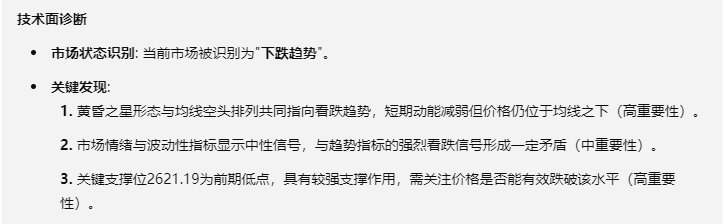
"The Evening Star… so that's what it means!" Ajie slapped his thigh and quickly compared it with his chart. The three K-line combination that he previously thought looked "a bit strange" suddenly gained a clear meaning.
The AI not only interpreted the patterns but also integrated market sentiment and the macro environment:
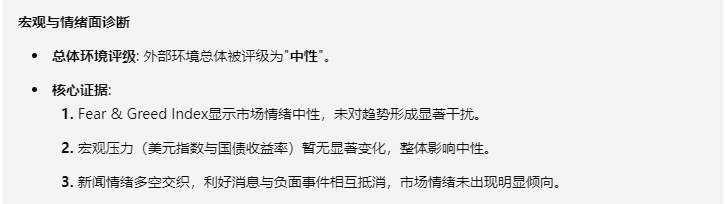 “Current external sentiment is neutral, with no major news disrupting the market. Therefore—technical analysis speaks for itself.”
What made Ajie feel most considerate was that the AI also provided two clear "action plans" and explicitly stated its "thought logic":
“Based on the above analysis, we offer two strategic ideas for your reference, considering your own risk tolerance:”
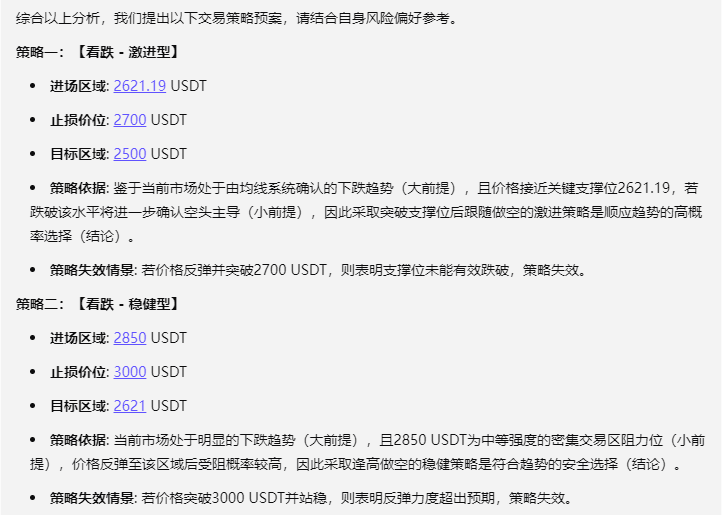
“It not only tells me ‘what it thinks,’ but also explains ‘why it thinks so,’ and even provides ‘if A happens, consider B; if C happens, consider D’ response ideas.”
Ajie felt an unprecedented clarity. This was different from any "teacher's" one-way impartation; it felt more like an interactive, logically deduced teaching.
He suddenly realized that the lines and numbers that had been jumping before him were no longer anxiety-inducing but a set of logical, structured, and rhythmic market language. AI had helped him translate this language.
Of course, the AI also did not forget to remind him at the end:
“This content is for reference only and does not constitute any investment advice. The market has risks; invest cautiously.”
Seeing this sentence, Ajie felt even more at ease. It did not deify itself and clearly defined the boundaries of the tool.
Ajie smiled as he closed the analysis page. He did not immediately and blindly place an order according to any strategy. But the anxiety that had arisen from "not understanding" had dissipated by more than half. He now understood:
Technical analysis is not a form of divination or mysticism, but a language for understanding the psychological and behavioral traces of the market crowd. A good auxiliary tool is like an excellent translator or navigator; it won't decide your destination for you, but it can help you more clearly identify signposts, understand the map, and plan possible routes, allowing your own journey to be clearer and more composed.

From then on, whenever Ajie faced the intricate K-line charts, he would habitually click on that feature.
He knew that his calm, rational "crypto guide" would once again help him unravel the complexities and illuminate the key signposts and forks in the road ahead.
Join our community to discuss and become stronger together!
Official Telegram community: t.me/aicoincn
AiCoin Chinese Twitter: https://x.com/AiCoinzh
Group chat - Wealth Group:
https://www.aicoin.com/link/chat?cid=10013
免责声明:本文章仅代表作者个人观点,不代表本平台的立场和观点。本文章仅供信息分享,不构成对任何人的任何投资建议。用户与作者之间的任何争议,与本平台无关。如网页中刊载的文章或图片涉及侵权,请提供相关的权利证明和身份证明发送邮件到support@aicoin.com,本平台相关工作人员将会进行核查。