Institutional investors and retail investors are clashing fiercely in their expectations as the end of the year approaches, rewriting the historical patterns of the "Christmas rally" in the crypto market.
In late December 2025, the cryptocurrency market is once again anticipating the annual "Santa Claus rally," with investors focusing on the seasonal uptrend window indicated by historical data from December 24 to early January of the following year.
This seasonal phenomenon, originating from the traditional U.S. stock market, has also become a focal point in the crypto market in recent years. With institutional funds deeply involved and macroeconomic uncertainties increasing, the debate over whether "Santa Claus" will visit the crypto world as expected is particularly intense.
The "Christmas rally" in the crypto market has never been a certainty. Data from the past seven complete cycles since 2018 shows that years of price increases only account for 57%, and the average increase is entirely lifted by the extreme performance of 46.15% during the 2020 bull market.
1. Historical Patterns and Cyclical Influences
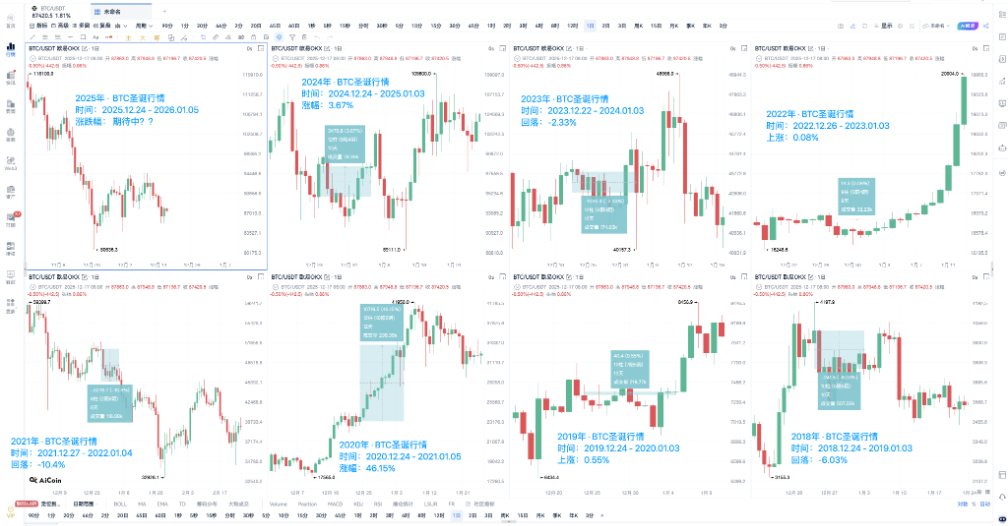
Looking back at the history of Bitcoin's Christmas rally, data reveals the truth behind this seasonal phenomenon. Over the past seven years, Bitcoin's performance during the Christmas period has shown significant divergence, with the probabilities of increases and decreases being roughly equal, and the probability of increases around 57%. The performance of BTC during the past seven complete Christmas-New Year cycles (approximately from December 24 to January 3-5 of the following year) is as follows:
● 2024 (2024.12.24 → 2025.01.03): +3.67% (slight increase)
● 2023 (2023.12.22 → 2024.01.03): -2.33% (slight decrease)
● 2022 (2022.12.26 → 2023.01.03): +0.08% (basically flat)
● 2021 (2021.12.27 → 2022.01.04): -10.4% (significant decrease)
● 2020 (2020.12.24 → 2021.01.05): +46.15% (super increase)
● 2019 (2019.12.24 → 2020.01.03): +0.55% (slight increase)
● 2018 (2018.12.24 → 2019.01.03): -6.03% (slight decrease)
2. Diverging Views: Optimism, Caution, and Disruptive Interpretations
The current market predictions for the "Christmas rally" have formed three distinct camps, with the debate extending far beyond short-term price fluctuations to touch on the understanding of the market's essence.
1. Cautious Camp: Concerns Over Macro Shadows and Trends
This is the dominant voice in the market at present. Mainstream analysts have significantly lowered the probability of a strong Christmas rally from over 70% a month ago to 30%-40%. The core logic behind this is:
● Doubts About Macro Momentum: Although the Federal Reserve began cutting interest rates in December, its forward guidance is less "dovish" than the market expected. Confidence in subsequent continuous rate cuts has wavered, and expectations for further easing of dollar liquidity have been discounted, weakening the core engine for the rise of risk assets.
● Lack of Consensus on Technicals: After a rebound, Bitcoin's price has failed to effectively hold above the widely watched key resistance zone of $95,000-$97,000. The cautious camp believes this indicates that the market has not formed a unified upward force, and the rebound may merely be a technical correction.
2. Seasonal Optimists: Historical Windows and Structural Improvements
This camp is not blindly bullish but is based on observations of specific market structures.
● Support from Historical Probabilities: Data shows that the period from Thanksgiving to Christmas has historically been a relatively strong statistical window for Bitcoin. Some traders believe that with the overall market leverage having significantly decreased from high levels and potential selling pressure easing, seasonal buying could present trading opportunities.
● The Correlation Effect with U.S. Stocks: The correlation between the crypto market and traditional risk assets still exists. If U.S. stocks strengthen at year-end due to traditional factors like the "window dressing" effect, it could provide external support for the crypto market.
3. Macro Disruptors: A Liquidity Perspective Beyond Cycles
Some KOLs, represented by former BitMEX CEO Arthur Hayes, offer radical views that completely break away from traditional analytical frameworks.
Hayes argues that being fixated on halving cycles or seasonal patterns is outdated, and the liquidity trends of global central banks (especially the U.S. and Japan) are the sole determinants of Bitcoin's price. He asserts that under the current global policy mix, Bitcoin has the potential to surge towards $200,000 to $250,000 by the end of the year.
While such views are not widely accepted, the global liquidity narrative they emphasize is increasingly becoming an important dimension for market analysis.
3. Institutional Changes Altering the Game Rules
● The biggest difference in the Christmas rally of 2025 compared to previous years lies in the change of the main players. Since the approval of the spot Bitcoin ETF, institutional funds have been continuously flowing into the market through this channel, fundamentally altering the structure of market participants.
● In a low liquidity environment, retail sentiment may "ignite" the initial rally, but the scale and sustainability of the rally will ultimately depend on the direction of institutional funds. This change makes market behavior more rational and predictable.
● Institutional participation not only changes the funding structure but also affects market volatility patterns. The decline in trading volume due to holidays, in the context of ETFs continuously "accumulating," may exhibit volatility characteristics completely different from those of traditional retail markets.
4. How Three Key Variables Will Play Out
The final direction of this year's Christmas rally will depend on the evolution of several key variables.
1. The "Second Shoe" of Macro Policy
● After the interest rate cut in December, the market's focus quickly shifted to: Is this a passive response to recession fears, or the active starting point of a new round of easing?
● Any strong data regarding an economic "soft landing" or "no landing" could change the market's pricing of the Federal Reserve's policies for next year, instantly reversing the trend of risk assets. The macro narrative remains a Damocles' sword hanging over the market.
2. The "Thermometer" of ETF Fund Flows
● This is the most direct window to observe institutional movements. During Christmas, whether ETFs experience sustained net inflows or turn to net outflows will become the gold standard for judging whether institutions choose to "hold assets over the holiday" or "take profits." Sustained inflows will provide the strongest price support, potentially offsetting retail selling pressure; conversely, it could signal the end of the rally.
3. The "Health" of Market Structure
● Leverage Liquidation Risks: After previous corrections, the overall market leverage has decreased, but caution is needed as sudden price fluctuations in a low liquidity environment may still trigger chain liquidations, resulting in "longs killing longs" or "shorts killing shorts."
● Whale Behavior: On-chain data regarding "whale" addresses holding large amounts of Bitcoin will provide important leading indicators, whether they choose to transfer to exchanges (potential selling signal) or continue withdrawing from exchanges (accumulation signal).
5. A New Observational Framework for Investors
● In a market reshaped by institutions and high macro uncertainty, investors need to update their strategic toolbox. They must shift from guessing prices to observing signals, viewing ETF fund flows as a "heartbeat monitor" of institutional sentiment.
● Furthermore, investors should prepare for volatility rather than simply betting on direction. In low liquidity periods, significant two-way volatility is the norm, and maintaining flexibility through options strategies or position management is more important than predicting direction.
● The global liquidity narrative proposed by KOLs like Arthur Hayes is also worth noting; although their views are radical, they remind investors not to be confined to a single analytical framework. In the current environment, a multidimensional observation of the market is more reliable than relying on a single indicator.
The "Christmas rally" at the end of 2025 has evolved from a somewhat romantic seasonal speculation into a cold, complex, and highly institutionalized tug-of-war. It is no longer a simple game of historical probabilities but a litmus test of global macro liquidity, emerging institutional capital allocation behaviors, and traditional market seasonal effects resonating together.
For investors, the true gift may not be a guaranteed upward bonus but rather the necessity to learn to understand this increasingly mature and complex financial ecosystem with a more professional and comprehensive perspective amid market changes. Whether "Santa Claus" visits the crypto world this year or not, the ongoing game itself has already imparted a profound lesson to all participants: in this new era, the days of investing solely based on faith and calendars are long gone.
Join our community to discuss and grow stronger together!
Official Telegram community: https://t.me/aicoincn
AiCoin Chinese Twitter: https://x.com/AiCoinzh
OKX benefits group: https://aicoin.com/link/chat?cid=l61eM4owQ
Binance benefits group: https://aicoin.com/link/chat?cid=ynr7d1P6Z
免责声明:本文章仅代表作者个人观点,不代表本平台的立场和观点。本文章仅供信息分享,不构成对任何人的任何投资建议。用户与作者之间的任何争议,与本平台无关。如网页中刊载的文章或图片涉及侵权,请提供相关的权利证明和身份证明发送邮件到support@aicoin.com,本平台相关工作人员将会进行核查。