Original |Odaily Planet Daily(@OdailyChina)
Author|Golem(@web3_golem)
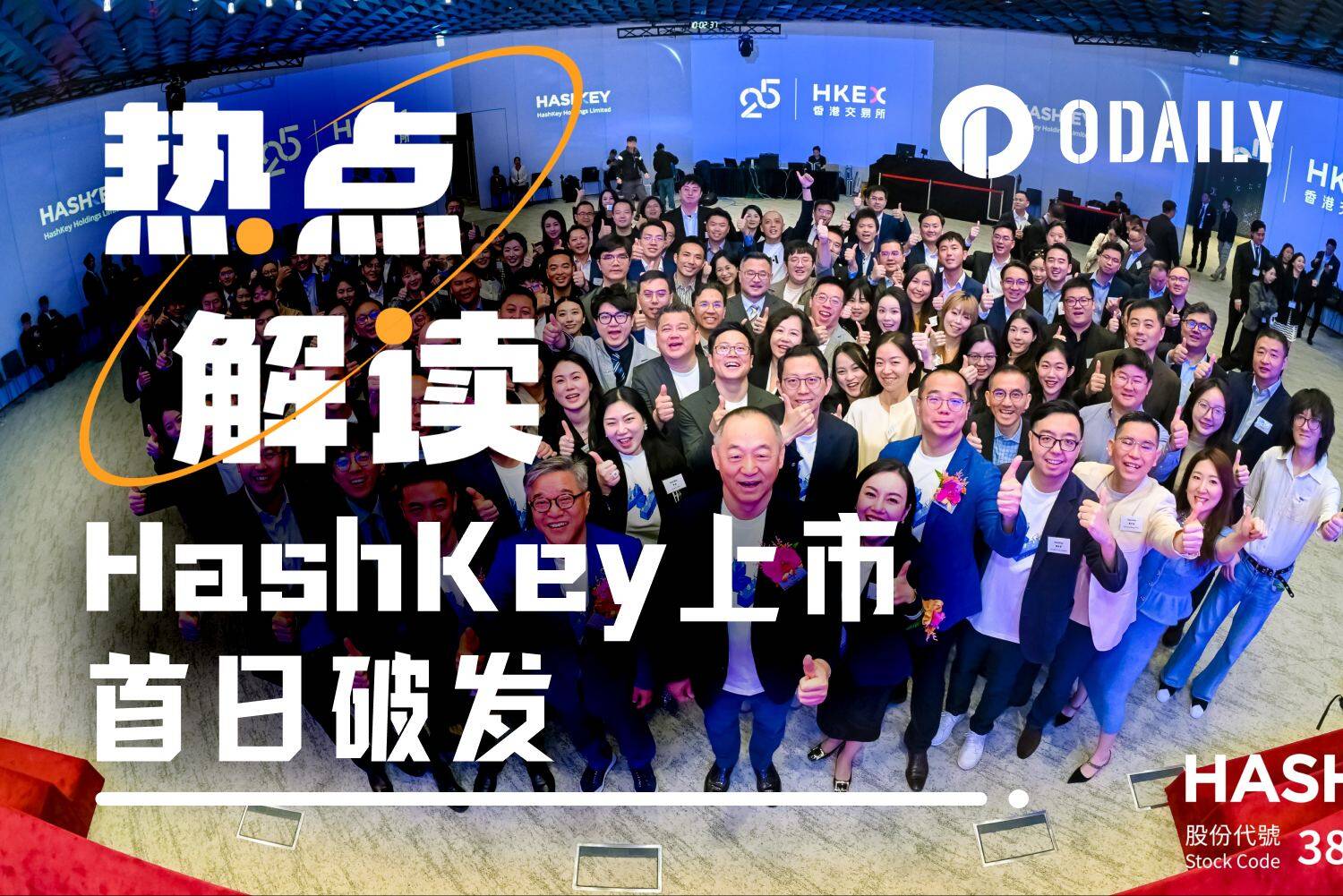
On December 17, HashKey Holdings (03887.HK) officially listed on the stock exchange. Unfortunately, the "first Hong Kong stock of a cryptocurrency exchange" fell below the issue price of HKD 6.68 within the first hour of trading.
According to Hong Kong stock market data, HASHKEY HLDGS reached a peak price of HKD 7.12 during trading, but then fell steadily, hitting a low of HKD 6.12. The closing price on the first day was HKD 6.67, close to the issue price.
This stock price performance starkly contrasts with the investment enthusiasm shown during HashKey Holdings' IPO period. On December 12, HashKey Holdings concluded its IPO, selling 240.6 million shares at HKD 6.68 each, raising HKD 1.67 billion (approximately USD 206 million) for this Hong Kong IPO. The public offering portion was oversubscribed by 393.71 times, and the international placement portion was also oversubscribed.
Public opinion has become divided; on one hand, some cryptocurrency practitioners praise HashKey for pushing the crypto industry towards the mainstream, marking an important milestone in Hong Kong's Web3 development; on the other hand, Hong Kong stock investors, who eagerly participated in the IPO, were left disappointed.
Statistics show that the rate of stock price decline in Hong Kong is between 24% and 30% in 2025, and the first cryptocurrency stock has not escaped this range.
"The Eastern Coinbase," a self-indulgence for crypto enthusiasts?
At the beginning of December, when HashKey Holdings completed its listing hearing and published its prospectus, Odaily conducted an in-depth analysis of the many challenges faced by HashKey Holdings' businesses, such as four consecutive years of financial losses, poor development of exchange operations, lack of competitiveness in the on-chain ecosystem, excessive R&D and compliance expenses, and the abundance of compliance licenses, stating that investors need to consider their investments carefully. _(Related reading: __Four consecutive years of losses, HSK sluggish, can HashKey's counter-cyclical IPO win over the capital market? _)
However, the subsequent enthusiasm in the HashKey IPO subscription market indicates that the market still has high expectations for the "first cryptocurrency stock in Hong Kong" and is not overly concerned about HashKey's losses (the prospectus states that losses are due to the trading platform still being in the early development stage and high investment period).
It is worth noting that HashKey's IPO will allocate 40% of the funds for technology and infrastructure iteration, another 40% for market expansion and ecosystem partnerships, and the remaining 20% for operations, risk management, and general corporate purposes.
The message is clear: "Although I am not making money now, I have growth potential. Let go of your chips, and let's bet on the future together."
While the stock market values financial statements and corporate cash flow, there are many well-known companies that are not profitable but have high growth potential, and investors are willing to pay for them—such as Amazon, which reported losses for three consecutive years before going public, but this did not prevent it from growing into an e-commerce giant. A more relevant example is Coinbase, which, like HashKey, follows a compliance path and also reported losses before going public, yet still attracted capital after its IPO.
However, those who compare HashKey to Coinbase often overlook key differences, focusing on regional compliance as a commonality between HashKey and Coinbase, emphasizing HashKey's compliance premium and high growth potential.
In my view, the biggest difference between HashKey and Coinbase lies in the substantial compliance expenses that brought tangible business returns to Coinbase, while HashKey, despite obtaining a compliance license in Hong Kong, has not shown significant business data improvement.
Before Coinbase went public in 2021, the company reported having 56 million registered users, while HashKey's exchange currently has only 138,000 registered users; before Coinbase's IPO, its daily trading volume reached the billion-dollar level, while HashKey's daily trading volume remains at the million-dollar level. As for HashKey's on-chain services and asset management business, they are even less comparable, and these two business segments contribute very little to HashKey's revenue.
The secondary investors' skepticism towards the "Coinbase comparison" is also evident, as HashKey Holdings' stock price has already fallen below the issue price in yesterday's Futu dark trading.
However, in this lackluster environment, discussing the significance of HashKey's listing apart from its stock price performance coincidentally hits the collective sweet spot of the crypto industry's hope to break through.
An exception? The first of its kind?
Judging a hero by a single day is indeed shortsighted; let us broaden our perspective. For the Chinese crypto community, another significant meaning of HashKey's listing in Hong Kong is that it symbolizes the further "deregulation" and acceptance of the crypto industry by the Hong Kong capital market. HashKey's listing has fired the first shot, and in the future, more quality crypto projects may take root and flourish in Hong Kong, potentially triggering a bull market. The strategic significance represented by HashKey has already far exceeded its intrinsic value.
From this perspective, who has the opportunity to be the next in line?
My judgment is that HashKey's listing may be an isolated case for crypto companies in Hong Kong, primarily due to a key individual.
Xiao Feng, a prominent figure in the crypto space, is not the largest shareholder of HashKey; the true controller of HashKey is Lu Weiding, chairman of Wanxiang Group, who stood beside him to ring the bell this morning.
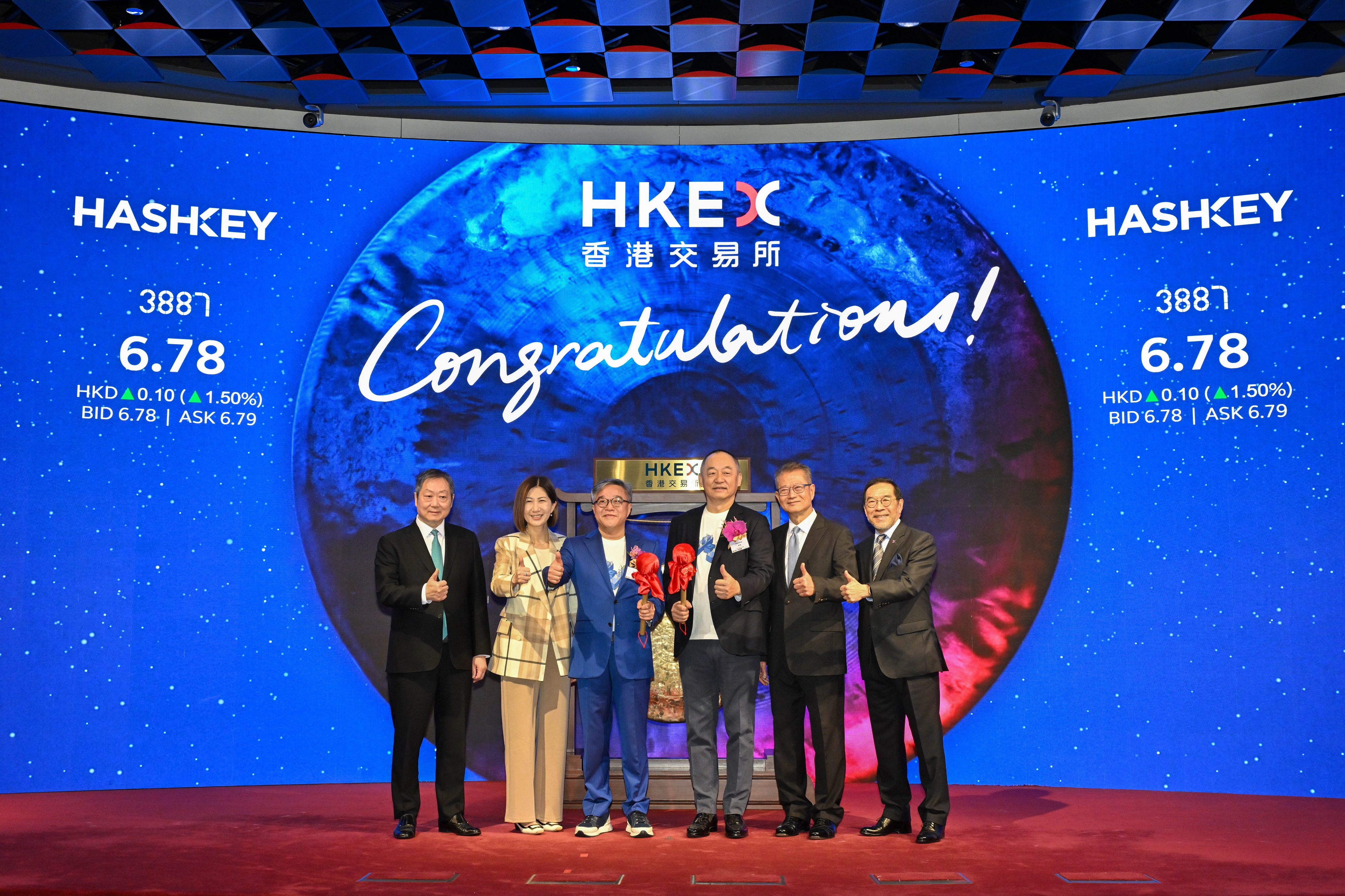
Lu Weiding (third from left) with Xiao Feng (third from right)
Lu Weiding is the main controlling shareholder of HashKey, holding 43.2% of the shares and able to exercise 22.9% of the voting rights through the employee stock ownership platform, while Xiao Feng, as the founder of HashKey, holds 16.3%; other investors collectively hold 17.6%. The shareholding structure clearly shows Lu Weiding's absolute voice in HashKey.
Lu Weiding took over as chairman of Wanxiang Group after the death of his father, Lu Guanqun. Wanxiang Group is a large domestic entity that started in the automotive parts manufacturing industry and later expanded into real estate, tourism, agricultural products, finance, energy, and metal resources.
Since Lu Weiding took over as chairman, he has vigorously developed Wanxiang Group's financial industry, which includes numerous financial enterprises such as Minsheng Life, Tonglian Payment, Zhejiang Merchants Fund, Puxing Juneng, Wanxiang Trust, Wanxiang Leasing, and Tonghui Futures, creating a Wanxiang financial empire.
Why is Lu Weiding crucial for HashKey's listing?
Because in addition to being the chairman of Wanxiang Group and the main controlling shareholder of HashKey, Lu Weiding is also a representative of the 14th National People's Congress, vice chairman of the All-China Federation of Industry and Commerce, a member of the Zhejiang Provincial Political Consultative Conference, and a distinguished entrepreneur in Zhejiang Province. These identities and the resources they represent provide HashKey with a stronger support system.
In today's regulatory context, how can other followers replicate this advantage, and will their path to listing be smooth? Thus, comparing HashKey to a "model for Hong Kong crypto" could lead to misjudgments for entrepreneurs and investors.
For a long time to come, HashKey will not just be "the first cryptocurrency stock in Hong Kong," but may also be a lonely runner who squeezed into the arena due to favorable timing, location, and human factors.
免责声明:本文章仅代表作者个人观点,不代表本平台的立场和观点。本文章仅供信息分享,不构成对任何人的任何投资建议。用户与作者之间的任何争议,与本平台无关。如网页中刊载的文章或图片涉及侵权,请提供相关的权利证明和身份证明发送邮件到support@aicoin.com,本平台相关工作人员将会进行核查。


