Original | Odaily Planet Daily (@OdailyChina)
Author | Ethan (@ethanzhangweb3)_
RWA Sector Market Performance
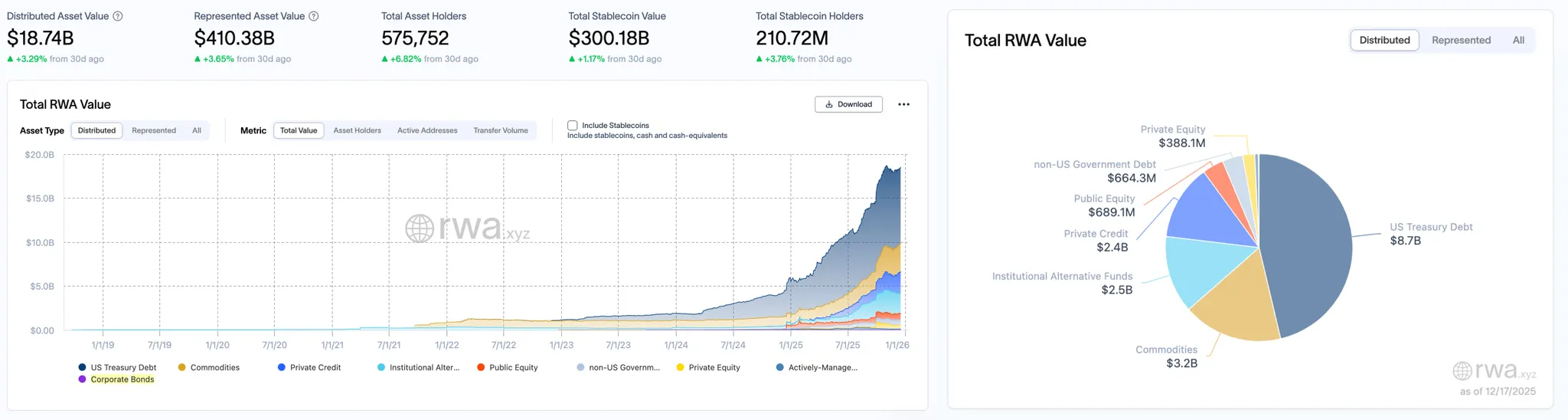
According to the rwa.xyz data dashboard, as of December 17, 2025, the total on-chain value of RWA (Distributed Asset Value) is $18.74 billion, an increase of $300 million from $18.44 billion on December 9, representing a growth of approximately 1.63%. This ends a period of stagnation, indicating that the activity of on-chain assets is gradually recovering. The broad representative asset value (Represented Asset Value) rose from $391.66 billion to $410.38 billion, with a weekly increase of 4.92%, marking the largest single-week increase in nearly two months, possibly related to the recovery of off-chain asset valuations. The total number of asset holders also continued to rise, increasing from 561,558 to 575,752, with a net increase of over 14,000 in one week, a growth rate of 2.52%. The stablecoin market appeared relatively stable, with the total market cap slightly decreasing from $301.92 billion to $300.18 billion, but still remaining at a high level. The number of users grew from 207.75 million to 210.72 million, an increase of nearly 3 million, with a growth rate of 1.42%.
In terms of asset structure, U.S. Treasury bonds remain the largest component of on-chain distributed assets, but this week saw a slight decline from $8.8 billion to $8.7 billion, indicating a cooling of the U.S. Treasury bond craze. Meanwhile, commodity assets remained stable, increasing slightly from $3.1 billion to $3.2 billion, marking the third consecutive week of upward trend, gradually showcasing the potential of emerging safe-haven assets. Private credit did not continue its previous rebound this week, with a slight increase from $2.2 billion to $2.4 billion, maintaining a neutral stance. Institutional alternative funds remained unchanged at $2.5 billion, indicating a cautious trend in capital allocation.
Among other sub-assets, public equity continued to rise, increasing from $671.7 million last week to $689.1 million, performing relatively well among equity assets. Non-U.S. government debt also saw a slight increase, rising from $637.2 million to $664.3 million, but still less than 1/10 of U.S. Treasury bonds. Private equity decreased this week from $391.6 million to $381 million, showing a slight reduction.
Trend Analysis (Comparison to Last Week)
This week, the keywords for the RWA sector are "Valuation Recovery + User Growth." The overall recovery of on-chain asset value and the significant increase in representative asset scale indicate that the repricing of off-chain assets may be driving the overall RWA valuation center upward. Structurally, the pullback in U.S. Treasury bonds may have released some high liquidity funds, diverting them towards commodities and public equity sectors, forming a new risk preference indicator. The growth in the user base of stablecoins is particularly crucial, as off-market funds continue to flow into the market, laying a "reservoir" for subsequent growth in on-chain assets.
Market keywords: Structural Optimization, Valuation Recovery, User Expansion.
Key Event Review
U.S. Congress Urges SEC to Allow Bitcoin and Cryptocurrencies in 401(k) Retirement Plans
The U.S. Congress is urging the Securities and Exchange Commission (SEC) to approve the inclusion of Bitcoin and other cryptocurrencies in 401(k) retirement plans. Members of the House Financial Services Committee have written to SEC Chairman Paul Atkins, urging him to update securities rules to treat digital assets as an investment category equivalent to other alternative investments in retirement accounts. The letter points out that Americans saving for retirement should have more investment options, as current rules are outdated and overly restrictive, hindering millions from accessing new asset classes. Additionally, the letter emphasizes the need to redefine the "qualified investor" standard. The current strict investor qualification regulations limit participation in certain private and alternative investment markets.
BNB Chain: A New Stablecoin to Launch
BNB Chain announced on the X platform that a brand new stablecoin will be launched based on BNB Chain, aimed at integrating liquidity across various application scenarios, specifically designed for large-scale applications.
Community speculation suggests that the project may be United Stables, with more details expected to be announced on December 18.
Negotiations on U.S. Crypto Market Structure Bill Continue, Possible Delay Until January
Negotiations in the U.S. Senate regarding the crypto market structure bill may be delayed until January due to unresolved disagreements. The legislative text has been privately circulated among industry insiders, and industry executives briefly reviewed the current draft at a White House meeting on Thursday, hosted by Patrick Witt, a crypto advisor to President Donald Trump. The negotiations involve Senate Democrats, Republicans, the White House, and the crypto industry, with four major points of contention still needing resolution. These disagreements include ethical standards for government officials' participation in digital assets, particularly the involvement of President Donald Trump, whether stablecoins should be linked to yields, and the SEC's jurisdiction over tokens and decentralized finance (DeFi). Patrick Witt stated on the X platform that the White House and Senate Republicans "are aligned on the need to protect software developers and DeFi." Despite the disagreements, the intensity and pace of negotiations remain high. Cody Carbone, CEO of the Digital Chamber, stated that there is a genuine desire and motivation among all parties to complete the legislation, with actual progress expected in early next year.
The U.S. Securities and Exchange Commission (SEC) released guidelines for investors on crypto wallets and asset custody on Friday, systematically outlining the advantages and risks of different crypto asset storage methods. The guidelines compared self-custody and third-party custody models, reminding investors to understand whether the custodian engages in asset rehypothecation and whether client assets are commingled when choosing a third-party custodian. The SEC also introduced the main differences between hot wallets and cold wallets: hot wallets, being connected to the internet, face higher risks of hacking and cybersecurity threats; cold wallets, while reducing online attack risks, may lead to permanent loss of assets if the storage device is damaged, stolen, or if the private key is lost. Market participants believe that these guidelines indicate a significant shift in the SEC's regulatory attitude towards the crypto industry. The day before, SEC Chairman Paul Atkins stated that the traditional financial system is accelerating its migration to on-chain, and the SEC has also approved DTCC to explore the tokenization of assets such as stocks, ETFs, and government bonds.
Korean Financial Services Commission Fails to Submit Korean Won Stablecoin Regulatory Bill on Time
The ruling party in South Korea had previously called for various ministries and the Financial Services Commission (FSC) to submit a regulatory bill for the Korean won stablecoin by December 10, but the FSC failed to submit the bill on time. A spokesperson for the FSC stated that the commission needs more time to coordinate positions with relevant agencies, and it is better to publish its proposal when submitting the bill to the National Assembly than to rush to complete it before the deadline.
Nasdaq Plans to Extend Trading Hours for Stocks and Trading Products to 23 Hours
Nasdaq has filed documents with the SEC to extend trading hours for stocks and exchange-traded products (ETPs) from 16 hours daily to 23 hours a day, five days a week. This move aims to meet the growing demand from global investors for extended trading in the U.S. stock market and to align with new investor expectations formed by the around-the-clock trading of the cryptocurrency market. According to the proposal, Nasdaq's new trading hours will include: daytime trading session: 4:00 AM to 8:00 PM Eastern Time; one-hour market closure: 8:00 PM to 9:00 PM (for maintenance, testing, and trade settlement); nighttime trading session: 9:00 PM to 4:00 AM the next day. The entire trading week will start at 9:00 PM on Sunday and end at 8:00 PM on Friday. The existing regular trading hours (9:30 AM to 4:00 PM) will remain unchanged. Nasdaq stated in the filing that this move is aimed at attracting order flow from foreign investors in different time zones, such as Asia, as well as investors active in the crypto digital asset market. This will make stocks of companies listed on Nasdaq, such as Coinbase (COIN), Robinhood (HOOD), and Strategy (MSTR), as well as many Bitcoin mining companies, more accessible to global traders.
U.S. SEC Allows DTCC to Custody on Blockchain and Recognize Tokenized Stocks and Other RWA Assets
The U.S. Securities and Exchange Commission (SEC) has granted permission to the Depository Trust & Clearing Corporation (DTCC) in the form of a no-action letter, allowing the company to custody and recognize tokenized stocks and other real-world assets (RWA) on the blockchain. This move enables DTCC to provide tokenization services on a pre-approved blockchain for a period of three years. SEC Commissioner Hester Peirce stated in a statement, "Although the project is still in the pilot phase and subject to various operational limitations, it marks an important step in the market's migration to on-chain." Michael Winnike, head of global strategy and market solutions at DTCC's clearing and securities services division, mentioned in an interview that after obtaining the license, DTCC will also expand its record-keeping operations to the blockchain. As a core clearing and settlement center of the U.S. financial system, DTCC plays a significant role in the equities and fixed income markets. Many liquid assets in the U.S. market are held in DTCC's custody division—Depository Trust Co. The company expects to launch new tokenization services in the second half of next year.
Trump Family Crypto Project WLFI Plans to Deploy USD1 Stablecoin on Canton Network
Canton Network announced that the Trump family crypto project World Liberty Financial (WLFI) will deploy the USD1 stablecoin on its network, aiming to expand the coverage of USD1 in the institutional on-chain finance sector and accelerate its application among globally regulated market participants, including collateral for derivatives and institutional loans, instant cross-border payments and 24/7 settlement, on-chain asset issuance, financing, and redemption.
U.S. Securities and Exchange Commission (SEC) Chairman Paul Atkins stated on the X platform that the U.S. financial market is about to transition to on-chain and will prioritize innovation and actively adopt new technologies. The SEC has issued a no-action letter to the U.S. Depository Trust Company (DTC), indicating that the on-chain market will provide investors with greater predictability, transparency, and efficiency. DTC participants can now directly transfer tokenized securities to other participants' registered wallets, and these transactions will be officially recorded and tracked by DTC.
Trump Family Crypto Project WLFI Plans to Deploy USD1 Stablecoin on Canton Network
Canton Network announced that the Trump family crypto project World Liberty Financial (WLFI) will deploy the USD1 stablecoin on its network, aiming to expand the coverage of USD1 in the institutional on-chain finance sector and accelerate its application among globally regulated market participants, including collateral for derivatives and institutional loans, instant cross-border payments and 24/7 settlement, on-chain asset issuance, financing, and redemption.
Visa Opens USDC Settlement Services to Banks in the U.S. via Solana
Visa has begun allowing U.S. banks and payment partners to use the dollar-backed stablecoin USDC for transaction settlements within the United States.
Cross River Bank and Lead Bank are among the first institutions to use Visa's USDC settlement service via the Solana blockchain, with plans for broader rollout in 2026.
Visa stated that this move aims to provide participating banks with faster fund transfers and a seven-day settlement window, while not changing the consumer card experience. As of November 2025, the company's annualized settlement volume for stablecoins has exceeded $3.5 billion.
Hot Project Updates
Ondo Finance (ONDO)

One-Sentence Introduction:
Ondo Finance is a decentralized finance protocol focused on structured financial products and the tokenization of real-world assets. Its goal is to provide users with fixed-income products, such as tokenized U.S. Treasury bonds or other financial instruments, through blockchain technology. Ondo Finance allows users to invest in low-risk, high-liquidity assets while maintaining decentralized transparency and security. Its token ONDO is used for protocol governance and incentive mechanisms, and the platform also supports cross-chain operations to expand its application in the DeFi ecosystem.
Latest Updates:
On December 15, Ondo Finance announced on the X platform that its tokenized stock and ETF platform will launch on the Solana blockchain in early 2026, aiming to bring Wall Street liquidity to the internet capital markets.
Previously, it was reported that the U.S. Securities and Exchange Commission (SEC) had concluded its investigation into the tokenized asset company Ondo Finance without recommending any charges.
This investigation began in October 2023, initiated by former SEC Chairman Gary Gensler, primarily examining whether Ondo complied with U.S. securities laws when tokenizing U.S. Treasury bond products and whether the ONDO token should be classified as a security. An Ondo spokesperson stated that the company received formal notification in late November that the two-year SEC investigation had concluded. Since the appointment of pro-crypto SEC Chairman Paul Atkins, the agency has ended most investigations related to cryptocurrencies. Ondo stated that the resolution of the investigation has cleared obstacles for its expansion in the U.S., as the company had previously registered as an investment advisor and acquired Oasis Pro Markets, a SEC-registered broker-dealer, ATS operator, and transfer agent. Ondo is scheduled to hold its annual Ondo Summit in New York on February 3, where it is expected to announce new tools and products for tokenized real-world assets.
MSX (STONKS)

One-Sentence Introduction:
MSX is a community-driven DeFi platform focused on tokenizing U.S. stocks and trading them on-chain. The platform achieves 1:1 physical custody and token issuance through a partnership with Fidelity. Users can mint stock tokens like AAPL.M and MSFT.M using stablecoins such as USDC, USDT, and USD1, and trade them 24/7 on the Base blockchain. All transactions, minting, and redemption processes are executed by smart contracts, ensuring transparency, security, and auditability. MyStonks aims to bridge the gap between TradFi and DeFi, providing users with a high-liquidity, low-barrier entry into on-chain investments in U.S. stocks, building a "Nasdaq of the crypto world."
Latest Updates:
On December 3, data from the MSX official website (msx.com) showed that the platform's trading volume reached $2 billion in the past 24 hours, setting a new single-day historical high. As of the time of publication, the total trading volume on the platform has surpassed $20.6 billion, with a surge of over $7.5 billion in the past five days, an increase of over 57%. Additionally, MSX concluded its points season S1 on December 2, and the M Credits earned by users will be directly used for future MSX token allocations.
On December 5, MSX founder Bruce stated on X that Nasdaq has submitted an application for stock tokens, and MSX is ready to transition to "official" tokens. He mentioned, "Nasdaq submitted its application for stock tokens to the SEC in September this year, and if progress is swift, it will officially launch in Q1 next year. The launch of Nasdaq's stock tokens will impact all 'unofficial stock tokens,' and MSX is prepared to transition to 'official' tokens at any time."
Related Links
Summarizing the latest insights and market data in the RWA sector.
Top 5 L1 Public Chains to Watch in 2026: The Mainline Evolution from DeFi to RWA
Aimed at investors, developers, and traders, helping to clarify which public chains are continuously gathering real activity, users, and long-term value.
免责声明:本文章仅代表作者个人观点,不代表本平台的立场和观点。本文章仅供信息分享,不构成对任何人的任何投资建议。用户与作者之间的任何争议,与本平台无关。如网页中刊载的文章或图片涉及侵权,请提供相关的权利证明和身份证明发送邮件到support@aicoin.com,本平台相关工作人员将会进行核查。


