Author: Deng Tong, Golden Finance
On December 11, 2025, the Depository Trust Company (DTC) received a no-action letter from the U.S. Securities and Exchange Commission (SEC), allowing it to tokenize a portion of its custodial assets. DTC aims to leverage blockchain technology to connect traditional finance (TradFi) and decentralized finance (DeFi), thereby building a more resilient, inclusive, and efficient global financial system. Previously, the Office of the Comptroller of the Currency (OCC) issued Interpretive Letter 1188, confirming that national banks could engage in permissible banking activities related to risk-free principal cryptocurrency asset trading.
This article focuses on the recent regulatory actions of the SEC and OCC.
1. SEC: DTCC Can Tokenize Stocks, Bonds, and Treasury Securities
Yesterday, the Depository Trust & Clearing Corporation (DTCC) announced that its subsidiary, the Depository Trust Company (DTC), has received a no-action letter (NAL) from the U.S. Securities and Exchange Commission (SEC), permitting it to offer a new service for tokenizing real-world assets held by DTC in a controlled production environment under federal securities laws. DTC expects to launch this service in the second half of 2026.
The no-action letter authorizes DTC to provide a three-year tokenization service on a pre-approved blockchain for DTC participants and their clients. According to the no-action letter, DTC will be able to tokenize real-world assets, with their digital versions enjoying the same rights, investor protections, and ownership as traditional assets. Additionally, DTC will provide a high level of resilience, security, and robustness comparable to traditional markets.
This authorization applies to a range of specific high-liquidity assets, including the Russell 1000 Index (representing the 1,000 largest publicly traded companies in the U.S.), ETFs tracking major indices, and U.S. Treasury bills, bonds, and notes. This no-action letter is significant as it allows DTC to launch the service more quickly than in other circumstances, under specific limitations and statements, once the service is finalized.
The SEC's no-action letter is a key driver in the company's broader strategy to advance a secure, transparent, and interoperable digital asset ecosystem, fully realizing the potential of blockchain technology.
DTCC President and CEO Frank LaSalla stated, "I want to thank the SEC for their trust in us. The tokenization of the U.S. securities market is expected to bring numerous transformative benefits, such as collateral liquidity, new trading models, 24/7 access, and programmable assets, but this can only be achieved if the market infrastructure lays a solid foundation to embrace this new digital era. We are very pleased to take this opportunity to further empower the industry, our participants, and their clients, and to drive innovation. We look forward to collaborating with all parties in the industry to safely and reliably realize the tokenization of real-world assets, thereby promoting the future development of finance for generations to come."
To support this strategy, DTCC's tokenization program will enable DTC participants and their clients to utilize comprehensive tokenization services powered by the DTCC ComposerX platform suite. This will allow DTC to create a unified liquidity pool in both the traditional finance (TradFi) and decentralized finance (DeFi) ecosystems, building a more resilient, inclusive, cost-effective, and efficient financial system.
According to the no-action letter, DTC is permitted to provide limited production environment tokenization services on L1 and L2 providers. DTCC will provide more details in the coming months regarding onboarding requirements (including wallet registration) and the approval process for L1 and L2 networks.
SEC Chair Gary Gensler noted: On-chain markets will bring greater predictability, transparency, and efficiency to investors. DTC participants can now directly transfer tokenized securities to the registered wallets of other participants, with these transactions tracked by DTC's official records. This initiative by DTC marks an important step toward on-chain capital markets. I am pleased to see the benefits this program brings to our financial markets and will continue to encourage market participants to innovate to drive us toward on-chain settlement. But this is just the beginning. I look forward to the SEC considering granting innovation exemptions, allowing innovators to leverage new technologies and business models to begin transitioning our markets to on-chain without being burdened by cumbersome regulatory requirements.
2. OCC: Crypto Companies with Bank Licenses Treated Equally with Other Financial Institutions
On December 8, U.S. Comptroller of the Currency Jonathan Gould stated that cryptocurrency companies seeking a U.S. federal bank charter should be treated equally with other financial institutions.
So far this year, the OCC has received 14 applications for new bank charters, "including applications from entities engaged in novel or digital asset activities," which is nearly on par with the number of similar applications received by the OCC over the past four years. "The chartering system helps ensure that the banking system keeps pace with financial developments and supports modern economic growth. Therefore, institutions engaged in digital asset and other emerging technology-related businesses should have the opportunity to become federally regulated banks."
Regulators "receive letters almost daily from existing national banks inquiring about their own exciting innovative products and services initiatives. All of this enhances my confidence in the OCC's ability to effectively regulate new entrants and existing banks' new businesses in a fair and equitable manner."
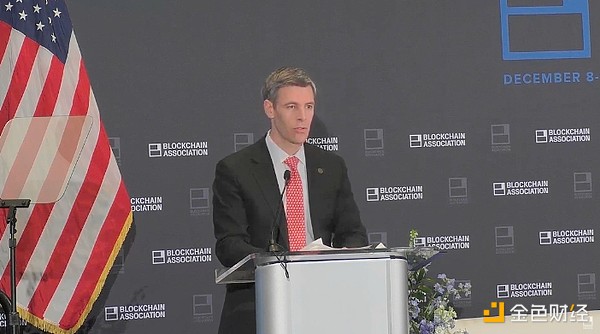
Office of the Comptroller of the Currency Director Jonathan Gould speaking at the 2025 Blockchain Association Policy Summit. Source: YouTube
3. What Impact Do the SEC and OCC's Policy Directions Have?
With DTC approved to tokenize core assets such as stocks, bonds, and ETFs on-chain, real-world assets are officially being incorporated into the U.S. federal securities system. This means that core asset classes in traditional financial markets will soon have "native versions" on the blockchain, enjoying all the legal rights of traditional assets; the OCC has explicitly stated that institutions engaged in digital asset businesses can apply for federal bank charters on par with traditional institutions, marking the first formal pathway for the crypto industry to enter the "compliance core" of the U.S. banking system; the regulatory directions of the SEC and OCC are, in fact, part of the U.S. competition for global standards in digital finance. As blockchain technology becomes financial infrastructure, the U.S. is adopting a model similar to the internet era: leading global rule-setting through institutional and regulatory frameworks.
Appendix 1: Key Points from Gould's Speech:
Among the applications currently submitted to the OCC, several are regarding the establishment of new national trust banks or banks wishing to convert to national trust banks. This growth indicates healthy market competition, reflects a commitment to innovation, and should encourage all of us. The number of applications has returned to the OCC's normal levels, consistent with past experiences and practices.
Since the 1970s, the OCC has been responsible for issuing charters for national trust banks, a power explicitly granted to the Office of the Comptroller of the Currency (OCC) by Congress in 1978. Currently, the OCC regulates about 60 national trust banks. Some banks and their industry associations have expressed concerns about certain pending applications. They point out that approving these applications would violate OCC's precedents, as it would allow national trust banks to engage in non-trust custodial activities.
They fail to acknowledge that for decades, the OCC has allowed national trust banks to engage in non-trust custodial activities. In fact, prohibiting national trust banks from engaging in non-trust activities would not only threaten the dynamic development of the federal banking system but also disrupt the existing traditional business of national trust banks, which exceeds one trillion dollars.
According to relevant regulations, national trust banks must limit their business activities to the operations of trust companies and their related activities. Although there have been recent contrary claims, non-trust activities, particularly custodial and safekeeping, have always been fully within their authorized business scope since the OCC began issuing charters for national trust banks.
In fact, most national trust banks have already engaged in this business, including those that are subsidiaries or affiliates of insured national banks or insured state banks providing full-service offerings. In the third quarter of this year, national trust banks reported that the scale of non-trust custodial or safekeeping assets they managed approached $2 trillion, accounting for about 25% of their total managed assets.
Therefore, if non-trust custodial and safekeeping services are deemed unacceptable for pending charter applications, it would also require a reassessment of the legality of existing and mature national trust bank businesses, thereby disrupting the flow of funds in existing economic activities. Although some new charter applicants (especially those in the digital or fintech space) may propose businesses that could be seen as new activities for national trust banks, custodial and safekeeping services have been conducted electronically for decades.
For example, banks, including existing national trust banks, typically hold corporate tickets and clients' custodial rights electronically. Therefore, there is no reason to treat digital assets differently. Additionally, we should not confine banks (including existing national trust banks) to past technologies or business models.
This is tantamount to heading toward decline. The business activities of national trust banks have changed, and so have those of other banks nationwide. State trust companies are also currently involved in activities related to digital assets. For instance, several states, including New York and South Dakota, have authorized their trust companies to provide digital asset-related services to clients, including custodial services.
Some existing banks/credit unions have also expressed concerns about potential unfairness or believe that the OCC lacks the regulatory capacity to oversee new activities proposed by existing applicants. These concerns could hinder innovative initiatives that could better serve bank customers and support local economies.
As I mentioned earlier, the OCC has been regulating the activities of national trust banks for decades, ensuring that both trust and non-trust activities (involving millions of dollars in asset management) are conducted safely and soundly in accordance with applicable laws.
The OCC has years of experience regulating a cryptocurrency-native bank—national trust banks—and receives feedback almost daily from existing national banks regarding their innovative products and services. All of this enhances my confidence in the agency's ability to effectively regulate new entrants and existing banks' new businesses in a fair and equitable manner.
We welcome the initiatives of existing banking institutions and will ensure that both new and old banking institutions are treated fairly and held to the same high standards when their business activities and risks are similar. The federal banking system's ability to evolve from the telegraph era to the blockchain era and actively embrace new technologies to provide banking products and services to customers from rural areas to urban centers is one of its greatest advantages. Although Congress reformed national banks over 160 years ago, they remain a vital part of the U.S. financial system today. This is not by chance. Rather, it is a direct result of Congress and the courts recognizing that banks can and must adapt and develop new ways to conduct long-standing businesses. Simply because the activities of national banks (including national trust banks) are considered new or different from the advantages of large technology markets does not justify preventing them from engaging in reasonably permitted activities, as this would undermine this fundamental premise. This could lead to economic stagnation and potentially have profound effects on the banking system.
Appendix 2: What Other No-Action Letters Has the SEC Recently Issued?
A no-action letter is a document originating from the U.S. legal system, indicating that a regulatory agency will not take legal or enforcement action against an entity or individual under its jurisdiction if they conduct a proposed action as described in the application. Its core function is to eliminate regulatory uncertainty and is not a legally binding document.
On September 29, 2025, the SEC issued a no-action letter indicating that for a certain token issued by DoubleZero, based on the described factual circumstances, the SEC would not recommend taking enforcement action regarding that token arrangement. This move is seen as an important signal of regulatory changes in the crypto market, representing the official willingness to make case-by-case determinations on certain token and security distinctions.
On September 30, 2025, the SEC's Investment Management Division issued a "no-action letter" to Simpson Thacher, confirming that under certain conditions, state-chartered trust companies could be considered qualified custodians under Rule 206(4)-2 (Advisers Act qualified custodians) and the 1940 Act, and the SEC would not take enforcement action against businesses and registered funds in this arrangement. This move helps traditional asset management firms gain clearer regulatory positioning around crypto asset custody and compliance services.
免责声明:本文章仅代表作者个人观点,不代表本平台的立场和观点。本文章仅供信息分享,不构成对任何人的任何投资建议。用户与作者之间的任何争议,与本平台无关。如网页中刊载的文章或图片涉及侵权,请提供相关的权利证明和身份证明发送邮件到support@aicoin.com,本平台相关工作人员将会进行核查。


