Written by: Yangz, Techub News
Since Solana Mobile launched its first-generation phone, Saga, and stirred up excitement within the crypto community, discussions about "Web3 mobile terminals" have remained marginal in the overarching narrative of technology and consumer electronics. It feels more like a spontaneous experiment within the crypto circle, never truly reaching mainstream visibility.
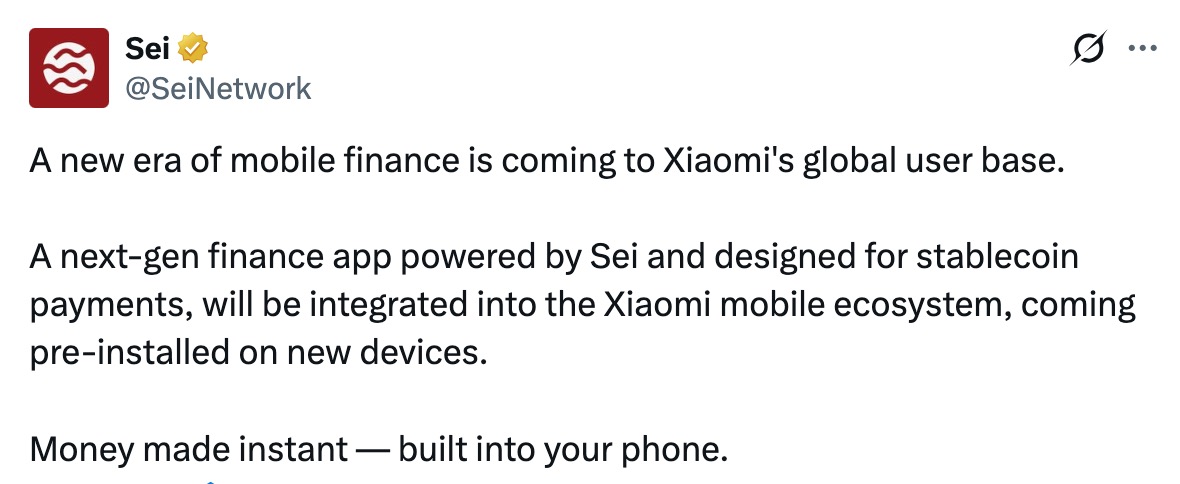
However, an announcement from Sei last night, akin to a boulder thrown into a quiet pond, instantly shattered this marginalization, creating substantial ripples far beyond previous discussions. The shock lies in the fact that Sei is not collaborating with another blockchain-native manufacturer but has directly partnered with the world's third-largest smartphone manufacturer—Xiaomi.
As Sei Labs co-founder Jay Jog stated, "We are transitioning from a world where you have to seek out cryptocurrency to a world where cryptocurrency actively finds you." Blockchain technology will no longer be merely a toy for geeks or investors but aims to seamlessly integrate into the daily digital lives and real consumption scenarios of ordinary people through hundreds of millions of mainstream consumer devices worldwide. A sprint from marginal experiments to the center stage may be just beginning.
The Dual-Track World of Competitors: Native Experiments and Cautious Exploration by Giants
As Sei and Xiaomi collaborate to outline a blueprint for breaking boundaries, the track for Web3 mobile terminals is already filled with competitors of various forms. They can be roughly divided into two distinctly different paths: one is the "hardcore experiments" of Web3 native manufacturers, attempting to redefine smartphones through extreme crypto integration; the other is the "cautious exploration" of traditional consumer electronics giants, carefully weighing the vast existing market against strict regulatory compliance.
The most representative experiment of the Web3 native path is undoubtedly Solana Mobile. When its first phone, Saga, was released in 2023, it was rated by renowned tech blogger Marques Brownlee as "one of the worst phones of the year" due to its mediocre hardware and an initial high price of $1,000. However, with the comprehensive revival of the Solana ecosystem by the end of 2023, the BONK token airdrop, which exceeded the phone's price, led to a rush to buy it out by the end of 2023. This revealed an awkward yet real early driving force for native Web3 phones: financial incentives far outweigh product experience.
Influenced by this fundamental factor, in October this year, Solana Mobile announced it would stop providing software updates and security patches for Saga. This Web3 phone, once highly anticipated by the industry, went from being ignored to causing a buying frenzy due to an airdrop, and then to a hasty conclusion, all within just over two years.
As for the second-generation product, Seeker, launched in August this year, it attempts to fundamentally reconstruct the value narrative of native Web3 phones. It not only underwent a comprehensive hardware upgrade but, more importantly, built a deeper integration system of software and hardware along with a new economic model. Seeker features a self-custody crypto wallet, Seed Vault, deeply integrated with the hardware, and is equipped with an upgraded Solana decentralized application store, aiming to become a secure digital vault and exclusive ecological portal for crypto-native users. Additionally, the TEEPIN (Trusted Execution Environment Platform Infrastructure Network) architecture launched with Seeker aims to establish a decentralized three-layer technical framework, providing a secure and trustworthy mobile access foundation for developers, users, and device manufacturers. Furthermore, Seeker will introduce the SKR token to directly reward ecological builders and actively participating users. But the question remains: can this ecological construction truly change the awkward situation where users buy but do not use? The answer is still to be revealed.
Other Web3 native players are also actively trying. For instance, as early as 2022, Polygon collaborated with Nothing, founded by OnePlus co-founder Carl Pei, to launch the Nothing Phone (1). Currently, the company has updated its devices to Nothing Phone (3a) and completed a Series C funding round of $200 million at a valuation of $1.3 billion in September this year, led by Tiger Global. In 2024, the African crypto startup Jambo will collaborate with the Aptos Foundation to launch a $99 phone targeting users in Africa, Southeast Asia, and Latin America. Additionally, since Trump's presidency, the Trump Organization, closely linked to Web3, has launched the T1 smartphone, which billionaire Mark Cuban speculated might pre-load a crypto wallet and earn transaction fees.
In stark contrast to the Web3 native path is the cautious exploration by traditional tech giants like Apple and Samsung. Apple maintains ultimate control over all applications within the iOS ecosystem—including cryptocurrency wallets and trading platforms—through its strict App Store review process. While mainstream crypto wallets like MetaMask can be downloaded from the App Store, Apple has not integrated a native crypto wallet function at the iOS system level; in contrast, Samsung has shown a more proactive integration stance, announcing a strategic partnership with Coinbase to allow Galaxy device users in the U.S. to manage their Coinbase accounts directly through Samsung Wallet, but this feels more like a "value-added service" rather than a comprehensive expansion plan. As for Huawei, its limitations are evident due to complex geopolitical factors. The common logic among these giants is pragmatic and clear: the existing business models (hardware sales, app store commissions, payment service fees) are lucrative and stable, and recklessly embracing the high volatility and regulatory uncertainties of crypto functions may pose risks far greater than potential rewards.
The Third Path: The Strategic Alliance of Xiaomi and Sei
In light of the above context, the collaboration between Xiaomi and Sei opens a third path between traditional giants and native explorers. It avoids the lengthy and risky process of building a "Web3 city" from scratch, opting instead to systematically embed the crypto ecosystem directly into an already existing "smartphone metropolis" with billions of residents. The core logic is to eliminate all intermediate frictions for users from "cognition" to "use" of Web3. Users will be able to create a secure wallet with almost zero barriers using familiar Google or Xiaomi accounts and face a carefully curated decentralized application (DApp) store, rather than navigating a vast and unfriendly public chain ecosystem alone.
The strategic depth of this collaboration is clearly reflected in its market approach. Xiaomi's hardware channel provides Sei with a ready-made, precise global market map. The collaboration will initially focus on emerging markets such as Europe, Latin America, Southeast Asia, and Africa, which share the common characteristic of often insufficient traditional financial coverage, while smartphones are becoming the absolute center of digital life. According to reports, Xiaomi holds over one-third of the market share in Greece and nearly a quarter in India, making these high-penetration markets ideal testing grounds. As for its goal, it is not to compete for existing crypto users but to provide Xiaomi's vast emerging market user base with their first entry into a crypto wallet, achieving the crucial breakthrough of "from zero to one."
The ambition of the collaboration also points to a virtual and real consumption closed loop. According to the plan, both parties will launch stablecoin payment functions in Hong Kong and the EU in the second quarter of 2026. The imaginative space of this initiative lies in its attempt to anchor blockchain from the investment realm of digital assets to the everyday transactions of physical goods and services. In the future, users may be able to directly use Sei-based stablecoins to purchase anything from smartphones to electric vehicles in over 20,000 Xiaomi retail stores worldwide. This marks a shift from "pre-installed wallets" to "reshaping consumption behavior," aiming to deeply weave blockchain technology into Xiaomi's existing hardware sales, retail network, and user ecosystem.
The partnership between Xiaomi and Sei is essentially a social experiment based on billions of hardware devices. It avoids the heavy path of "self-built cities" for Web3 native devices and chooses an agile strategy of "borrowing a boat to go to sea," directly sailing into the ocean of mainstream users. Its progress and results will answer a key industry question: is the most effective path for the large-scale adoption of blockchain to integrate rather than disrupt these already existing, powerful business and consumer ecosystems?
Challenges and Prospects: The Unfinished Journey of Web3 Mobile Terminals
Despite differing paths and enticing blueprints, whether it is Xiaomi's "borrowing a boat to go to sea," Solana's "ecological city-building," or Samsung's "gradual integration," the road to the popularization of Web3 mobile terminals is still fraught with thorns. The challenges it faces are not only related to technology and products but are deeply rooted in regulation, economics, and human nature itself.
The primary and most fundamental challenge comes from the globally fragmented and continuously evolving regulatory environment. Stablecoins as payment tools will be the first litmus test for the collaboration between Xiaomi and Sei in the pilot projects in Hong Kong and the EU. It needs to directly confront a series of highly complex and country-specific compliance requirements, including AML, KYC, cross-border fund flows, and tax identification. Even in regions with relatively clear regulations, the uncertainty of approval processes may still severely slow down the pace of commercial implementation. For Xiaomi, which aims for globalization, this means it must conduct "compliance customization" across dozens of different jurisdictions, the complexity and cost of which should not be underestimated.
Secondly, the "last mile" problem of user experience remains unsolved. A truly "seamless" experience requires completely hiding the technical complexities of blockchain (such as gas fee fluctuations, network confirmation delays, and private key management) behind operations as simple as scanning a QR code for payment. This not only necessitates robust underlying technologies (such as account abstraction and gas fee payment on behalf) but also demands a profound understanding of the psychology and behavioral habits of ordinary users. The eternal paradox of security and convenience is particularly prominent here: excessive convenience may sacrifice security, while emphasizing self-custody responsibility inevitably raises the usage threshold. Designing a process that is both secure and seamless is a shared challenge of product philosophy and technical implementation.
Looking ahead, the payment pilot projects between Xiaomi and Sei in Hong Kong and the EU will provide real data and user feedback from mainstream consumption scenarios. If the response is positive, it may trigger follow-ups from more manufacturers, accelerating industry integration; if it encounters a lukewarm reception or compliance issues, it could cool the entire track once again.
Conclusion
From the brief two-year "lifespan" of Solana Saga to the cautious explorations of Samsung and Apple, and now to the grand layout of Xiaomi and Sei, the story of Web3 mobile terminals is far from reaching its final chapter. It is no longer merely a hardware proposition about whether "Web3 phones" are viable, but has evolved into a profound experiment on how blockchain technology can integrate into the global digital life infrastructure.
Xiaomi's choice represents a pragmatic yet ambitious route: not pursuing disruptive hardware forms but rather seeking pervasive ecological transformation. If this path can be successfully navigated, its significance will far exceed the success of a single company or a single public chain. It will prove that the cornerstone of Web3 may not require us to replace the devices in our hands but rather to quietly upgrade the world that already exists within our devices. The ultimate answer will not depend on any press conference or white paper but will rely on the natural and simple choice made by countless consumers globally in real scenarios, a choice that may very well be a crisp "beep."
免责声明:本文章仅代表作者个人观点,不代表本平台的立场和观点。本文章仅供信息分享,不构成对任何人的任何投资建议。用户与作者之间的任何争议,与本平台无关。如网页中刊载的文章或图片涉及侵权,请提供相关的权利证明和身份证明发送邮件到support@aicoin.com,本平台相关工作人员将会进行核查。


