Written by: Glendon, Techub News
In the past year, the cryptocurrency industry has developed rapidly, and the open and improved regulatory policies in the United States have undoubtedly been a major driving force behind this trend. At the same time, this is also an important factor in the market's expectation that the industry will once again enter an upward cycle next year.
Yesterday, Paul Atkins, Chairman of the U.S. Securities and Exchange Commission (SEC), stated at the Blockchain Association Policy Summit held in Washington, D.C., "The best is yet to come. By next year, all the seeds we have sown will sprout and grow, and we will be able to reap the fruits." Paul Atkins' remarks suggest that the U.S. will quickly advance its key agenda on cryptocurrency regulation at the beginning of the new year. He also mentioned that one of the top priorities will be to promote the implementation of the "Innovation Exemption" framework for cryptocurrency and fintech projects.

The "Innovation Exemption" is one of the core policies of the SEC's "Project Crypto," aimed at providing regulatory flexibility for cryptocurrency and blockchain projects, reducing compliance costs, and allowing them to test and launch new products under supervised conditions without immediately adhering to full securities registration requirements, thereby accelerating the approval process for cryptocurrency products. This policy is expected to officially take effect in January 2026, marking a shift in the U.S. cryptocurrency regulatory model from the previous "enforcement-based regulation" to a more innovation-supportive model.
In addition, Paul Atkins also mentioned several policies, including the "Token Classification Act" plan and the cryptocurrency market structure bill. So, what bills have been enacted in the U.S. cryptocurrency sector this year, and which policies are still in progress awaiting approval? This article will provide a comprehensive overview.
U.S. Cryptocurrency Regulatory Policy Iteration Reshaping Market Landscape
The moment Trump was re-elected as President of the United States, the future of the cryptocurrency industry faced a significant turning point. At the beginning of this year, the White House issued an executive order titled "Strengthening America's Leadership in Digital Financial Technology," which revoked the cryptocurrency policies of the Biden administration, clearly stating the intention to "protect and promote privately operated cryptocurrencies" and requiring "technologically neutral legal support for cryptocurrency development." This executive order also established a Presidential Digital Asset Market Working Group and prohibited the establishment of a Central Bank Digital Currency (CBDC), officially setting the tone for subsequent federal-level cryptocurrency policies.
GENIUS Act: The First Federal Regulatory Framework for Stablecoins
On February 4, the U.S. Senate proposed the "Guidance and Establishment of a National Innovation Act for U.S. Stablecoins" (GENIUS Act), aimed at building a compliance system for stablecoins from multiple dimensions, including definitions, issuing entities, reserves, and transparency. On July 18, Trump officially signed the bill at the White House, marking the first time the U.S. has established a regulatory framework for digital stablecoins through federal legislation.
The passage of the GENIUS Act is undoubtedly a milestone event in the regulation of cryptocurrencies and the development of digital finance in the U.S. It signifies a fundamental shift in the U.S. governance approach to stablecoins: from the previous "ambiguous regulation" of cryptocurrencies to actively constructing rules and embracing innovation. The act provides a "compliance path" for the stablecoin market and a "clear runway" for innovators.
Following this, the cryptocurrency industry entered a rapid development phase lasting four months, with numerous Wall Street institutions entering the market, and the ETF and DAT sectors gaining unprecedented popularity, officially ushering the cryptocurrency market into the "institutional era." During this period, Bitcoin and Ethereum also reached historical highs of $126,000 and $4,956, respectively, under the profound influence of this policy.
"Strategic Bitcoin Reserve": From Executive Order to Local Legislative Practice
On March 6, Trump signed an executive order announcing the establishment of a "Strategic Bitcoin Reserve" and a "Digital Asset Reserve," explicitly including approximately 200,000 bitcoins confiscated by the government through judicial procedures and administrative fines into the reserve, while exploring strategies to increase Bitcoin holdings through budget-neutral approaches. Based on this, more than 18 states in the U.S. have proposed bills related to "Bitcoin Strategic Reserves."
On May 7, New Hampshire officially signed HB 302, becoming the first state in the U.S. to pass legislation for a "Strategic Bitcoin Reserve." Subsequently, Arizona quickly followed suit by passing related Bitcoin reserve legislation. On June 21, Texas officially signed the "BTC Reserve Act" (SB 21), becoming the third state to establish a Bitcoin reserve, and officially launched the Bitcoin reserve program at the end of November, with an initial investment of $5 million to purchase IBIT from BlackRock. While most states in the U.S. have taken a wait-and-see approach, Texas took the lead in breaking the deadlock, igniting a "spark" to advance Bitcoin reserves.
SEC's "Project Crypto": Innovating Regulatory Logic and Clarifying Token Attributes
On July 31, SEC Chairman Paul Atkins launched the "Project Crypto" initiative. This plan encompasses multi-dimensional policy innovations, focusing on key areas such as regulatory modernization, token classification, and decentralized regulatory boundaries, aiming to fundamentally reshape the regulatory logic of the U.S. cryptocurrency era, update securities rules and regulations, and promote "moving the entire U.S. financial market onto the blockchain" to modernize the U.S. securities regulatory framework.
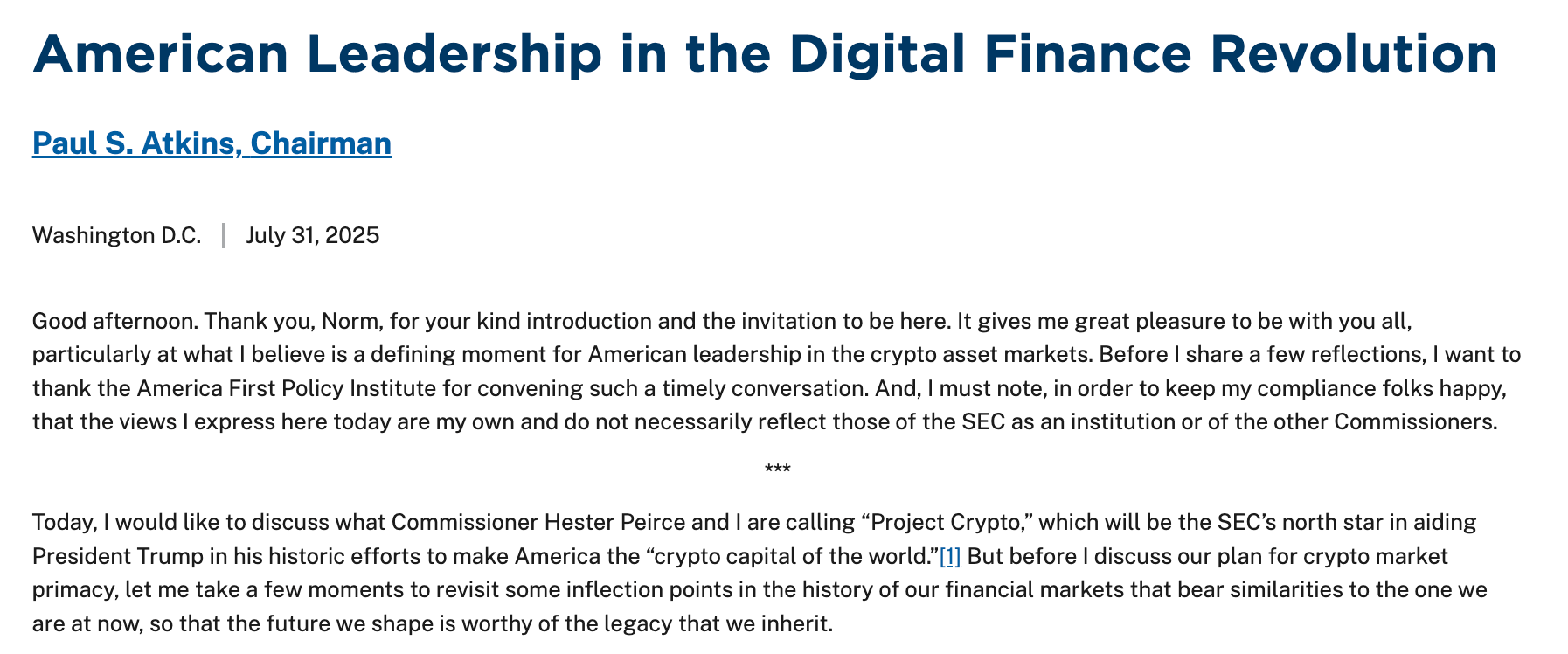
Atkins has emphasized that the SEC needs to recognize the boundaries of its jurisdiction, avoid "over-regulation stifling innovation," and establish "tailored" standards for the digital asset market through proactive rule-making, issuing interpretive guidance, and exemption measures. In mid-November, Atkins further proposed specific implementation details for the "Project Crypto" reform plan and the "Token Classification Act" framework to clearly distinguish which cryptocurrencies qualify as securities.
This classification framework centers around the Howey Test. The Howey Test serves as the legal benchmark for determining whether a transaction constitutes an "investment contract" (i.e., a security), and this plan has innovated upon it. The plan posits that investment contracts are not a "permanent label"; if a token was once part of an investment contract, its "security attributes" may terminate as conditions such as network maturity, code deployment, and decentralization of control change. This logic is based on the "maturity hypothesis," which suggests that as the underlying network develops, functionality is established, and governance becomes decentralized, the "security attributes" of the token may naturally dissipate.
However, the current token classification framework is still in the proposal stage and has not been formally passed. At this stage, the SEC has initiated supporting work for "Project Crypto," including drafting rules and opening public comments, but the policy's implementation still requires the SEC to finalize details and push for execution. Additionally, the previously mentioned "Innovation Exemption" policy is also set to be implemented at the beginning of next year.
CFTC's "Crypto Sprint" Plan: Steadily Advancing in Phases
On July 31, Caroline D. Pham, acting chair of the U.S. Commodity Futures Trading Commission (CFTC), announced the CFTC's 12-month "Crypto Sprint" plan, aimed at establishing a comprehensive regulatory framework for crypto assets through phased policy implementation. The plan mainly includes three parts: first, allowing registered futures exchanges (such as designated contract markets) to trade spot crypto asset contracts; second, enabling tokenized collateral (including stablecoins) in the derivatives market; and third, making technical amendments to CFTC regulations regarding collateral, margin, clearing, settlement, reporting, and record-keeping to support the use of blockchain technology and market infrastructure (including tokenization).
The first measure of this plan has officially been implemented this month. On December 4, the CFTC approved regulated platforms to open trading for spot digital asset products, with the crypto derivatives trading platform Bitnomial being the first to launch a leveraged spot market.
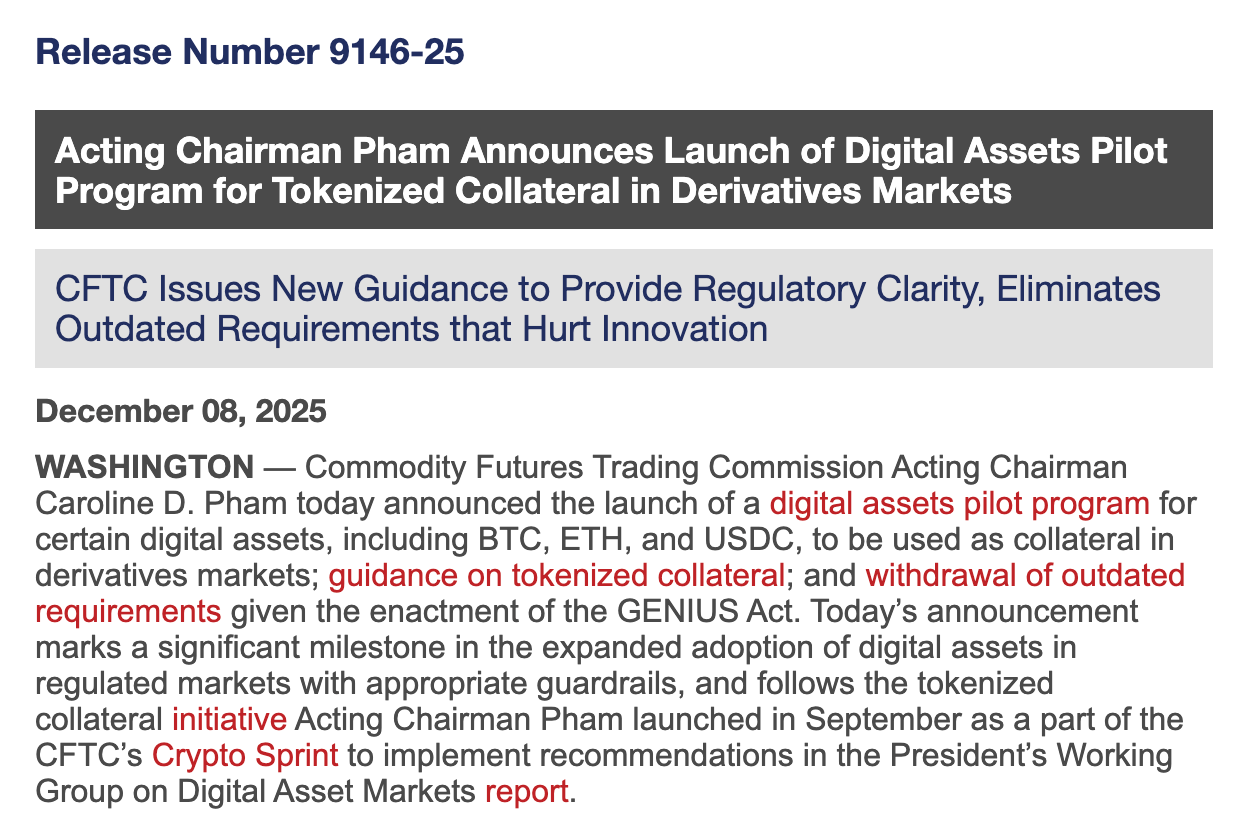
Additionally, regarding the policy of "enabling tokenized collateral in the derivatives market," the CFTC is expected to release guidance by the end of the year and officially implement it at the beginning of next year. Notably, the CFTC has launched a pilot program this week allowing certain digital assets, such as Bitcoin, Ethereum, and USDC, to be used as collateral in the U.S. derivatives market. This plan is part of the initiative to establish rules for the use of tokenized collateral (including tokenized versions of real assets like U.S. Treasuries). Currently, only futures commission merchants (FCMs) that meet specific criteria can participate.
The CLARITY Act: The "Top-Level Design" of Cryptocurrency Market Structure
Compared to the aforementioned policies that have been implemented or partially enacted, the most anticipated policy in the current market is the "Digital Asset Market Clarity Act" (the CLARITY Act), which is the cryptocurrency market structure bill.
The CLARITY Act was introduced by French Hill, Chairman of the House Financial Services Committee and Republican Congressman from Arkansas, on May 29. It is a regulatory framework bill tailored for the digital asset market by the U.S. Congress. It focuses on core issues such as the classification of digital assets, the division of regulatory responsibilities, and market access rules, aiming to clarify the "structured" regulatory logic of the cryptocurrency market through legislation.
In building the regulatory framework, the bill first accurately delineates the categories of digital assets and regulatory responsibilities. Security tokens (such as fundraising tokens) are regulated by the SEC and must comply with securities law registration and disclosure requirements; while digital commodities like Bitcoin and Ethereum fall under the jurisdiction of the CFTC. At the same time, the bill clearly defines the scope of regulation: the SEC is responsible for the registration of security tokens and anti-fraud enforcement, while the CFTC exercises jurisdiction over the spot and derivatives markets for digital commodities, requiring exchanges, brokers, and other intermediaries to register and segregate customer funds. The bill plans to clarify responsibilities through a "dual-agency division of labor" model, thereby completely eliminating the ambiguity in digital asset regulation.
Moreover, the bill further subdivides digital assets into categories such as digital commodities and stablecoins, creating tailored regulatory rules for different types and constructing a "classified regulation" market structure. Additionally, it introduces DeFi and infrastructure exemption mechanisms and establishes a blockchain "maturity" certification mechanism. These innovative measures not only comprehensively protect investor interests and crack down on fraudulent activities but also reserve exemption space and research leeway for industry innovation.
The CLARITY Act is of great significance to the cryptocurrency industry, with its importance comparable to the profound impact of the 1933 Securities Act in establishing investor protection mechanisms for the U.S. capital market. If the CLARITY Act is successfully passed, it will become another "milestone" law in the cryptocurrency field.
Regarding the expected implementation of the bill, Paul Atkins revealed in a live interview with Fox News that the CLARITY Act is about to pass, which will bring much-needed regulatory clarity to the cryptocurrency industry. On Tuesday, New York Democratic Senator Kirsten Gillibrand and Wyoming Republican Senator Cynthia Lummis also spoke at the Blockchain Association Policy Summit, stating, "Negotiations on the cryptocurrency bill between Democrats and Republicans have been steadily progressing, and last week's first bipartisan meeting went very smoothly, with no factors hindering the bill's advancement."
Lummis further stated that the Senate version of the cryptocurrency market structure bill is expected to be announced this weekend, with a hearing scheduled for next week to revise and vote on the bill.
According to Bloomberg, Bank of America CEO Brian Moynihan, Citigroup CEO Jane Fraser, and Wells Fargo CEO Charlie Scharf are expected to meet with bipartisan senators on December 11 to discuss the upcoming vote on cryptocurrency market structure legislation. Key topics of the meeting include opposition to allowing stablecoins to pay interest, the competitive position of banks in the cryptocurrency space, and preventing cryptocurrency assets from being used for illegal activities. This series of positive developments indicates that the bill's implementation may be entering a countdown phase, with the cryptocurrency industry standing at a critical juncture of transformation.
Summary
The steady advancement and imminent implementation of multiple cryptocurrency bills and policies in the U.S. undoubtedly clear many obstacles for the innovative development of the cryptocurrency industry, pointing to a clear direction that will drive the market towards a more orderly and prosperous future.

As SEC Chairman Paul Atkins stated in his live interview with Fox News, "With the development of digital assets, market digitization, and tokenization, the entire U.S. financial market is expected to be on-chain within the next two years." This trend not only provides a clear path for compliant development in the cryptocurrency industry but also promotes the deep integration of traditional finance and innovative technology, reshaping the global financial ecosystem. Under this trend, the cryptocurrency industry is also expected to welcome another "summer" next year.
免责声明:本文章仅代表作者个人观点,不代表本平台的立场和观点。本文章仅供信息分享,不构成对任何人的任何投资建议。用户与作者之间的任何争议,与本平台无关。如网页中刊载的文章或图片涉及侵权,请提供相关的权利证明和身份证明发送邮件到support@aicoin.com,本平台相关工作人员将会进行核查。


