Written by: Rhythm Worker
Travel blogger Lan Zhanfei, who has over 20 million followers on Douyin, was robbed.

Lan Zhanfei is a well-known figure in the short video circle. He started as a game streamer and later shifted to travel content, boasting 26.63 million followers on Douyin and a significant following on Weibo as well. He once jokingly mentioned during a live stream that if he seriously pursued commercialization, he could earn nine figures in a year.
However, after the incident where Lan Zhanfei was allegedly held at knife point by a Chinese man and two Black accomplices at a five-star hotel in South Africa, the cryptocurrency community expressed a familiar sense of dread.
In recent years, kidnapping cases targeting cryptocurrency asset holders have surged from France to the UAE, and from the US to South America. The ability to transfer assets without relying on banks, combined with the often "staggering" wealth of crypto millionaires, has made them prime targets for certain criminal groups rather than "random victims." This also explains why the security budgets of crypto tycoons are astonishingly high, leaving traditional companies in shock.
In the following content, let's take a look at the security budgets of crypto tycoons.
Coinbase CEO
In the crypto circle, Coinbase CEO Brian Armstrong's security expenditure is among the highest.
In Coinbase's annual proxy statement submitted to the SEC for April 2025, it was disclosed that in 2024, Coinbase spent $6.2 million on Brian's personal security. Since 2020, Coinbase has invested over $20 million in his security.
This means that Brian spends nearly $20,000 a day on security.
Brian's security procedures are detailed to a paranoid extent: they include certified armed guards, secure accommodation arrangements, and security measures for his residence. All packages delivered to Brian's home must undergo X-ray screening, and if any suspicious items are found, the security team immediately initiates bomb disposal procedures.
This rigorous process faced a dramatic "false alarm" test on July 12, 2025.
That day, Brian was not home when a white unmarked van delivered a package. As the security team conducted the standard X-ray check, the screen displayed the outlines of batteries, wires, and cylindrical objects, which closely matched the typical structure of an improvised explosive device. The security personnel immediately contacted local law enforcement, and a bomb squad quickly arrived on the scene to investigate.
After a thorough inspection, the truth was revealed: the package contained a tequila gift box from The All-In Podcast (@theallinpod), and the batteries and wires seen on the X-ray were actually part of a lighting device for the bottles.

Although it was a false alarm, it indirectly proved that Coinbase's $6.2 million annual security expenditure for Brian is indeed very useful.
Michael Saylor
As the "largest corporate holder of Bitcoin," Michael Saylor, Executive Chairman of Strategy (formerly MicroStrategy), saw his security budget increase from $1.4 million to $2 million in October 2025.
This adjustment was prompted by a surge in violent incidents targeting corporate executives from 2024 to 2025, including the stabbing of the CEO of UnitedHealth Group and attacks on security personnel from Rudin Management.
In 2013, Michael Saylor's annual security costs were only $58,000, and he was questioned by some investors about why a software company CEO would spend so much on bodyguards. However, since he began aggressively buying Bitcoin in 2020, the company had accumulated over 580,000 BTC by 2025. This significantly increased Saylor's personal risk, leading to a rise in his security budget to the current $2 million.
Now, when Saylor attends events, he is accompanied by personal bodyguards, armed drivers, and private jets. In May and September 2025, he was spotted surrounded by bodyguards at several Bitcoin bars in New York. Although the specific size of his security team has not been disclosed, a survey by Goldman Sachs Ayco indicates that similar executives typically have at least one accompanying bodyguard and an armed driver.

Saylor also faces unique threats on a digital level. In January 2024, his security team had to delete about 80 AI-generated deepfake videos daily, which impersonated Saylor to promote Bitcoin scams, luring users to scan QR codes for fake "Bitcoin doubling" activities. Saylor himself warned on social media: "There is no such thing as a risk-free Bitcoin doubling method… My team deletes about 80 fake AI-generated YouTube videos daily… Don't believe it, verify it."
This ongoing digital threat combined with physical security needs explains why this Bitcoin billionaire requires such a substantial security investment.
Vitalik Buterin
In stark contrast to the high-profile security of Brian Armstrong and Saylor, Ethereum co-founder Vitalik Buterin's lifestyle epitomizes "contrast art."
Since obtaining permanent residency in Singapore in 2023, he has been living a minimalist life: renting an apartment in Bukit Timah for about 5,000-7,000 SGD per month, taking the subway, working in cafes, and even hand-washing clothes to save $4 on laundry. Despite having a net worth exceeding $1 billion, he appears no different from ordinary residents on the streets of Singapore, without bodyguards or entourage.
However, when attending events, organizers typically provide some bodyguard teams to ensure his safety.
For instance, during the Devcon-related events in Thailand in December 2024, Bodyguard VIP Thailand provided customized personal security plans for several crypto guests, including Vitalik, with top local bodyguards. In September 2024, a photo taken by a participant at a crypto conference showed Vitalik surrounded by several bodyguards and security measures.
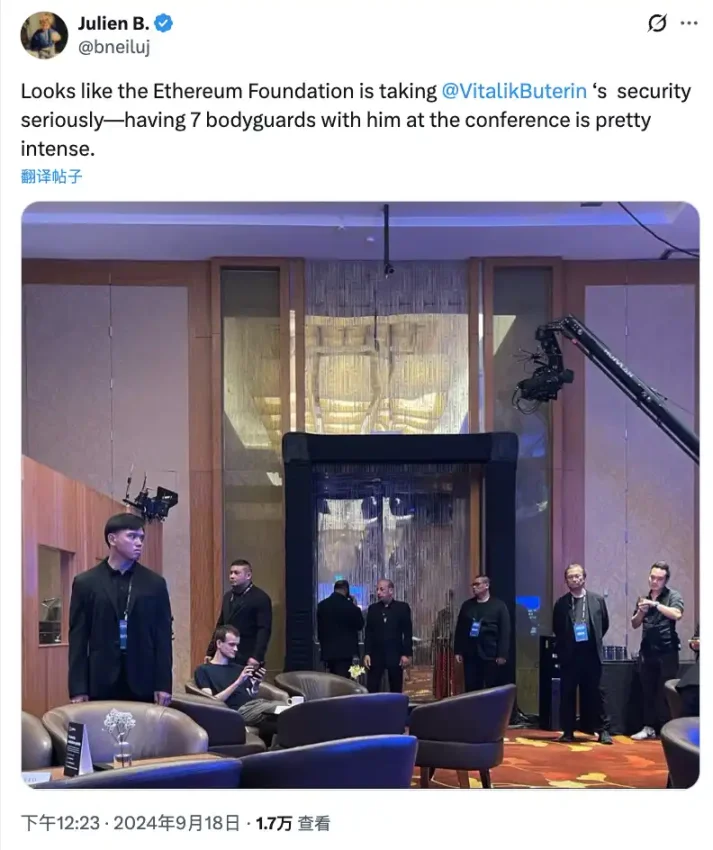
Yet, it seems that most of the time, people do not see Vitalik with bodyguards. For example, at the ETHCC conference in Brussels in July 2024, Vitalik arrived alone by bus in the rain, his clothes still wet during his speech, and left on foot afterward, without any bodyguards accompanying him.
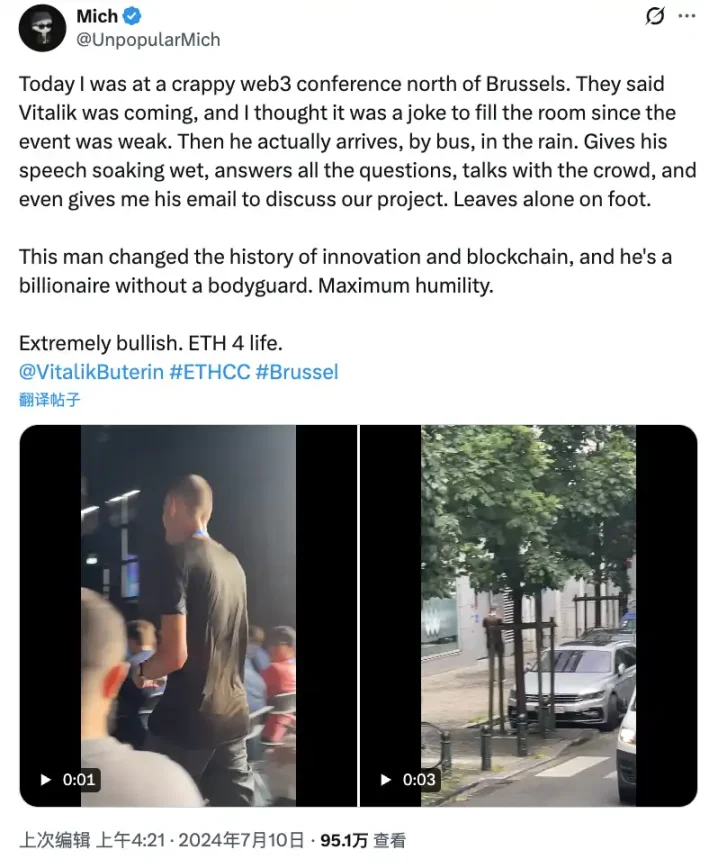
The biggest threat Vitalik faces is also on a digital level. In 2023, he fell victim to a SIM swap attack, which allowed the attacker to reset his Twitter password and post a phishing NFT minting link, resulting in the theft of approximately $700,000 in assets from Vitalik's fans. This incident has led him to continue discussing the dangers of SIM swap attacks publicly, warning users to remove their phone numbers linked to their X accounts.
Justin Sun
Justin Sun, who often acts flamboyantly, also has notable security arrangements, frequently accompanied by several burly bodyguards.
Particularly during Sun's trip to Hong Kong in June 2023, there were reports of a large bounty for slapping him and throwing eggs at him. In this context, the four bodyguards accompanying Sun received considerable attention from netizens, with one particularly fierce-looking bodyguard being rated as the best.

Later, Sun mentioned on social media that he mistakenly thought this bodyguard was Filipino, but he turned out to be a Gurkha from Nepal, one of the most famous mercenary systems in the world.

Sun's security awareness is also very advanced, not only reflected in his security measures but also in his privacy protection regarding the value of his wealth.
On August 11, 2025, Sun sued Bloomberg in the US for violating a confidentiality agreement while compiling the billionaire index, disclosing detailed cryptocurrency holdings he provided for wealth verification. Such detailed disclosures could increase the risks of "theft, hacking, kidnapping, and personal harm to him and his family" through wallet clustering analysis. He even cited Bloomberg's own reports as court evidence: in 2025, there were 51 cases of crypto investors being violently coerced into handing over their private keys.
Zhao Changpeng
In contrast, the security details of Binance founder CZ are less exposed.
It wasn't until the court ruling documents in the US in 2024 that media outlets discovered a letter of support from a "classmate" named Xin Wang, who claimed to be a friend of CZ from his youth and also his bodyguard. Xin Wang recalled in the letter his acquaintance with Zhao Changpeng at McGill University, describing young CZ as a "bookish, bespectacled kid," who has now grown into an "older version" while maintaining "quiet, practical kindness."
This bodyguard is clearly not an ordinary security personnel; he is the CEO of Bayview Acquisition Corp, providing M&A advice to financial institutions, holds legal qualifications in California, England, and Wales, and was appointed as an independent board member of Binance in April 2024. Such a multifaceted identity is quite rare in the crypto industry's security field.
Early Ethereum Co-founder Anthony
Another co-founder of Ethereum, Anthony Di Iorio, has taken a drastically different security approach compared to Vitalik, maintaining round-the-clock security arrangements.
Perhaps it is because Anthony comes from a wealthy family or because, as an early participant in Ethereum, the ETH he holds easily makes him a high-value target. The self-custody nature of cryptocurrency assets means that traditional financial insurance cannot cover potential personal threats.
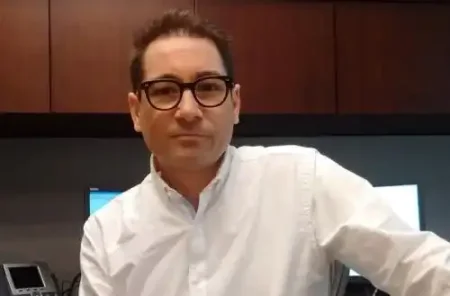
Therefore, since 2017, he has employed a private security team that accompanies him wherever he goes or waits at his destination. In 2018, Forbes estimated his net worth to be between $750 million and $1 billion, placing him among the top 20 wealthiest individuals in the cryptocurrency field. That year, he made headlines by purchasing Canada’s most expensive apartment, a three-level penthouse, for $22 million, partially paid in digital currency.
As a result, it seems that in 2018, his security team also increased its budget, with witnesses observing him traveling with a "small entourage including bodyguards." This round-the-clock security arrangement continued until he exited the industry.
In 2021, he announced his decision to "liquidate" and exit the industry based on personal safety and other considerations, stating that he would no longer fund any blockchain projects. He candidly remarked, "I don’t feel safe in this industry… If I focus on bigger issues, I think I will be safer."
He then sold his company Decentral, severing major ties with blockchain startups, and shifted his focus to philanthropy to avoid being labeled as a "cryptocurrency person."
Circle CEO
Circle CEO Jeremy Allaire manages the $78 billion USDC stablecoin and a $20 billion publicly traded company, making him a key figure in crypto financial infrastructure.
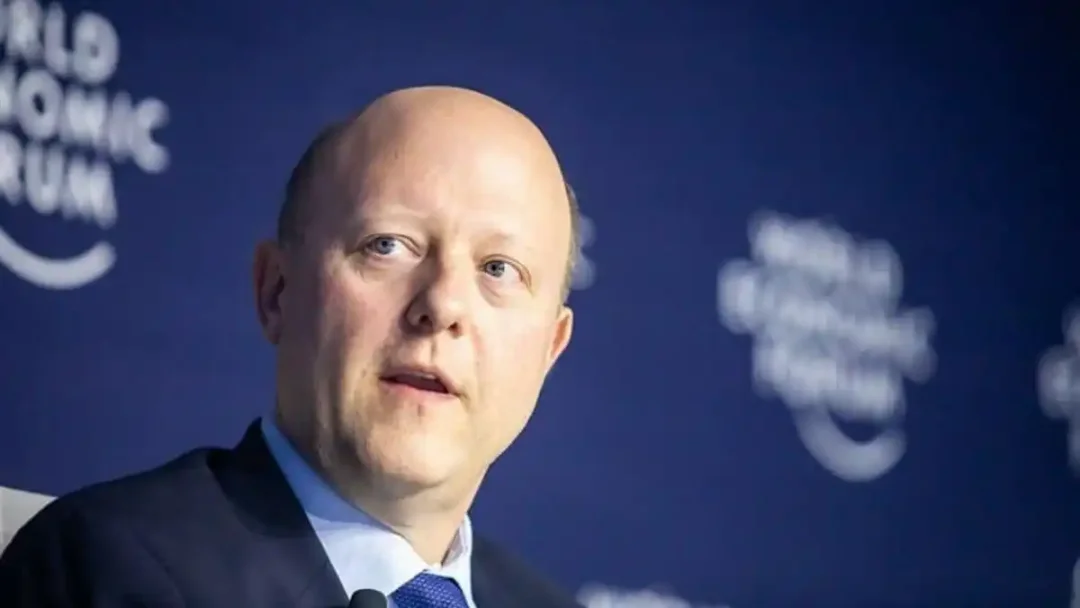
According to Circle's S-1 initial public offering filing submitted on April 1, 2025, the company allocated $800,000 for Allaire's personal security in 2024.
In a year when multiple "crypto kidnapping cases" erupted in France, Dubai, Argentina, and other locations, this amount does not seem exaggerated. Several reports cited Circle's prospectus to confirm this figure.
免责声明:本文章仅代表作者个人观点,不代表本平台的立场和观点。本文章仅供信息分享,不构成对任何人的任何投资建议。用户与作者之间的任何争议,与本平台无关。如网页中刊载的文章或图片涉及侵权,请提供相关的权利证明和身份证明发送邮件到support@aicoin.com,本平台相关工作人员将会进行核查。


