About CIRCLE: What You Might Not Know - Unlocking of CRCL and the Definition by IRS.
Recently, many friends have been discussing Circle. For me, it comes down to one judgment: is Circle worth buying now?
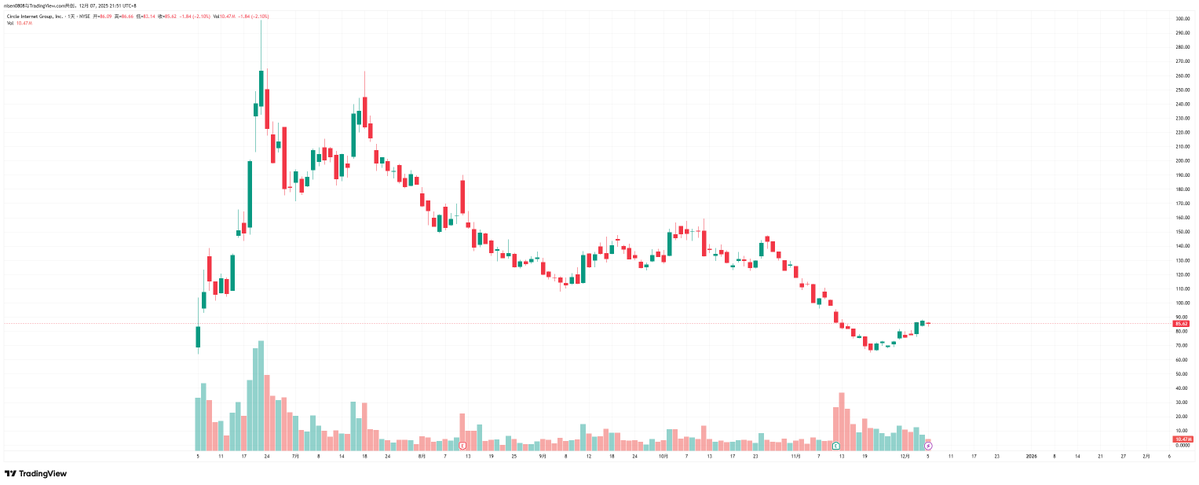
From the price perspective, $CRCL has returned to its issuance price. Although there has been some rebound recently, the momentum is not very strong. Personally, I see two main reasons: one is that the overall environment of the cryptocurrency market is not good, and the other is that the Federal Reserve's interest rate cut cycle will indeed affect CRCL's expected income. But these are the most important points.
I am not very inclined to buy right now, mainly because the unlocking period for CRCL has started on December 2. In fact, on August 13, Circle had already released about 11.5 million shares early due to meeting the stock price criteria. This has had some impact on the market, and now is precisely the time when the release volume is the largest, including most of the shares held by executives, early investors, founders, and employees that were subject to a 180-day lock-up period.
Among these, there are many shares that have already been traded OTC, which amount to tens of millions of shares. Of course, this does not mean that these shares will necessarily be sold off in the market, but there is still short-term risk. The current price is indeed quite good, close to the issuance price, so buying is not a big issue. However, the key point is whether there are better options besides CRCL.
Additionally, from the perspective of stablecoins, USDC is indeed the most likely institution to be among the first to obtain a stablecoin license in the United States, which is beyond doubt. Currently, USDC's competitors are almost all unable to compete, including USD1, while USDT is far from compliance.
However, whether this license can change USDC's current position in the market, I don't think so. The market will not change just because USDC has obtained a license. USDT remains the most widely used stablecoin globally, and even if USDC becomes the first, the profits from just holding US Treasury bonds will be very limited.
Moreover, from the perspective of lower payment, while the path for USDC as a payment method in the U.S. is smooth, there is a significant disadvantage in the payment scenarios for USDC that I see many friends have not discussed: the IRS treats USDC as property rather than cash!
This point is extremely crucial and is currently the most core yet difficult part of stablecoin legislation. On the surface, USDC is pegged to USD at a 1:1 ratio, appearing like "digital cash," but under the U.S. tax law system, anything that is not considered "legal tender," including stablecoins, is viewed as property by the IRS, falling into the same tax category as stocks, ETFs, gold, and Bitcoin.
The consequence of this is that as soon as you "use it," it is equivalent to "selling it."
And as soon as a "sale" occurs, U.S. tax law requires calculating whether there is a capital gain or capital loss upon asset disposal. Even if you just buy a $5 cup of coffee, as long as there is even a $0.0001 difference between the cost of USDC and the "market price" at the time of use, you have generated a capital gain or loss.
This means:
Using USDC for payment = You are selling USDC
Selling USDC = You must calculate whether you made a profit
Making a profit = You have to pay capital gains tax
Regardless of whether you make a profit = You must record & report taxes
This absurdity is enough to prevent any ordinary American from using USDC as a daily payment tool. What’s more troublesome is that even if USDC = USD with minimal fluctuations in the financial market, for the IRS, as long as there is no zero fluctuation + legally defined as USD, USDC cannot be treated as currency.
Thus, legally USDC ≠ USD, even if economically they are almost equivalent. This is one of the biggest structural barriers facing Circle. The U.S. allows USDC payments, allows financial institutions to integrate, allows businesses to settle, and allows cross-border circulation, but as long as the tax law remains unchanged, USDC will never be able to achieve large-scale adoption in domestic retail payments, because no consumer is willing to calculate capital gains for every single purchase, nor will they prepare a tax record just to buy a cup of milk tea.
This is also why USDC is growing rapidly globally, but has been slow to take off in the U.S. domestic payment sector.
The Stablecoin Bill (GENIUS Act) clearly defines the issuance mechanism, regulatory framework, and reserve structure, but it does not address the most critical issue: the tax identity of stablecoins. As long as the IRS continues to view USDC as property, Circle will forever rely on B2B, cross-border settlement, on-chain settlement, and financial backend to enter the domestic payment system, and cannot become a true "payment tool" on the retail end like Cash App, Venmo, or Apple Pay.
This also limits USDC's payment scenarios in the U.S. and caps its potential in the payment field. Perhaps one day the IRS will change this mindset, and then USDC may have a place, but until that day comes, the road for USDC as a retail payment tool will be very difficult, while outside the U.S., it is almost the domain of USDT.
Ultimately, I think CRCL is worth buying, but I will not buy it now, of course, this is just my personal opinion, and I may be wrong.
Bitget VIP, lower fees, better benefits
免责声明:本文章仅代表作者个人观点,不代表本平台的立场和观点。本文章仅供信息分享,不构成对任何人的任何投资建议。用户与作者之间的任何争议,与本平台无关。如网页中刊载的文章或图片涉及侵权,请提供相关的权利证明和身份证明发送邮件到support@aicoin.com,本平台相关工作人员将会进行核查。


