When the entire DeFi market is still struggling for a 5% yield, a structural arbitrage trading opportunity is emerging through Equity Perps. The retail demand for leverage on high Beta (high volatility) assets like $NVDA (NVIDIA) has created a significant funding rate premium, while institutional funds are currently finding it difficult to close this spread.
The perpetual contracts invented by BitMEX have created a new model for "making money" in the crypto space. Now, this mechanism is starting to engulf the traditional stock market.
We believe that due to the heightened speculative sentiment among retail investors, the oracle mechanism during off-market hours, and the friction between TradFi and DeFi, there are clear inefficiencies in the current U.S. stock perpetual market.
Today's article will guide you step-by-step on how to leverage these factors to construct a Delta-Neutral yield strategy. Let's get straight to the point.
From XBTUSD to U.S. Stock Perpetuals: What is this thing?
In 2016, BitMEX launched the XBTUSD perpetual contract, creating the first tool that allowed traders to speculate on prices with leverage without a delivery date. It became the most traded product in the history of the crypto space.
Today, we are witnessing the next evolution of this invention: Equity Perpetual Contracts. Although this is currently popular mainly on niche platforms like Hyperliquid, BitMEX will soon launch its own U.S. stock perpetual products. We firmly believe that 24/7 trading of stock perpetuals is the inevitable future of finance.
The stock perpetual contracts on Hyperliquid are synthetic, cash-settled contracts:
● Quanto (Dual Currency) Exposure: You do not hold the stock and have no voting rights. You are trading a price feed settled in USDC.
● No Dividends: Unlike holding NVDA spot, you do not receive dividends. The impact of dividends has already been "priced in" to the funding rate curve.
● 24/7 Trading: This is crucial for arbitrageurs. The Nasdaq closes at 4 PM, but this thing operates year-round without breaks.
● Why Arbitrage: The funding fee is settled hourly. If you hold a short position over the weekend, when the underlying spot market "freezes," you can earn 48 hours of funding fees for free.
Opportunity: U.S. Stock Funding Rate Arbitrage
Here is a snapshot of the yields for some assets: 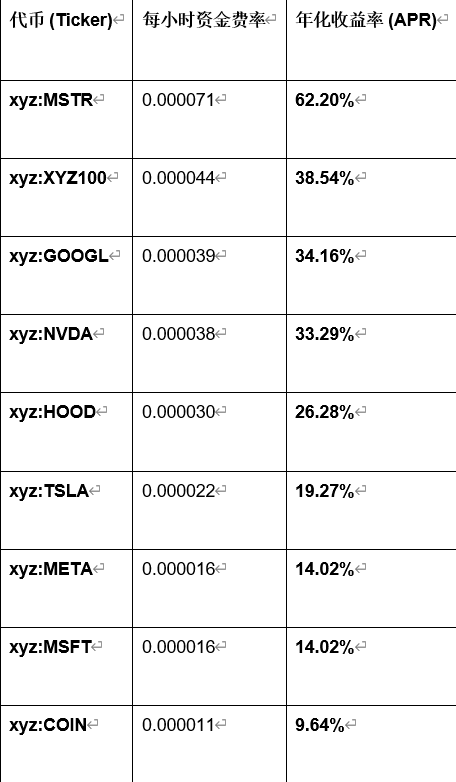
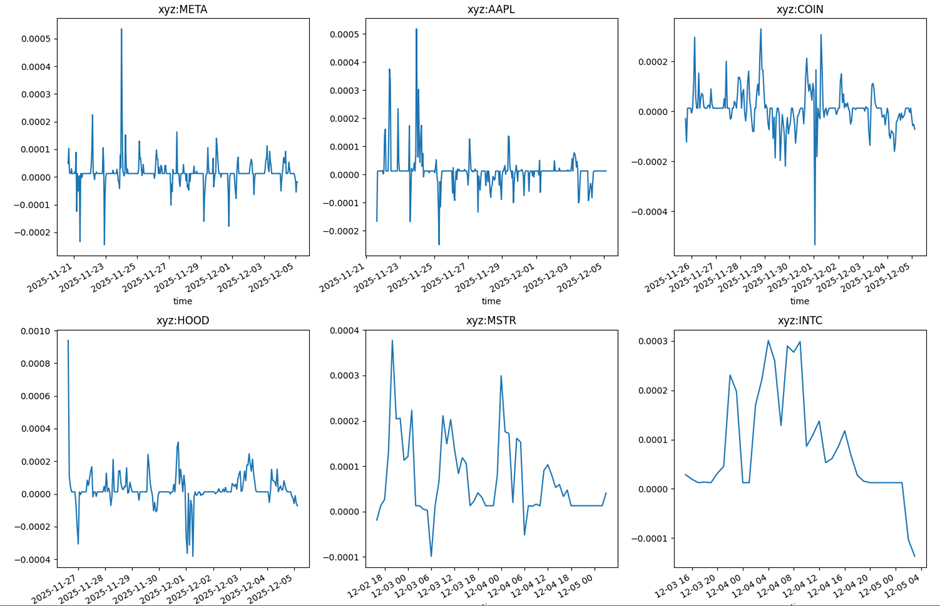
Specific Operational Strategy
● Asset Class: HIP-3 Stock Perpetual Contracts (on Trade.xyz at Hyperliquid)
● Target Asset: NVDA (NVIDIA)
● Yield: ~30%
This strategy is essentially a Delta-Neutral Basis Harvest. You are taking advantage of the pricing inefficiencies between the "24/7 degens rushing to trade on-chain" and the "traditional traders working 9 to 5" off-chain.
Trading Structure
- Long (Off-chain): Buy spot NVDA in your brokerage account.
- Short (On-chain): Short the NVDA-USDC perpetual contract on Hyperliquid.
Your Edge: Since your notional amounts in both directions are the same, your net Delta is 0. Whether NVDA rises to $500 or falls to $50 is of no concern to you. You are purely harvesting the funding fees—the money that retail investors rushing to leverage pay you hourly as "tuition."
Conclusion
We invented cryptocurrency perpetual contracts at BitMEX, and it is inevitable that this superior market tool will eventually "swallow" traditional assets.
The current price misalignments in U.S. stock perpetual contracts provide a rare window of opportunity, where market structure, retail psychology, and regulatory friction overlap, creating excess returns (Alpha). For those capable of managing the liquidation risks of high-volatility assets, shorting the "Degen buying" on U.S. stock perpetuals is currently one of the most attractive trades in terms of risk-adjusted return.
BitMEX will soon launch its own U.S. stock perpetual contracts. Stay tuned.
免责声明:本文章仅代表作者个人观点,不代表本平台的立场和观点。本文章仅供信息分享,不构成对任何人的任何投资建议。用户与作者之间的任何争议,与本平台无关。如网页中刊载的文章或图片涉及侵权,请提供相关的权利证明和身份证明发送邮件到support@aicoin.com,本平台相关工作人员将会进行核查。


