Written by: Glendon, Techub News
Against the backdrop of accelerating cryptocurrency legislation and regulatory policies in the United States, the role of the Commodity Futures Trading Commission (CFTC) as the "digital commodity regulator" in the crypto space is becoming increasingly clear.
Recently, there have been continuous developments in the U.S. cryptocurrency regulatory landscape. On December 3, SEC Chairman Paul Atkins revealed during a live interview with Fox News that the "Cryptocurrency Market Structure Bill" is set to pass, which will bring much-needed regulatory clarity to the cryptocurrency industry. Following this, CFTC Acting Chair Caroline D. Pham announced yesterday that spot cryptocurrency products will begin trading for the first time on federally regulated CFTC-registered futures exchanges in the U.S. The CFTC stated that this move marks a key step towards the goal of establishing the U.S. as the "world cryptocurrency capital."
Regulatory Framework Breakdown: "Crypto Sprint" Plan
Behind this groundbreaking development is the CFTC's careful advancement over the past four months. As early as the end of July, Pham announced a 12-month policy execution framework called the "Crypto Sprint" plan, aimed at establishing a comprehensive regulatory framework for crypto assets through phased policy implementation. On August 4, Pham officially announced the launch of a new initiative allowing spot crypto asset contracts to be traded on CFTC-registered futures exchanges (such as designated contract markets). This initiative is the first measure under the "Crypto Sprint" plan, aimed at implementing various recommendations from the Trump administration's Digital Asset Market Working Group report.
In addition to promoting the development of spot trading for crypto assets, the plan covers multiple aspects. Firstly, it enables the use of tokenized collateral, including stablecoins, in the derivatives market; secondly, it establishes rules for technical amendments to CFTC regulations regarding collateral, margin, clearing, settlement, reporting, and record-keeping to support the use of blockchain technology and market infrastructure (including tokenization) in the U.S. market. According to the announcement, this rule-making process is expected to begin next year and be completed by August 2026, aiming to improve the regulatory framework at a systemic level and extend regulation to areas that have not been adequately addressed before.
For a long time, the U.S. has faced the dilemma of unclear jurisdictional boundaries between the SEC and CFTC in cryptocurrency regulation. With both agencies launching the "Project Crypto" and "Crypto Sprint" plans, this "territorial dispute" has come to an end, and the situation is beginning to change positively.
On September 2, the SEC's Trading and Markets Division, along with the CFTC's Market Oversight Division and other departments, jointly announced a cross-agency initiative to coordinate the trading process of spot crypto asset products, making trading more standardized and orderly.
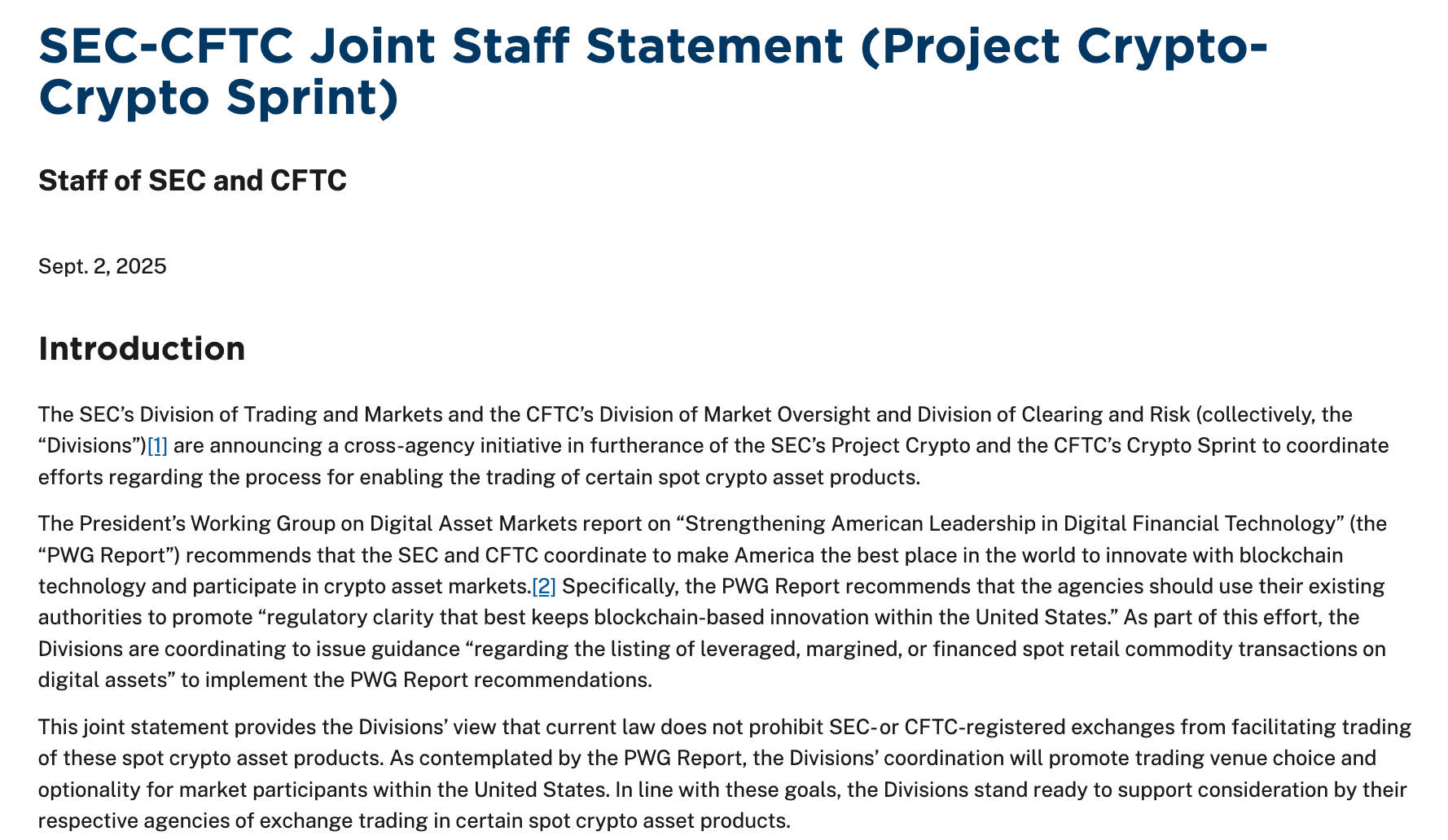
In this initiative, the two agencies coordinated to issue guidance on "listing leveraged, margin, or financed spot retail commodity transactions on digital assets" based on the Commodity Exchange Act (CEA). This framework, based on the CEA, requires leveraged retail commodity transactions to occur on designated contract markets (DCM) registered with the CFTC, foreign boards of trade (FBOT), or national securities exchanges (NSE) registered with the SEC. Additionally, the framework covers core aspects such as margin management, clearing and settlement, market monitoring, data transparency, and investor protection, aiming to build a federal regulatory framework that is both clear and innovative.
By incorporating the crypto spot market into the existing U.S. commodity regulatory system, this initiative effectively addresses long-standing regulatory gaps in market structure, custody, and trading innovation, making the entire regulatory system more complete and clear. Currently, designated contract markets under CFTC regulation include traditional financial institutions such as the Chicago Mercantile Exchange (CME), Chicago Board Options Exchange (CBOE), and Intercontinental Exchange (ICE), as well as native cryptocurrency companies like Coinbase's derivatives division, crypto derivatives trading platform Bitnomial, and prediction markets Kalshi and Polymarket US.
Among them, Bitnomial has taken the lead, becoming the first derivatives exchange in the U.S. to offer spot cryptocurrency trading. This Chicago-based company submitted self-certification documents last month to conduct retail leveraged spot trading under the Commodity Exchange Act, allowing customers to buy and sell digital assets and engage in financing operations directly on the exchange.
CFTC's Cryptocurrency Legislative Process is Accelerating
Within the CFTC's "Crypto Sprint" plan, there is another policy that requires close attention: the use of tokenized collateral, including stablecoins, in the derivatives market. This policy is expected to release guidance by the end of the year and be officially implemented early next year. Pham referred to tokenized collateral as a "killer application" for the stablecoin market, emphasizing its potential in modernizing collateral management and enhancing capital efficiency. She pointed out that by optimizing non-cash collateral management through distributed ledger technology, market participants can allocate funds more flexibly, thereby achieving greater returns.
The CFTC's formal opening of cryptocurrency spot product trading clearly indicates that the CFTC is steadily advancing its regulatory framework and marks the beginning of a new era of innovation and market structure reshaping in the crypto industry. The rapid and efficient implementation of this decision is attributed to Pham's philosophy. She believes that blockchain technology and the tokenization of financial instruments are not merely new technological tools but represent a structural modernization upgrade of the underlying market infrastructure. Therefore, she consistently advocates for a "simplified" regulatory approach and believes that the U.S. must adopt a durable and flexible regulatory strategy to adapt to the continuous emergence of innovations, avoiding the creation of regulatory barriers and market fragmentation. This means relying on technology-neutral regulations that can keep pace with innovation without frequent amendments.
Guided by this philosophy, the CFTC is actively taking a series of practical measures to enhance real-time collateral liquidity and optimize capital efficiency, while also strengthening the resilience of the U.S. clearing and settlement infrastructure.
With the opening of spot trading for crypto products, traditional financial institutions and other mature market participants may be more inclined to conduct business on regulated exchanges due to the familiar and compliant trading environment provided by the CFTC, thereby obtaining or further increasing their cryptocurrency exposure. For the crypto industry, the impact of this initiative is undoubtedly profound, as compliant trading is expected to attract traditional financial institutions like BlackRock and Fidelity to accelerate their layouts, promote the launch of leveraged spot trading products, and potentially alleviate the current liquidity contraction in the crypto market. At the same time, this positive trend has also heightened market expectations for the tokenized collateral policy.
It is worth mentioning that Michael Selig, the CFTC chair nominee put forward by Trump, also has a deep and comprehensive understanding of crypto products. He previously served as the chief legal advisor for the SEC's crypto task force and has been dedicated to coordinating the policy guidelines of the SEC and CFTC to ensure high consistency across all areas of the financial and cryptocurrency industries under the regulatory framework. During a Senate Agriculture Committee hearing at the end of November, he clearly stated that if confirmed, he would promote the establishment of a "clear and simple" regulatory framework for crypto assets to avoid unnecessary disruptions to the market from excessive enforcement.
Meanwhile, Pham is actively seeking corporate CEOs to enrich the newly established CEO Innovation Council at the CFTC. This council aims to further strengthen its efforts during this critical period of expanding the regulatory scope over digital assets and to build a stable communication channel between the agency and regulators to jointly formulate responsible regulatory regulations. It is not difficult to foresee that the CFTC's policy-making process will accelerate, and it will play a more critical role in the field of cryptocurrency regulation.
Of course, during the implementation of specific policies, challenges such as market volatility and technological adaptation will inevitably arise. However, overall, this move by the CFTC undoubtedly accelerates the integration of crypto assets into the mainstream market, injecting certainty into the industry while also providing a model for global regulatory collaboration.
免责声明:本文章仅代表作者个人观点,不代表本平台的立场和观点。本文章仅供信息分享,不构成对任何人的任何投资建议。用户与作者之间的任何争议,与本平台无关。如网页中刊载的文章或图片涉及侵权,请提供相关的权利证明和身份证明发送邮件到support@aicoin.com,本平台相关工作人员将会进行核查。


