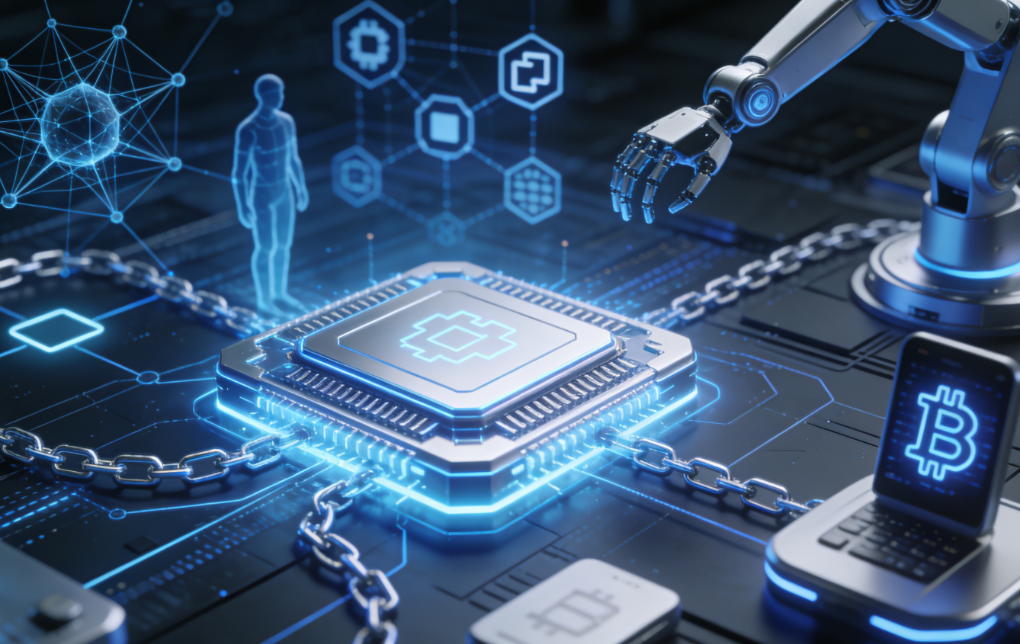
When you are still focused on breakthroughs in a single technology, tech giants have already woven AI, blockchain, and robotics into an invisible web, quietly reconstructing the underlying logic of business and society.
Sandy Carter begins her article in Forbes with a famous quote from "Alice in Wonderland": "You have to run twice as fast to stay in the same place." This aptly describes the current pace of technological development. In 2026, we will witness not an independent breakthrough in a single technology, but a deep integration of multiple dimensions such as AI, blockchain, robotics, and Web3.
In this integration, traditional business models and work methods will face disruptive challenges. Those who can embrace this trend first will gain an advantage in the new round of competition.
1. Integration Trends
● The technological landscape of 2026 will exhibit unprecedented characteristics of integration. Gartner categorizes this trend as "integrators," which includes the synergy of various technologies such as multi-agent systems, domain-specific language models, and physical AI.
● A research report from the well-known investment firm ARK Invest also emphasizes that the five major technology platforms of artificial intelligence, robotics, energy storage, public blockchain, and multi-omics sequencing are undergoing an unprecedented deep integration.
● A breakthrough in a single technology is no longer the key to a company's success; instead, the ability to integrate technologies is becoming a new standard for measuring corporate competitiveness.
● The development trends in the telecommunications industry confirm this judgment. Forbes predicts that by 2026, telecommunications networks will transition from passive transmission channels to intelligent systems capable of actively perceiving the surrounding world. The network itself can detect changes in the environment and understand the physical world.
2. Trust Mechanisms
● As AI agents become increasingly common, the number of autonomous agents deployed by companies has surged. These agents can access sensitive data, initiate operations, and even make payments. In this context, establishing a reliable trust mechanism has become a fundamental requirement for the large-scale application of AI.
● Blockchain technology is evolving into a trusted infrastructure. By 2026, more AI companies will integrate blockchain for signing, source tracing, and verification.
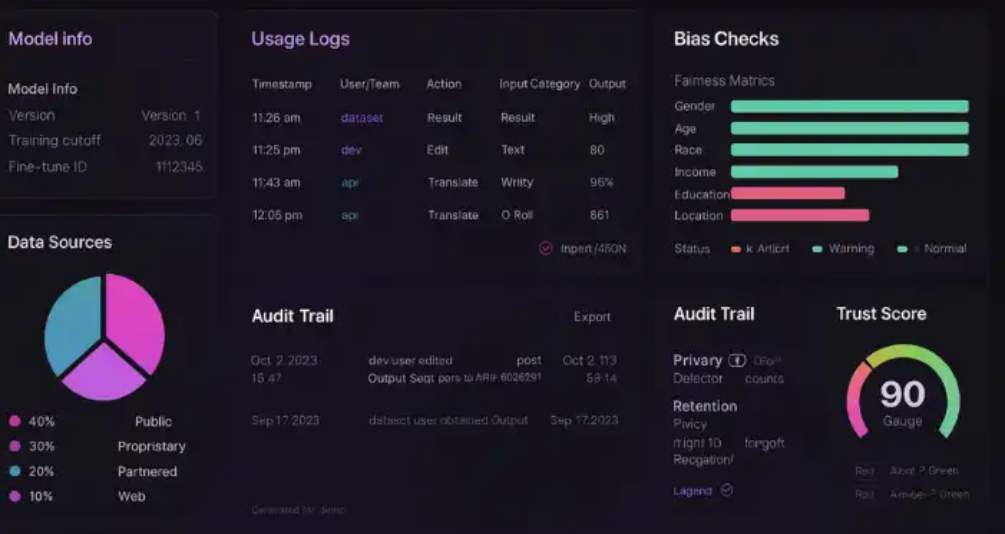
● Every significant agent action will be recorded in a lightweight ledger, enabling compliance, governance, and accountability in large-scale scenarios.
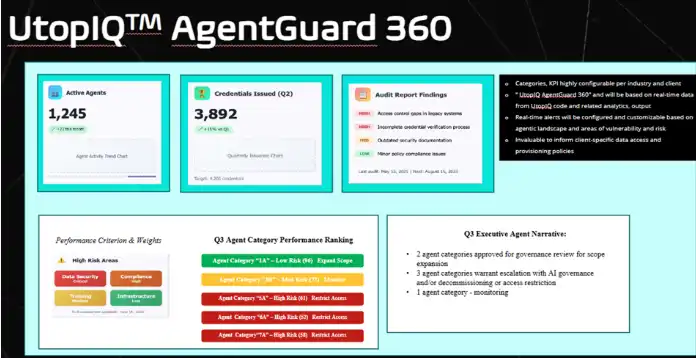
● AI agent authentication is transitioning from an optional feature to a core operational requirement. Platforms like UtopIQ have launched AI agent dashboards that ensure agents operate only within authorized limits through dynamic credentials and blockchain-supported audit logs. This trend is referred to by UtopIQ co-founder and CEO Kristen Schmidt as the "trust layer of AI."
3. Business Transformation
● The proliferation of AI agents is reshaping traditional business models. The SaaS (Software as a Service) model faces challenges—when AI agents can perform the work of an entire team, seat-based software pricing suddenly seems outdated.
● Companies will shift to paying for agent actions, outcomes, and ongoing workflows, rather than for features in static applications. Winners will build agent ecosystems, while losers will be stuck in suddenly outdated application models.
● This shift will force companies to engage in strategic reflection. The core question for CEOs in 2026 will be: Which tasks should be handled by humans? Which tasks should be handled by agents? Which tasks should be jointly handled by both? Companies that embrace agent-driven restructuring will achieve double-digit productivity gains, while those resisting change will be restructured by competitors.
● In the telecommunications sector, AI agents will enable networks to operate autonomously and self-repair, capable of detecting and resolving technical issues, optimizing network performance in real-time, and automatically providing customer service. By 2030, the market size for AI agents in telecommunications is expected to soar from $3.75 billion to nearly $12 billion.
4. Machine Society
● By 2026, we will see the emergence of new communication and collaboration models among AI agents. AI and robotics companies are developing early communication architectures that allow agents and machines to coordinate tasks. This is evolving into mature inter-agent communication protocols, where robots, digital assistants, enterprise systems, and autonomous tools will begin to negotiate responsibilities and safety boundaries in real-time.
● Dr. Aadeel Akhtar, founder and CEO of PSYONIC, points out: "Shared A2A protocols will redefine human-machine interaction, allowing robots and AI agents to understand tasks in a consistent and intuitive manner." This interoperability will become an industry standard and open doors for breakthroughs in fields such as prosthetic devices and personal robots.
● In home scenarios, robotics technology is becoming more practical and specialized. Cooking robots will take the lead, preparing fresh meals at acceptable prices. For example, Posha allows users to choose from thousands of recipes, add fresh ingredients and seasonings, and then automatically complete the cooking of the entire meal.

5. Governance Challenges
As technology deeply integrates, new governance challenges also emerge. By 2026, regulators will require explainability and source tracing in decisions involving hiring, lending, healthcare, and risk.
● The insurance industry will introduce new liability models, and ethical performance scoring will become the standard for measuring transparency, fairness, and safety.
● Data security and privacy protection have become pressing issues. Particularly concerning is the issue of children's data security. By 2026, there may be a major data misuse scandal involving child robots. Such robots may store or share sensitive information without proper consent, prompting regulators, parents, and developers to prioritize safety and privacy in the consumer robotics space.
● In this context, the value of human-created content is being re-evaluated. As the internet becomes flooded with "garbage content" generated by AI, human storytelling will become a scarce and high-value "currency."
● Marketing thought leader Mark Schaefer notes: "Whatever happens in our AI future, human art will exist." Art is an interpretation of the human experience, establishing emotional bonds between us.
6. Human-Machine Symbiosis
● The technological panorama of 2026 presents a multidimensional and deeply intertwined landscape. In the data center field, artificial intelligence is transitioning from a "tenant" to an "owner" that determines the planning, design, construction, and operation of data centers. From training large models with hundreds of billions of parameters to reasoning high-concurrency AIGC applications, AI is reshaping the infrastructure of data centers.
● In the content creation field, as AI-generated content becomes ubiquitous, human storytelling gains scarce value. Organizational content that approaches artistic standards—authentic, original, and vulnerable—will become a luxury in the eyes of customers.
● The human voice, real experiences, and original creativity stand out more than ever in a world flooded with synthetic content.
● For businesses and individuals, the technological literacy requirements in 2026 have also undergone profound changes. In large enterprises' hiring processes, recruiters have begun to pay attention to whether candidates use AI to prepare for interviews, analyze job descriptions, or organize responses.
● Leaders are starting to believe that if candidates do not use AI in interviews, they may not use AI in their work either. AI literacy is becoming a basic requirement, and not using AI may become a disadvantage.
As intelligent robots begin to shop autonomously, as blockchain records the trajectory of every AI decision, and as human content becomes a luxury in the digital world, a revolution of integration between technology and society is quietly unfolding.
2026 will redefine the boundaries of speed and trust. Those organizations and individuals who can embrace integration, rebuild trust, and reshape experiences will become the leaders of the future world.
Join our community to discuss and grow stronger together!
Official Telegram community: https://t.me/aicoincn
AiCoin Chinese Twitter: https://x.com/AiCoinzh
OKX benefits group: https://aicoin.com/link/chat?cid=l61eM4owQ
Binance benefits group: https://aicoin.com/link/chat?cid=ynr7d1P6Z
免责声明:本文章仅代表作者个人观点,不代表本平台的立场和观点。本文章仅供信息分享,不构成对任何人的任何投资建议。用户与作者之间的任何争议,与本平台无关。如网页中刊载的文章或图片涉及侵权,请提供相关的权利证明和身份证明发送邮件到support@aicoin.com,本平台相关工作人员将会进行核查。


