Original Title: "Stock Price Halved but Long-Term Capital Bets, Revealing Strategy's 'Mysterious Shareholder Group'"
Original Author: Wenser, Odaily Planet Daily
Amid market turbulence, the stock price of Strategy, the "BTC Treasury Company Leader," continues to decline. Although the company recently announced the establishment of a $1.44 billion dividend reserve to support dividends and interest payments, it failed to restore market confidence—coupled with previous news of a potential removal from the MSCI index, its stock price once plummeted nearly 10%.
However, from the perspective of shareholder structure, Strategy still attracts some long-term capital, including institutions like Deutsche Bank, which has an asset management scale of $1.6 trillion.
Revealing the Shareholder Composition of Strategy (MSTR): Nearly 50% Held by Public Companies and Retail Investors
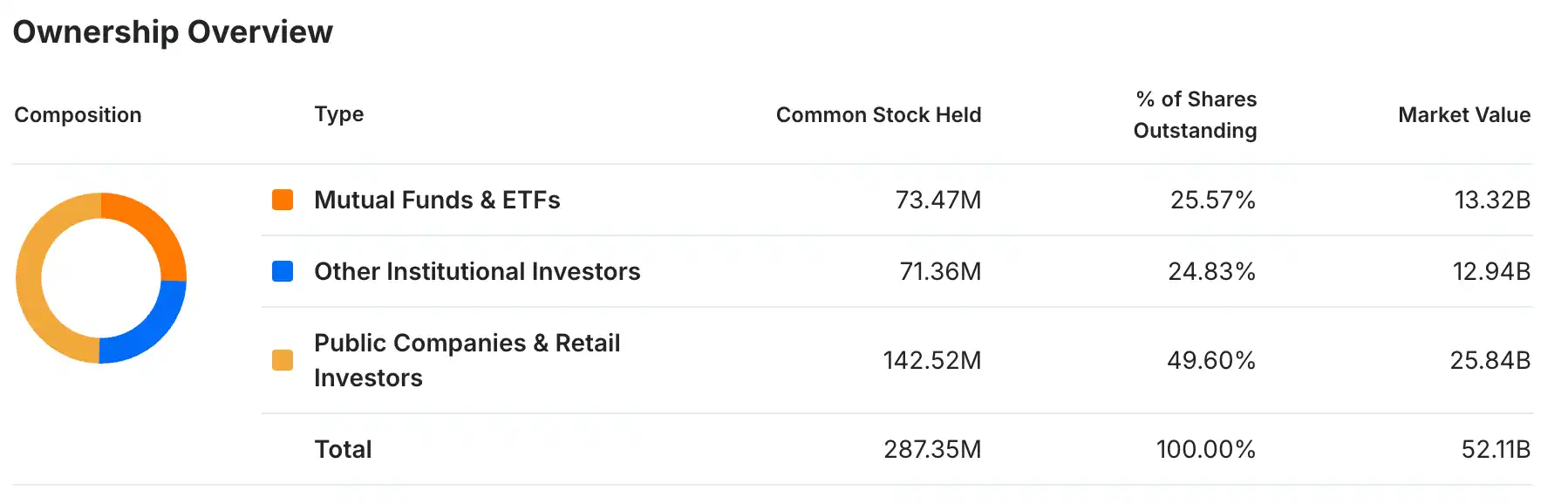
According to information from Investing, as of the end of Q3 this year, the common stock holdings of Strategy are primarily composed of mutual funds and ETFs, institutional investors, public companies, and retail investors, among which:
Mutual funds and ETFs account for 25.57% of holdings;
Institutional investors account for 24.83% of holdings;
Public companies and retail investors account for 49.6% of holdings.
Currently, the total number of Strategy (MSTR) shares is approximately 287 million, with a total market value of around $52.1 billion.
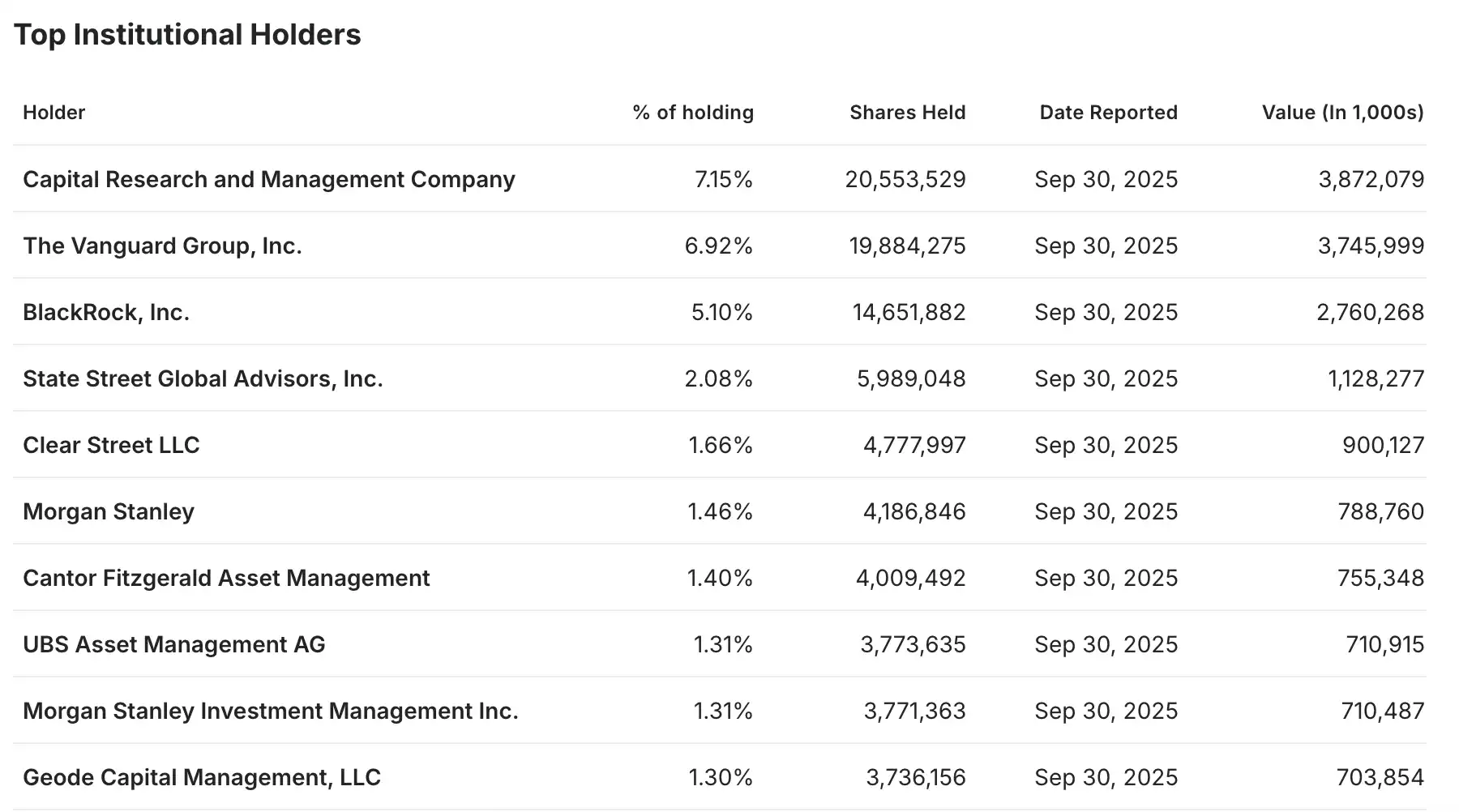
Among institutional investors, Strategy's shareholders include globally renowned companies such as Vanguard Group, BlackRock, Morgan Stanley, and UBS Asset Management.
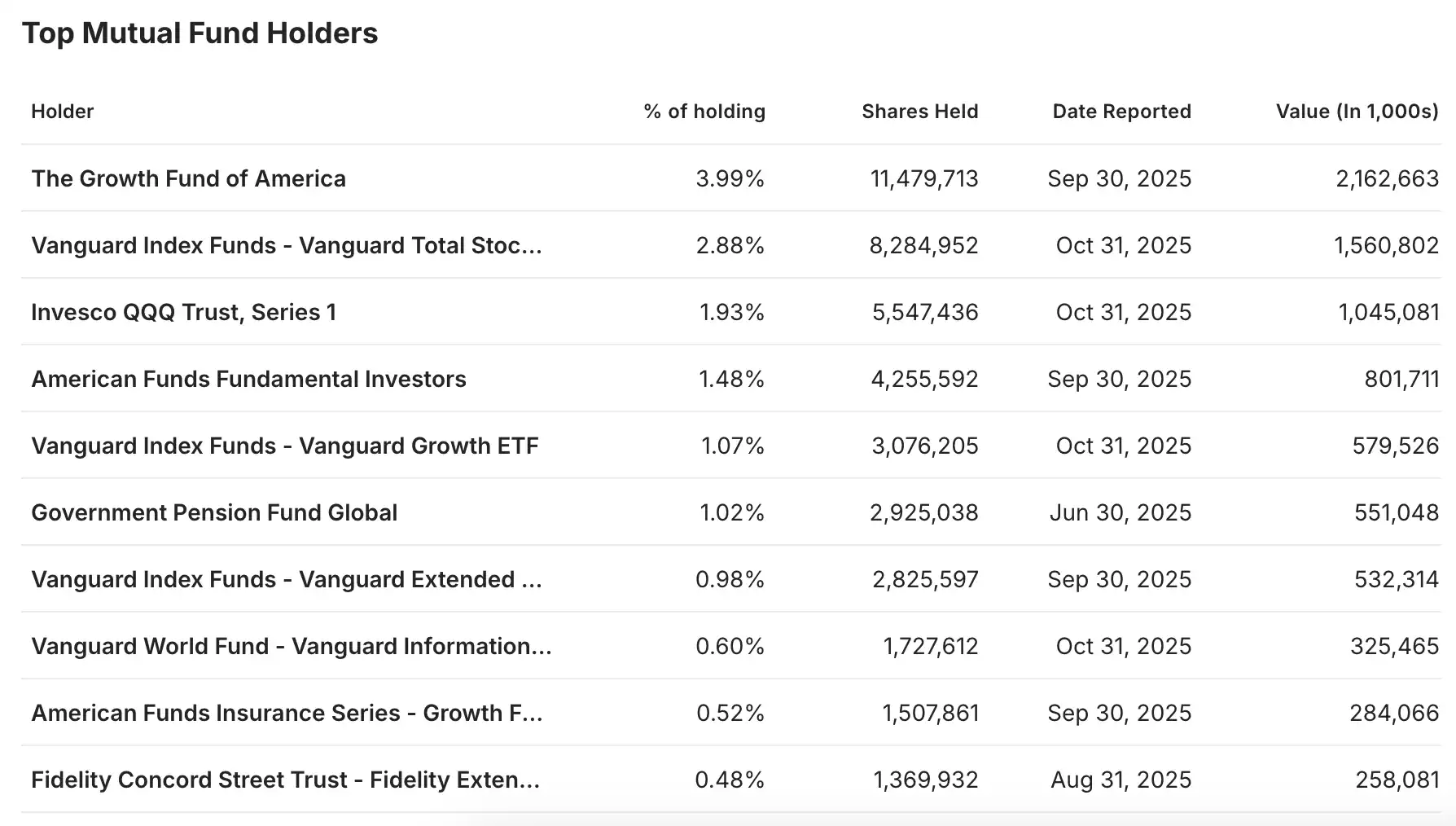
In mutual funds, the shareholder list of Strategy is also quite impressive, with the top holders being well-known funds in the industry.
Next, aside from the conventional asset management institutions, we will focus on selecting some representative holding shareholders for a separate introduction, to help everyone better understand the many "mysterious shareholders" behind Strategy, which is honored as the "No. 1 Concept Stock of BTC" and "Leader of the DAT Trend."
Central Banks and Large Banks: The "Invisible Tycoons" of Strategy Stock Holdings
In the list of Strategy shareholders, one particularly unique group is undoubtedly the central banks and large banks of various sovereign nations. Although the main reason for various central banks holding Strategy stock is often to implement diversified investment strategies or to increase indirect exposure to BTC assets, their holdings are indeed an undeniable fact and the most direct form of "voting with their feet."
According to information from Stockzoa, as of the end of Q3, the central banks and large banks holding Strategy stock are as follows:
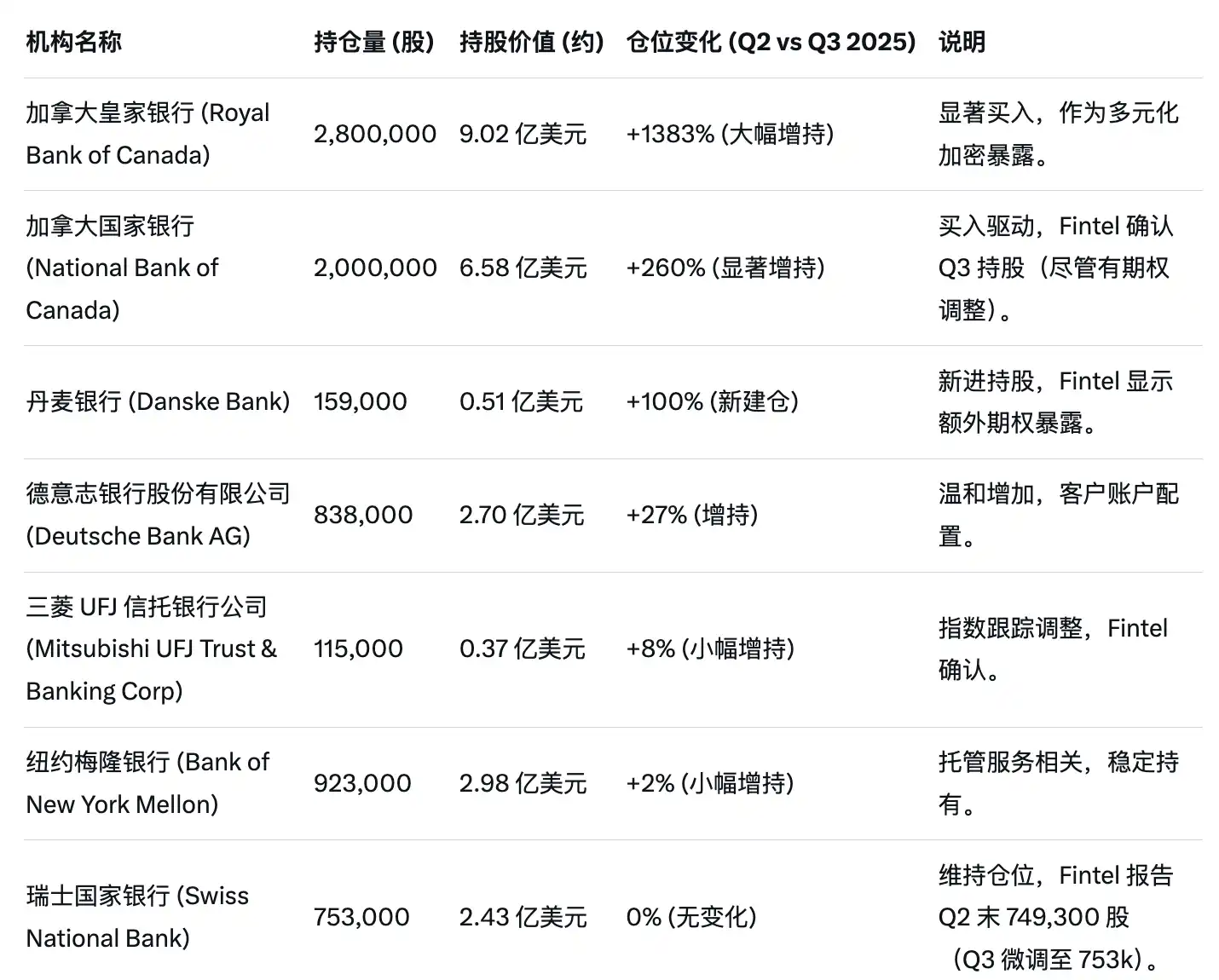
In addition to the above banks, some central banks briefly held Strategy stock but exited shortly after due to market fluctuations or their own asset allocation requirements. For example, the Norwegian central bank held about $500 million in MSTR shares at the beginning of the year, subsequently increased its holdings to about 2.98 million shares, and ultimately liquidated all holdings in Q2 this year, valued at about $1.2 billion, with a loss of about $200 million; the Saudi central bank (Saudi Arabian Monetary Authority) also disclosed holding 25,600 shares of MSTR, indirectly holding BTC asset exposure, but may have since liquidated.
Pension and Endowment Funds: Potential Players Among Strategy's Q3 Shareholders
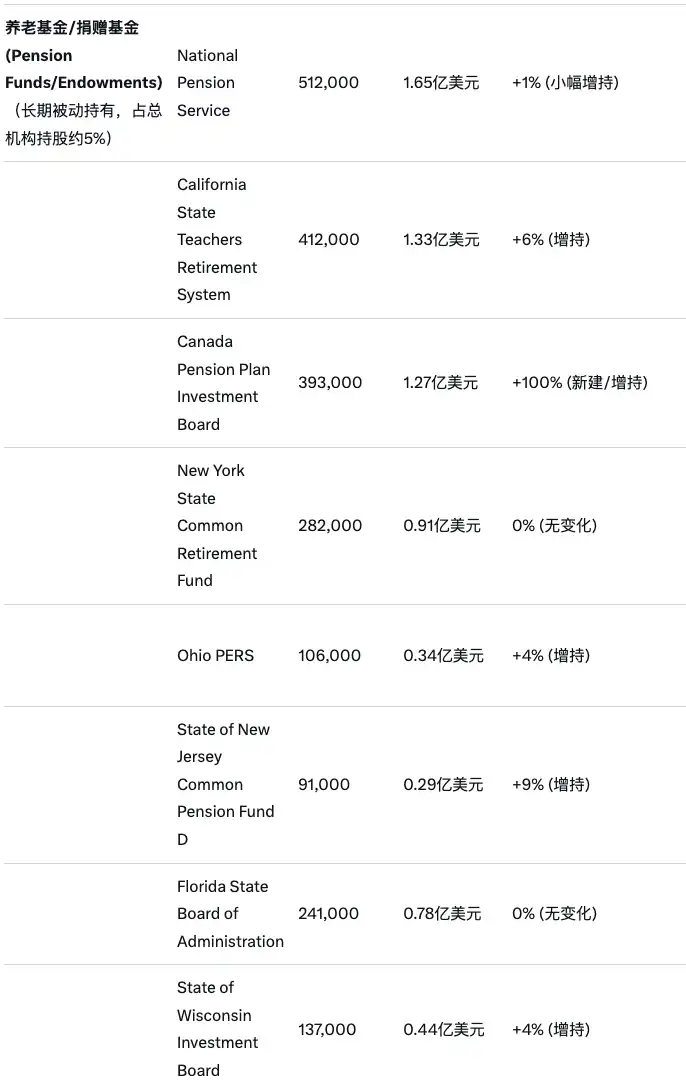
Apart from banking institutions, pension funds and endowment funds are also one of the "main forces" among Strategy stock holders. Moreover, due to their massive capital scale, the hope for further increases in Strategy stock holdings may still depend on their performance.
Similarly, according to information from Stockzoa, as of the end of Q3 (compared to Q2), the pension funds and endowment funds holding Strategy stock are as follows (compiled from Grok):
This mainly includes national pension funds, state pension funds, industry foundations, Canadian pension funds, and other institutional organizations.
Hedge Funds: "Shark-like Predators" Among Strategy Shareholders?
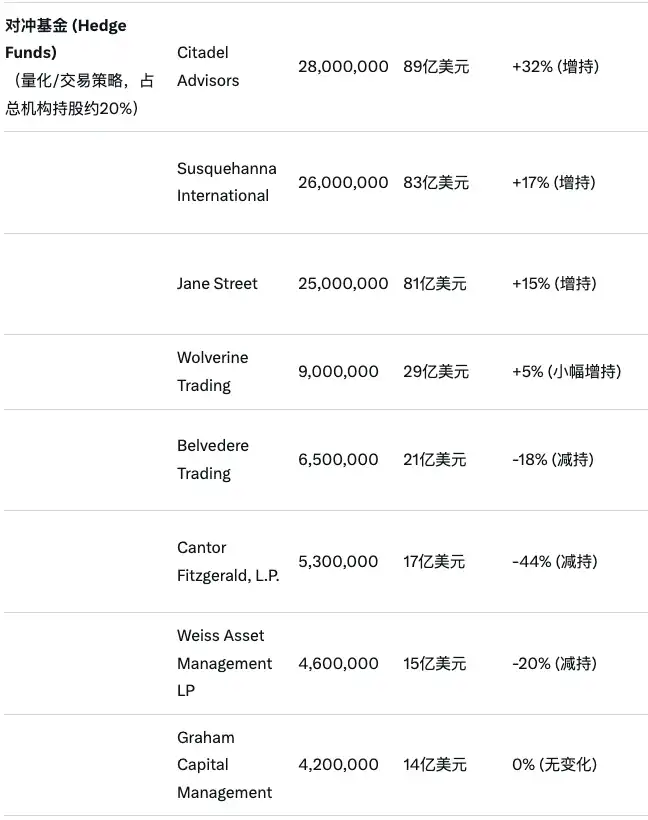
Among Strategy's holding shareholders, hedge funds may be the most sensitive to market trends and the most perceptive. Therefore, in Q3, although most hedge funds chose to increase their holdings of MSTR stock, crypto brokerage firms and established hedge funds like Cantor Fitzgerald, L.P. and Weiss Asset Management LP still opted to reduce their stock holdings.
According to information from Stockzoa, as of the end of Q3 (compared to Q2), the hedge funds holding Strategy stock are as follows (compiled from Grok):
Data Perspective on Changes in Strategy Shareholders: Institutions Remain the Main Holders, with Increasing Forces Far Exceeding Decreasing Forces
Aside from the above group classification perspective, some hidden information can also be gleaned from the changes in Strategy's institutional shareholders.
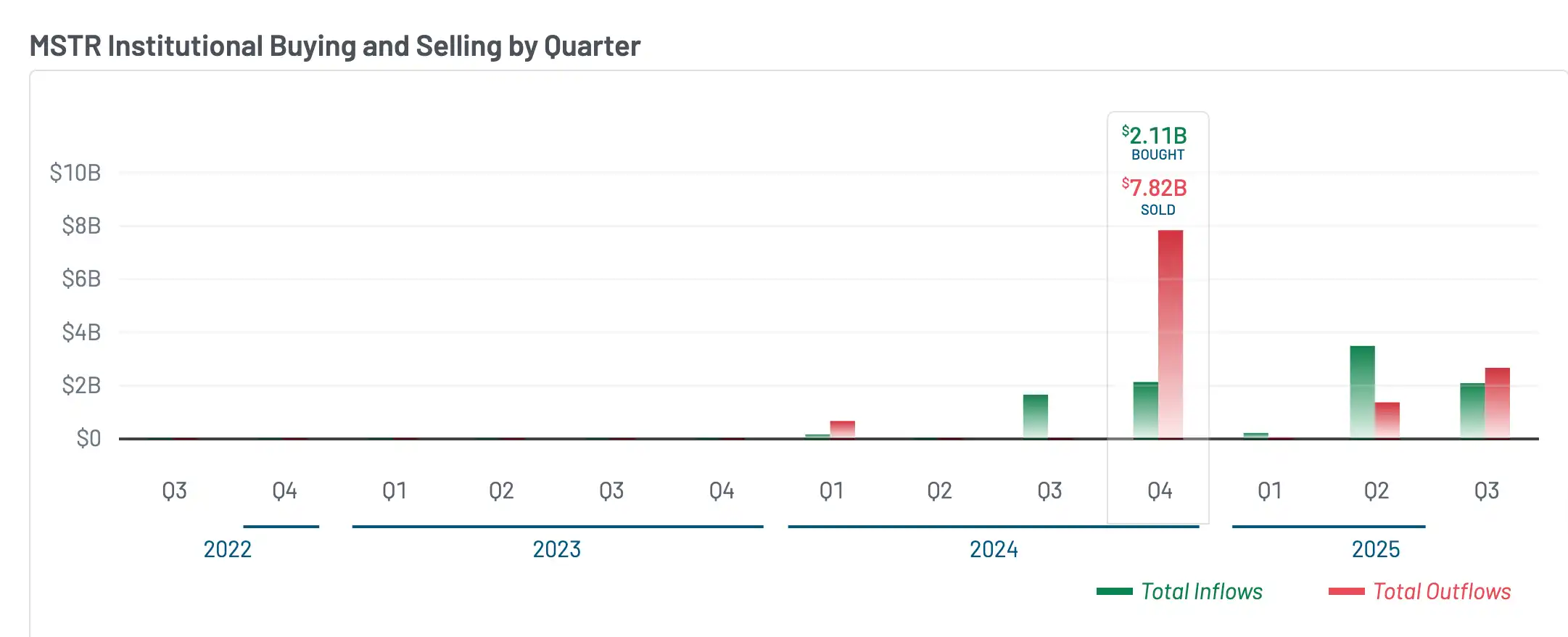
Strategy Stock Trading Data Relatively Balanced, Far Below Historical Peaks
According to data from Marketbeat, the inflow and outflow of Strategy stock reached a record 7.82 billion shares sold and 2.11 billion shares bought in Q4 2024, with a buy-sell ratio approaching an astonishing 1:4; in contrast, this figure dropped to 2.64 billion shares sold and 2.07 billion shares bought in Q3 this year, with a buy-sell ratio of about 1:1.25, indicating a relatively balanced buying and selling data. From this perspective, Strategy stock has not entered the so-called "panic selling phase," but is in a state of normal fluctuation.
Behind the Institutional Holding Data: The Number of Increasing Institutions is Twice that of Decreasing Institutions
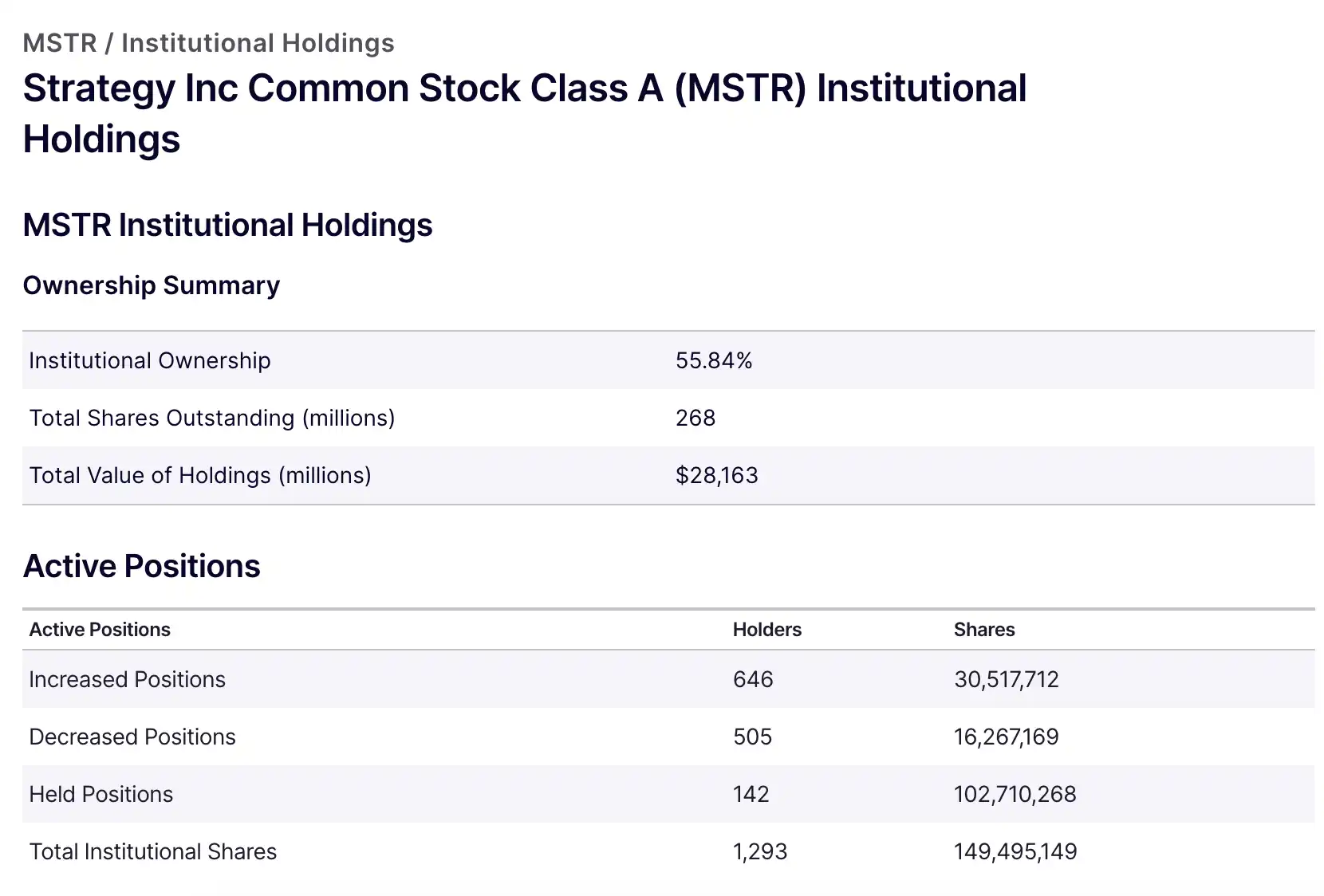
According to data from the Nasdaq official website, the current institutional holding ratio of Strategy stock is approximately 55.84%, with a total of 1,293 holding institutions, among which 646 are increasing their holdings; 505 are decreasing their holdings; and 142 are maintaining their positions.
Additionally, the number of shares increased by the increasing institutions is about twice that of the shares decreased by the decreasing institutions (30.51 million shares: 16.26 million shares), indicating that the market can normally digest the buying of Strategy stock; and more institutions chose to remain unchanged, with the number of shares held by these institutions reaching 102 million shares, accounting for about two-thirds of the institutional holding ratio, highlighting the confidence of institutional investors in Strategy's future.
In summary, despite the significant drop in stock price, the fundamental holdings of Strategy and the structure of institutional holdings have not shown significant deterioration. As the market gradually warms up, there may be hope for a rebound and a new upward trend.
免责声明:本文章仅代表作者个人观点,不代表本平台的立场和观点。本文章仅供信息分享,不构成对任何人的任何投资建议。用户与作者之间的任何争议,与本平台无关。如网页中刊载的文章或图片涉及侵权,请提供相关的权利证明和身份证明发送邮件到support@aicoin.com,本平台相关工作人员将会进行核查。


