This article is from: Binance Blockchain Week
Translation|Odaily Planet Daily (@OdailyChina); Translator|Ethan (@ethanzhangweb3)_
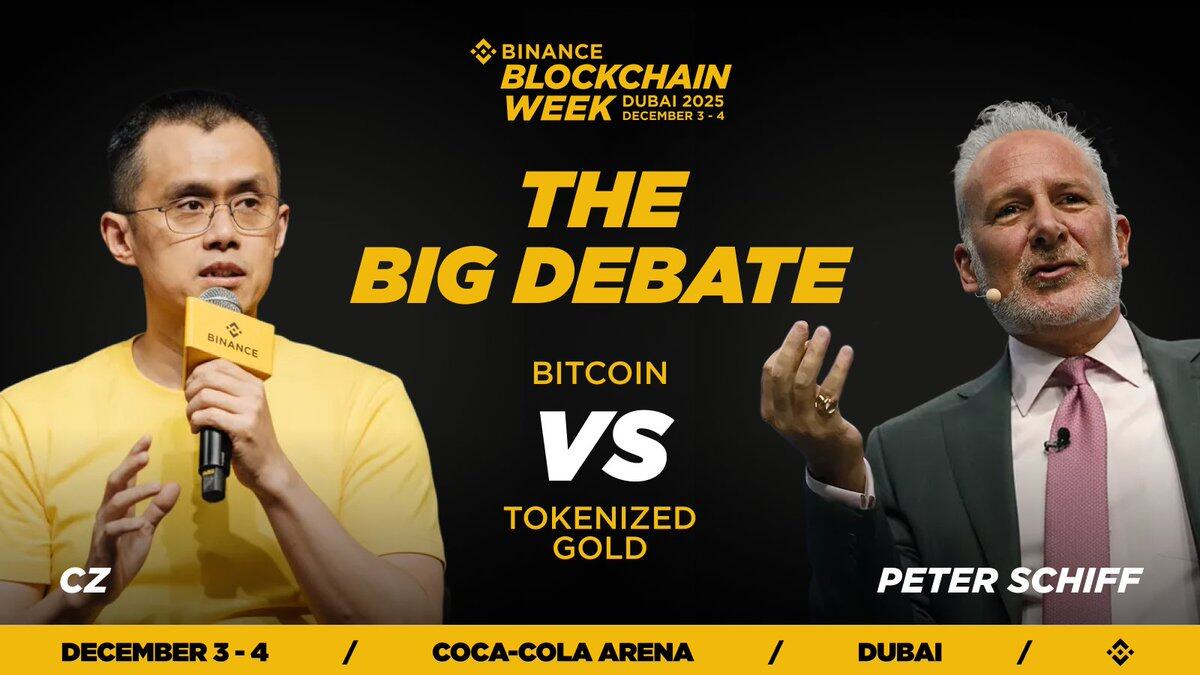
On December 4th, Dubai time, a debate titled "Bitcoin vs. Tokenized Gold" initiated by "Gold Father" Peter Schiff against Binance founder CZ officially began on the main stage of Binance Blockchain Week at the Coca-Cola Arena.
This highly anticipated debate focused on the core disagreement regarding "the intrinsic value of digital assets versus physically backed assets":
Peter Schiff:
Bitcoin is a "digital tulip bubble," its value stems from "the collective delusion of speculators," and it is essentially a "purely speculative asset," with its price relying entirely on "greater fools."
"No one prices goods in bitcoin or pays salaries in bitcoin; merchants must convert it to fiat currency," it cannot serve as a unit of account or a medium of exchange, and has no practical application scenarios.
Bitcoin has "zero value support, relying solely on confidence," while tokenized gold has physical backing, combining scarcity with the convenience of blockchain, supporting physical redemption or token transfer.
CZ:
Bitcoin is "gold 2.0 in the digital age," transferring 1 kilogram of gold internationally requires declaration, while bitcoin can be transferred in seconds via mobile; the monetary function of gold has long been replaced by fiat currency, but bitcoin addresses the pain points of cross-border payments (payment time for African users reduced from 3 days to 3 minutes).
Bitcoin has a total supply of 21 million coins, with transparent supply, while gold reserves are unknown and rely on third-party storage trust; it already has hundreds of millions of users and a market cap of $2 trillion, with a stable ecosystem, definitely not a "Ponzi scheme."
Gold prices are also volatile (recently down 10%), while bitcoin achieves "seamless use" through products like the Binance card, with liquidity and payment convenience far exceeding that of gold.
It is worth noting that both sides do not hold entirely opposing views; they both acknowledge that tokenized gold "significantly enhances the liquidity of gold," but there remains a fundamental disagreement on "whether bitcoin possesses core monetary attributes."
In fact, this confrontation had been foreshadowed. Previously, the two appeared on a podcast hosted by crypto community streamer Threadguy, CounterParty TV, where they expressed their views on cryptocurrency and the future of decentralization, but a single podcast exchange was far from satisfying the public's expectations for this "new versus old asset showdown." Schiff's appearance this time was particularly confident, as he had been continuously "attacking" bitcoin on social media for the past two months: in mid-November, when bitcoin fell below $90,000, gold prices remained above $4,000; by the end of November, gold and silver had increased by 60% and 95% respectively for the year, based on which he repeatedly declared the "digital gold" narrative bankrupt and predicted that the "strong gold, weak currency" trend would continue until 2026. (Recommended reading: "What did CZ say during the 3 hours before the '1011 purge'?", "Gold Father Peter Schiff declares war on CZ: BTC will eventually go to zero, 'tokenized gold' is the digital return of currency")
Ultimately, this debate, filled with both tension and interest, concluded with "agreeing to disagree." Odaily Planet Daily closely followed this heated debate, and the complete translation is as follows:
Peter Schiff's Tokenized Gold Project
CZ: First of all, Peter, thank you very much for being here. I consider myself half a host, so I want to start politely; we’ll see later if we "get into it."
Thank you for taking the time to come here. I think it takes a lot of courage to stand on this stage in front of this audience. Honestly, that gives me quite an advantage.
Peter Schiff (hereinafter referred to as Schiff): I actually have some supporters in the audience.
CZ: Of course, absolutely.
Schiff: Even if they disagree with me on bitcoin, they still support me on many other issues. But I really appreciate you hosting this event and inviting me. At least you have the courage to face me. You know, I’ve been trying to get Michael Saylor to debate for years, and he still hasn’t dared to come. But you are completely unafraid.
CZ: I can call him for you tonight.
Schiff: Let’s see if he’s still around.
CZ: I want to give you a chance to introduce yourself first. You are currently working on tokenization-related business and will actually launch a tokenized gold project in the future, right?
Schiff: The origin of this matter actually started when I talked about tokenized gold on a cryptocurrency podcast; you probably saw that episode. Yes, my website is called TGold.com. The "T" in the name stands for Tokenized Gold. Honestly, I was quite surprised that Tether didn’t grab this domain, but since no one was using it, I registered it.
On TGold.com, you can now directly purchase physical gold and silver, which we will store for you. All assets are independently segregated and stored separately, not mixed gold. This is real allocated gold, not unallocated. So the ownership of the gold completely belongs to you, and it is indeed stored in the vault.
In addition to directly selling it for dollars, in the future, users will have two ways to withdraw gold. The first is to withdraw physical gold; you can choose any denomination of gold bars or coins. The other way is to withdraw it as tokens. After withdrawing as tokens, you can put them in your own wallet or deposit them in an exchange once it goes live. The key point is that you can withdraw tokens at any time, and they represent your ownership of that portion of gold.
You own real gold stored in the vault, and the token is proof of your ownership. It’s like when you check a coat and get a claim ticket; that ticket isn’t the coat itself, but it allows you to retrieve the coat. The principle of tokenized gold is exactly the same.
And because the tokens are divisible, you can transfer any part of them to someone else, and that person becomes the new owner of that portion of gold. The gold itself won’t move; it will still be in the vault, but ownership can be settled instantly.
In this case, you can use the tokens as a medium of exchange. You are transferring ownership of the gold, not moving the physical gold. This way, you are essentially reactivating the monetary properties of gold: it can be transferred, it can be divided, it can circulate, while still retaining the core value foundation, with the tokens corresponding to real gold that exists in the vault and can be redeemed at any time.
CZ: So, if I understand correctly, you mean that in terms of divisibility, transferability, portability, and as a medium of exchange, tokenized gold is actually better than physical gold, right?
Schiff: From the perspective of monetary use, that is indeed the case. Of course, if you want to use gold for actual production, like making jewelry, you still need to redeem the tokens for physical gold. Or if you are in chip manufacturing and need gold material, you must redeem it as well.
But if you are using gold as currency, then yes, tokenization does improve its properties. This is similar to practices from hundreds of years ago. Back then, people stored gold in blacksmith shops, and the blacksmith would issue an IOU, which later circulated in the market because it was more convenient to carry than gold itself. When governments began issuing paper money, they were accepted because they were backed by gold.
So commercial activities no longer settled directly in gold but traded in paper currency. But the value of paper currency came from gold. Today’s fiat currency is no longer backed by any asset; it relies solely on people’s confidence. Tokenized gold brings this mechanism into the digital world: I no longer hold a piece of paper but a digital certificate. I also don’t need to hand you a paper note face-to-face; I can transfer ownership online.
This is also why I often say that bitcoin is essentially more like fiat currency because it has no physical backing. Tokenized gold, on the other hand, is "anchored"; its value comes from the gold itself. Bitcoin’s value relies entirely on market confidence; if people believe in it, they will buy it.
CZ: We will delve deeper into bitcoin later. Yes, I just want to confirm: in many application scenarios, tokenized gold may indeed be more practical than physical gold. Because once it is on-chain, it is not only transferable and divisible but also easier to use. Of course, all of this is based on the premise that it is indeed backed by real gold.
Schiff: Yes, that’s the point. It makes gold easier to use, just as paper money made gold easier to use back then. Of course, later government intervention destroyed the monetary system, but that’s a government issue, not a gold issue. Issuing gold through tokens does not require government involvement. Any reputable private institution can tokenize gold without official endorsement, and people can still use it as currency. Moreover, even if there are tokens issued by different institutions in the market, they are still interchangeable because the gold they represent is essentially the same.
CZ's "Physical Gold Bar" Challenge and Verification Dilemma
CZ: Since we are talking about gold, let’s look at some physical gold. If possible, bring out that "mysterious box." This thing is indeed quite heavy. Here is a beautifully crafted box. The language on it, I guess, is Kyrgyz, and it was brought back from Kyrgyzstan, along with a national-level certification document. I recently got it from a very important person there, so I consider myself lucky. Let’s open it and take a look. It is indeed heavy. It says "Kyrgyzstan," one kilogram of pure gold, purity 999.9, with a corresponding serial number.
Schiff: That’s right, it is indeed heavy.
CZ: But is this gold real?
Schiff: Well, I can’t be completely sure. Do you want me to identify it right now?
CZ: Let’s see how to identify it.
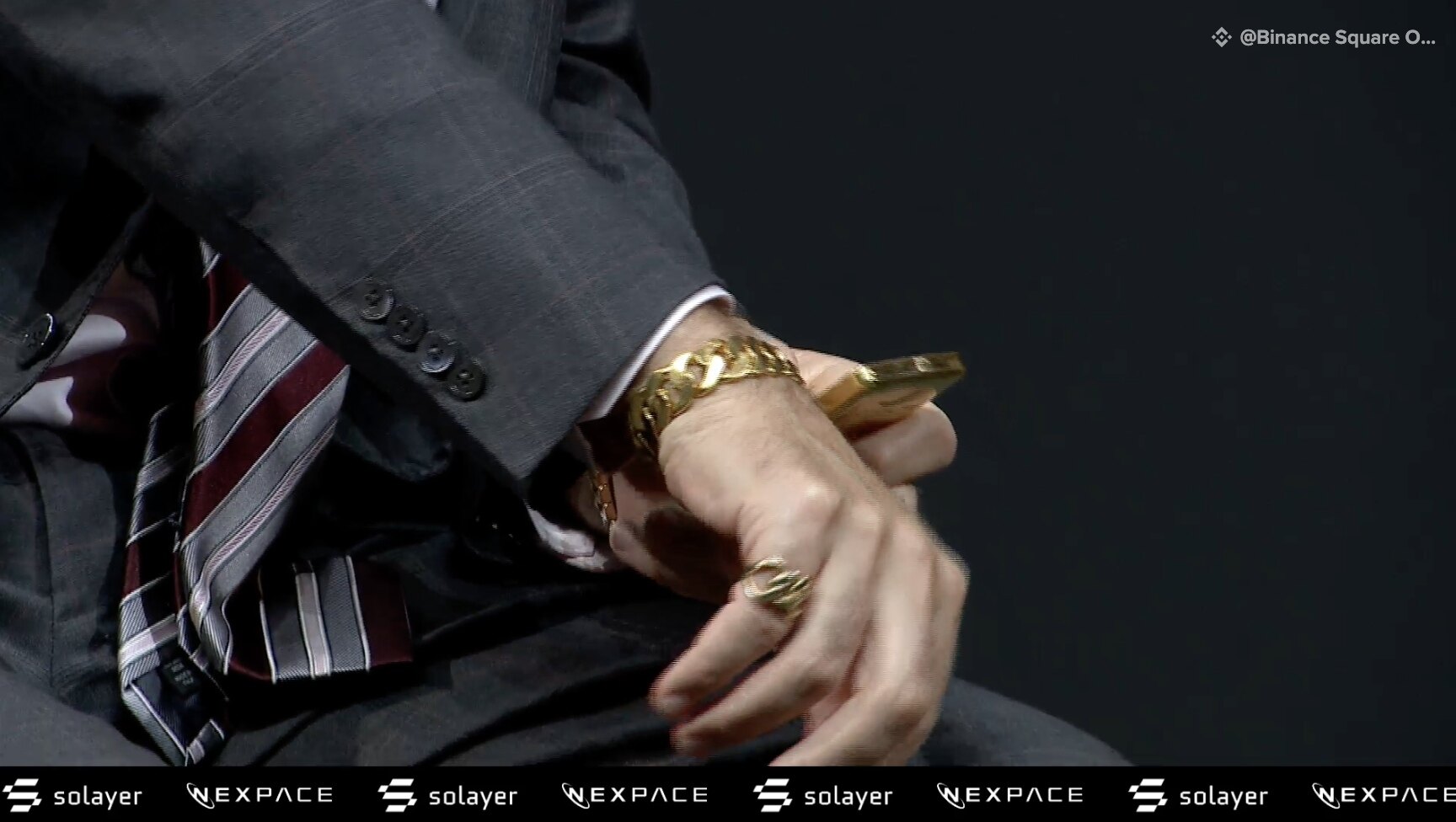
Schiff: You see, this color… if it’s pure gold, it should look like this. The bracelet I have on is also pure gold, but it seems to have a bit of a different hue compared to this piece. But to be honest, I can’t determine it just by looking at it; maybe it really is gold.
CZ: I can tell you that this was given to me by a very important person.
Schiff: I understand. But I noticed that the name of the mint printed on it is one I've never heard of. For gold, the key is the credibility of the mint. If you know which mint produced it and you trust them, it's because they must maintain their reputation. But the name on this one is completely unfamiliar to me, so strictly speaking, it should be sent for testing to confirm. However, just based on the color, there is indeed a slight difference compared to my bracelet.
CZ: Maybe it's due to some special specifications or processes; I'm not quite sure either.
Schiff: Are you planning to give this to me?
CZ: Oh, you mean if I were to give it as a gift? Indeed, it would make a nice "gift."
Schiff: I can't be sure what you mean. If you are just giving it to me as a gift, rather than as a gold asset… that would be another matter.
CZ: So how much is it worth now? Just this whole piece.
Schiff: Gold is currently about four thousand dollars per ounce. So I estimate this piece is worth around fifty thousand dollars. I haven't calculated it precisely, but in terms of volume, it is indeed a large piece of gold.
CZ: AI tells me this piece is worth about one hundred to one hundred thirty thousand dollars. Almost one hundred thirty thousand.
Schiff: No matter how you calculate it, the price of gold is what it is.
CZ: It weighs one kilogram.
Schiff: One kilogram? How many ounces is that?
CZ: Thirty-two ounces.
Schiff: Alright. You see, I want to give you a little. Since it’s worth one hundred thirty thousand (dollars), I certainly wouldn’t give away the whole piece. I can share a portion with you, but you can’t divide it; that’s exactly my point. You also can’t just break off half and give it to me. What we sell in our company are standardized products, like one-ounce gold coins. You can directly buy small denomination gold, and we only sell products from reputable mints. This way, you don’t have to guess or test; you know it’s genuine when you get it, and you can see if it has been tampered with.
CZ: Actually, I really want to give it to you, but I’m worried you won’t be able to take it out of the country, you know.
Schiff: What? No one will stop me. I can just put it in my bag; no one will care.
CZ: Are you sure? In this country, the police would immediately come after you and take you away.
Schiff: Just for carrying this piece of gold?
CZ: Exactly, it depends on whether you declare it and where this gold came from and who sold it.
Schiff: What if I say you gave it to me? What would happen?
CZ: That could be even more trouble. This piece of gold is indeed real; it was given to me by the President of Kyrgyzstan, so I certainly wouldn’t just give it away.
Schiff: I understand. It seems this piece has already become a sentimental item for you, so you don’t want to give it to me.
CZ: Especially after you just mentioned "sentimental value." But we can talk about that later. The point is, if I transfer some bitcoin to you now, you can immediately verify it has arrived; we have many ways to confirm the transfer success almost instantly.
Schiff: Yes, I understand that.
CZ: The same logic applies to tokenized assets; if you send it to someone else, they can almost instantly verify it.
Schiff: Yes, tokenized gold is the same.
"Intangible" Virtual Assets vs. "Eternal" Physical Gold
CZ: Now I want to respond to your earlier point; you said bitcoin "has no backing." Let me ask it another way: do you use an iPhone? I use an iPhone myself; you probably don’t use Android, right?
Schiff: I also use an iPhone.
CZ: Then you are obviously using the internet. You use X, Google, Facebook, right? These are all virtual products. The internet itself seems like "nothing."
Schiff: Yes, it is intangible.
CZ: But X is valuable, and Google even more so, right? So the "virtual existence" of the internet itself has tremendous value.
Schiff: That’s right; I don’t deny that.
CZ: In fact, bitcoin itself does not exist. I don’t know if the audience is aware of this: there is no file called "bitcoin" on the blockchain. What exists are just transaction records on the ledger. When you say, "I’m sending you one bitcoin," you are not actually sending anything; you are just adding a record to the ledger.
Schiff: That’s right; what you call "sending me one bitcoin" doesn’t actually move anything. I completely understand that.
CZ: Exactly. The amount of bitcoin an address has is determined by looking at all its inputs and outputs and calculating the difference. So bitcoin does not have a fixed "storage location." But that doesn’t mean that because it is virtual, it has no value. Google has tremendous value, and Twitter has tremendous value. Many virtual things are inherently very valuable. And gold, despite having industrial uses, its industrial value is far lower than the market value we assign to it because it is scarce.
Schiff: First of all, just because something is an intangible asset doesn’t mean it has no value. I certainly know that intangible assets can also be very valuable, like company goodwill.
But the key point is that bitcoin's "intangible" nature is not the issue. The problem is: you can’t do anything with bitcoin. Its only use is "you can transfer it to someone else." It has no practicality.
Of course, the entire system of bitcoin is very cleverly designed; I understand that. But when I transfer bitcoin to you, I am not actually giving you anything. I have nothing in my hands, and no physical item is being transferred.
When I transfer tokenized gold to you, I am transferring ownership of a real asset. This ownership corresponds to gold that must be physically delivered from a vault. What gives gold its value is its utility.
Gold has physical and chemical properties that other metals do not possess; many industries must use gold and cannot substitute it with copper or other metals. Some technologies can only rely on gold, and the industry needs it now. Gold is scarce, and its production is limited, which can maintain high value based solely on supply and demand.
Some say, "Maybe the real value of gold isn’t that high." Maybe, but I can’t be sure. But prices are always determined by supply and demand.
Gold also has another use as a reserve asset for central banks, supporting currency issuance. This also affects the market price of gold because central banks need it and must buy it from the market. And gold does not corrode or get damaged.
That’s exactly it. When I own gold, I am not just considering "what I can do with it today," but rather "the value of what others can do with it at any moment in the future."
Gold from ten thousand years ago still exists today; it does not rot, disappear, or change in nature. The price of gold reflects its present value for all future uses. Goods that can rot or wear out cannot do this because they will eventually disappear.
But gold will not. It exists eternally. That is why it can serve as a store of value. When I hold gold, I am storing its use value from now until forever. Even if I don’t use it now, someone will need this piece of gold in the future; someone needs it today, and someone will need it in the future, but in any case, this piece of gold will always be there.
Deep Debate on Scarcity and Monetary Attributes
CZ: You mentioned a lot just now, and many of your points are quite interesting. I feel like we are about to "convince" you to come over to our side.
Schiff: He doesn’t think so. (pointing to the audience)
CZ: Let’s start with gold. You mentioned that gold "exists eternally." But how much gold is there in the world?
Schiff: I don’t need to know an exact number, but I know that gold is extremely scarce, and its supply grows very slowly.
CZ: But we really don’t know the exact quantity, right? We have no idea how much gold is still in the earth’s crust.
Schiff: Right, I don’t know how much gold is buried underground either.
CZ: Maybe tomorrow a giant gold mine will be discovered, possibly in Africa, China, or anywhere.
Schiff: Yes, that is possible.
CZ: Then the supply of gold would suddenly increase. Furthermore, synthetic diamonds can already be made now; in the future, chemical technology might be able to synthesize gold, which is the ultimate goal of alchemy. Once that is achieved, gold will no longer be scarce, and everyone will be able to "manufacture gold."
Schiff: Alchemists have been trying this for centuries. Indeed, someone recently claimed to be able to produce tiny amounts of gold.
CZ: I am skeptical about that. But the key point is: the total amount of gold is uncertain, while the total amount of bitcoin is certain. You just said that the uses of gold can extend into the future, but the supply of bitcoin is written in code; we know exactly how much there will be in the end and how much has been mined now. This is a fixed supply mechanism.
You also mentioned a point about central banks and gold; we all know what happened in 1971 (the end of the gold standard). So, as you said, today’s currency is no longer backed by gold.
Schiff: Yes, modern currency can no longer be directly exchanged for gold. But if a country’s currency depreciates, the central bank still needs to use its reserve assets to stabilize the exchange rate, and gold is one of the most important. When a currency is under pressure, the central bank can sell gold and buy back its currency to support the exchange rate. That’s why central banks still need to hold gold reserves.
CZ: So when the price of gold rises, does it mean that many central banks are printing more money to buy gold?
Schiff: Central banks have been printing money; that is the source of inflation.
CZ: You mentioned utility value earlier. Your point seems to be: bitcoin has no value because it is not a physical, tangible asset like gold?
Schiff: The value of gold indeed comes from its utility.
CZ: But the industrial use of gold is not actually the main source of its value. The primary value of gold comes from its scarcity. And bitcoin has its own utility; it is not just a transfer tool. Bitcoin represents a monetary innovation, a technological upgrade of an asset class.
Schiff: I don’t think it is a technological upgrade of currency because it is not widely used as currency. It is also not "money" because it is not a commodity. By definition, money should be the most liquid commodity, and bitcoin does not meet that condition, even if the government gives it some classification.
CZ: There are different standards for "what is money," and there are different levels of definitions for value. Bitcoin is now a $2 trillion or even a future $3 trillion asset, and it is growing healthily.
Schiff: Bitcoin certainly has a price; no one denies that. But the reason it has a price is that someone is willing to buy it; and many holders are unwilling to sell because they hope for a higher price. But just because it has a price does not mean it has intrinsic value. Its primary use today is speculation; people buy it because they believe they can sell it for a higher price in the future, which is a speculative behavior akin to collecting.
CZ: Your definition of money is very narrow; that’s the definition you and the government are used to. Let’s ask the audience, how many people think bitcoin is money? (raises hands) See? While we can debate the definition of "money," many people indeed treat bitcoin as money.
Schiff: But nothing is priced in bitcoin. It is not a unit of account.
CZ: Prices are all relative concepts. We can completely reverse the calculation, for example, how many bitcoins equal one dollar.
Schiff: That's just an exchange rate conversion. The real issue is that no one selling goods or services prices them in bitcoin. Even if employees "receive their salaries in bitcoin," their compensation is essentially still based on dollars or euros, just converted to bitcoin at the time of payment. It is not widely used as a unit of account or as a medium of exchange. Most bitcoin is traded on exchanges; people speculate with it rather than consume it. You cannot consider it a store of value because you cannot store something you do not actually own.
CZ: Price volatility does not mean an asset cannot be used for payment. I received my salary in bitcoin in 2014.
Schiff: What was your salary at that time?
CZ: I don't remember the exact number, but it wasn't high, around one hundred thousand dollars.
Schiff: Wait, you said you were paid in bitcoin. Was your salary calculated in a fixed amount of bitcoin?
CZ: As you mentioned earlier, we would convert it once a month based on the current price of bitcoin.
Schiff: Then it is not a salary fixed in bitcoin. If it were money, someone would say, "My monthly salary is 0.1 BTC, regardless of fluctuations." That would be truly priced in bitcoin.
CZ: I can show you some contracts from Binance; we do have examples of settlements in bitcoin. For instance, if an early investor or partner wanted to exit, we would tell them, "You can choose dollars or bitcoin." At that time, both parties agreed to settle for a certain amount of bitcoin, and later, as the price rose, they received more value.
Schiff: That’s just because they were already bitcoin investors or were willing to accept bitcoin. That is an exception, not the norm.
300 Million User Consensus vs. "Greater Fool" Theory
CZ: It is an exception, but it does exist; there are indeed people using bitcoin as a unit of account.
Schiff: But that is not a widespread phenomenon. The vast majority of bitcoin transactions are not for purchasing goods or services but purely for trading bitcoin itself. There is no labor output, no exchange of goods, just buying, selling, and speculation. That is what most of the activity is about right now.
CZ: I don’t think it’s entirely like that, but we might be getting off-topic. What we are arguing about is not whether "bitcoin is money." To discuss this, we need to first unify the definition of "money." But the more important question is: Does bitcoin have value?
Many people present believe that bitcoin is valuable. Its value does indeed partly come from speculation, but a large part comes from its usability; I can hold it, carry it, and transfer it across countries. You know I often have to move to different countries. If it were physical gold, that would be troublesome. Gold is certainly a good store of value, but the value of bitcoin is not just about "storage"; it has been continuously rising over the past 15 years, driven by actual demand.
Schiff: Tokenized gold solves these problems because you can carry tokenized gold with you.
CZ: But the premise of tokenized gold is that you must trust a third party.
Schiff: We just need to trust a reliable third party.
CZ: But with bitcoin, I don’t need to trust anyone.
Schiff: That is certainly a utility. However, while you don’t need to trust a third party, you must trust something more abstract; you have to believe that people will still be willing to accept bitcoin in the future.
CZ: I trust the technology.
Schiff: Even so, the value of bitcoin still depends on whether people continue to want it. Of course, you just mentioned that the total supply of bitcoin is 21 million.
CZ: Trusting the math and code of bitcoin is easy.
Schiff: If you put it another way, it is 21 million trillion satoshis. That doesn’t seem so scarce, especially with so many "satoshis." The total supply has a limit, but if people no longer need it, that limit is meaningless.
CZ: The fact is, people do need it. If you look at the growth data, Binance's user base has stabilized at 300 million.
Schiff: Yes, there are indeed more people "gambling" on bitcoin now than in the past. They are attracted by the hype and early profit-takers, who are selling their coins to newcomers. These activities have indeed attracted many people. But the utility of bitcoin you mentioned can actually be achieved by thousands of other tokens as well. Cross-border transfers, ease of carrying, and ease of sending are not unique features of bitcoin.
Also, you mentioned that we do not know how much gold is in the earth. That is true. But we can also say that we do not know how many cryptocurrencies will be created because anyone can issue a new token at almost no cost.
Look at those meme coins; how did they come about? They are everywhere. There are hundreds or even thousands of them, and they keep increasing. The supply is almost unlimited, and they are all competing for the same market. Bitcoin is also in this context…
CZ: Simply issuing a new coin is meaningless. A token must be adopted by a large number of users; it must have real utility, not just a feature tacked onto a product. The utility must be recognized by a large community. As for the "gambling" you mentioned, there are 300 million users on Binance holding some form of bitcoin, which is a huge scale.
Schiff: You are running a very large casino.
CZ: No, no, Binance is not a casino; it is essentially a marketplace. You see, our user base is larger than the population of most countries. I know it sounds exaggerated, but it is a fact.
Schiff: It is indeed astonishing.
CZ: When a system reaches a scale of hundreds of millions of users, it is no longer just gambling.
Schiff: But scale does not change its essence. Whether you call it a decentralized Ponzi scheme, a pyramid structure, or a chain letter, the mechanism does not change because the number of participants increases. The more people involved does not make it "legitimate." Are you suggesting that having more people makes it reasonable?
CZ: The reality is that 300 million people are participating in what you call a "pyramid."
Schiff: Exactly, that is the problem. It is a huge pyramid structure that is even spreading to the whole world. Look at what has happened in the past few years; the price of bitcoin is still around forty thousand dollars.
CZ: I think you mean "millions of people hold it."
Schiff: What I mean is that when bitcoin is priced in gold, its purchasing power has decreased by 40% compared to four years ago. Four years ago, at the peak of 69,000 dollars, bitcoin could be exchanged for 37.2 ounces of gold. Before I came here today, I specifically checked, and it is now only about 22.15 ounces. Its purchasing power in gold has decreased by 40%.
CZ: That was the peak four years ago. But gold has indeed outperformed bitcoin over the past four years. What if we extend the time frame, say eight years?
Schiff: Let me finish my point. Even looking at just the past four years, what has happened during that time? We launched the first spot bitcoin ETF; many companies began to imitate MicroStrategy's approach, and MicroStrategy itself financed hundreds of billions of dollars through stocks and bonds to buy bitcoin; other companies are also increasing their holdings. You can see bitcoin appearing in Super Bowl ads, celebrity endorsements, the NFT craze; El Salvador made it legal tender; there are even proposals to establish strategic reserves of bitcoin.
All these resources, promotions, and funds are unprecedented. Financial media talks about bitcoin every day; every advertisement is about cryptocurrency, and even the biggest donors in political campaigns come from the crypto industry.
But with such intense promotion, the price of bitcoin has fallen from its peak. If it has dropped 40% (even more when adjusted for inflation) during such a favorable four years, what makes you think it will be higher in the future? In my view, it is severely overvalued.
CZ: There are various reasons for the price drop. But if you look at certain intervals, it has dropped 80% relative to gold.
Schiff: Since you call bitcoin "digital gold," then measuring it against gold seems the most reasonable, right? I just used the peak from four years ago for comparison; that is not a random selection.
CZ: But any asset can yield completely opposite conclusions by choosing different time periods.
Schiff: This is not "randomly picking a time period"; this is bitcoin's historical peak. And my point is that despite such massive hype and promotion, the price has not reached new highs. Look at those who claim bitcoin will rise to 10 million dollars, like Michael Saylor. His logic seems to be that as long as you buy bitcoin, you are guaranteed to make a profit; mortgage your house, bet your farm, borrow money to go all in because it will definitely go up.
If this is "certain," the market price would have reflected it long ago.
CZ: It takes time for prices to reach reasonable levels. Just like you say gold will be worth more in the future, it doesn’t mean it is worth that price today.
Schiff: I just believe that the dollar will continue to depreciate, and the euro will too, because central banks are still printing money.
CZ: We are both clear on that.
Schiff: But that has nothing to do with bitcoin. The value of bitcoin entirely depends on the number of buyers and sellers because it has no real utility. Gold has real demand; people need gold, and they will buy it. If the price of gold drops, they buy more. But no industry "needs" bitcoin; people just "want" it. And this "want" entirely comes from their expectation of price increases. Once that idea disappears, no one will continue to hold it.
Practical Payments and "Cooperation Space" for Both Sides
CZ: Well, say what you will. Let’s talk about the future, about the next generation, the young people today. Do you think they will prefer bitcoin or gold as they grow up?
Schiff: Prefer? I think they will ultimately prefer gold because they will lose a lot of money in bitcoin. However, for young people, losing money actually has its "benefits."
CZ: It’s "many people," not "some people."
Schiff: But he has already sold his coins. My point is that losing a lot of money in bitcoin when you are young can actually be beneficial because you are still young; you have a lifetime to earn that money back and a lifetime to learn from this painful experience. So for those young people who go bankrupt in a bitcoin crash, the good news is that the money you are losing now will prevent you from losing more in the future. When you are young, you don’t have much money anyway; losing more is limited. When you get older and accumulate wealth, that is when "not losing money" really matters. From this perspective, bitcoin is an expensive but valuable lesson.
CZ: Bitcoin went from being worthless in 2010 to 50 cents during the pizza transaction, and now it’s at 100,000 or 90,000 dollars. Do you know how many people have lost money in bitcoin and how many have made a fortune? Too many.
Schiff: Well, let me ask: how many people here have actually sold their bitcoin and locked in their profits? Clearly, not that many.
CZ: But you need to realize that the audience here is a bit different.
Schiff: There is no doubt that early bitcoin buyers have indeed made huge fortunes. I know quite a few people who made over a hundred million dollars.
CZ: Some even made billions. So you are well aware of this.
Schiff: Yes, many of them are my neighbors in the community. They can afford the expensive houses there because they sold a large batch of bitcoin they bought in the early years. They essentially hit the jackpot.
CZ: But that money was earned by them. Many people you know made a lot of money from bitcoin.
Schiff: But that's because they got in early. People who entered in the past few years haven't made any money at all. It is the losses of the later entrants that constitute the gains of the early buyers; those who are making money are cashing out. Everything bitcoin does is just transfer wealth from buyers to sellers. The creation of bitcoin itself has not added any real wealth to the world. We now have about 20 million bitcoins, which did not exist 15 years ago. But because of their existence, our lives have not improved. Bitcoin does not produce any value; it simply allows some people to become rich at the expense of others' assets.
Moreover, those who have already lost a lot of money in bitcoin may not even realize they have lost, because they still hold bitcoin, and the paper price is still $90,000, $93,000, or whatever the current number is. But once they try to cash out, the losses will become immediately apparent. Because if a large number of holders want to sell at the same time, there simply isn't enough market to absorb it, and the market will collapse directly.
CZ: Let me share a little story I mentioned earlier today. During the time I was going through the lawsuit in the U.S., I received a lot of supportive letters from users. One user from Africa told me that before Crypto came along, before bitcoin appeared, he had to walk three days from his village to the office to pay his bills, and then walk back. Three days a month spent on the road is a huge time cost. But since he got into Crypto and started using Binance, his payment time has turned into three minutes. With this change, he gradually accumulated $50, $100, $300, even $1,000. For people in some impoverished countries in Africa, $1,000 is a significant amount. This has truly changed his life.
Schiff: I admit there is indeed value there, but you don't need bitcoin itself. You can completely use stablecoins, tokenized assets, like tokenized gold, or other blockchain-based forms.
CZ: Yes, even when using stablecoins, you still rely on blockchain technology. And the most widely used and successful application of blockchain to date is still bitcoin. Bitcoin has the largest market cap and the largest user base. You said, "Anyone can issue a token, and that doesn't mean the token has value," but bitcoin is completely different; it has formed a huge global community. Mainstream crypto assets, including some projects on Binance, also belong to this category. Value does not arise because you "issued something," but because people are actually using it. This African user is using it, and many more people around the world are using it. Its use case is growing, not decreasing. It is no longer just "a little better than pocket change," but a technology that truly helps people preserve value.
Schiff: I don't think so. I remember when bitcoin first rose to $1,000, how many years ago was that?
CZ: You were against it back then too.
Schiff: Of course I was against it. Although at that time I thought the price might rise again, because clearly someone was buying, fundamentally, the nature of bitcoin had not changed at all. It reminds me of many merchants back then announcing, "We accept bitcoin," for a simple reason: bitcoin was rising too fast, and those holding it suddenly became wealthy, so merchants tried to attract these new rich users. But now that situation has actually decreased. Today, the idea of using bitcoin as "currency" is less popular than it was back then. Even within the industry, it is acknowledged that bitcoin does not perform well as a means of payment, and many other crypto assets are more suitable as currency. So they changed the narrative and packaged bitcoin as "digital gold." But it is not digital gold; it is completely unlike gold. Just like if I take a picture of a hamburger, I can't say it's "digital food"; you can't fill your stomach by eating it.
CZ: Let me ask the audience, who here has a Binance card? I don't have mine with me. Can someone pass one up?
Schiff: That's a token, right? BNB is a token. Uh, no, what is that?
CZ: That's a Visa card.
Schiff: But BNB is indeed a token.
CZ: I just wanted to show the card itself. When you say Crypto is not used for payments and is being used less and less, I wanted you to see this. Thank you. You see, this is the Binance card.
Schiff: But you mean this card sells the user's bitcoin and then pays the merchant in dollars, right?
CZ: Yes, it operates very smoothly.
Schiff: But that is different from my vision of gold payments. I want gold to be transferred from buyer to seller without having to convert it into fiat currency. Your card is convenient, but it does not pay with bitcoin itself; you are selling bitcoin to get dollars, and then paying with dollars, which is no different from any debit card linked to a brokerage account. But you are not "paying with bitcoin"; you are just selling bitcoin and then consuming with the cash you received. That card just keeps you in the traditional financial system.
CZ: But is anyone really using gold to make payments today?
Schiff: Almost no one.
CZ: So are there more people paying with bitcoin than with gold?
Schiff: But you are not "paying with bitcoin" there either. When using that card, bitcoin is sold, and the merchant always receives dollars.
CZ: This needs to be viewed from two perspectives: merchants not wanting to accept Crypto, or finding it difficult to accept Crypto, is a historical issue. If merchants do not accept it, users cannot pay. The Binance card solves this dilemma: users swipe the card, and the cryptocurrency is deducted; the merchant receives the fiat currency they want; we complete the conversion in the middle, benefiting both parties.
Schiff: But I wouldn't use gold to complete the same consumption operation like I would with cryptocurrency. The key is: when developed countries face more severe inflation in the future, I believe more and more merchants will be willing to accept gold.
CZ: How many merchants have that special capability…
Schiff: They don't have that capability now; it's not even an option. But suppose you are a merchant, right? Inflation is not 2% a year, but 2% a week. You sell your inventory, and by the time you restock, the costs have already risen significantly because the price has gone up again between selling and restocking. But if you receive gold, you can restock with gold; and in a gold-priced system, costs won't spike due to short-term inflation.
CZ: But gold prices have also dropped in the past few weeks. You just mentioned the peak, but it has indeed dropped recently.
Schiff: That is the overall situation over the past few years. Sometimes gold prices will soar, so it usually doesn't "stably decline" as you said.
CZ: For merchants with only a 10% profit margin, such volatility…
Schiff: I certainly know that. But bitcoin fluctuating 10% in a day is not new either.
CZ: I can assure you that there are already millions of users using the Binance card.
Schiff: Then maybe I can ask you to make me a "gold card."
CZ: I would be very happy to; you know… I am actually considering something similar.
Schiff: I have already been talking to banks to see who is best suited to be the issuer.
CZ: Of course, I am a supporter of bitcoin. You know that. I am not against gold; I am just saying bitcoin is "better gold." You said earlier that people do not use it for payments, but in fact, many people are using it for payments "unconsciously."
Schiff: But that doesn't even count as a real payment method.
CZ: From the user's perspective, they are using it to pay right now. They do not need to sell bitcoin themselves, convert it to cash, then convert currency, and then pay, right?
Schiff: But I can achieve the same effect with gold or other assets. I can do this with a stock portfolio. I have some clients with brokerage accounts; I can get them a debit card, and every time they swipe the card, it uses the account as collateral, then sells a little stock to complete the payment. It’s the same mechanism.
CZ: That’s great, but my point is: people are indeed using Crypto to pay.
Schiff: No, they are not using Crypto to pay. They are using Crypto as collateral, selling it to convert to fiat currency to make payments. That is a different concept. It has not been "directly used" as a medium of payment. You are liquidating bitcoin and then consuming with the proceeds. There is a fundamental difference here.
CZ: This is just a matter of definition. From the user's perspective, we handle all the backend conversions. They swipe the card and get what they want.
Schiff: I understand, but there is indeed a difference. And if the price of bitcoin suddenly crashes, that will be a big problem for those planning to consume with bitcoin, because when they really want to sell, they won't get much for it and thus won't be able to buy much.
CZ: I think most people here won't have that problem; they have enough Crypto in hand.
Schiff: When its price was $93,000, the value was enough. What if it drops to $9,000? Who knows where it will drop to?
CZ: I mean, any price is volatile. Even the value of fiat currency is volatile, right?
Schiff: Relative to each other?
CZ: Relative to each other, and relative to actual purchasing power. All prices are volatile. Many people call stablecoins "Stable coins," but in my view, that term is completely misnamed. There is nothing truly stable in the world; everything is in flux.
Schiff: It is stable relative to itself. A dollar stablecoin is stable against the dollar, but the dollar itself is unstable. That is why I believe: what bitcoin can do, gold can do too. And since you can have tokens backed by real gold, why hold a token that has no asset backing? Why? If you can hold legitimate, real, regulated gold-backed assets, why choose "fiat-backed cryptocurrency"?
CZ: But the essence is exactly the opposite: whatever you can do with gold and fiat, we can do with bitcoin.
Schiff: But right now you cannot, because you cannot store value in bitcoin. In terms of value storage, bitcoin has always been a speculative asset.
CZ: The price of bitcoin has been rising over the past 15 years throughout its existence.
Schiff: Yes. But first of all, in the long term, that is not considered a "long enough" time. Bitcoin has a price, I admit. But "price" and "value" are two different things. You cannot store "price." Bitcoin has a price today, but no one knows what it will be tomorrow. And it has no "intrinsic value" today, nor will it tomorrow. But that does not stop people from buying it. The vast majority of the value attributed to bitcoin comes from the belief that buying it will make them rich. They think, "As long as I endure the volatility, I will eventually become wealthy." That is the source of its demand.
When people are no longer willing to buy it, when the fantasy of "BTC to the moon" disappears, the demand will disappear as well.
CZ: Your perspective on this issue is entirely that of a speculator, but that is actually not correct.
Schiff: The vast majority of people buying bitcoin are indeed speculators. Maybe many people in this room are bitcoin extremists who truly believe those narratives, fine. But who do you think the majority of bitcoin buyers are?
CZ: You mean bitcoin? How many people here are developing in the bitcoin ecosystem? There are many people writing code and doing projects; you can see a group right here. So not everyone is a speculator. Of course, speculators do exist…
Schiff: But this room is inherently a biased sample.
CZ: Of course, I know that.
Schiff: Right? Developers are important to the ecosystem, but they are just one part of what drives bitcoin. The real driving force behind buying is the bitcoin ETF. Those institutions and corporate treasuries that entered before, they buy it just because it's going up. They see the hype and are told, "You should buy; this is a digital asset, and it will rise," so they stuff it into their portfolios. They don't care about what you call the characteristics of bitcoin. They don't self-custody; they just buy a code symbol through a broker. They want the price to go up; if the price stops rising or even falls, they will sell and turn to speculate elsewhere.
CZ: What you describe is exactly the same in the stock market and fiat currency market. Every market has speculators and builders. The speculators are the loudest and run the fastest, which is why NASDAQ exists. Those buying bitcoin ETFs are also buying stock ETFs and currency ETFs. The traditional market is the same. So just because there are speculators doesn't prove that bitcoin has no value.
Schiff: Indeed, but having speculators in the stock market doesn't legitimize bitcoin. When I speculate on a stock, at least in theory, I am betting on the future value of a company. It may grow, increase sales, boost profits, and raise dividends. In other words, I am betting on the company's development, not pure speculation.
Schiff: Binance is not small, right? Binance is a good business. You are the casino; you are the house, and the profit model is obvious.
CZ: We are licensed financial institutions in over 30 countries. Legal, legitimate financial institutions. Okay, go on.
Schiff: Also, aside from those trading bitcoin on your platform. Wait, where was I? You interrupted me, and I forgot what I was going to express.
CZ: We were talking about speculators.
Schiff: Right. So, when you speculate on a company, you are betting that it will be more valuable in the future. But when I buy bitcoin, bitcoin will not generate more returns in the future because it currently has zero returns. It is not a productive asset. Speculating on bitcoin is just betting that someone will take it off my hands at a higher price in the future. It is purely a bet that demand will be higher than it is now, and the price will be higher than it is now. This is a one-dimensional price speculation.
Unlike stocks or real estate, bitcoin is more speculative. When you buy stocks, in most cases, you are buying a real company that generates income and pays dividends; not all stocks are purely "gambling." But bitcoin is 100% speculation. I buy it just because I believe someone will pay a higher price in the future. And that person buys it because he believes the next person will pay a higher price; the asset itself has not changed at all.
CZ: We have discussed: speculators are indeed part of the ecosystem, and while they are loud and trade frequently, they are just one part, right?
Schiff: But that is the main driving force behind the price.
CZ: You are amplifying a part of the ecosystem to represent everyone. If there were only speculators, bitcoin's price could not be sustained at all. There are always some fundamental holders in the market supporting the price.
Schiff: Yes, but bitcoin has fallen 40% relative to gold over the past four years. And I dare say that at least half of the people holding bitcoin today bought it in the past four years.
CZ: I'm not sure.
Schiff: I am quite sure. And at least half of the market cap was bought in these four years.
CZ: In the later stages of each cycle, there will indeed be a lot of value bought at high levels, but in terms of numbers, I am not sure, because this round of ETFs is very large, and you mentioned that.
Schiff: Yes, those individual shareholders in the ETFs, they hold bitcoin indirectly through the ETFs, and they are recent entrants; they do not have the huge gains of early investors.
CZ: But early gains could never be replicated. Any asset is like this; it cannot always be 100 times or 1,000 times.
Schiff: But these people still have such expectations. Those buying bitcoin do indeed expect huge returns. If you look back at all the predictions from the beginning of this year, a bunch of "fundamental analysis" and "macro analysis"… bitcoin is now lower than it was on January 1.
CZ: If you look forward, the higher point is above last November's high.
Schiff: That is because it was sold off before. But looking back at Saylor (the founder of MicroStrategy) and their predictions at the beginning of this year, where did they say bitcoin would be by the end of the year? Not one prediction was downward; they were all $200,000, $250,000. It was always "pie in the sky" predictions. Retail investors buy bitcoin because they hope it will keep rising. They did not enter to lose money, but the result is that they indeed lost.
CZ: That is happening. There will always be people making predictions in the market; I usually do not make predictions, but when prices rise, people will invest. They are either willing to take risks or understand the market.
Schiff: I think many people do.
CZ: The same goes for gold; the same goes for the stock market.
Schiff: But you do not see a large influx of private investors into gold. I have been in the gold business; I run Schiff Gold, but since 2010, not many people have consulted me.
CZ: There has indeed been a large influx of funds into the crypto space, but not into gold, because gold does not have a "get rich quick" sexy story. People pursue higher returns; this is typical psychology of users in the TikTok era.
Schiff: But gold has actually performed better than bitcoin over the past few years, especially in the last four years. However, those buying bitcoin have not bought gold. Central banks are buying gold. They know what they are doing: buying gold, not buying bitcoin. But I believe that private investors will buy more gold next, and the funds released after the crypto bubble bursts may accelerate this process.
Schiff: In fact, I have always believed that the reason bitcoin has performed so strongly over the past decade is largely because gold has been stagnant for 12 or 13 years. Gold rose from under $300 in 1999 and 2000 to $1,900 in 2011, experiencing a huge increase that attracted a lot of funds; but then it began to consolidate for a long time. During this window, bitcoin emerged and was packaged as "digital gold."
CZ: Gold 2.0.
Schiff: Yes, it was treated as "Gold 2.0." As long as gold weakens, bitcoin can steal its thunder and attract capital that should have flowed into gold, gold stocks, and other precious metal-related assets. But now gold has broken out of the consolidation zone. In the past two years, gold prices have doubled, and silver has also caught up, currently at historical highs, nearly $60 per ounce, breaking through the previous $50 double top resistance.
Schiff: So we are in a new phase of a bull market for precious metals. I do not believe gold and silver will consolidate again; they may continue to strengthen in the coming years. In this environment, I think bitcoin will find it hard to compete. Those who already hold gold have no reason to sell their gold to buy bitcoin; and those who made the mistake of selling gold to buy bitcoin a few years ago will now regret it and try to reverse the trade, selling bitcoin to buy back gold. But by then, there may be no one to take over bitcoin, and the price will crash as a result.
CZ: Okay, on this point, let's seek common ground while reserving differences. I do hope gold performs well, and I also hope your tokenized gold project succeeds.
Schiff: Maybe we can collaborate on that product.
CZ: Of course.
Schiff: I want my token to be listed on a platform like Binance.
CZ: No problem. We welcome you to join the digital asset space and enter a truly functional digital world. Of course, my belief differs from yours; I believe gold will perform well, but bitcoin will perform even better.
Schiff: I do not believe bitcoin can compete with gold, especially on a physical level.
CZ: We will know next year. Finally, thank you, Peter, for coming here. I wish you all the best with your tokenized gold.
Schiff: Thank you, everyone.
免责声明:本文章仅代表作者个人观点,不代表本平台的立场和观点。本文章仅供信息分享,不构成对任何人的任何投资建议。用户与作者之间的任何争议,与本平台无关。如网页中刊载的文章或图片涉及侵权,请提供相关的权利证明和身份证明发送邮件到support@aicoin.com,本平台相关工作人员将会进行核查。


