Written by: Yangz, Techub News
On the first trading day of December, Bitcoin's price fell below $84,000, with an intraday volatility of 7.29%, causing market sentiment to plummet. However, this gloomy trend did not last: with a strong rebound from Tuesday to Wednesday, Bitcoin not only regained all its losses but also drew investors' attention to the core driving force behind this surge. In the context of the Federal Reserve's interest rate cut expectations for December yet to materialize and the chairperson's selection still undecided, what force reversed Bitcoin's downward trend? The answer may lie in the latest decision of the world's second-largest asset management giant—Vanguard Group.
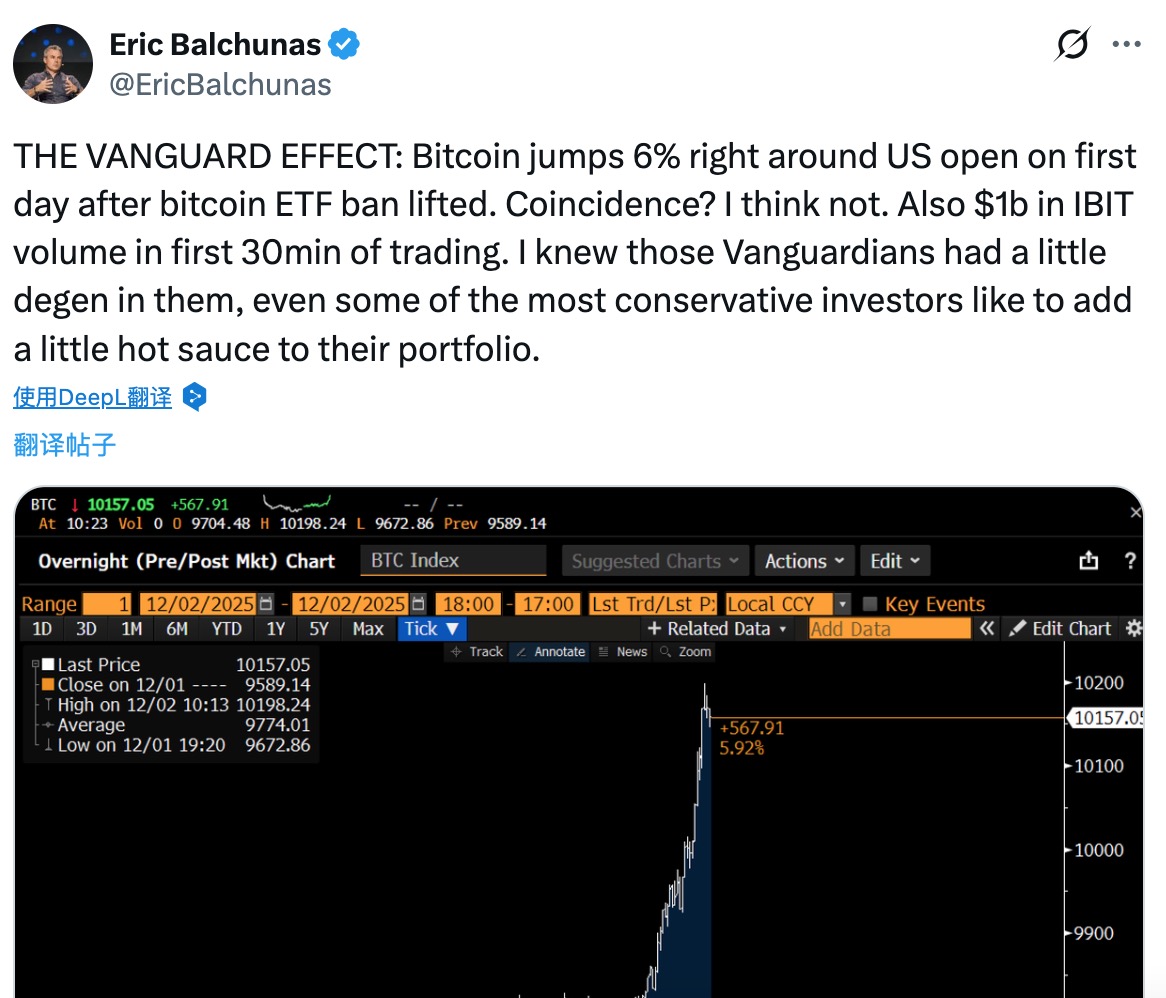
On December 2, Vanguard Group published an announcement titled “Cryptocurrencies and Vanguard: What Investors Need to Know” on its official website, officially announcing that it would allow clients to trade certain third-party cryptocurrency ETFs and mutual funds through its brokerage accounts. Bloomberg ETF analyst Eric Balchunas referred to the significant rebound in the market that followed as the "Vanguard Effect."
From "Firm Resistance" to "Passive Holding" to "Limited Opening"
Vanguard's shift is not a whimsical trend-following move but a "strategic opening" that has been carefully weighed and clearly defined. This decision stands in stark contrast to its nearly "dogmatic" public resistance stance over the past few years.
According to a report by Bloomberg, when the U.S. spot Bitcoin ETF was approved last year, then-CEO Tim Buckley explicitly stated, "We believe it does not belong in a long-term investment portfolio," and refused to offer related trading on its brokerage platform, citing "speculative" reasons, while also claiming there were no plans to launch any proprietary cryptocurrency products. Company executives have repeatedly described cryptocurrencies as an "immature asset class," arguing that they lack history, have no intrinsic economic value, and could cause "serious damage" to investment portfolios.
However, an ironic fact is that through its vast network of passive index funds, Vanguard has unknowingly become the largest "staunch" holder of Bitcoin—being a major institutional shareholder of Strategy. According to data compiled by Bloomberg based on regulatory filings, Vanguard holds over 20 million Class A common shares of Strategy, accounting for about 8% of its total issued Class A common shares, and may surpass Capital Group Cos. in the fourth quarter to become the largest fund holder of the stock.
This fact of "passive holding" reveals a fundamental divergence between Vanguard's public stance and its actual risk exposure. The ultimate force that pushed this conservative giant to make a "last-minute" turnaround was the persistent and undeniable direct demand from retail and institutional investors. Since the launch of the U.S. spot Bitcoin ETF in January 2024, this innovative product category has accumulated assets at an unprecedented speed, becoming one of the fastest-growing sectors in the history of the U.S. fund industry. Recently, the approval of various altcoin ETFs such as SOL/XRP/LINK has also garnered significant attention. The booming market undoubtedly brings direct competitive pressure to Vanguard.
SoSoValue data shows that Vanguard's biggest competitor, BlackRock, the world's largest asset manager, has a Bitcoin spot ETF (IBIT) that, even after experiencing capital outflows and price corrections, still has an asset scale exceeding $70 billion (peaking at about $100 billion two months ago). Faced with such a large and rapidly growing adjacent market, it is difficult for Vanguard to remain aloof. This policy adjustment undoubtedly opens the door to regulated cryptocurrency ETFs and funds for Vanguard's more than 50 million brokerage account clients, managing over 11 trillion dollars in assets (as of July 31, 2025).
However, Vanguard's opening strategy is clear and restrained. The company emphasizes that it only allows trading of third-party products that meet regulatory standards on its platform but does not create its own. Additionally, funds classified as "meme coins" by the U.S. Securities and Exchange Commission will also be excluded. Andrew Kadjeski, head of Vanguard's brokerage and investment business, stated, "Cryptocurrency ETFs and mutual funds have withstood the test of market volatility, achieving their expected goals while maintaining liquidity; moreover, the management processes for such funds have matured, and investor preferences are continuously evolving."
It is noteworthy that this shift occurred more than a year after the appointment of Vanguard's new CEO, Salim Ramji. This executive, who came from BlackRock and has long advocated for blockchain technology, undoubtedly brought a new perspective to the company's strategic assessment, ultimately facilitating this key transition from "passive involvement" to "actively providing access."
The Ripples of the "Vanguard Effect"
Vanguard's strategic shift is like a stone thrown into the lake of traditional finance, bound to create ripples that spread throughout the market and industry.
In the short term, this decision acts as a timely "shot in the arm," effectively reversing the pessimistic sentiment that arose from the market correction, propelling Bitcoin's price into a strong rebound after the announcement. The surge in trading volume for Bitcoin spot ETFs is also direct evidence of capital rushing in; from a broader perspective, Vanguard's "limited opening" strategy has far-reaching demonstrative significance. For many global pension funds, insurance companies, and traditional asset management institutions that are still cautiously observing, the compliant entry of the industry's second-largest giant undoubtedly provides a substantial action template and risk control reference. It clearly indicates that crypto assets can be included in traditional investment service systems within a strictly defined framework, just like alternative assets such as gold.
Of course, Vanguard's case also suggests that the path to future integration will be a gradual fusion under prudent architecture. The strict product screening, mature risk control systems, and extreme emphasis on regulatory compliance brought by traditional giants will, in the long run, become important external forces for reducing volatility and enhancing transparency and stability in the crypto market; at the same time, a more vibrant and competitive new ecosystem will emerge: traditional asset management giants will engage in new competition in product innovation, fee structures, and customer service; while crypto-native institutions must accelerate their evolution in compliance, custody, and institutional-level services to consolidate their core advantages.
Conclusion
Vanguard's transition from "firm resistance" to "limited opening" is a micro-history of financial evolution co-written by market forces, client demands, and competitive realities. It is not a "surrender" of traditional finance but a pragmatic strategic recalibration, finding a new balance between adhering to core investment philosophy and responding to the changes of the times.
As Bloomberg analyst Eric Balchunas insightfully noted, giants like Vanguard always carry a bit of "degen gene," meaning even the most conservative investors sometimes like to add a spoonful of "hot sauce" to their portfolios. Yes, this is the instinctive curiosity for new opportunities inherent in human nature and the natural pursuit of potential efficiency by capital.
In the long scroll of financial evolution, Vanguard's turn is destined to become a profound footnote. It proclaims a fact: when conservative guardians finally choose to open the city gates, the tide of the times is unstoppable. This is not only a key step for crypto assets toward mainstream acceptance but also another clear victory for market will penetrating traditional barriers.
免责声明:本文章仅代表作者个人观点,不代表本平台的立场和观点。本文章仅供信息分享,不构成对任何人的任何投资建议。用户与作者之间的任何争议,与本平台无关。如网页中刊载的文章或图片涉及侵权,请提供相关的权利证明和身份证明发送邮件到support@aicoin.com,本平台相关工作人员将会进行核查。


