(Note: The regulatory framework, market classification, and legal environment discussed in this article are based on the United States (especially federal and state) regulatory system and are unrelated to the legal environments of other countries or regions.)
In the past two years, prediction markets have rapidly transitioned from a fringe concept in the crypto space to the mainstream technology venture capital and financial capital landscape.
The compliance newcomer Kalshi recently completed a $1 billion Series E funding round, raising its post-money valuation to $11 billion, with a lineup of investors including Paradigm, Sequoia, a16z, Meritech, IVP, ARK Invest, CapitalG, and Y Combinator, among the most influential capital.
Market leader Polymarket received a strategic investment from ICE at a valuation of $9 billion and subsequently raised $150 million led by Founders Fund at a valuation of $15 billion, currently continuing to raise funds at a valuation of $12 billion.
With such a dense influx of capital, every time we publish in-depth articles on prediction markets, the comment section inevitably includes remarks like, "It's just gambling in disguise."
Indeed, in easily comparable sectors like sports, prediction markets and gambling platforms do have surface-level similarities in gameplay. However, on a more fundamental and broader level, there are structural differences in their operational logic.
The deeper reality is that with the entry of first-tier capital, they will push to write this "structural difference" into regulatory rules, becoming the new industry language. The capital is betting not on gambling, but on the infrastructure value of a new asset class: event derivatives exchanges (DCM).
From a regulatory perspective:
The U.S. gambling market = state-level regulation (individual differences are significant), high taxes (even a major source of revenue for many states), heavy compliance, and numerous restrictions;
New prediction markets = financial derivatives exchanges, federal regulation (CFTC/SEC), nationwide applicability, unlimited scale, and lighter tax systems.
In summary: The boundaries of asset classes are never academic discussions or philosophical definitions, but rather the distribution of power between regulation and capital.
What are the structural differences?
First, let's clarify the objective facts: Why are prediction markets not gambling? Because at their core, they are two completely different systems.
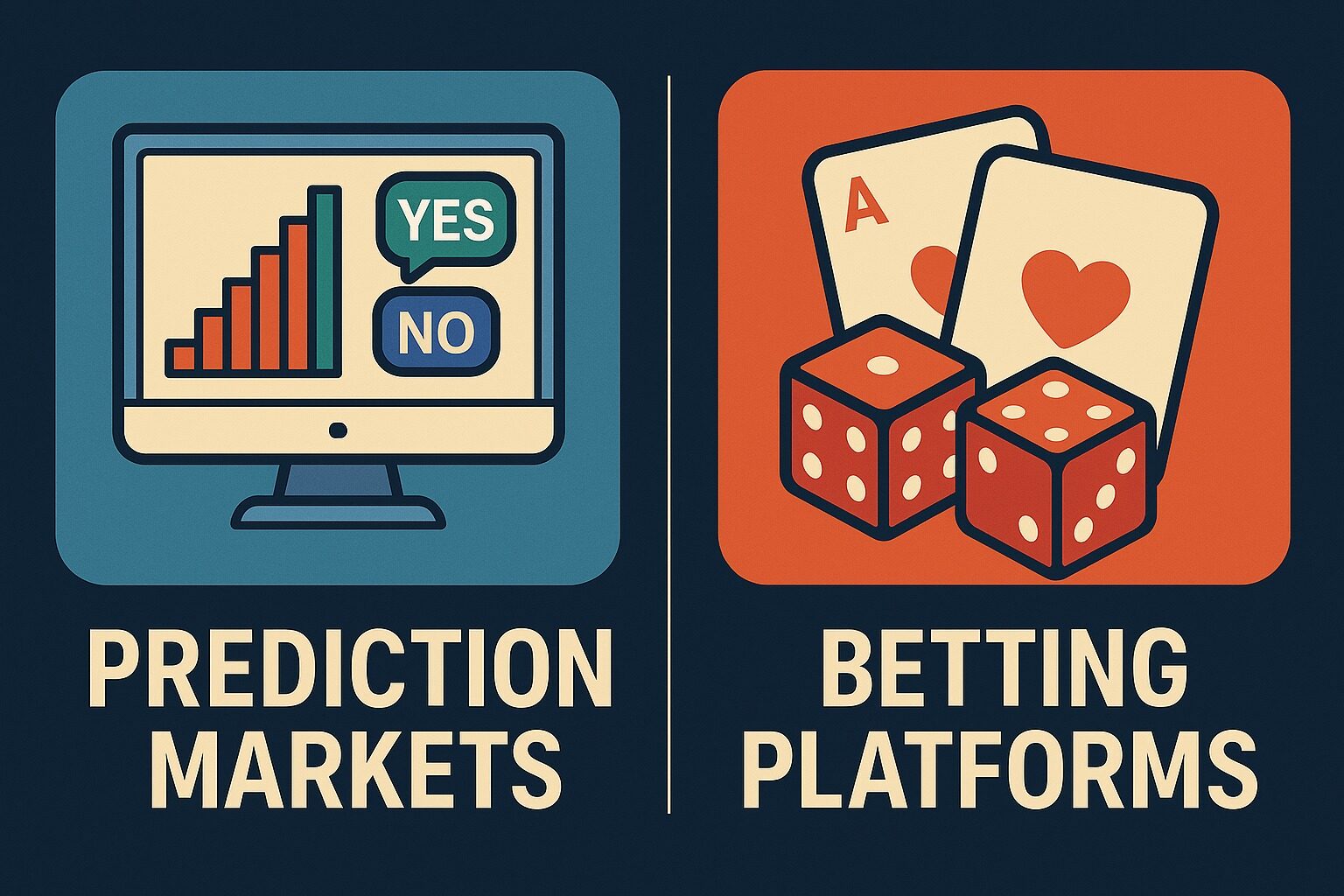
1. Different price formation mechanisms: Market vs. House
Essentially, the transparency differs: Prediction markets have public order books, and data is auditable; gambling odds are internally calculated and not visible, and platforms can adjust them at any time.
● Prediction Markets: Prices are matched by the order book, using market-based pricing typical of financial derivatives, determined by buyers and sellers. The platform does not set probabilities or bear risks, only charging transaction fees.
● Gambling Platforms: Odds are set by the platform, incorporating a house edge. Regardless of the event outcome, the platform typically maintains a profit safety zone through probability design. The platform's logic is "long-term victory."
2. Differences in purpose: Entertainment consumption vs. Economic significance
The real data generated by prediction markets has economic value and is used for risk hedging in financial decision-making, potentially even influencing the real world, such as media narratives, asset pricing, corporate decisions, and policy expectations.
● Prediction Markets: They can generate data products, such as for macro event probability assessments, public sentiment and policy expectations, corporate risk management (weather, supply chain, regulatory events, etc.), probability reference targets for financial institutions, research institutions, and media, and can even serve as a basis for arbitrage and hedging strategies.
The most well-known case is during the U.S. elections when many media outlets referenced Polymarket data as one of the polling references.
● Gambling Platforms: Purely for entertainment consumption, gambling odds ≠ real probabilities, with no data spillover value.
3. Participant structure: Speculative gamblers vs. Information arbitrageurs
Liquidity in gambling is consumption, while liquidity in prediction markets is information.
● Prediction Markets: Users include data model researchers, macro traders, media and policy researchers, information arbitrageurs, high-frequency traders, and institutional investors (especially in compliant markets).
This results in high information density in prediction markets, which are forward-looking (e.g., on election night, before CPI announcements). Liquidity is "active and information-driven," with participants seeking arbitrage, price discovery, and informational advantages. The essence of liquidity is "informational liquidity."
● Gambling Platforms: Primarily ordinary users, prone to emotional betting and driven by preferences (loss chasing/gambler fallacy), such as supporting "their favorite player," with bets not based on serious predictions but rather on emotions or entertainment.
Liquidity lacks directional value; odds do not become more accurate due to "smart money," but rather due to adjustments by the house's algorithms. There is no price discovery; the gambling market is not designed to discover real probabilities but to balance the house's risk, essentially being "entertainment consumption liquidity."
4. Regulatory logic: Financial derivatives vs. Regional gambling industry
Prediction Markets: Kalshi is recognized by the CFTC in the U.S. as an event derivatives exchange (DCM), with financial regulation focusing on market manipulation, information transparency, and risk exposure, and prediction markets follow the tax regime for financial products. Additionally, prediction markets, like crypto trading platforms, are inherently globalizable.
Gambling Platforms: Gambling falls under state gambling regulatory agencies, with regulatory focus on consumer protection, gambling addiction, and generating local tax revenue. Gambling must pay gambling taxes and state taxes. Gambling is strictly limited by regional licensing systems, making it a localized business.
II. The most easily "similar-looking" example: Sports predictions
Many articles discussing the differences between prediction and gambling often focus on examples with social attributes, such as predicting political trends or macro data, which are completely different from gambling platforms and easier for everyone to understand.
However, in this article, I want to highlight the most easily criticized example, which is the "sports predictions" mentioned at the beginning. To many sports fans, prediction markets and gambling platforms appear to be indistinguishable in this regard.
But in reality, the contract structures of the two are different.
Current prediction markets use YES/NO binary contracts, for example:
Will the Lakers win the championship this season? (Yes/No)
Will the Warriors achieve more than 45 wins in the regular season? (Yes/No)
Or discrete range contracts:
"Will a player score more than 30 points?" (Yes/No)
Essentially, these are standardized YES/NO contracts, with each binary financial contract being an independent market with limited structure.
Gambling platform contracts can be infinitely subdivided or even customized, such as:
For example, specific scores, half-time vs. full-time, how many times a specific player shoots from the free-throw line, total three-pointers, parlays, custom parlays, point spreads, over/under, odd/even, individual player performance, corner kicks, fouls, red/yellow cards, injury time, live betting (real-time odds every minute)…
Not only are they infinitely complex, but they are also highly fragmented event trees, essentially allowing for infinitely parameterized fine-grained event modeling.
Thus, even in seemingly similar topics, the mechanistic differences lead to the four structural differences discussed earlier.
In sports events, the essence of prediction markets remains an order book, formed by buyers and sellers, market-driven, and fundamentally more akin to an options market. The settlement rules only use official statistical data.
In contrast, on gambling platforms, odds are always: set/adjusted by the house, incorporating a house edge, with the goal of "balancing risk and ensuring house profits." In terms of settlement, there is discretion in interpreting odds, and odds can have ambiguous spaces, with different platforms potentially yielding different results on fragmented events.
III. The ultimate question: A power reallocation regarding regulatory jurisdiction
The reason capital is rapidly betting billions of dollars on prediction markets is not complicated: it is not focused on "speculative narratives," but rather on a global event derivatives market that has yet to be formally defined by regulation—a new asset class with the potential to stand alongside futures and options.
What confines this market is an outdated and ambiguous historical question: Do prediction markets count as financial instruments or as gambling?
If this line is not clearly drawn, the market cannot thrive.
Regulatory jurisdiction determines industry scale; this is an old logic from Wall Street, now being applied to this new track.
The ceiling for gambling is at the state level, which means fragmented regulation, heavy tax burdens, inconsistent compliance, and institutional funds cannot participate. Its growth path is inherently limited.
The ceiling for prediction markets, however, is at the federal level. Once included in the derivatives framework, it can reuse all the infrastructure of futures and options: globally applicable, scalable, indexable, and institutionalizable.
At that point, it will no longer be a "prediction tool," but a complete set of tradable event risk curves.
This is also why Polymarket's growth signals are so sensitive. Between 2024 and 2025, its monthly trading volume repeatedly surpassed $2-3 billion, with sports contracts becoming one of the core growth drivers. This is not "cannibalizing the gambling market," but directly competing for the attention of traditional sportsbook users—and in financial markets, the migration of attention is often a precursor to the migration of scale.
State regulatory agencies are extremely resistant to allowing prediction markets to fall under federal regulation because it means two things happening simultaneously: gambling users being siphoned off and state governments' gambling tax base being directly intercepted by the federal government. This is not just a market issue, but a fiscal issue.
Once prediction markets fall under the CFTC/SEC, state governments not only lose regulatory authority but also lose one of the "easiest to collect and most stable" local taxes.
Recently, this game of chess has begun to become public. Odaily Planet Daily reported that the Southern District Court of New York has accepted a class action lawsuit accusing Kalshi of selling sports contracts without obtaining any state gambling licenses and questioning its market-making structure, which "effectively pits users against the house." A few days ago, the Nevada Gaming Control Board also stated that Kalshi's sports "event contracts" essentially belong to unlicensed gambling products and should not enjoy the regulatory protection of the CFTC. Federal Judge Andrew Gordon bluntly stated at the hearing: "Before Kalshi, no one would have thought that sports betting belonged to financial products."
This is not a product dispute; it is a conflict over regulatory jurisdiction and fiscal interests, and a struggle for pricing power.
For capital, the underlying question is not whether prediction markets can grow; but rather, how large they will be allowed to grow.
免责声明:本文章仅代表作者个人观点,不代表本平台的立场和观点。本文章仅供信息分享,不构成对任何人的任何投资建议。用户与作者之间的任何争议,与本平台无关。如网页中刊载的文章或图片涉及侵权,请提供相关的权利证明和身份证明发送邮件到support@aicoin.com,本平台相关工作人员将会进行核查。


